A falling column of liquid, like the water from your faucet, will tend to break up into a series of droplets due to the Plateau-Rayleigh instability. This instability is driven by surface tension. Small variations in the radius of the column occur naturally. Where the radius shrinks, the pressure due to surface tension increases, causing liquid to flow away, which shrinks the column’s radius even further. Eventually the column pinches off and breaks into droplets. What’s especially neat is that the size of the final droplets can be predicted based on the column’s initial radius and the wavelength of its disturbances. (Video credit: BYU Splash Lab)
Tag: science

Bouncing on a Pool
There’s something wonderfully serene about watching water droplets skate their way across the surface of a pool. Here the pool of water is being vibrated at a frequency just below the Faraday instability – meaning that no standing waves form on the surface. Instead, the bounce is just enough to create a thin layer of air between the droplet and the pool to prevent coalescence. With each bounce, gravity’s effect on the water tries to drain the air away, but each rebound lets more air rush in to hold the droplet up. Eventually, gravity wins and the droplets coalesce into the pool. In high-speed that process is mesmerizing, too. (Video credit: K. Welch)

Effects of Hills on Flow
Hills and other topology can have interesting and complex effects on a flowfield. With the FAITH experiment, NASA has been investigating an axisymmetric model hill using a combination of experimental methods. The video above shows flow visualization over the hill in a water channel using dye injection both upstream and downstream of the model. They’ve also done wind tunnel tests with oil-flow visualization, particle-image velocimetry, pressure sensitive paint and other measurement techniques. There are nice photos of some of these by Rob Bulmahn. By combining qualitative and quantitative flow measurement techniques, the researchers are able to capture many different aspects of the flow, which can then be shared and compared with other groups’ works. (Video credit: NASA Ames Research Center)

Mercedes-Benz Tornado
The world’s most powerful artificial tornado is part of the Mercedes-Benz Museum in Stuttgart, Germany. Though popular enough with visitors that the staff will bring out smoke generators to make it visible, the tornado was not built as an attraction – It’s actually part of the building’s fire protection system. The modern open design of the museum meant that conventional smoke removal systems were inadequate. Instead vorticity is generated in the central lobby with 144 wall-mounted jets. The angular velocity created by the jets is strongest at the middle, in the vortex core, due to conservation of angular momentum – exactly the way a spinning ice skater speeds up by pulling his arms in. The core of the vortex is a low pressure area, which draws outside air toward it – this is how the tornado pulls in smoke when there is a fire. The fan on the ceiling provides the pressure draw necessary for the smoke to be pulled up and out of the building at a supposed rate of 4 tons per minute. See the tornado in action here. (Photo credit: Mercedes-Benz Passion; submitted by Ivan)

Dendritic Designs
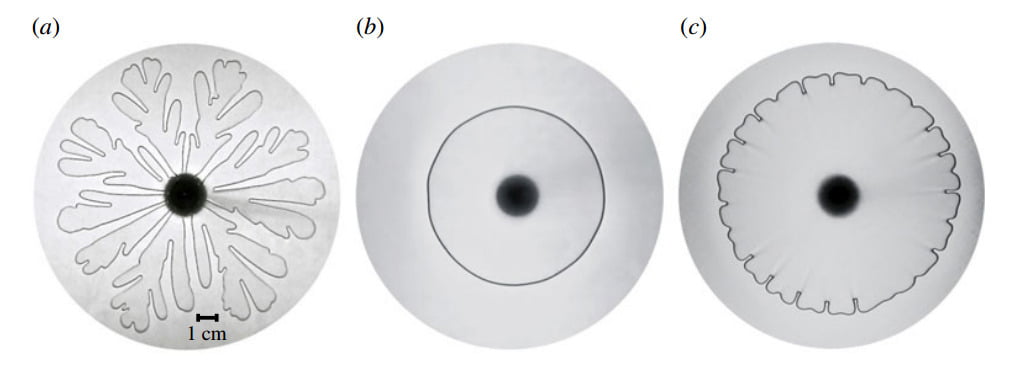
Imagine a thin layer of viscous liquid sandwiched between two horizontal glass plates. Then pull those plates apart at a constant velocity. What you see in the image above is the shape the viscous fluid takes for different speeds, with velocity increasing from left to right and from top to bottom. For lower velocities, the fluid forms tree-like fingers as air comes in from the edges. At higher velocities, though, there’s a transition from the finger-like pattern to a cell-like one. The cells are actually caused by cavitation within the fluid. When the plates are pulled apart fast enough, the local low pressure in the fluid causes cavitation bubbles to form just before the force required to remove the plate reaches its peak. (Photo credit: S. Poivet et al.)

Electrowetting
The electrowetting effect can change the shape of a liquid droplet on a surface by applying a voltage across the surface and droplet. Surface tension is a kind of measure of the energy required to maintain a certain drop shape, and that energy can be both chemical and electrical. In the video above, the droplet maintains a small contact area naturally (with no voltage). It expands and flattens under an electrical charge. Varying the voltage will change the degree to which the droplet flattens, but only to a point. Electrowetting is used to control variable lenses and some types of electronic displays. The technology may be used to replace current generation LCDs. (Video credit: V. Arya/Duke University)

Reader Question: Drafting in Triathlons
Reader juleztalks writes:
I’ve just entered an amateur triathlon, and there’s a whole load of rules about not “drafting” in the cycle stage (basically, not sitting in other cyclists’ slipstream). However, there are no such rules for the swim or run stage; I thought the effects would be the same from drafting other swimmers and runners. Any ideas?
As in many endurance sports, it’s all a question of energy savings from drag reduction. Drag on an object, like a triathlete, is roughly proportional to fluid density (air for cycling or running, water for swimming), frontal area, and the velocity squared. Because drag increases more drastically for an increase in velocity, it makes sense one would worry most about drag when one’s velocity is highest – on the bike.
Drafting has major benefits in cycling and can reduce drag on a rider by 25-40%. Aerodynamic drag accounts for 70% or more of a cyclist’s energy expenditure, so that reduction can really add up. The energy saved by drafting during cycling can even increase a triathlete’s speed during a subsequent running leg. So it makes sense for a sport’s governing body to be concerned with it.
That said, there’s plenty of room for drag reduction in swimming as well. Even though the velocities are much lower, water’s density is 1,000 times higher than air’s, generating plenty of drag for an athlete to overcome. For swimmers at maximum speed, drafting can reduce drag by 13-26%, depending on relative positioning. Such drafting has been found to increase stroke length and may (or may not) improve subsequent cycling performance.
Although a similar reduction in drag is possible by drafting when running, drag on a runner only accounts for about 8% of his/her energy expenditure so such savings would matters very little next to the swimming and cycling legs. There could be some psychological benefits, though, in terms of pacing oneself. (Photo credit: Optum Pro Cycling p/b Kelly Benefit Strategies)

Flapping Foil Wake
This gorgeous visualization shows the flow behind a flapping foil. Flow in the water tunnel is from right to left, with dye introduced to show streamlines. A flapping foil is a good base model for most flapping flight as well as finned swimming – anything that oscillates to create thrust. As the foil flaps, vorticity is generated and shed along the trailing edge, creating a regularly patterned wake of trailing vortices. (Video credit: R. Godoy-Diana)
(Source: https://player.vimeo.com/)
Droplet Impact Visualized
When a drop falls from a moderate height into a shallow pool, its impact creates a complicated pattern. The photo above is a composite image showing a top-down view 100 ms after such an impact. On the left side, the flow is visualized using dye whereas the right shows a schlieren photograph, in which contrast indicates variations in density. Both methods show the same general structure – an inner vortex ring generated at the edge of the impact crater and formed mostly of drop fluid and an outer vortex ring, consisting primarily of pool fluid, formed by the spreading wave. Both regions show signs of instability and breakdown. (Photo credit: A. Wilkens et al.)

The Silence of Owls
Owls are nearly silent hunters, able to swoop down on their prey without the rush of air over their wings giving away their approach, thanks to several key features of their feathers. The trailing edge of their feathers–or any lifting body, like an airplane wing–are a particular source of acoustic noise due to the interaction of turbulence near the surface with the edge. Since owls are especially good at eliminating self-produced noise in a frequency range that overlaps human hearing, investigators want to learn what works for owls and apply to it aircraft. A recent theoretical analysis uses a simplified model of the feather as a porous, elastic plate. The researchers found that the combination of porosity with the elasticity of the trailing edge significantly reduced noise relative to a rigid edge. (Photo credit: N. Jewell; research credit: J. Jaworski and N. Peake)