
Frost typically forms when supercooled droplets of water scattered across a surface freeze together. The freezing spreads via tiny ice bridges that link droplets together into a frozen network. The animation above shows this process in action. Freezing starts in a droplet off-screen on the right and quickly spreads. Watch carefully, and you can see the ice bridges growing toward the unfrozen droplets. This is because the ice bridges are fed by water vapor evaporating from the droplets. If one can spread the droplets far enough from one another, it’s possible for a droplet to evaporate completely before the ice bridge reaches it, thereby disrupting the spread of frost. (Video credit: J. Boreyko et al.; research paper)
Tag: science

Researching Wind Turbines
Two of the most awesome things (in my admittedly biased opinion) about fluid dynamics are the amazing facilities we build for experiments and the tests they allow us to do. In this video, you get a behind-the-scenes look at one such facility, used for wind turbine research at Princeton.
One challenge of wind turbine research is accurately capturing the aerodynamic effects of full-scale wind turbines in the controlled-environment of a laboratory. At Princeton, they match conditions between their model turbines and the real ones by drastically raising the density in their wind tunnel. This means that running the tunnel requires a series of compressors and storage tanks full of compressed air, and it also means that the wind tunnel itself has to be quite hefty to handle the pressure difference inside and out. Definitely check out the full video for more on their wind tunnel and what it can help them learn about wind turbines. (Video credit: M. Miller and J. Keifer; submitted by M. Miller)

Spore Squirting
The fungus Pilobolus spreads its spores with a squirt cannon. Each spore sits on the end of a round fluid-filled pod. Like many plants, the fungus uses a process called osmosis to pump water into the pod. Through osmosis, the fungus increases the concentration of certain molecules inside the pod, which draws water into the pod and increases its pressure. Eventually, the pod ruptures, sending the spore aloft on a jet of fluid that accelerates it at 20,000+g! (Image credit: BBC Earth Unplugged, source; research credit: L. Yafetto et al.)
Underwater Explosions in Slow Mo
The Slow Mo Guys bring their high-speed skills to underwater explosions in this new video. The physics of such explosions is very neat (but also incredibly destructive). When the fuse ignites, a blast wave travels outward in a sphere, creating a bubble filled with gas. Eventually, the pressure of the surrounding water is too great for the bubble to expand against. When its expansion slows, that much larger pressure from the surrounding water starts to crush the bubble back down. Decreasing the volume of the bubble raises its pressure and its temperature again, and this often reignites any leftover fuel and oxidizer left in the bubble. The secondary shock bubble will re-expand, kicking off another round of expansion and collapse. (Video credit: The Slow Mo Guys; submitted by potato-with-a-moustache)

Hummingbird Drinking

Hummingbirds are master acrobats, able to hover and drink simultaneously before flitting off to the next flower. At first glance, you might expect that their tongues are simply tiny straws that use surface tension and capillary action to draw up nectar. But it turns out that process is just too slow for the fast-paced birds.
Instead, hummingbirds use a forked tongue with a long groove on either half. When the hummingbird extends its tongue, its beak compresses the grooves and squeezes them together. Once the tongue reaches nectar, the grooves expand, which draws nectar up along the full length of the tongue grooves. This allows the bird to fill its tongue much faster than it could otherwise, enabling the hummingbird to lick up nectar more than 10 times a second.
There’s a neat excerpt from a documentary including this research over here (Tumblr won’t allow the embedded version); the full documentary premieres today on PBS. (Image credits: A. Rico-Guevara et al., sources 1,2; submitted by mypronounsareherrchancellor)

Floating on a Granular Raft


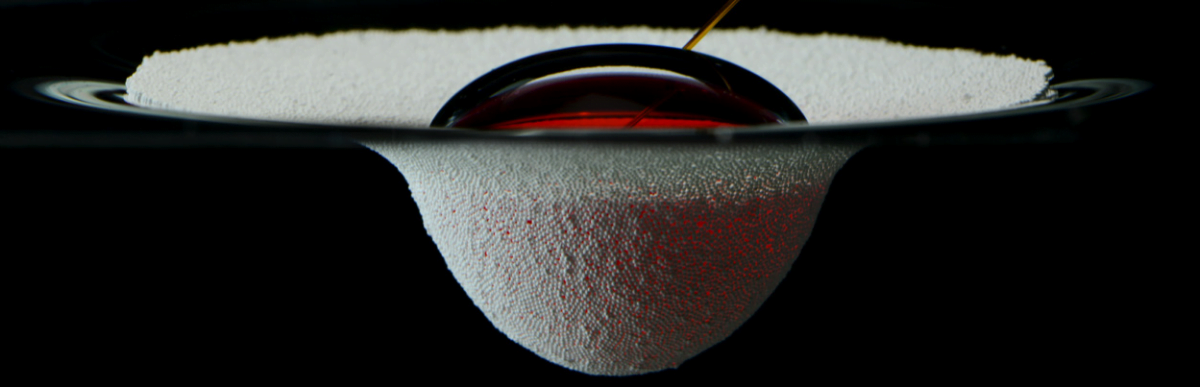
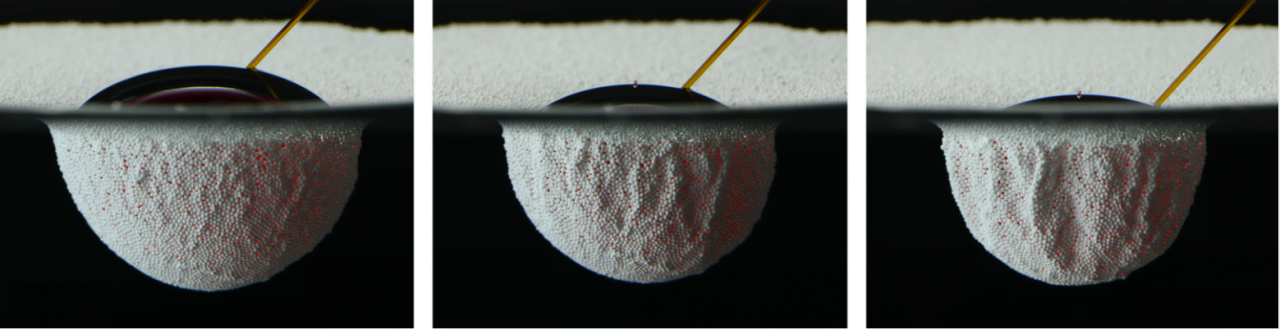
A thin layer of hydrophobic particles dispersed at an oil-water interface is strong enough to prevent a water droplet from coalescing. The researchers refer to this set-up as their granular raft. As the red-dyed water droplet gets larger (top row), it deforms the raft more and more, but the grains continue to keep the drop separate from the fluid beneath (middle row). When water is removed from the droplet, wrinkles form on the raft as the drop’s volume shrinks. This is because the contact line – where the droplet, grains, and air meet – is pinned. The grains already touching the drop are held there by adhesion. But since the drop is shrinking, the area on the raft has to shrink, too – thus wrinkles! (Photo credits: E. Jambon-Puillet and S. Protiere, original)
“Gargantua”
Peering into a vortex feels like staring into an abyss in the Julia Set Collective’s “Gargantua”. Like their previously featured works, this video uses a macro perspective on fluid phenomenon to create an alternate sense of scale. Instead of a whirlpool, we could be observing a wormhole. Part of this is a matter of fooling our brains with perspective, but it also works because, on some level, we recognize that these same fluid patterns occur at very different lengthscales and so it is believable that what we see is much bigger than in reality. (Video credit and submission: S. Bocci/Julia Set Collective)

A Molecular View of Boiling
All matter is made up of molecules. But most of the time we treat fluids as materials with given properties – like density, viscosity, and surface tension – without worrying about the individual molecules responsible for those material characteristics. Now that we have much more powerful computers, though, we can begin to simulate fluid behavior in terms of molecules.
The animations above show some examples of this. In the top animation, we see a gas condensing into a liquid. As the temperature decreases, molecules start clumping together, and eventually settle into a droplet on the solid surface. The lower animation shows the opposite situation – boiling – in which bubbles of vapor nucleate next to the solid surface and grow as more liquid changes phase. To see more examples, including droplets pinching off, check out the full video. (Image credit: E. Smith et al., source; submitted by O. Matar)

Hairy Surfaces Keep Skin Dry
Big animals like whales and sea lions stay warm in cold waters by having thick layers of insulating blubber. But smaller mammals, like beavers and sea otters, have a different mechanism for staying warm – their thick fur traps air near their skin, keeping the cold water at bay. Researchers used flexible, 3D-printed “hairy” surfaces to see how hair density, diving speed, and fluid viscosity affected the amount of air trapped between hairs. This enabled them to build a mathematical model describing the physics, which can now be used to predict, for example, the characteristics needed for a hairy wetsuit that could keep surfers warm in and out of the water. For more on this research check out MIT News’ video, and for a closer look at sea otter fur – not to mention a healthy overdose of pure adorable – check out the video below. (Photo credit: F. Frankel; video credit: Deep Look; research credit: A. Nasto et al.)

Vortex Wake in Quebec


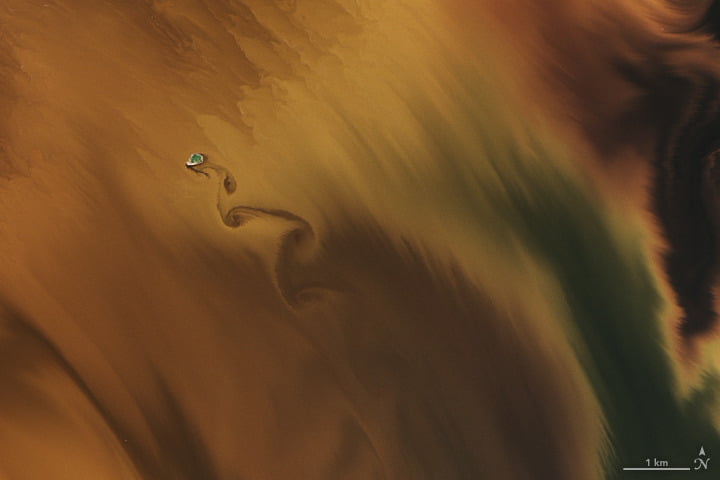
These satellite images show Rupert Bay in northern Quebec. Sediment and tannins have stained the bay’s waters various shades of brown, which helps show the dynamic flows of the area. Rivers empty into the bay, but the tide appears to be coming in from the northwest as well. The flow is just right to create a wake of alternating vortices off a tiny island near the center of the bay. This pattern is known as a von Karman vortex street and often appears in the wake of spheres, cylinders, and, yes, islands. (Image credit: NASA Earth Observatory; submitted by Adam V.)


