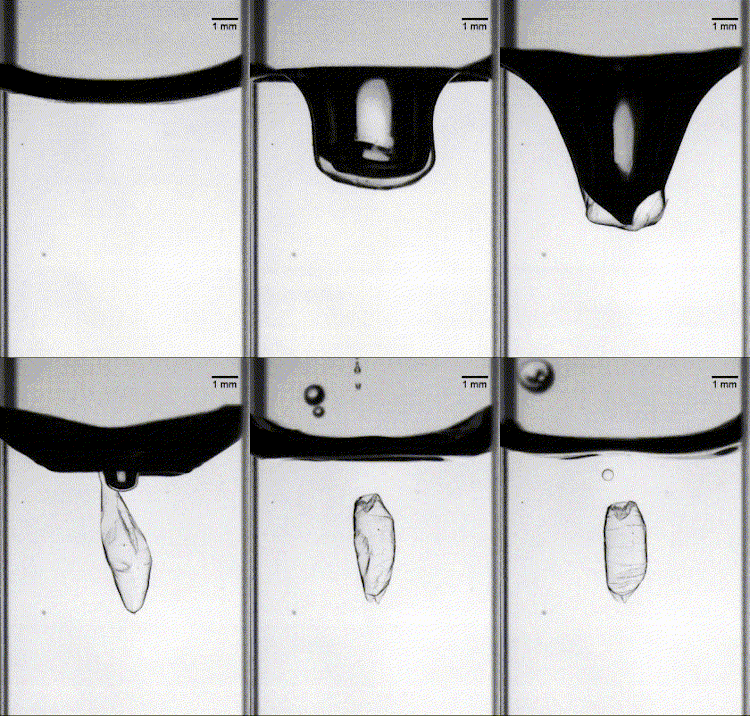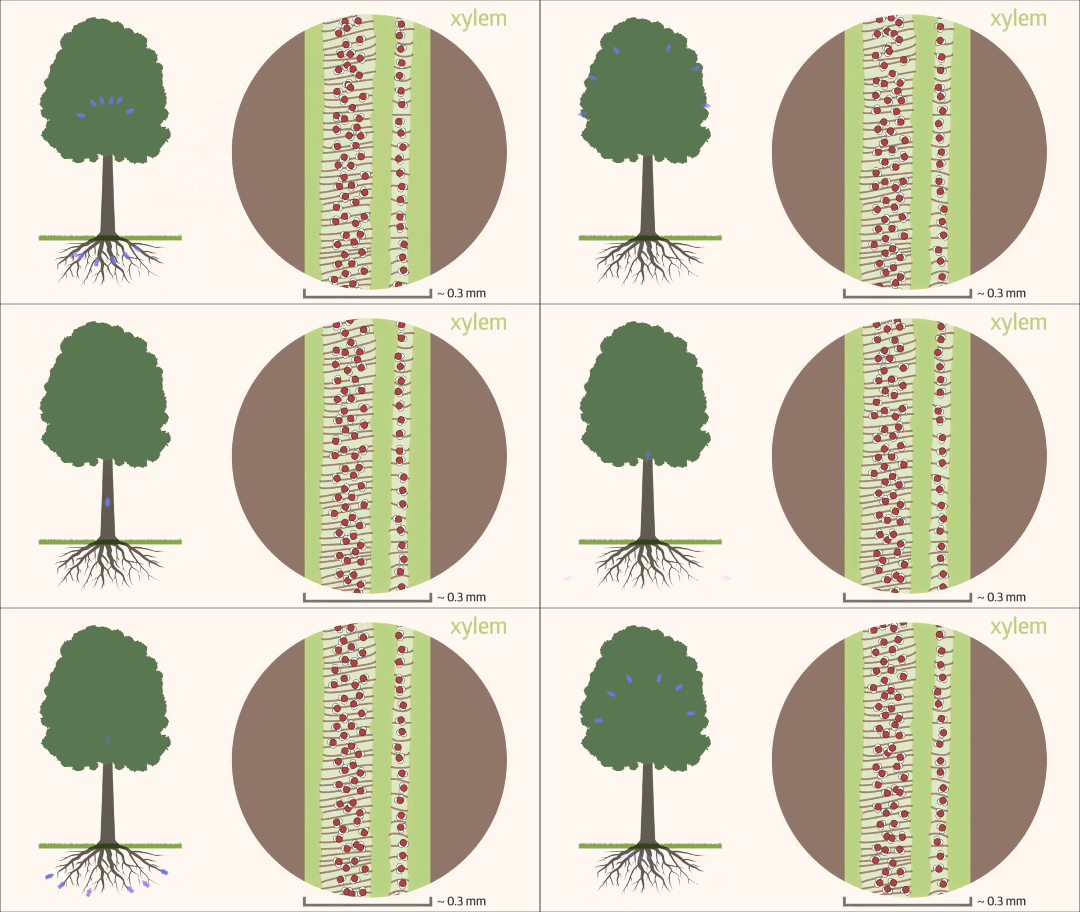
Acoustic levitation traps particles using specially shaped sound waves, but, thus far, it’s only been useful for small particles. One common method of trapping forms the sound waves into a vortex-like shape. Particles in one of these acoustic vortices will spin rapidly, become unstable, and get ejected from the vortex if they’re larger than about half the wavelength of sound used. Recently, though, researchers have stabilized much larger particles by trapping them between two acoustic vortices with opposite spins. The researchers alternate between the two vortices so that each can counteract the other in order to hold the particle in the center of the trap. The new technique has enabled them to trap particles up to 4 times larger than those in previous experiments. (Image and research credit: A. Marzo et al., source; via Science)
Tag: science

“Dance Dance”
Artist Thomas Blanchard is no stranger to fluid dynamics. His previous short films focused on mixtures of oil and paint, but in “Dance Dance,” flowers are front and center. There are obvious splashes of color and clouds of diffusion toward the end of the video, but fluid dynamics are there throughout. The oozing, inexorable march of ice crystallizing over petals and leaves has a fluidity that’s heightened by timelapse. It’s a reminder that this phase change is unsteady and full of shifts too subtle to notice in real-time. In the second act, we see flowers blossoming in timelapse, bursting open dramatically before settling in with a subtle shift of their stamens. Motions like these are driven by the flow of fluids inside the plant. By shifting small concentrations of chemicals, plants drive the water in their cells via osmosis. This pumps up cells that cause the petals to spread and unfurl. (Video and image credit: T. Blanchard; via Colossal)

Rain on Car Windows
As a child, I loved to ride in the car while it was raining. The raindrops on the window slid around in ways that fascinated and confused me. The idea that the raindrops ran up the window when the car moved made sense if the wind was pushing them, but why didn’t they just fly off instantly? I could not understand why they moved so slowly. I did not know it at the time, but this was my early introduction to boundary layers, the area of flow near a wall. Here, friction is a major force, causing the flow velocity to be zero at the wall and much faster – in this case roughly equal to the car’s speed – just a few millimeters away. This pushes different parts of large droplets unevenly. Notice how the thicker parts of the droplets move faster and more unsteadily than those right on the window. This is because the wind speed felt by the taller parts of the droplet is larger. Gravity and the water’s willingness to stick to the window surface help oppose the push of the wind, but at least with large drops at highway speeds, the wind’s force eventually wins out. (Image credit: A. Davidhazy, source; via Flow Viz)

Jovian Polar Vortices
Jupiter’s atmosphere is full of enduring mysteries, and its poles are no exception. Instruments aboard the Juno spacecraft have gotten a better look at Jupiter’s North and South poles than any previous mission, and what they’ve found raises even more questions. Both of Jupiter’s poles feature a central cyclone ringed by other, similarly-sized cyclones. The North pole has eight outer cyclones (top image), while the South pole has five (bottom image), shown above in infrared. Despite being close enough that their spiral arms intersect, the cyclones don’t seem to be merging into something like Saturn’s polar hexagon. For now, scientists don’t know how this arrangement formed or why it persists, but the longer Juno can study the vortices up close, the more we’ll learn. (Image credit: NASA/JPL-Caltech/SwRI/ASI/INAF/JIRAM; research credit: A. Adriani et al.; submitted by Kam-Yung Soh)

Absorbing Bubbles
This is a bubble absorber. It’s formed from an array of three springs, seen end-on in the upper center, each of which is coated to make it superhydrophobic. The hollow interior of the springs is filled with air and ventilated to the atmosphere. As bubbles rise through the water, they contact the springs and readily coalesce with the interior gas. In the blink of an eye, the large bubble is almost completely absorbed into the thin air film that clings to the springs. Superhydrophobic arrays like these may be useful in power and life support systems that need to separate liquid and gas phases under low-gravity conditions. (Image credit: N. Pour and D. Thiessen, source)

Nautilus Swimming
The shellbound chambered nautilus is a champion of underwater jet propulsion. It can eke out efficiencies as high as 75%, far outclassing other jet-based swimmers like squid, salps, and jellyfish. That high efficiency is especially important for the nautilus, which spends a great deal of time at depths where the oxygen needed to fuel movement is in short supply. To get around, the nautilus draws water in through an enlarged orifice, then squirts it out little by little. Its this asymmetry between drawing in and expending that keeps efficiency high. By releasing a jet slower and at lower speeds, the nautilus is able to reduce wasteful losses to friction and thereby keep the efficiency high. The drawback is that the nautilus swims relatively slowly at an average of around 8 centimeters–less than one body length–per second. (Image credit: Simon and Simon Photography/University of Leeds; research credit: T. Neil and G. Askew; via NYTimes; submitted by Kam-Yung Soh)
Caught in a Whirl
Vortex rings may look relatively calm, but they are concentrated regions of intensely spinning flow, as this poor jellyfish demonstrates. The rings form when a high-speed fluid gets pushed suddenly (and briefly) into a slower fluid. In the case of this bubble ring, a burst of air is pushed by a diver into relatively still water. The vorticity caused by the two areas of fluid trying to move past one another forms the ring. Like a spinning ice skater who pulls his arms inward, the narrow core of the vortex spins fast due to the conservation of angular momentum. Meanwhile, the bubble ring moves upward due to its buoyancy, pulling nearby water in as it goes. This catches the hapless jellyfish (who relies on vortex rings itself) and gives it quite a spin. But. don’t worry, the photographer confirmed that the jelly was okay after its ride. (Video credit: V. de Valles; via Ashlyn N.)

Castle-like Clouds
An astronaut captured this towering cloud over Andros Island from orbit aboard the ISS. This is a cumulus castellanus cloud, named for the castle-like crenelations at its top. Castellanus clouds form in areas with strong vertical updrafts, often due to cloud-level atmospheric instabilities rather than heating at the Earth’s surface. These clouds frequently proceed rain or even thunderstorms. What distinguishes castellanus from other types of cumulonimbus clouds is their shape: castellanus clouds have protrusions that are taller than they are wide – like the castles for which they are named. (Image credit: NASA / Expedition 48; via NASA Earth Observatory)

Modons
The spin of the Earth creates myriad eddies in our oceans, most of which move slowly westward at a speed dependent on their latitude. You can see many in the animation above as green and red rings slowly marching to the left. According to theory, it’s possible for two of these eddies to combine to become more than the sum of their parts; under the right conditions, the two conjoined eddies could become a modon, which, like a vortex ring, is capable of traveling far faster than its parental eddies. Despite the theory, however, no one had ever observed a modon in nature.
A new paper uses satellite imagery to identify nine modons in different locations around the world. One is shown above. Watch the eastern coast of Australia carefully, and you’ll see a modon form. It moves much faster than its surroundings, first southward toward Tasmania, then quickly eastward toward New Zealand. Thin black circles mark the two eddies that make up the modon. The strength and speed of these features makes them capable of pulling significant water mass with them. This suggests that they may play a role in ocean life, transporting water of different temperatures and nutrient content into regions it would not otherwise reach. (Image and research credit: C. Hughes and P. Miller; via Gizmodo)

Chemistry in Infrared
Many chemical reactions, and the flows that accompany them, are invisible to the human eye. But in infrared wavelengths those same events are vibrant and energetic. In this video from the Beauty of Science group, various chemical reactions are shown in visible and IR wavelengths, revealing very different perspectives on the same thing. Many of the reactions are exothermic, meaning that they produce heat as they occur. Because of this the thermal imaging shows where the most intense reaction is occurring at a given time. Other areas gradually darken as diffusion and flow move and dilute the heat energy released. (Video and image credit: Beauty of Science, source)