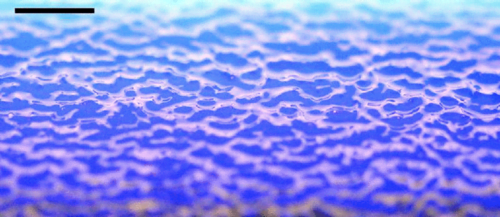
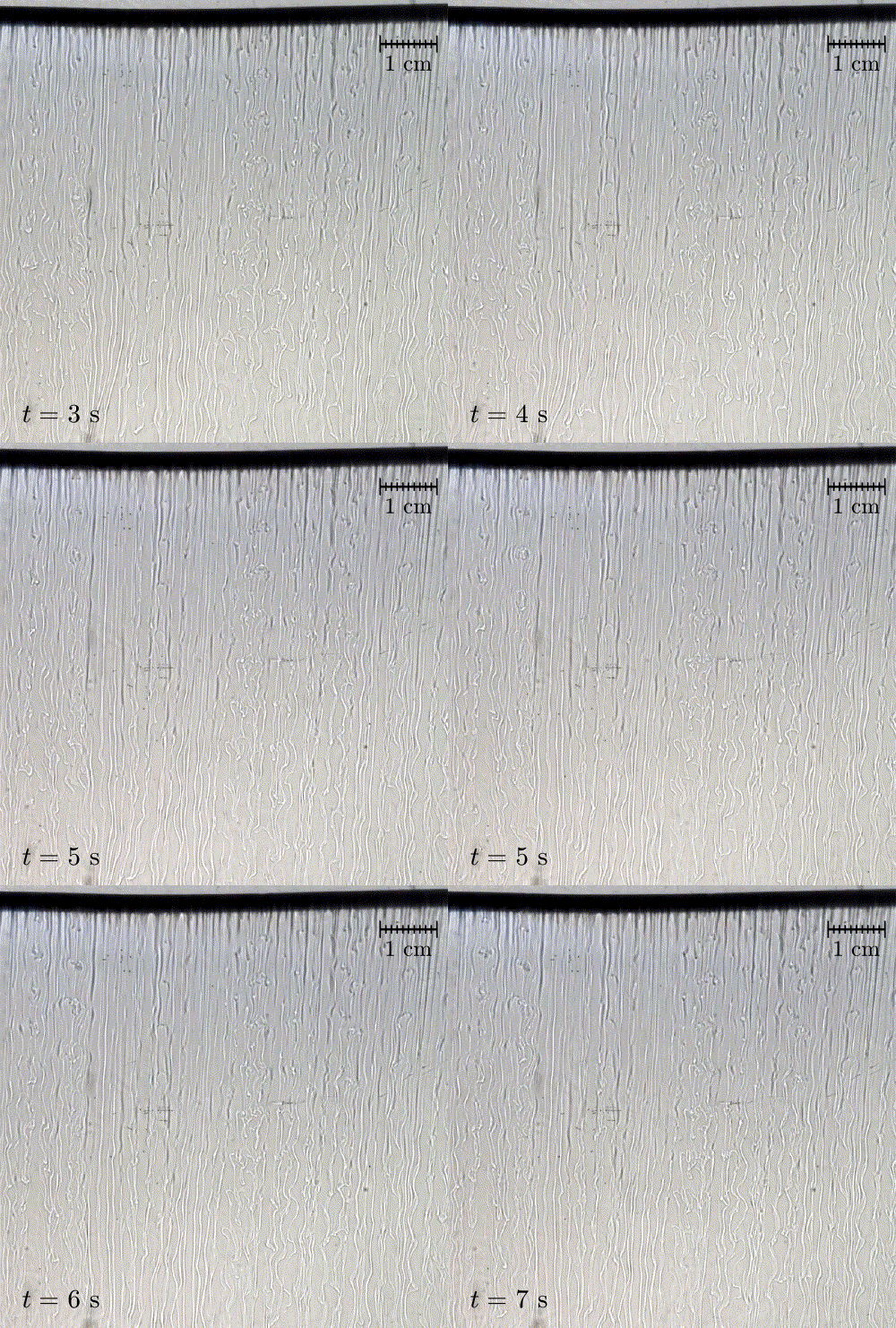
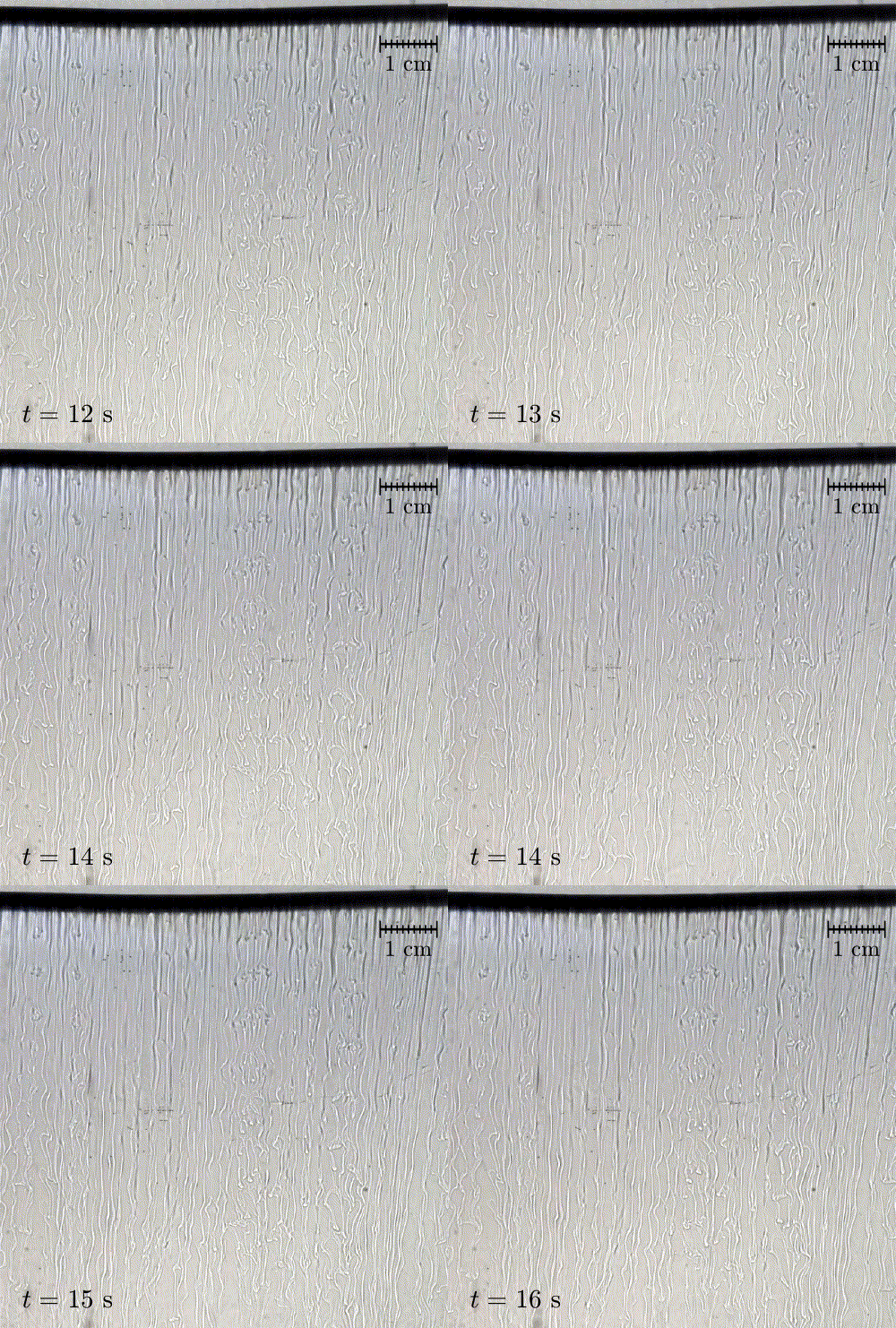
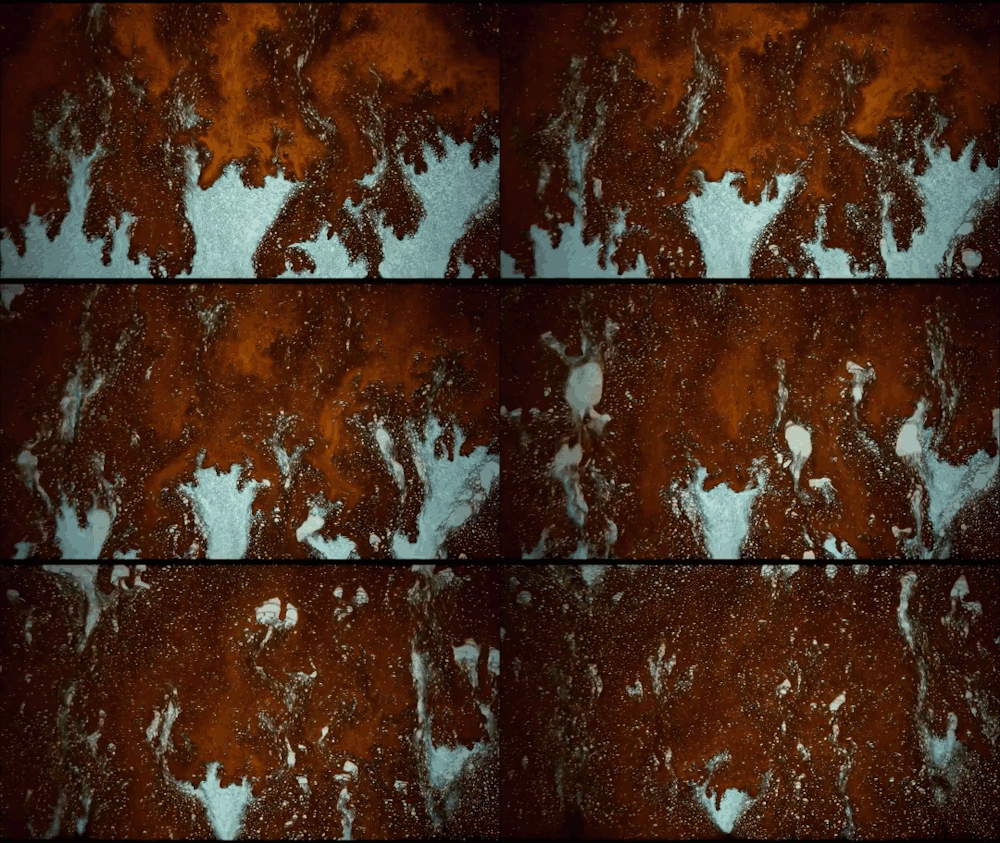
A river’s flow constantly changes its underlying bed. The rocks and particulates beneath a flowing river can typically be divided into two zones: an upper layer called the bed-load zone where the flow moves particles with it and a lower layer where particles are mostly trapped but may creep over long periods. In gravelly river-beds this upper bed-load zone tends to accumulate more large particles, a phenomenon known as armoring. Experiments show that, in this region, large particles have a net vertical velocity moving upward, while smaller particles tend to move downward. Exactly why large particles are more prevalent in the bed-load zone in unknown; several theories have been offered. One suggests that the size segregation is similar to the Brazil nut effect and that smaller particles have a tendency to fall into gaps and sink more easily than larger ones. (Image and research credit: B. Ferdowsi et al., source)
Tag: science

Juno’s Citizen Science
The Juno mission’s JunoCam has been producing stunning photos each time the spacecraft swoops past Jupiter. The instrument has a planning team, but its primary use is for citizen scientists, who have been suggesting images to take each orbit and have been processing those images. Most of the photos we see are like the one on the left above – photos that have been heavily color-enhanced to highlight details. The image on the right shows what Jupiter would look like to the human eye. Look closely, and you’ll catch many of the same colors and shapes in both photos.
At a recent conference, a member of JunoCam’s team presented scientific results that have come from the instrument, including analysis of Jupiter’s polar storm systems (8 vortices for the north pole and 5 for the south), tantalizing hints at Jovian equivalents to earthly cloud types, and more. She also announced a new Analysis page where members of the public can both see the science in progress and participate first-hand! (Image credit: NASA / SwRI / MSSS / G. Eichstädt / S. Doran; NASA / JPL-Caltech / SwRI / MSSS / B. Jónsson; via E. Lakdawalla; submitted by jshoer)

The Foggy Grand Canyon
On occasion in the late fall and early winter, the Grand Canyon can fill with clouds of fog. This occurs when a layer of warm air traps cold, moist air inside the canyon, creating what’s known as a temperature inversion. The trapped air’s moisture condenses into fog, creating the appearance of a cloud sea lapping at the canyon walls. Such inversions often proceed a big snowstorm, as shown in this video. (Video and image credit: H. Mehmedinovic / SKYGLOWPROJECT; via Gizmodo)


The Lava Lamps That Secure the Internet
A wall of lava lamps in a San Francisco office currently helps keep about 10% of the Internet’s traffic secure. Internet security company Cloudflare uses a video feed of the lava lamps as one of the inputs to the algorithms they use to generate large random numbers for encryption. The concept dates back to a 1996 patent for a product called LavaRand. The idea is that using a chaotic, unpredictable source as a seed for random number generators makes it much harder for an adversary to crack your encryption.
With lava lamps, a lot of that chaos comes from the fluid dynamics involved – without perfect knowledge of thousands of variables, it would be impossible to simulate the lava lamp wall and get the same outcome as the real one – but there’s also randomness that comes from the measurement. People walking by, shifts in lighting, and random fluctuations of individual pixels all help make the video feed unpredictable. For those interested in the details of how Cloudflare uses their lava lamps, the company explains things for both technical and non-technical readers. You can also check out Tom Scott’s video for a good overview. (Image and video credit: T. Scott; submitted by Jean H.)

Water Atop Oil
At first glance, this image looks much like the impact of any drop on a pool of the same liquid, but that’s not what you’re seeing. This is the impact of a water droplet on a thin film of oil, and the immiscibility of those two fluids has important effects on the collision. When the water drop impacts, it spreads and forms a compound crown that rises out of the fluid. Eventually, that momentum runs out and the crown falls into the liquid.
Water’s intermolecular forces are strong enough to pull the remains of the droplet back in on itself. As that fluid collides at the center, it gets forced up into a central jet with enough energy to eject a droplet or two at its tip. Even though this looks like a Worthington jet, it’s not. Worthington jets form after the collapse of a cavity in the impacted liquid – in other words, they form on pools, not on films. Despite the visual similarity, this central jet is formed entirely differently! (Image and research credit: Z. Che and O. Matar, source; submitted by O. Matar)

Jumping Droplets
Condensation, which removes heat by changing a vapor into a liquid, is a common feature in industrial heat transfer. When droplets form on surfaces, they typically have to grow to millimeter size before gravity causes them to slide off and open up the surface to new droplet formation. Hydrophobic surfaces can shed droplets a little sooner. Droplets only 100 micrometers in size will spontaneously jump off hydrophobic surfaces due to the release of excess surface energy during droplet coalescence, but this only happens when those droplets have a small contact area with the surface. Defects in the nanoscale structure of the surface can allow water to squeeze in between posts and hold on.
To counter this, new experiments packed copper nanowires into a dense 3D array. This permits fewer defects and helps condensing droplets leap from the surface sooner. Each droplet carries away a bit of the surface’s heat. The new method is impressively efficient at it. Researchers found the new heat exchanger could remove 100% more heat than previous hydrophobic designs. (Video credit: Science; research credit: R. Wen et al.)

Seeing the Wake
Hot exhaust gases churn in the wake of this climbing B-1B Lancer. The high temperature of the exhaust changes the density and, thus, the refractive index of the gases relative to the atmosphere. Light traveling through the exhaust gets distorted, making the highly turbulent flow visible to the human eye. Note how the four individual engine exhaust plumes quickly combine into one indistinguishable wake. This is typical for turbulence; it’s hard to track where any given fluctuations originally came from. The airplane’s wingtip vortices are just visible as well, if you look closely. (Image credit: T. Rogoway; submitted by Mark S.)

Pilot-Wave Hydrodynamics: Resources
This is the final post in a collaborative series with FYP on pilot-wave hydrodynamics. Previous posts: 1) Introduction; 2) Chladni patterns; 3) Faraday instability; 4) Walking droplets; 5) Droplet lattices; 6) Quantum double-slit experiments; 7) Hydro single- and double-slit experiments; 8) Quantum tunneling; 9) Hydrodynamic tunneling; 10) de Broglie’s pilot-wave theory
Thanks for joining us this week as we explored nearly two centuries’ worth of scientific discoveries around vibration, fluid dynamics, and quantum mechanics. For those who’d like to learn more about these and related topics, we’ve compiled some helpful resources below.
Other Videos, Articles, and Resources by Topic
Chladni Patterns
- ANSYS, “Chladni Plates”
- Brusspup, “Amazing Resonance Experiment!”
- Kenichi Kanazawa, “Color Sound”
- Microfluidic Chladni patterns
- Nigel Stanford, “Cymatics”
- Peter Remco, “Chladni patterns in a violin plate”
- Steve Mould, “Random couscous snaps into beautiful patterns”
Faraday Instability
- FYFD, Alligators and water dancing
- FYFD, Liquid crystals vibrating on a tuning fork
- Gallery of Fluid Motion, “The Tibetan singing bowl”
- Nigel Stanford, “Cymatics”
- Slow Mo Guys, “Chinese spouting bowl in slow motion.”
Quantum Mechanics
Pilot-wave Hydrodynamics
- Dual Walkers, learn about the physics from the researchers themselves
- Gallery of Fluid Motion, “The pilot-wave dynamics of walking droplets.”
- Gallery of Fluid Motion, “Shedding light on pilot-wave phenomena.”
- The Lutetium Project, “Never-ending bouncing droplets.”
- The Lutetium Project, “Dual walkers: drops and waves.”
- Through the Wormhole, Interview with Y. Couder
- Wired, “Have we been interpreting quantum mechanics wrong this whole time?”
- Veritasium, “Is this what quantum mechanics looks like?”
Selected (Academic) Bibliography by Topic
Articles marked with an asterisk (*) are recommended for their approachability and/or broad overview of the subject.
Chladni Patterns
- (*) M. Faraday, “On a peculiar class of acoustical figures; and on certain forms assumed by groups of particles upon vibrating elastic surfaces,” 1831.
- Lord Rayleigh, “On the circulation of air observed in Kundt’s tubes, and on some allied acoustical problems,” 1884.
- H. van Gerner et al., “Air-induced inverse Chladni pattern,” 2011.
Faraday Instability
- (*) M. Faraday, “On a peculiar class of acoustical figures; and on certain forms assumed by groups of particles upon vibrating elastic surfaces,” 1831.
Pilot-wave Hydrodynamics
- Y. Couder and E. Fort, “Single-particle diffraction and interference at a macroscopic scale,” 2006.
- A. Eddi et al., “Unpredictable tunnel of a classical wave-particle association,” 2009.
- (*) Y. Couder et al., “Walking droplets: A form of wave-particle duality at macroscopic scale?”, 2010.
- J. Molacek and J. Bush, “Droplets bouncing on a vibrating bath,” 2013.
- J. Molacek and J. Bush, “Droplets walking on a vibrating bath: toward a hydrodynamic pilot-wave theory,” 2013.
- D. Harris et al., “Wave-like statistics from pilot-wave dynamics in a circular corral,” 2013.
- O. Wind-Willassen et al., “Exotic states of bouncing and walking droplets,” 2013.
- (*) J. Bush, “Pilot-wave hydrodynamics,” 2015.
- D. Harris et al., “Visualization of hydrodynamic pilot-wave phenomena,” 2016.
(Image credit: A. Labuda and J. Belina)

Pilot-Wave Hydrodynamics: Droplet Tunneling
This post is part of a collaborative series with FYP on pilot-wave hydrodynamics. Previous posts: 1) Introduction; 2) Chladni patterns; 3) Faraday instability; 4) Walking droplets; 5) Droplet lattices; 6) Quantum double-slit experiments; 7) Hydro single- and double-slit experiments; 8) Quantum tunneling
Quantum tunneling is a strange subatomic behavior that was first described to explain how alpha particles escape a nucleus during radioactive decay. Classically, a particle trapped in a well can only escape if its energy is sufficiently high, but in quantum mechanics, even a particle with lower-than-necessary energy can occasionally “tunnel” out.
To test whether hydrodynamic walkers can tunnel, researchers built corrals. In the central region, the pool on which the walker moves is relatively deep. Over the walls, the pool is much shallower. In this shallow area, the wave from the droplet’s bouncing decays quickly, creating a partially reflective barrier. For most collisions, the walker reflects off the barrier. Other times, apparently at random, a collision results in the walker crossing the wall and tunneling out of its well.
Over many experiments, researchers were able to construct a probabilistic view of walker tunneling. In quantum mechanics, a particle’s likelihood of tunneling out of a well depends on the particle’s energy and the well’s thickness. The analogs for a walker are velocity and barrier thickness. The thicker the barrier, the harder it is for a walker to tunnel through. Conversely, a faster walker has a higher probability of tunneling through a barrier of a given thickness. As the authors themselves observe:
“Although our experiment is foreign to the quantum world, the similarity of the observed behaviors is intriguing.” #
As we wrap up our series tomorrow, we’ll consider some of those similarities more deeply.
(Image credits: A. Eddi et al., sources)

Pilot-Wave Hydrodynamics: Slit Experiments
This post is part of a collaborative series with FYP on pilot-wave hydrodynamics. Previous entries: 1) Introduction; 2) Chladni patterns; 3) Faraday instability; 4) Walking droplets; 5) Droplet lattices; 6) Quantum double-slit experiments
In quantum mechanics, the single and double-slit experiments are foundational. They demonstrate that light and elementary particles like electrons have wave-like and particle-like properties, both of which are necessary to explain the behaviors observed. Similarly, a hydrodynamic walker consists of both a particle and a wave, so, perhaps unsurprisingly, researchers tested them in both single-slit and double-slit experiments.
When a walker passes through a single-slit (top row), it’s deflected in a seemingly random direction due to its waves interacting with the slit. But if you watch enough walkers traverse the slit, you can put together a statistical representation of where the walker will get deflected. Compare that with the results for a series of photons passing through a slit one-at-a-time, and you’ll see a remarkable match-up.
If you test the walker instead with two slits, the droplet can only pass through one slit, but its accompanying wave passes through both (bottom row). Let enough walkers through the system one-by-one, and they, like their photonic cousins, build up interference fringes that match the quantum experiment. Diffraction and interference are only a couple of the walkers’ tricks, however. In the next posts, we’ll take a look at another analog to quantum behavior: tunneling.
(Image and research credits: Couder et al., source, selected papers 1, 2; images courtesy of E. Fort)