Clean-up of accidents like the 2010 Deepwater Horizon oil spill can be complicated by what goes on beneath the ocean surface. Variations in temperature and salinity in seawater create stratification, stacked layers of water with differing densities. When less dense layers are on top, the fluid is said to be stably stratified. Since oil is less dense than water, one might assume that buoyancy should make an oil plume should rise straight to the ocean surface. But the presence of additives or surfactants in the oil mixture plume can prevent that. With surfactants present, an oil mixture tends to emulsify, breaking into tiny droplets like a well-mixed salad dressing. Even if the density of the emulsion is smaller than the surrounding fluids, such a plume can get trapped at a density boundary, as seen in the photo above. Researchers report a critical escape height, which depending on the plume’s characteristics and stratification boundary, determines whether a plume escapes or becomes trapped. (Image credit: R. Camassa et al.)
Tag: plumes

The Physics of Sneezing
Sneezing can be a major factor in the spread of some illnesses. Not only does sneezing spew out a cloud of tiny pathogen-bearing droplets, but it also releases a warm, moist jet of air. Flows like this that combine both liquid and gas phases are called multiphase flows, and they can be a challenge to study because of the interactions between the phases. For example, the buoyancy of the air jet helps keep smaller droplets aloft, allowing them to travel further or even get picked up and spread by environmental systems. Researchers hope that studying the fluid dynamics and mathematics of these turbulent multiphase clouds will help predict and control the spread of pathogens. Check out the Bourouiba research group for more. (Video credit: Science Friday)

“Smoke”


Ethereal forms shift and swirl in photographer Thomas Herbich’s series “Smoke”. The cigarette smoke in the images is a buoyant plume. As it rises, the smoke is sheared and shaped by its passage through the ambient air. What begins as a laminar plume is quickly disturbed, rolling up into vortices shaped like the scroll on the end of a violin. The vortices are a precursor to the turbulence that follows, mixing the smoke and ambient air so effectively that the smoke diffuses into invisibility. To see the full series, see Herbich’s website. (Image credits: T. Herbich; via Colossal; submitted by @jchawner, @__pj, and Larry B)
P.S. – FYFD now has a page listing all entries by topic, which should make it easier for everyone to find specific topics of interest. Check it out!

Sneezes Vs. Coughs
Sneezing and coughing are major contributors to the spread of many pathogens. Both are multiphase flows, consisting of both liquid droplets and gaseous vapors that interact. The image on the left shows a sneeze cloud as a turbulent plume. The kink in the cloud shows that plume is buoyant, which helps it remain aloft. The right image shows trajectories for some of the larger droplets ejected in a sneeze. Like the sneeze cloud, these droplets persist for significant distances. The buoyancy of the cloud also helps keep aloft some of the smaller pathogen-bearing droplets. Researchers are building models for these multiphase flows and their interactions to better predict and counter the spread of such airborne pathogens. For similar examples of fluid dynamics in public health, see what coughing looks like, how hospital toilets may spread pathogens, and how adjusting viscoelastic properties may counter these effects. For more about this work, see the Bourouiba research group’s website. (Image credit: L. Bourouiba et al.)
Overflowing Foam
Hitting a glass bottle full of a non-carbonated drink can shatter the bottle due to cavitation, but doing the same with a carbonated beverage can make the bottle overflow with foam. The video above breaks down the physics of this bar prank. It all begins with nucleation and the tiny bubbles of carbon dioxide that form in the liquid. Striking the top of the bottle generates a compression wave that travels through the liquid, shrinking bubbles as it passes. When it hits the bottom of the bottle, it gets reflected as an expansion wave that expands the bubbles. This reflection happens several times between the free surface of the liquid and the bottom of the bottle. The rapid collapse-and-expansion of the bubbles makes them implode into a cloud of tinier bubbles that expands until the local supply of carbon dioxide is used up. At this point, the buoyancy of the bubbles carries them upward in plumes, creating more bubbles with the dissolved carbon dioxide nearby. And, all of a sudden, you’ve got foam everywhere. Like all of this week’s videos, this video is an entry in the 2013 Gallery of Fluid Motion. (Video credit: J. Rodriguez-Rodriguez et al.)

Incense in Transition
A buoyant plume of smoke rises from a stick of incense. At first the plume is smooth and laminar, but even in quiescent air, tiny perturbations can sneak into the flow, causing the periodic vortical whorls seen near the top of the photo. Were the frame even taller, we would see this transitional flow become completely chaotic and turbulent. Despite having known the governing equations for such flow for over 150 years, it remains almost impossible to predict the point where flow will transition for any practical problem, largely because the equations are so sensitive to initial conditions. In fact, some of the fundamental mathematical properties of those equations remain unproven. (Photo credit: M. Rosic)

Plasma Jets
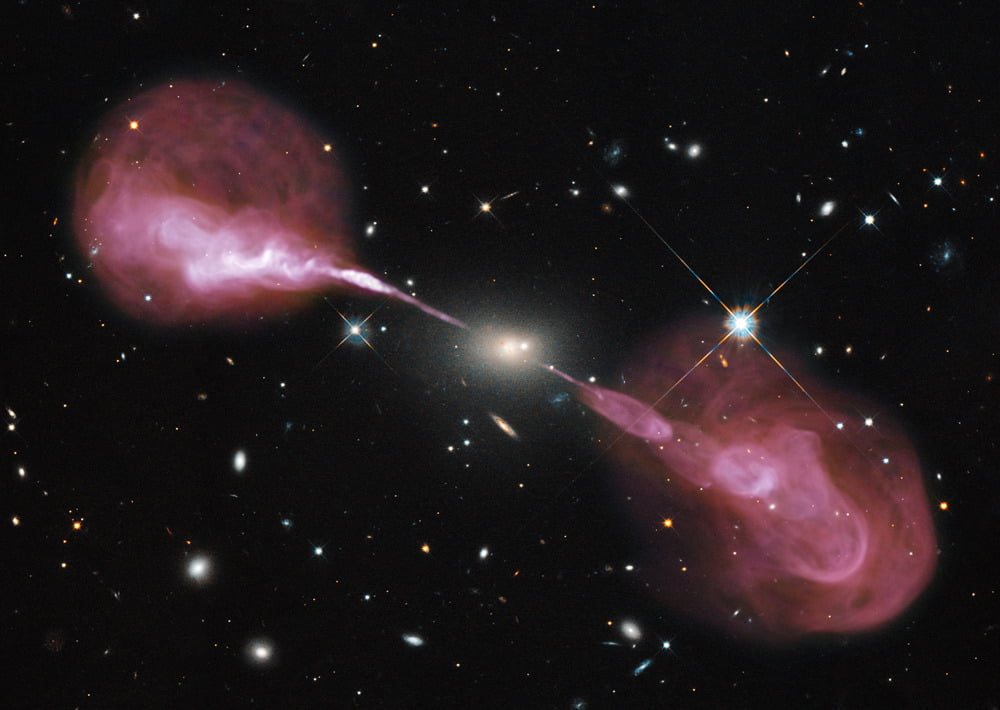
Jets of high-energy plasma and sub-atomic particles explode outward from the Hercules A elliptical galaxy at the center of this photo. The jets are driven to speeds close to that of light due to the gravitation of the supermassive black hole at the center of the elliptical galaxy. Relativistic effects mask the innermost portions of the jets from our view, but, as the jets slow, they become unstable, billowing out into rings and wisps whose turbulent shapes suggest multiple outbursts originating from Hercules A. (Photo credit:NASA, ESA, S. Baum and C. O’Dea (RIT), R. Perley and W. Cotton (NRAO/AUI/NSF), and the Hubble HeritageTeam (STScI/AURA); via Discovery)
Relighting a Candle
When a candle is blown out, a buoyant plume of unburned fuel/air mixture continues to rise for several seconds. By bringing a combustion source close to the plume, the mixture can ignite and flames will propagate back down to the candle wick to reignite it. Watch the slow motion replay near the end of the video and you can actually see the flame front propagate downward. (Video credit: G. Casavan, University of Colorado)

Rocket Exhaust
A fiery jet of exhaust remains amid plumes of smoke as a Soyuz rocket lifts off from Baikonur Cosmodrome bound for the International Space Station. The lengthscales of such turbulence range from tens of meters to only millimeters, highlighting the incredible difficulty of accurately capturing and describing the fluid motion of a practical engineering problem. (Photo credit: NASA/Carla Cioffi; via Visual Science)
Canyon Fire Timelapse
Wildfires continue to burn across Colorado and other parts of the United States. This timelapse video shows 5 days worth of the Waldo Canyon fire. Smoke billows through the night and day, with diurnal temperature changes and winds affecting whether the turbulent plumes rise high or hover on the horizon. It is hard to describe the eeriness of watching a fire burn uncontrollably on the horizon; we hope those fighting the fires stay safe and that those affected by the fires are able to return and recover soon. (Video credit: Steve Moraco; submitted by Chris P)