Tag: planetary science

  • Anak Krakatoa Tsunami

    Anak Krakatoa Tsunami

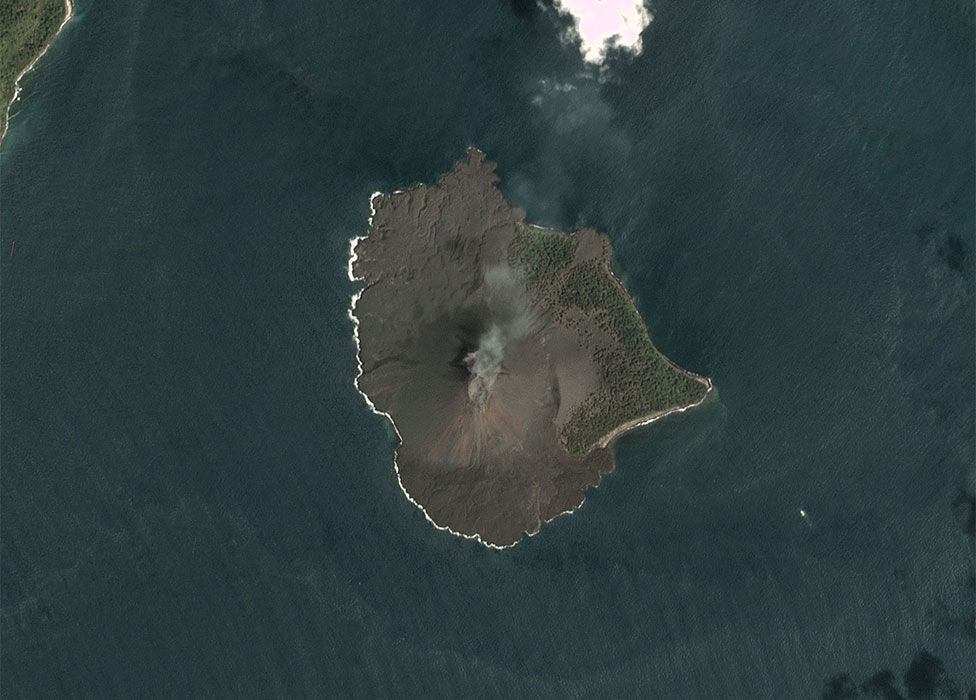
    In late December 2018, a landslide on the island Anak Krakatoa triggered a deadly tsunami in Indonesia. The island (upper left, pre-landslide) lost an estimated 300 meters of height in the landslide, dramatically altering its appearance (upper right; post-landslide). Much of the slide occurred underwater, dumping material into a crater left by the famous 1883 eruption of Krakatoa

    The slide displaced a massive amount of water, creating a tsunami that spread, refracting around nearby islands and reflecting off shorelines in complicated patterns. A new numerical simulation, shown above, models the post-slide tsunami based on terrain data and fluid physics. Its wave predictions match well with the high-water readings from nearby islands. The scientists hope that such models, combined with monitoring, will help save lives should a future eruption trigger more tsunamis.

    For a full picture of both the recent Anak Krakatoa eruption and its famous predecessor, check out this video. (Image credits: satellite views before and after landslide – Planet Labs; simulation – S. Ward, source; via BBC News; submitted by Kam-Yung Soh)

  • Featured Video Play Icon

    Recreating Pyroclastic Flow

    One of the deadliest features of some volcanic eruptions is the pyroclastic flow, a current of hot gas and volcanic ash capable of moving hundreds of kilometers an hour and covering tens of kilometers. Since volcanic particles have a high static friction, it’s been something of a mystery how the flows can move so quickly. Using large-scale experiments (top), researchers are now digging into the details of these fast-moving flows.

    What they found is that the two-phase flow results in a pressure gradient that tends to force gases downward. This creates a gas layer with very little friction near the bottom of the pyroclastic flow (bottom), essentially lubricating the entire flow with air. This helps explain why pyroclastic flows are so fast and long-lived despite their inherent friction and the roughness of the terrain over which they flow. (Image and research credit: G. Lube et al.; video credit: Nature; submitted by Kam-Yung Soh)

  • Prehistoric Seiche

    Prehistoric Seiche

    Sixty-six million years ago, a meteorite impact in modern-day Mexico wiped out the dinosaurs and most other living species of the time. To call the event catastrophic feels like an understatement. At the site of impact, rocks and animals were vaporized. Further away, molten rock condensed into glass beads that form a geological layer found around the world.

    Still further away, in what is now North Dakota and was then the bank of a freshwater river, scientists have discovered a deposit full of saltwater fish, sharks, and rays that would have lived in the vast inland sea (A) that stretched northward from Texas. The meteorite’s impact pushed these creatures kilometers upstream against the river’s natural flow.

    One possible explanation for the inundation is a tsunami. But geological evidence indicates the deposit took place within 15 minutes to two hours of the impact, when glass beads were still raining down. To travel the 3,000 km from the point of impact would take a tsunami on the order of 18 hours – far too long.

    Instead, the deposit is likely the result of a seiche (pronounced “saysh”) – a type of standing wave that occurs in an enclosed or partially enclosed body of water. If you imagine water sloshing in a cup or a tub, that’s essentially what a seiche is, but this was on a much larger scale. (For an example, check out this insane footage of an earthquake-induced seiche in a swimming pool.)

    What set the seiche to sloshing are the seismic waves triggered by the meteorite impact. They would have reached this site 6-13 minutes after the impact and triggered waves on the order of 10m. As the waves drove up the riverways, they carried dead and dying sea creatures with them, leaving them stranded on the riverbank until scientists uncovered them tens of millions of years later. (Image and research credit: R. DePalma et al.; via The Conversation; submitted by Kam-Yung Soh)

  • Featured Video Play Icon

    “The World Below”

    Since the first cosmonauts and astronauts entered orbit around our planet, they’ve held a unique perspective. Thanks to the timelapse photography of recent astronauts aboard the ISS and the editing skills of photographer Bruce W. Berry, Jr, the rest of us can enjoy a taste of that viewpoint. Turn up the volume, fire up the big screen, and enjoy.

    I particularly like how several of the sequences show off the depth of the atmosphere. Earth’s atmosphere is incredibly thin compared to the size of our planet – less than one percent of Earth’s radius – but thanks to the shadows that clouds cast on one another, you can really appreciate their height in sequences like the one at 2:26. (Video credit: B. Berry, Jr. using NASA footage)

  • Lava Bomb

    Lava Bomb

    What you see above is a homemade lava bomb. To systematically study what happens when groundwater meets lava, scientists melted basalt and created their own meter-scale explosion-on-demand. Inside the container, they can inject water and observe the resulting dynamics.

    Beneath the lava, the water forms what scientists call a domain. Thanks to the Leidenfrost effect, it can be protected from direct contact with the lava by a thin vapor layer that boils off it. If the water domain is large enough, buoyancy will pull it upward through the lava. Whether the water maintains a spherical shape or begins to distort and break up into smaller domains depends on the speed of its rise.

    At some point, though, either naturally or through an external trigger (like the sledgehammer you see above), the water and lava can contact, resulting in explosive vaporization of the water and an explosion. What’s visible at the surface depends on the depth at which the explosion takes place. Scientists are eager to characterize these variations, which will help them better predict the explosive danger of eruptions like Kilauea and Eyjafjallajökull. (Image and research credit: I. Sonder et al.; video credit: NYTimes; submitted by Kam-Yung Soh)

  • Stress Between Grains

    Stress Between Grains

    Granular materials like sand and beads can shift and flow in fluid-like ways, but they’re much harder to predict. Part of this is due to the way friction between individual grains transmits force through the network. Here, we see photoelastic beads responding to the intrusion of a narrow rod. The lightning-like flashes show how stress is traveling between neighboring grains. Notice how the lower grains are essentially frozen into a state of high stress, but the movable upper grains shift and readjust themselves to try and relieve stress.

    This experiment took place under lunar gravitational conditions. Lower gravity means that it takes a larger pile of grains on top to create a given stress. But it also means it’s easier for those movable top grains to shift or even get thrown up by a hastily applied force.  The purpose of experiments like this is to better understand how rovers and probes should dig in low-gravity environments without kicking up a cloud of regolith and dust. (Image credit: K. Daniels et al., source)

  • Understanding Jupiter

    Understanding Jupiter

    The swirling clouds of Jupiter hide a complicated and mysterious interior. For decades, scientists have worked to puzzle out the inner dynamics of Jupiter’s atmosphere and what could be going on inside it to generate the flows we see visibly. Near Jupiter’s equator, we see strong jets that flow either east or west, depending on their latitude; this creates the stunning cloud bands we’re used to seeing on the planet. Toward the poles, though, things look more like what we see above – swirling but unbanded.

    Through theory, experiments, and simulations, scientists have tried to work out exactly what ingredients are necessary to make Jupiter look this way, but it’s pretty tough to recreate the conditions simply because Jupiter is so extreme. You need a lot of rotation, a lot of turbulence, and a way to stretch that turbulence if you want to imitate Jupiter. There’s been progress recently, though, and it suggests that the jets we see on Jupiter are far more than skin-deep. Instead, they likely stretch deep into the Jovian atmosphere at the equator and ride somewhat shallower toward the poles. (Image credit: NASA JPL; research credit: S. Cabanes et al.)

  • Namibia From Above

    Namibia From Above

    From above, we see an all-new perspective on the flows of air and water that shape our world. Although they look like abstract art, these aerial photographs of Namibia by Leah Kennedy show rippling dunes and spreading fingers of water. Linear dunes like these grow when the prevailing winds are always from the same direction. Over time, rivers meander, always seeking new drainage paths. Patterns like these are probably driven by periodic flooding. (Image credit: L. Kennedy; via Colossal)

  • Forming Asteroids

    Forming Asteroids

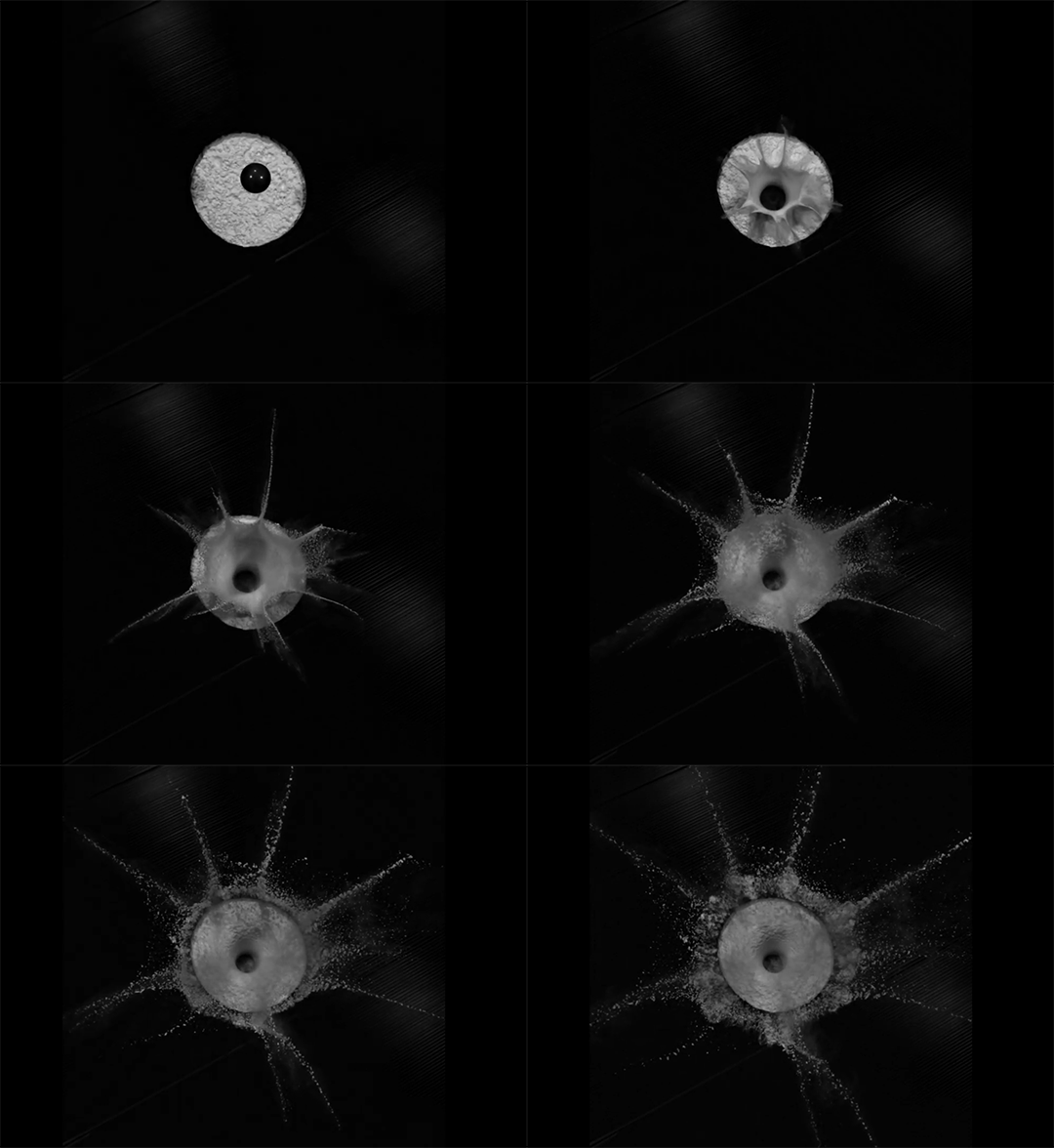
    Amidst the swirling gas and dust surrounding young stars, asteroids and planets form. Just how these bodies come together – especially before they are massive enough to exert any significant gravitational potential – is an open question. Researchers are trying to better understand the physics involved by studying how clusters of granular material behave when impacted. 

    Above you see footage from two experiments. Both take place in a drop tower under vacuum conditions. That means the effects of air drag and gravity are removed, just like in space. On the left, the cluster is made up of soft clumps of dust; on the right, the cluster contains hard glass beads. Surprisingly, the researchers found that the two different materials behave the same way. They were able to describe both sets of impacts with exactly the same model. This suggests there may be an underlying universal behavior behind all of these granular materials, though the researchers note more experiments are needed. (Image and research credit: H. Karsuragi and J. Blum; via APS Physics)

  • Watery Veins

    Watery Veins

    Glacial river veins wend and meander through these aerial photographs of Iceland by photographer Stas Bartnikas. Rivers naturally change their course over time, but here seasonal melts and the slow grinding of glaciers adds further chaos to the scene. Captured from above, these landscapes show the scars of past flows. (Image credit: S. Bartnikas; via Colossal)