Tag: planetary science

  • Upcoming Webcast

    Upcoming Webcast

    This weekend I’ll be holding my second live webcast for FYFD patrons. This month we’ll be focusing on the subject of planetary science, one of the coolest applications out there for fluid dynamics. My guests will be Keri Bean, a NASA JPL mission operations engineer and atmospheric scientist, and Professor Geoffrey Collins, a geologist at Wheaton College in Massachusetts. Keri has worked on all the recent Martian missions, including Mars Curiosity and the Phoenix Lander. She currently works on operations for the Dawn mission to Ceres. Geoff studies the geophysics of icy planets and moons like Pluto and Titan. He was part of the Galileo and Cassini missions to Jupiter and Saturn and is currently part of the team working on a future mission to Europa.

  • Featured Video Play Icon

    Pluto: Subsurface Convection

    Pluto’s rich and unexpected surface features indicate the dwarf planet is still geologically active. This is one of the largest surprises of the New Horizons mission because it was assumed that Pluto was too small, too isolated, and too old for such activity. Instead, its cryovolcanoes and surface convection cells point to significant and vigorous convection in Pluto’s mantle, likely heated by the decay of radioactive elements in its core. The simulation above shows a representation of mantle convection on Earth, simulated over billions of years.

    Mantle convection is described by the dimensionless Rayleigh number, which compares the effects of thermal conduction to those of convection. Above a fluid’s critical Rayleigh number, convection is the driving process in heat transfer. In Pluto’s case, if one assumes a mantle of pure water ice, the Rayleigh number is about 1600, barely enough to surpass the critical point where convection dominates. If, instead, one assumes a mantle containing 5% ammonia, the resulting composition has a Rayleigh number of more than 10,000–well past the critical point and large enough to support the vigorous convection necessary to explain Pluto’s surface features.  (Video credit: W. Bangerth and T. Heister; Pluto research credit: A. Trowbridge et al.; via Purdue University)

    This concludes FYFD’s week of exploring Pluto’s fluid dynamics. You can see previous posts in the series here.

  • Pluto: Convection in Sputnik Planum

    Pluto: Convection in Sputnik Planum

    The icy plain of Sputnik Planum, located in Pluto’s heart-shaped Tombaugh Reggio, is criss-crossed with troughs that divide the plain into polygons.  The current interpretation of these features is that they are the result of thermal convection. As with Rayleigh-Benard convection cells on Earth, the interior of the polygons is formed by the upwelling of warmer, buoyant material, and the troughs between cells mark locations where cooled material convects back into the mantle. On Pluto, these cells consist of nitrogen ice (and occasional water ice like the dirty black chunk seen in the upper right photo) that slowly rises and sinks from the planet’s surface, constantly refreshing the surface features. This would explain why Sputnik Planum is missing evidence of typical older features like impact craters. (Image credits: NASA/JHU APL/SwRI)

    Join FYFD all this week for a look at fluid dynamics and planetary science on Pluto! Check out the previous posts here.

  • Pluto: Cryovolcanoes

    Pluto: Cryovolcanoes

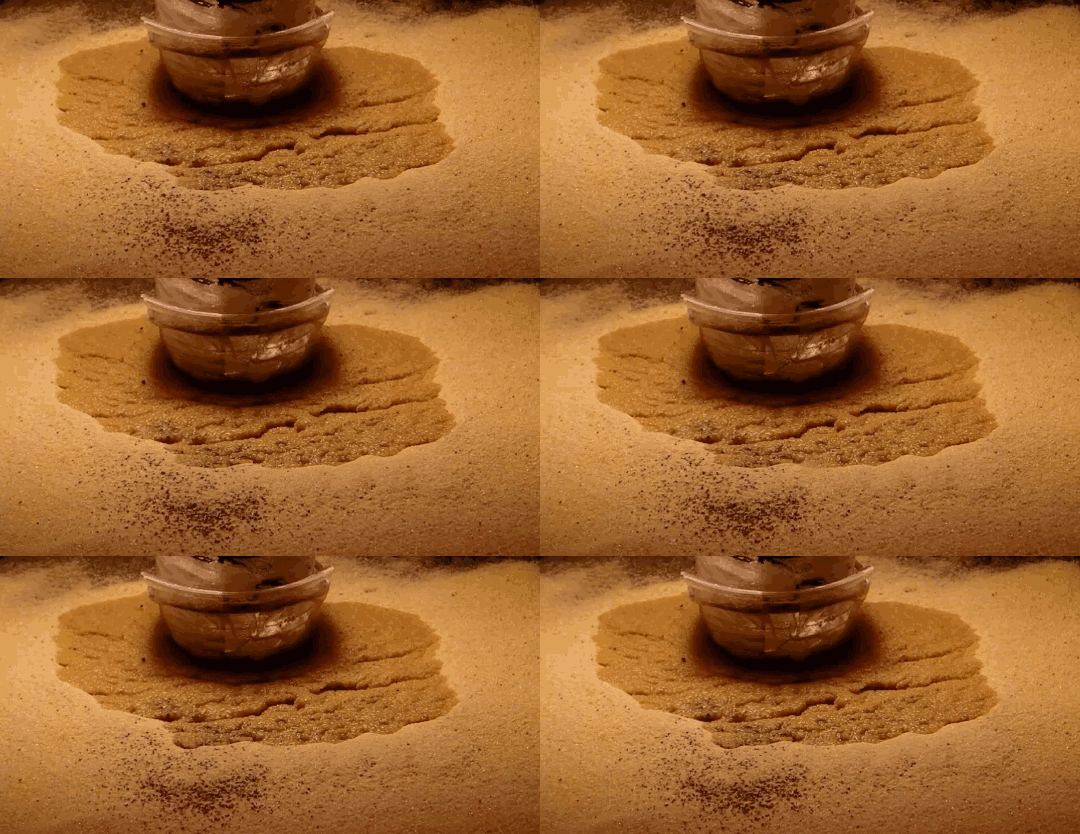
    Since its flyby last summer, NASA’s New Horizons mission has had planetary scientists questioning all our assumptions about Pluto and its fellow cold, icy worlds on the outskirts of the solar system. The two mountainous features above, the 4-km tall Wright Mons and 5.6-km tall Piccard Mons, are part of the mystery. Both mountains have a large depression in the middle, and their appearance from orbit is consistent with volcanoes seen on Earth and other planets. But instead of rock, these mountains are formed from water ice, and rather than spewing hot magma, it’s believed that these mountains are cryovolcanoes that erupt with a slurry of water, nitrogen, ammonia, or methane. Since no active eruptions were recorded during the flyby, scientists cannot be certain of the hypothesis, but it does explain the observed features. Check out the video below for a terrestrial demonstration of a “cryovolcano”. (Photo credits: NASA/JHU APL/SwRI; video credit: A. Cheri/U. Wash)

    Join FYFD all this week for a look at the fluid dynamics and planetary science of Pluto!

  • Barchan Dunes

    Barchan Dunes

    The winds of Mars create sand dunes that seem to flow like a liquid across the planet’s surface. Here the wind blows from right to left around the flat top mesas on the right side of the image. The dark, arc-shaped dunes formed in the wake of the mesas are called barchans and can move downstream remarkably intact, even able to cross paths with other dunes. (Photo credit: MRO, NASA; via APOD)