Tag: planetary science

  • Inside a Super-Earth

    Inside a Super-Earth

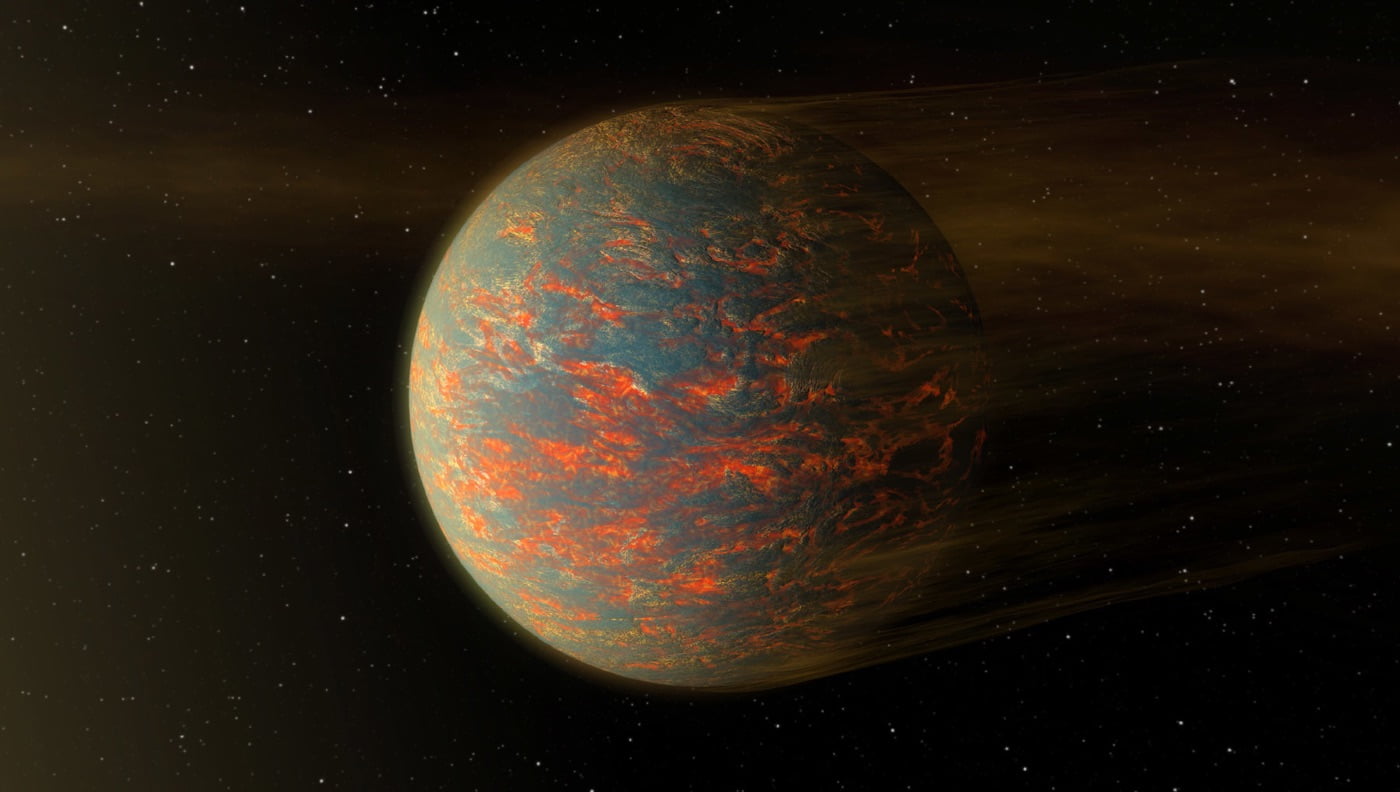
    When studying exoplanets, scientists often judge habitability by the possibility of liquid water on the planet’s surface. But there is more to Earth’s habitability than water. The liquid iron dynamo within our planet is critical for life here because it generates magnetic fields that protect the planet from harmful solar radiation. It’s been difficult to predict what the interiors of a bigger and more massive planet like a super-Earth would look like, but a recent study changes that.

    Researchers at the National Ignition Facility used its high-powered lasers to subject liquid iron to conditions similar to those expected in a super-Earth’s core, including pressures as high as ~1000 GPa. That’s more than 3 times higher than pressures at the boundary where Earth’s liquid iron meets its solid core. Based on their findings, the team concluded that super-Earths likely have a similar interior structure to our planet, with a solid iron-heavy core surrounded by churning liquid iron capable of generating a protective magnetosphere. (Image credit: NASA; research credit: R. Kraus et al.; via Science)

  • Jovian Circulation

    Jovian Circulation

    Jupiter‘s atmosphere remains quite mysterious, due to our limited ability to measure the depths of the gas giant’s clouds. But measurements from the Juno spacecraft are continuing to shape researchers’ understanding of our massive neighbor. By tracking ammonia distributions in Jupiter’s belts and zones, a team has found a series of circulation cells similar to the Ferrel cells of Earth’s midlatitudes.

    Unlike the stronger Hadley cells and polar cells, Earth’s Ferrel cells are relatively weak. They’re driven by turbulence and the motion of the circulation cells to the north and south. The Northern and Southern hemispheres each have one Ferrel cell. In contrast, Jupiter — with its larger size and higher rotation rate — boasts eight Ferrel-like cells in each hemisphere! (Image and research credit: K. Duer et al.; via Universe Today; submitted by Kam-Yung Soh)

  • Probing Saturn’s Interior

    Probing Saturn’s Interior

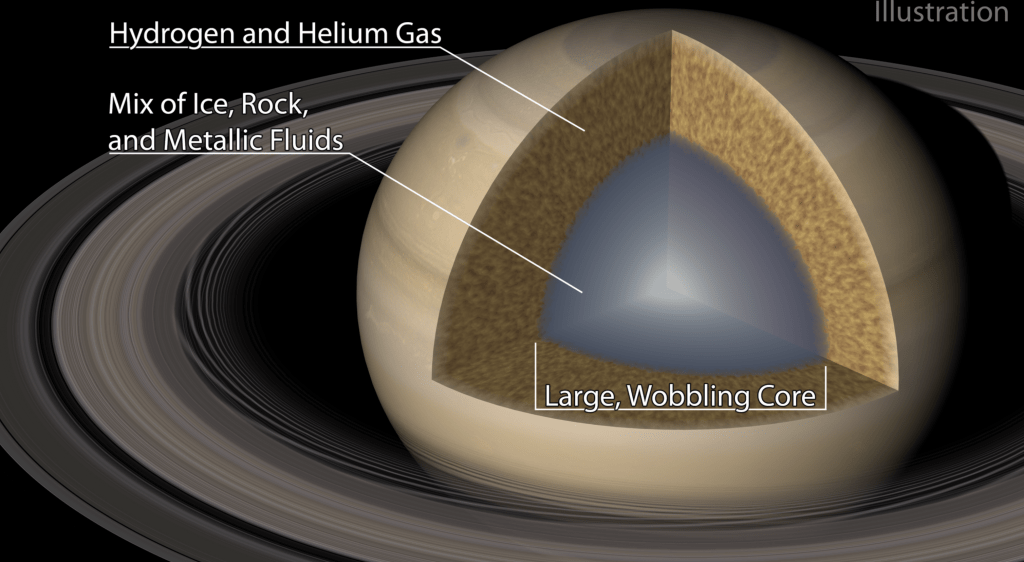
    Saturn’s rings are one of the most iconic sights in our solar system, and scientists are using them to learn more about the planet they surround. Until recently, scientists believed that gas giants like Saturn and Jupiter have dense, rocky cores buried beneath their gassy atmospheres. But a new study of Saturn’s rings suggests that Saturn’s core is far larger and more fluid than assumed.

    When the interior of Saturn wobbles, it causes gravitational shifts that affect the material making up its rings. By studying disturbances in the ring system — a technique known as ring seismology — researchers can deduce what motions took place inside the planet to cause the changes in the rings.

    Using data from the Cassini spacecraft, the authors determined that Saturn’s core likely spreads to nearly 60% of its radius, and, rather than being dense and rocky, the core is a relatively fluid mixture of ice, rock, and metallic fluids. The core diffuses gradually into the gaseous atmosphere, and it’s stably stratified against convection, so its wobbles are quite small for the planet’s size. (Image credit: rings – NASA; illustration – Caltech/R. Hurt; research credit: C. Mankovich and J. Fuller; via Gizmodo)

    Illustration of Saturn's interior showing a large, wobbly core composed of a mixture of ice, rock and metallic fluid.
  • Jupiter in Many Lights

    Jupiter in Many Lights

    Sometimes the key to unraveling a mystery is to observe the phenomenon in different ways. That’s why researchers are increasingly taking advantage of multiple instruments simultaneously observing targets like Jupiter. Here we see the gas giant in three different types of light: infrared, visible, and ultraviolet. Infrared bands reveal the hot and cold regions of Jupiter’s clouds, allowing scientists to identify convective areas. Ultraviolet observations can reveal high-energy processes, like Jupiter’s auroras. And the colors revealed in visible light can give hints about chemical make-up in different regions. But to get a fuller picture, scientists compare all three modes — along with radio signal data from Juno — to understand topics like the planet’s lightning-filled storms. (Image credits: International Gemini Observatory/NOIRLab/NSF/AURA/NASA/ESA, M.H. Wong and I. de Pater (UC Berkeley) et al.; via Gizmodo)

  • Ingenuity’s Dust Cloud

    Ingenuity’s Dust Cloud

    Mars is quite dusty. It periodically gets swallowed by planet-spanning dust storms, but it’s also home to regular dust devils whose size can put Earth’s to shame. Exactly how so much dust gets picked up by Mars’ incredibly thin atmosphere — only 1% of Earth’s — is still something of a mystery. So scientists were excited after the Ingenuity helicopter’s fourth flight, where cameras on the Perseverance rover caught a billowing dust cloud following Ingenuity as it flew. Knowing how the helicopter flies, they may be able to unravel just how its wake picks up and carries dust. Since Ingenuity’s only purpose was to demonstrate flight on another planet, this would be a big scientific bonus for an already successful mission! (Image credit: NASA/JPL-Caltech/ASU/MSSS/SSI; via Nature; submitted by Kam-Yung Soh and jpshoer)

  • The Variable Venusian Day

    The Variable Venusian Day

    Venus is a thoroughly unpleasant place thanks to its hellish temperatures and acidic clouds, but a new study adds another wrinkle to our strange sister planet: Venus’s day varies by up to 21 minutes in length. This peculiar factoid is the result of 15 years spent monitoring Venus’s rotation via radar. Previous attempts to pin down the exact length of Venus’s day produced differing answers; those disagreements make more sense in light of the new study, where individuals measurements of Venus’s rotation rate could differ by 3 minutes just from one (Earth) day to the next!

    So why does Venus’s rotation rate change so dramatically? Venus’s atmosphere is massive — 100 times more massive than Earth’s — and it spins incredibly fast. The upper layers of Venus’s atmosphere can complete a rotation in 4 Earth days, while the solid ground requires 243 Earth days. As the atmosphere spins and sloshes, some of its angular momentum gets transferred to the ground, changing the planet’s rotation rate. (Image credit: NASA/JPL-Caltech; research credit: J. Margot et al.; via AGU Eos; submitted by Kam-Yung Soh)

  • Featured Video Play Icon

    Ferrovolcanism

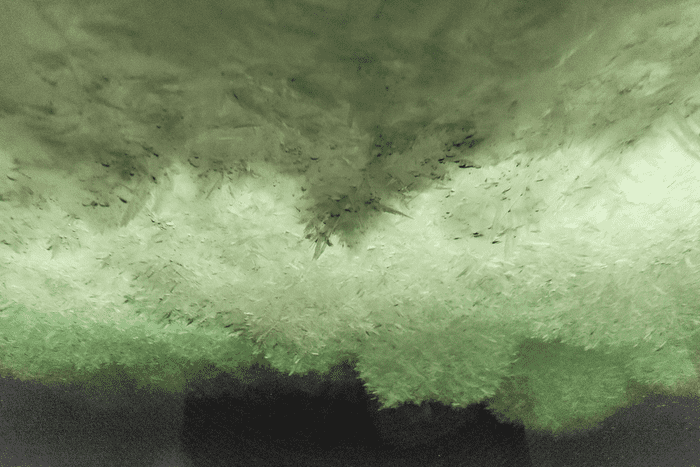
    Beyond Earth, scientists expect to find objects formed by a volcanism much different than what we typically see here. Researchers used Syracuse University’s Lava Project apparatus to simulate ferrovolcanism — in this case with a mixture containing both metallic lava and silicate lava. Interestingly, the team found that the two types of lava flow largely independently of one another. The silicate lava is much more viscous but less dense and flows relatively slowly. The metallic lava is far less viscous and flows about 10 times faster, but it’s also denser, so most of it flows beneath the silicate lava, with only a few fingers that burst out atop the other lava or erupt in braided flows from the leading edge of the flow.

    The upcoming Psyche mission will explore a metal asteroid (of the same name) that’s thought to be the remains of an early planet’s nickel-iron core. Studies like this one are giving planetary physicists new insight into the kinds of geological features await us there. (Video and research credit: A. Soldati et al.; via AGU Eos; submitted by Kam-Yung Soh)

  • Blue Dunes

    Blue Dunes

    This false-color image shows a Martian dune field near the northern polar cap. The image itself covers an area 30 kilometers wide, but the dune field stretches over an area the size of Texas. In the photo cooler areas have been rendered in bluer tints, while warm areas are shown in yellow and orange. The sun warms the wind-sculpted dunes more than in the valleys that lie between. Complex dune networks like these build up over time as consistent winds push sand and create interactions between individual dunes. (Image credit: NASA/JPL-Caltech/ASU; via Colossal)

  • Rainfall Beyond Earth

    Rainfall Beyond Earth

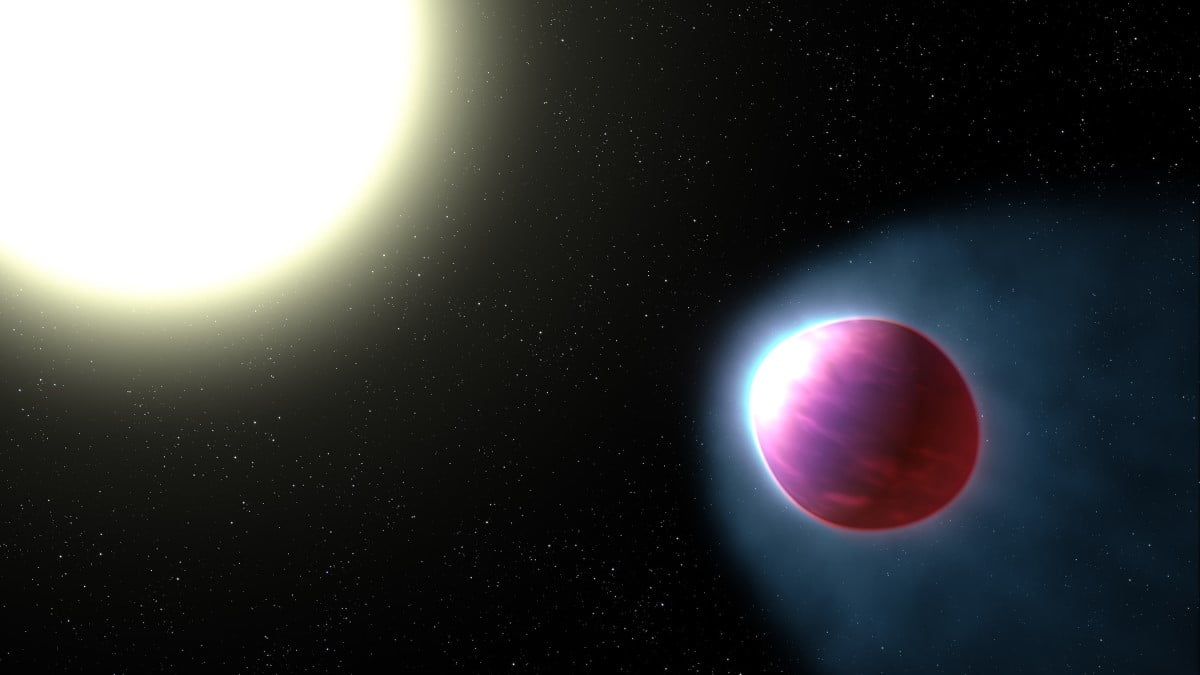
    Rain is not unique to our planet: Titan has methane rain and exoplanet WASP 78b is home to iron rain (ouch). A new study examines rainfall across planets from the perspective of individual rain drops. The authors examine raindrop shape, terminal velocity, and evaporation rate as a function of droplet size for a wide range of known and speculated atmospheres.

    They found that raindrops are surprisingly universal. Although planets with higher gravity tend to produce smaller raindrops, they found a remarkably narrow range for maximum drop size. That’s a pretty wild result, all things considered! The idea that iron, ammonia, methane, and countless other fluids falling through vastly different atmospheres all share very common characteristics is fascinating. (Image credit: NASA/JPL-Caltech/SwRI/MSSS/Brian Swift; research credit: K. Loftus and R. Wordsworth; via Science News; submitted by Kam-Yung Soh)

  • Jovian Auroras

    Jovian Auroras

    Like Earth, Jupiter is home to polar auroras that light the sky as charged particles interact with the planet’s magnetosphere. A recent paper identifies interesting features in the aurora that appear similar to expanding vortex rings (see inset below). Although the researchers cannot yet identify the origin of the rings, they hypothesize that the process begins at the far edges of Jupiter’s magnetosphere where it interacts with the incoming solar wind. One theory posits that shear flows and Kelvin-Helmholtz instabilities where the magnetosphere and solar wind meet drive the phenomenon. (Image credit: Jupiter – NASA, ESA, and J. Nichols, aurora features – NASA/SWRI/JPL-Caltech/SwRI/V. Hue/G. R. Gladstone/B. Bonfond; research credit: V. Hue et al.; via Gizmodo)

    Diagram showing an inset of Jupiter's northern aurora, with further insets showing the expanding ring features.