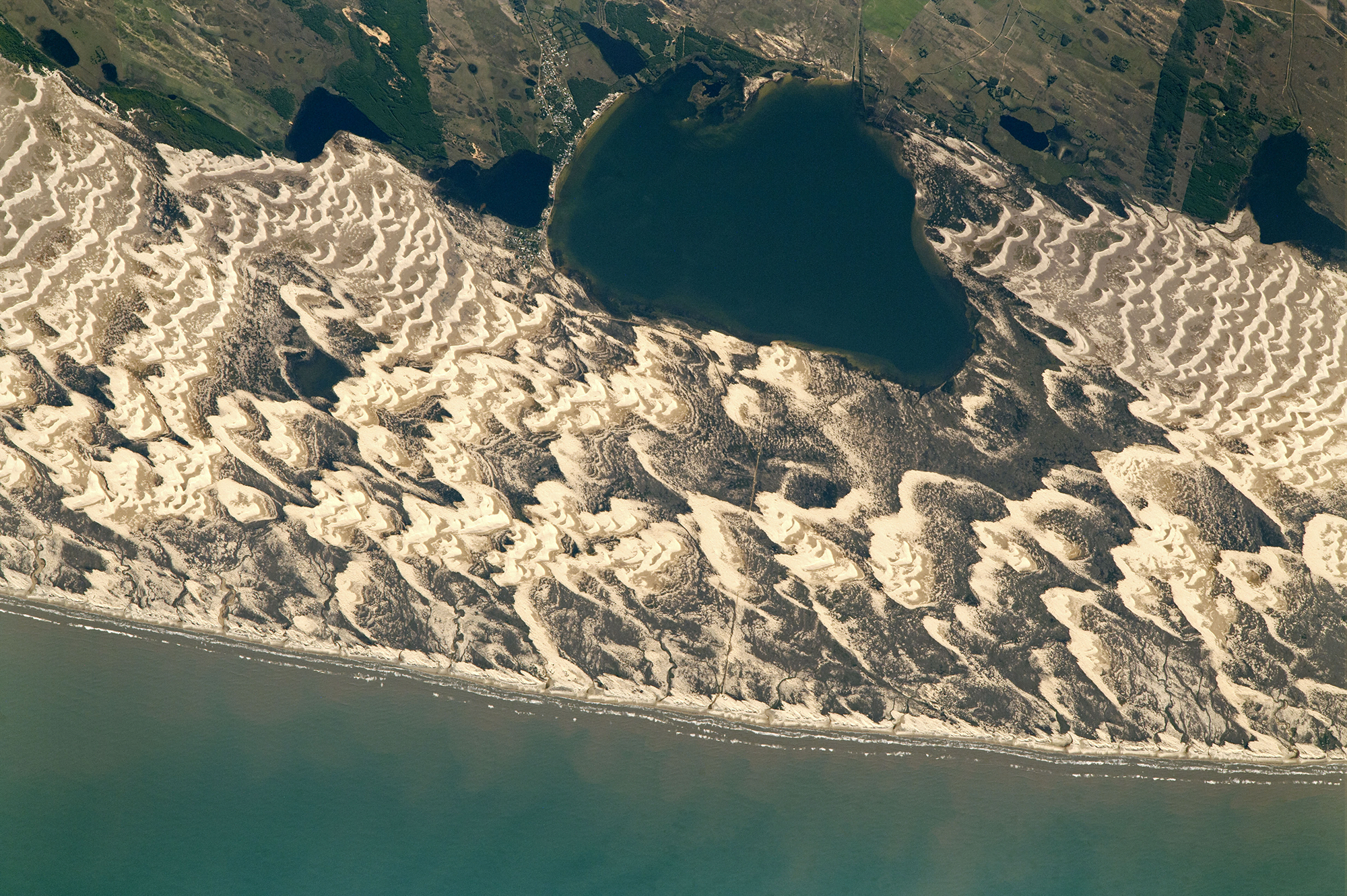
Barchan dunes collide in this astronaut image of Brazil’s southern coastline. Barchan (pronounced “bar-kahn”) dunes are crescent-shaped; their tips point downwind into their direction of travel. When many barchan dunes overlap, they coalesce into a dune field like the one seen here. A dune’s speed depends on many factors, including the wind speed, dune size, and its proximity to other dunes. In experiments, dunes have even chased one another and changed speeds to avoid collision. (Image credit: NASA; via NASA Earth Observatory)
Tag: planetary science

Changing Climes on Mars
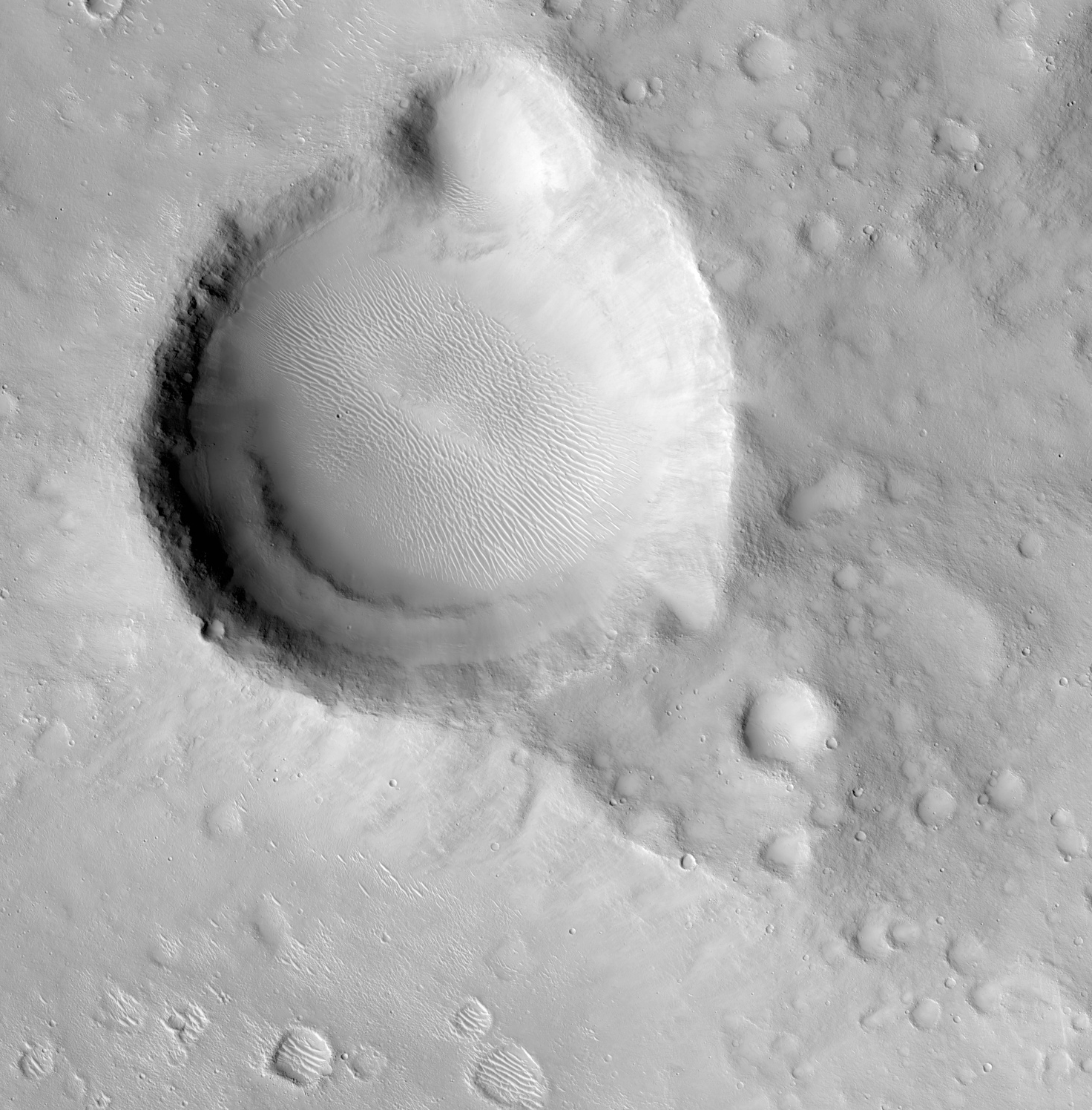
China’s Zhurong rover explored Utopia Planitia on Mars from May 2021 to December 2022. During that expedition, the rover uncovered evidence of a major shift in climate that took place some 400,000 years ago. Originally, the area was covered in crescent-shaped barchan dunes formed by winds from the northeast. But after Mars exited its last ice age — courtesy of a shift in its rotational axis — the winds shifted around 70 degrees, coming from the northwest. Those shifted winds eroded the barchan dunes and caused new transverse ridges to form atop them. (Image credit: NASA/JPL-Caltech/UArizona; research credit: J. Liu et al.; via Gizmodo)

Uranus’s Polar Cyclone
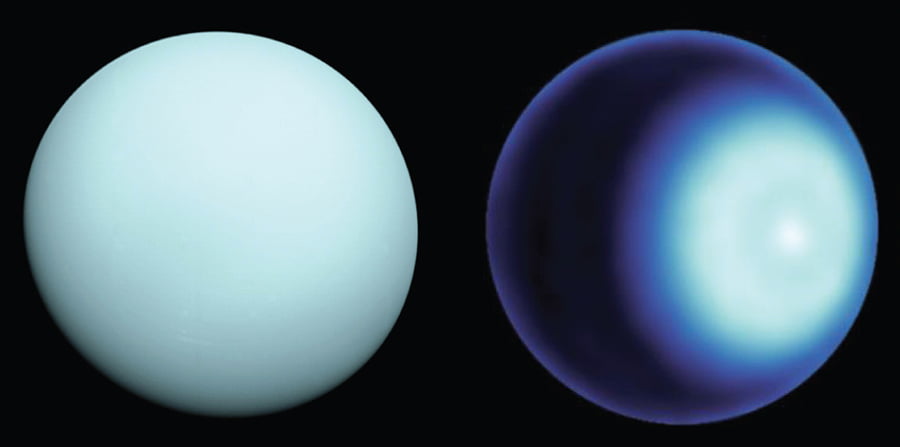
Uranus is an oddity among the planets of our solar system. Where other planets spin around an axis roughly in line with their orbital axis, Uranus spins on its side, placing its poles in line with the sun. On Earth, the polar regions are naturally colder the equator, but that doesn’t hold true for Uranus. Yet new observations of the ice giant show that it, like the other planets with atmospheres in our solar system, has a polar cyclone.
Those observations are thanks to improvements in radio astronomy over the past couple decades. Uranus’s odd orbital geometry means that each of its poles are hidden from Earth for 42 years at a time; the current northern-hemisphere spring marks our first view of Uranus’s northern pole since 1965. In the recent observations, researchers saw a bright spot on the pole, surrounded by a faint darker ring. The team modeled the temperature and gas composition necessary to match their observations and found that those patterns were consistent with a cyclone sitting at the northern pole. (Image credit: NASA/JPL-Caltech/VLA; research credit: A. Akins et al.; via Physics Today)

Jovian Swirls
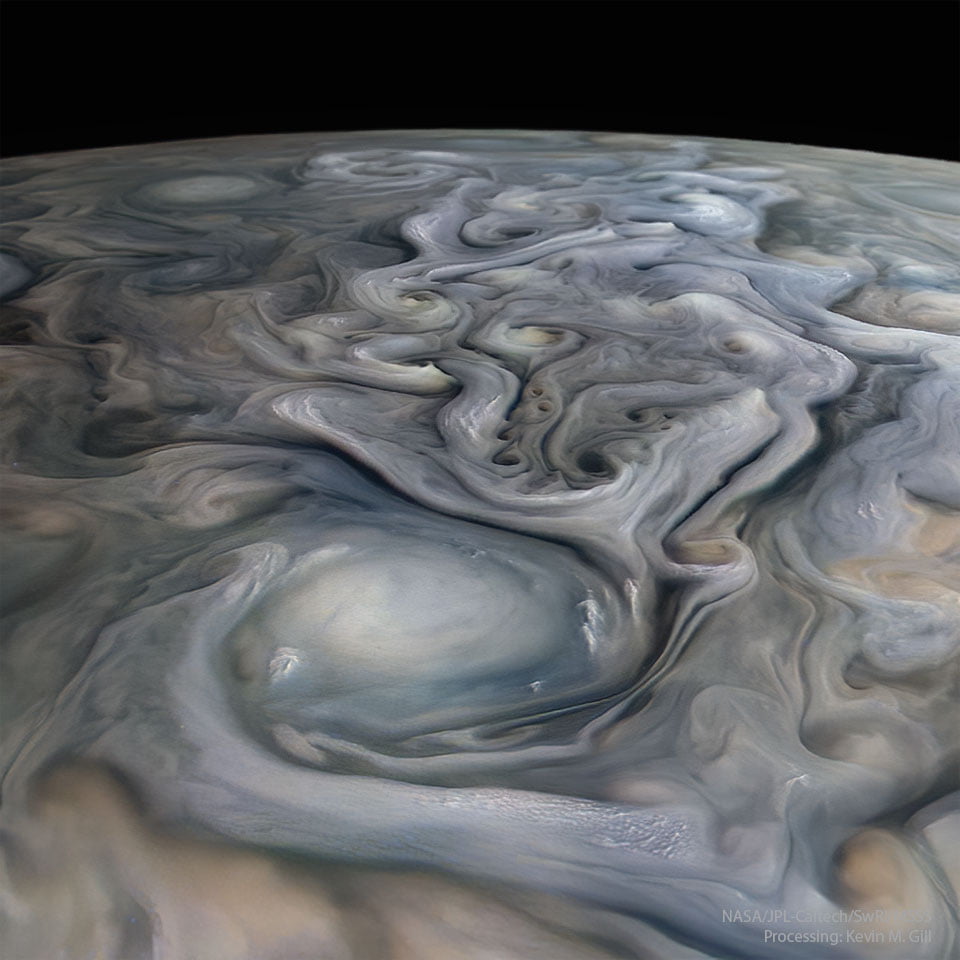
Jupiter, our solar system’s stormiest planet, shares many similarities with Earth. But where Earth’s strongest storms are cyclones centered on low-pressure regions, Jupiter’s longest and strongest storms are anti-cyclones, driven by areas of high pressure. They’re often massive — larger than the entire Earth — and persist for weeks, months, or years. This processed image comes from the JunoCam instrument and shows some of the incredible cloud structure in Jupiter’s atmosphere. Jupiter’s highest altitude clouds tend to be the lightest, while darker clouds remain lower. (Image credit: NASA/JPL-Caltech/SwRI/MSSS/K. Gill; via APOD)

Fast-Moving Martian Rivers
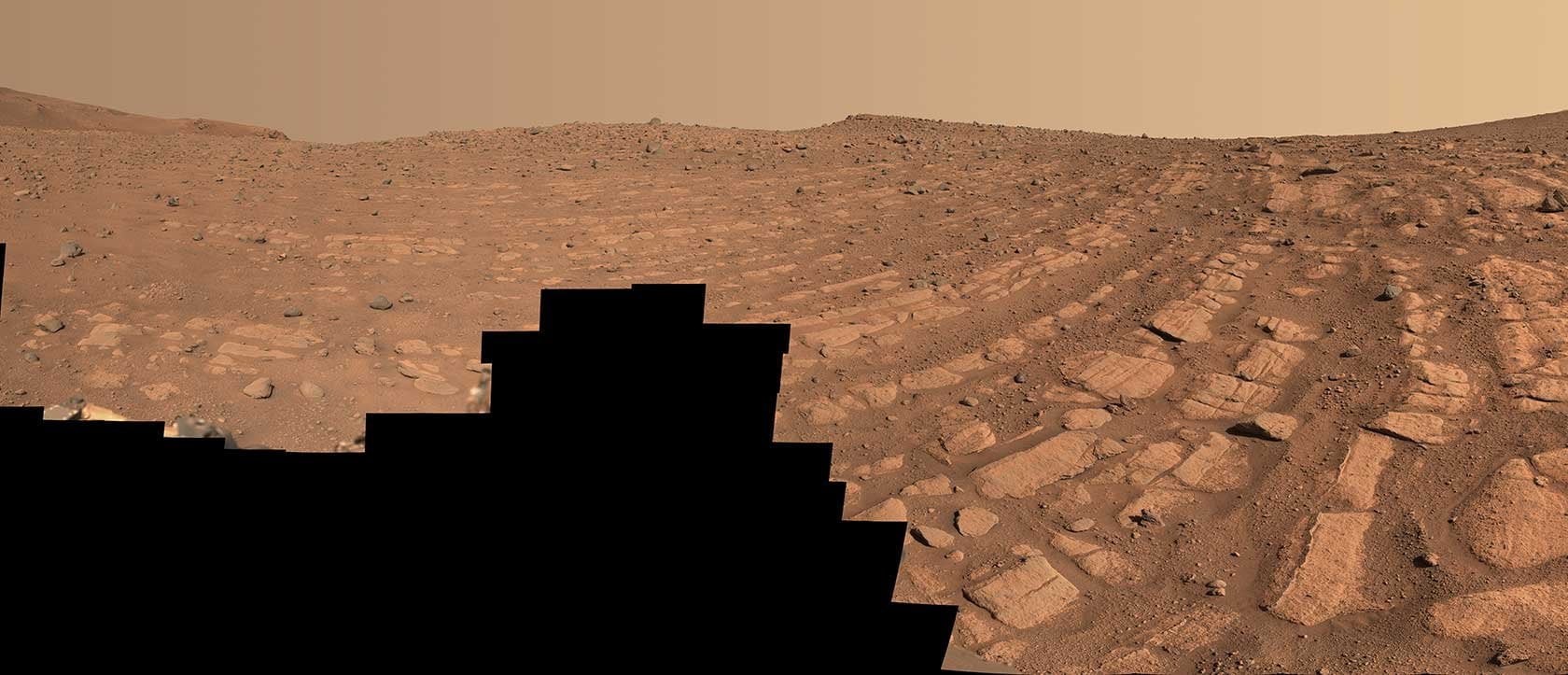
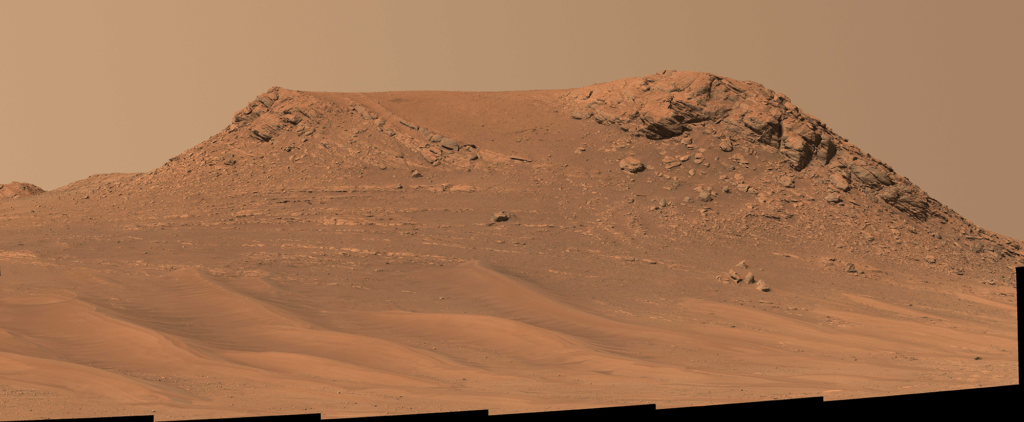
For the first time, scientists have found evidence of deep, fast-flowing ancient rivers on Mars. After examining images taken recently by the Perseverance rover in Jezero Crater, fluvial experts have spotted familiar signs of turbulent river flow. The mosaic above shows an area nicknamed “Shrinkle Haven,” where curved bands of rock mark the landscape. Although scientists are confident that a powerful river deposited these rocks, they’re still debating whether that river was a meandering one like the Mississippi or a braided river like the Platte.

Nicknamed “Pinestand,” this hill’s sedimentary layers were likely formed by a deep, fast-moving river. In another area, known as “Pinestand,” scientists spotted hills as high as 20 meters tall with clear sedimentary layers. Like Shrinkle Haven’s rock bands, formations like this are most often associated with a large, fast-flowing river. (Image credits: NASA/JPL-Caltech/ASU/MSSS; via Gizmodo; see also NASA JPL)

“Elements”
Photographer Mikko Lagerstedt specializes in Nordic landscapes, like the windswept snow seen here. I love the way he’s captured the snow that gets picked up and blown by the wind. Notice the hazy layer of snow hovering over the foreground. This snow is saltating, just as sand does in the desert. When flakes get picked up by the wind, they follow a ballistic trajectory, much like a cannonball in a high-school physics class. As the snow crashes back down, its impact knocks up more flakes, and the process continues. Repeat enough times, and you’ll see this hazy layer of blowing snow blanketing a snowscape. (Image credit: M. Lagerstedt; via Colossal)

Founts of Enceladus
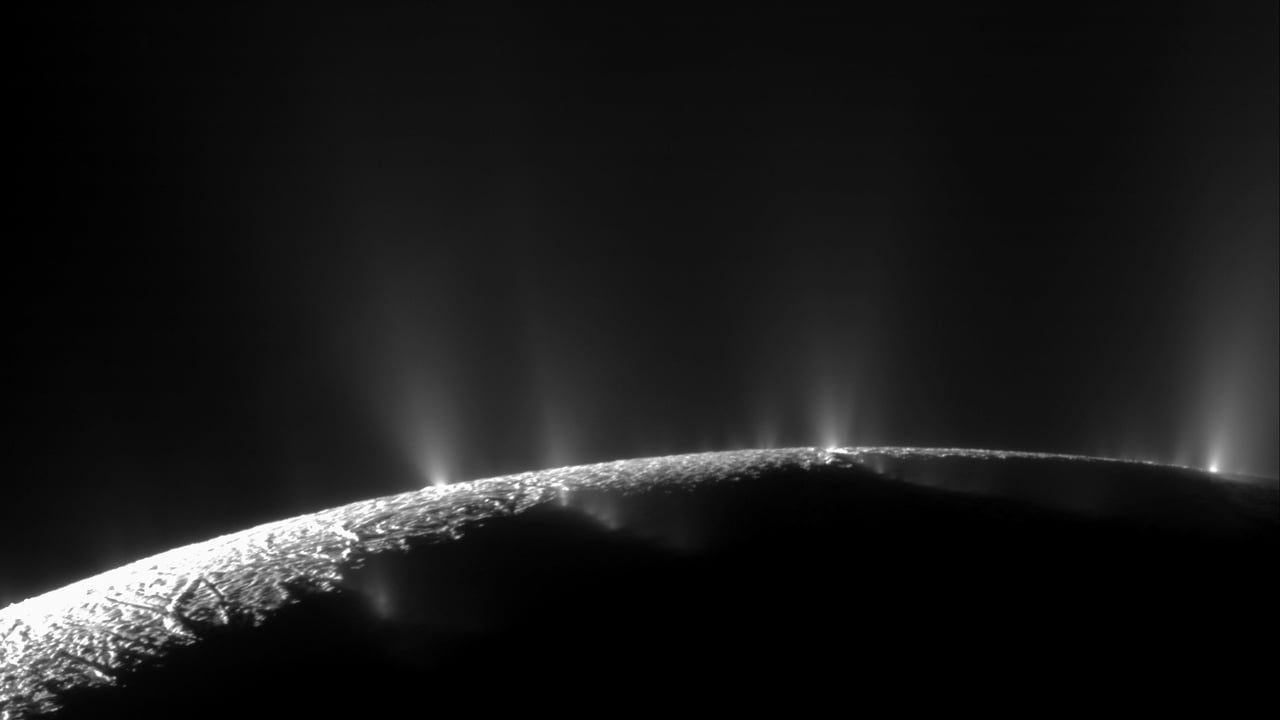
In its exploration of Saturn, Cassini discovered that the moon Enceladus is home to icy eruptions. Beneath its shell of ice, Enceladus has a global ocean of salty liquid water. The average thickness of the ice is 20 kilometers, putting the ocean seemingly out of reach — except at the moon’s southern pole, where icy plumes of ocean water jet out.
Here, where the ice is thinnest, the tidal forces Enceladus experiences from Saturn and its fellow moon Dione break through the ice. As the cracks open and close, liquid from the ocean sprays out, freezing into plumes that Cassini measured. Plans are underway for new missions that prioritize further sampling of Enceladus’ ocean. For now, we can only imagine what hides in its interior ocean. (Image credit: NASA/JPL-Caltech/SSI; for more, see M. Manga and M. Rudolph)

Rippling Airglow
Though we rarely notice it, our sky is always aglow. Washed in solar radiation, the oxygen and nitrogen molecules at high altitude get broken apart during the daytime and recombine at night, producing a luminescent glow that forms a uniform backdrop against the sky. In this image, the airglow forms a bull’s-eye-like set of rings, thanks to atmospheric gravity waves left behind by a thunderstorm. (Image credit: J. Dai; via APOD)

Listen to a Martian Dust Devil
A lucky encounter led the Perseverance rover to record the first-ever sound of a dust devil on Mars. The rover happened to have its microphone on (something that only happens a few minutes every month) just as a dust devil swept directly over the rover. Check out the video above to see and hear what Perseverance captured.
Using the rover’s instrumentation, researchers worked out that the dust devil was at least 118 meters tall and about 25 meters wide. The team was even able to determine the density of dust in the vortex from the sound of individual grain impacts captured in the acoustic signal! Serendipitous as the experience was, planetary scientists may now look to include microphones on more missions, since we now know how to get useful meteorological data from them. (Video credit: JPL-Caltech/NASA; image credit: LPL/NASA; research credit: N. Murdoch et al.; via AGU Eos; submitted by Kam-Yung Soh)
Snowing in the Core


Some rocky planetary bodies, like Jupiter‘s moon Ganymede, generate magnetic fields through snow-like, solid precipitation that falls in their liquid metal cores. To study this peculiar and complex arrangement, researchers look at sugar grains falling through — and dissolving into — water. The solid sugar grains mimic the iron snowflakes that fall in Ganymede’s core. As they sink, they drag fluid with them. But the grains can also dissolve, making the fluid around them denser and prone to sinking even faster. The dense, sinking flows trigger buoyant convection inside the surrounding fluid.
As seen in the experiments, there are many factors competing here. Large grains dissolve more slowly and are able to drag more fluid with them as they fall. Small grains, on the other hand, dissolve quickly, causing more buoyancy-driven flows. Laboratory analogs like these help scientists unravel the complexities of situations we cannot observe otherwise. (Image and video credit: Q. Kriaa et al.)