Although researchers have identified thousands of exoplanets in the last 25 years, most of them are far larger and far hotter than Earth. But a team recently announced the discovery of a temperate neighbor, Gliese 12 b, some 40 light years away. Gliese 12 b is a rocky Venus-sized planet orbiting the cool red dwarf star Gliese 12. Based on the star’s energy output and the planet’s characteristics, the team estimate its equilibrium temperature — about how hot it would be without an atmosphere — as 42 degrees Celsius. (For comparison, Earth’s average surface temperature is 15 degrees Celsius and rising.) The next goal will be to determine whether Gliese 12 b has an atmosphere and, if so, what it’s made up of. (Image credit: NASA/JPL-Caltech/R. Hurt; research credit: S. Dholakia et al.; via Gizmodo)
Tag: planetary science

Junggar Basin Aglow
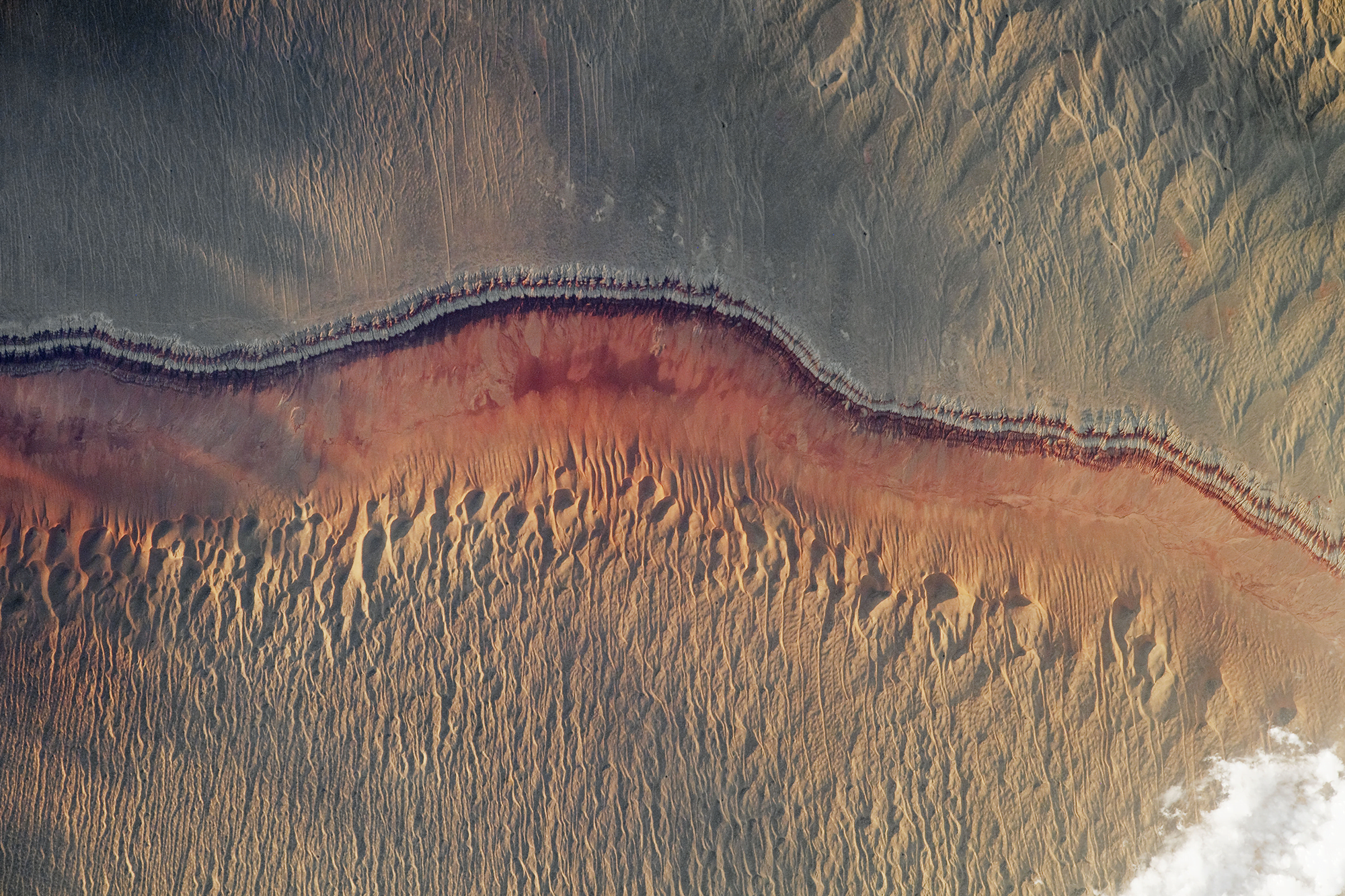
The low sun angle in this astronaut photo of Junggar Basin shows off the wind- and water-carved landscape. Located in northwestern China, this region is covered in dune fields, appearing along the top and bottom of the image. The uplifted area in the top half of the image is separated by sedimentary layers that lie above the reddish stripe in the center of the photo. Look closely in this middle area, and you’ll find the meandering banks of an ephemeral stream. Then the landscape transitions back into sandy wind-shaped dunes. (Image credit: NASA; via NASA Earth Observatory)

Venusian Lava Flows
Venus is often known as Earth’s twin, given its similar size and proximity. But, thanks to its runaway greenhouse effect, Venus is a hellish landscape buried beneath a hot atmosphere of carbon dioxide and sulfuric acid. Unlike Earth, Venus is not tectonically active, though it does have active volcanoes. A recent study re-examined synthetic aperture radar data from the Magellan spacecraft mission in the early 1990s and found that the data contained evidence of fresh lava flows.
The team found two areas near volcanoes where the surface backscatter changed significantly between orbital observations. After examining many possible explanations for the changes, the team concluded that the differences were most likely due to new lava. They even performed the same analysis for a volcanic field here on Earth between known lava flows and observed the same behavior. Combined with another recent study that found evidence of volcanic activity in Magellan data, signs are pointing toward Venus being about as volcanically active as our own planet, even if the mechanisms driving the volcanism differ. (Image credit: NASA/JPL-Caltech; research credit: D. Sulcanese et al.; via Gizmodo)

Rocky Exoplanet With an Atmosphere
In the past few decades, the number of exoplanets we’ve found has ballooned to over 5,000, but most of these worlds are gas giants closer to Jupiter than our rocky Earth. But a recent study has turned up evidence of a rocky exoplanet that, like Earth, has an atmosphere made up of more than hydrogen.
By combining observations from the JWST with those from other telescopes, the team found that 55 Cancri e — an exoplanet nearly 9 times more massive than Earth in a system about 41 light years from us — probably has an atmosphere made up of carbon dioxide or carbon monoxide. 55 Cancri e is still a planet extremely unlike our own, though; it’s tidally locked to its star so that one side always faces the star, and its equilibrium temperature is an estimated 2000 Kelvin. That’s actually a lower temperature than expected, indicating that an atmosphere is helping distribute heat around the planet. Based on the JWST measurements, the researchers suggest that the planet’s volatile atmosphere could be supported by outgassing from a magma ocean. (Image credit: NASA/ESA/CSA/R. Crawford; research credit: R. Hu et al.; via Gizmodo)

How Venus Is Losing Its Water
Since Venus formed at the same time as Earth and is similar in size, scientists believe it once had the same amount of water our planet does. Today, hellish Venus has hardly any water, a fact scientists have struggled to explain completely. Most of its water was lost long ago, as incoming particles from the solar wind stripped water from the upper atmosphere; unlike Earth, Venus doesn’t enjoy the protection of a magnetic field.
But that mechanism doesn’t explain just how arid Venus is now. A new study instead suggests that Venus’s water loss is ongoing, driven by simple chemical reactions. The team found that molecules of HCO+ (an ion made from one hydrogen, one carbon, and one oxygen atom) could mix with any remaining water to form a positively-charged molecule. Due to that charge, the chemical easily attracts loose electrons. Once combined, however, the resulting molecule is too energetic and breaks apart; when it does so, it releases highly-energetic hydrogen, which escapes the atmosphere into space. Without that hydrogen, water molecules can’t reform. This process of dissociative recombination could explain why the rest of Venus’s water has disappeared.
Science missions that have flown to Venus so far haven’t been equipped to measure HCO+, and the authors recommend this as a priority for future missions to our neighbor. With that data, we could confirm or disprove this mechanism for Venusian water loss. (Image credit: NASA; research credit: M. Chaffin et al.; via Gizmodo)

The Unusual Auroras of Mars
Earth, Saturn, and Jupiter have auroras at their poles, generated by the interaction of their global magnetic fields with the solar wind. Mars has no global magnetic field, only remnants of one frozen into areas of its crust; yet it, too, has auroras. Mars’s auroras are rarer and discrete. They occur most often over the southern hemisphere, and researchers now think they know why.
Four billion years ago, we think Mars had a global magnetic field, much like Earth does. But somehow the planet lost that field. The traces that remain are caught in the minerals of its crust, much like the ancient magnetic fields recorded in areas of the Earth’s sea floor. These magnetized regions of Mars’s crust, shown above as contours in pink and blue, are where the discrete auroras occur.
Using data from NASA’s MAVEN spacecraft, which orbits Mars, the team discovered a pattern. They found that auroras occur most often when the magnetic lines of the incoming solar wind run antiparallel to the magnetic field lines of the crust. This suggests that the auroras happen as a result of magnetic reconnection, a process where antiparallel magnetic field lines rearrange themselves, releasing energy as a result. Reconnection events provide an opportunity for electrons from the solar wind to accelerate into Mars’s atmosphere, exciting molecules there and generating the auroras. So far we’ve only caught the auroras in UV light, but hopefully one day we’ll see them in visible light as well. (Image credit: R. Lillis et al.; research credit: C. Bowers et al. and B. Johnston et al.; via APS Physics)

Reimagining Mars’ Interior
Older models of Mars assumed a liquid metal core beneath a solid mantle of silicates, but recent studies indicate that structure is missing at least one layer. Using data from the InSight lander’s seismometer, two teams independently calculated that a liquid silicate layer must surround the planet’s core. In September 2021, three meteorite pieces impacted Mars far from the InSight lander’s position. Since the Mars Reconnaissance Orbiter could exactly pinpoint the impact location, researchers were able to calculate just how long it took seismic waves from the impact to reach the lander.
Like on Earth, Mars has two varieties of seismic wave: transverse S-waves that only travel through solids and longitudinal P-waves that travel through both liquid and solid layers. S-waves reflect off any liquid-solid boundary, following a different path to a seismometer than P-waves that refract across the boundary and travel through liquid. For more of the story behind this discovery, check out this article at Physics Today. (Image credit: Mars – NASA/JPL-Caltech/University of Arizona, illustration – J. Sieben/J. Keisling; research credit: H. Samuel et al. and A. Khan et al.; via Physics Today)

An illustration of Mars’ interior and the paths followed by seismic waves before InSight picked them up. Fire in Ice
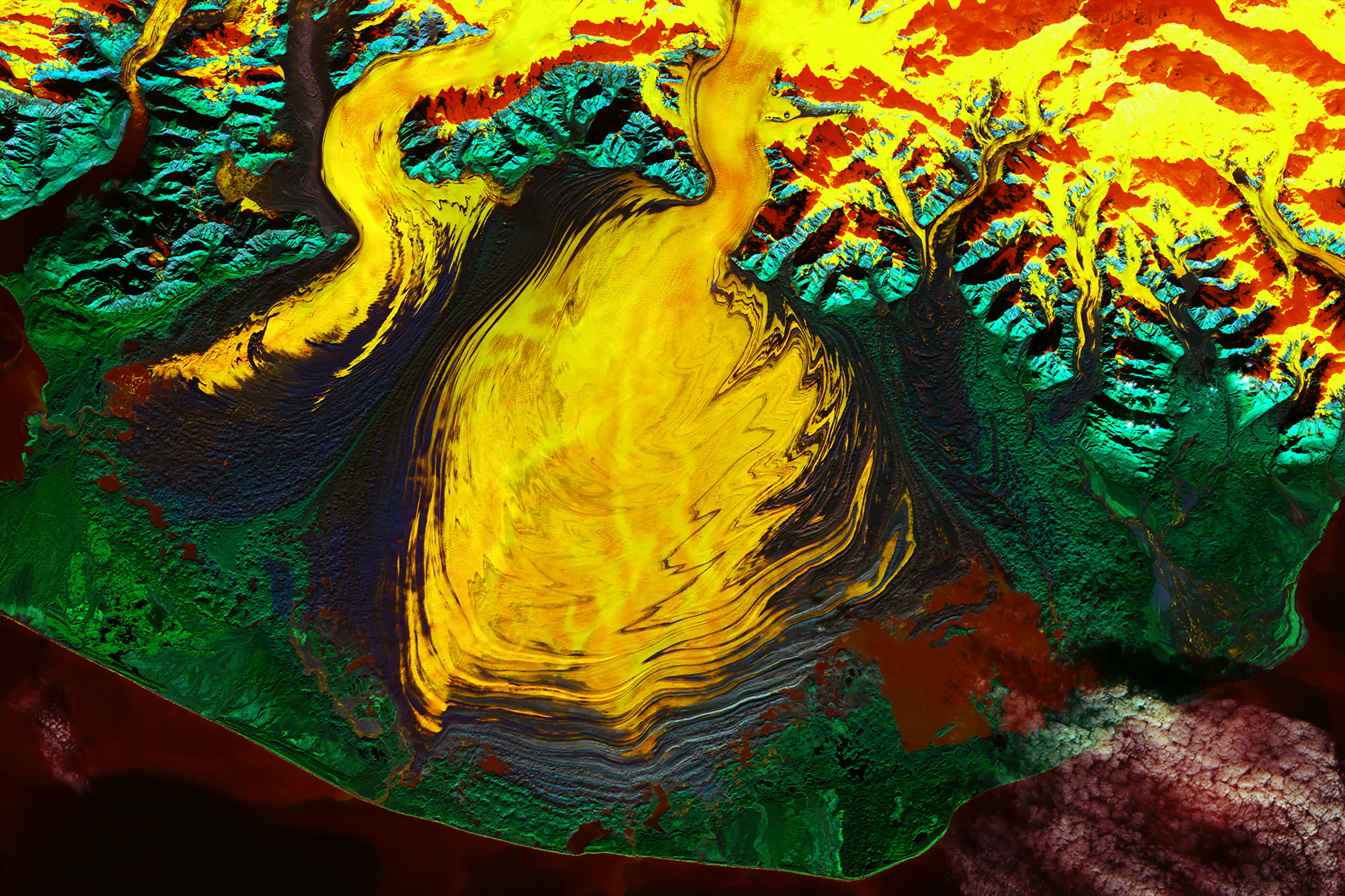
This false-color satellite image of Malaspina Glacier (Sít’ Tlein) is a riot of color. Composed of coastal/aerosol, near infrared, and shortwave infrared bands from Landsat 9, the colors highlight features otherwise hard to identify. Watery features appear in reds, oranges, and yellows; vegetation is green and rock appears in blue. The glacier covers more than 4000 square kilometers, an area larger than the state of Rhode Island. The dark lines atop the glacier are moraines, where rock, soil, and other debris has been scraped up along the glacier’s edge. Over time, changes in the glacier’s velocity cause the moraines to fold and shear, creating the zigzag pattern seen here. (Image credit: W. Liang; via NASA Earth Observatory)

Exoplanet Heating
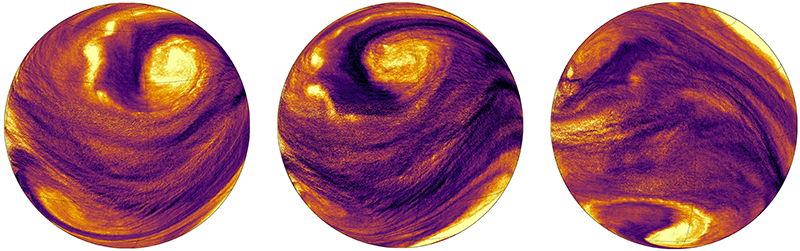
WASP-96B is a tidally-locked exoplanet between the size of Saturn and Jupiter. This hot, massive planet lies close to its star, orbiting in less than three-and-a-half Earth days. A recent study shows that planets like these can have very different weather, depending on what depth their atmosphere absorbs heat at.
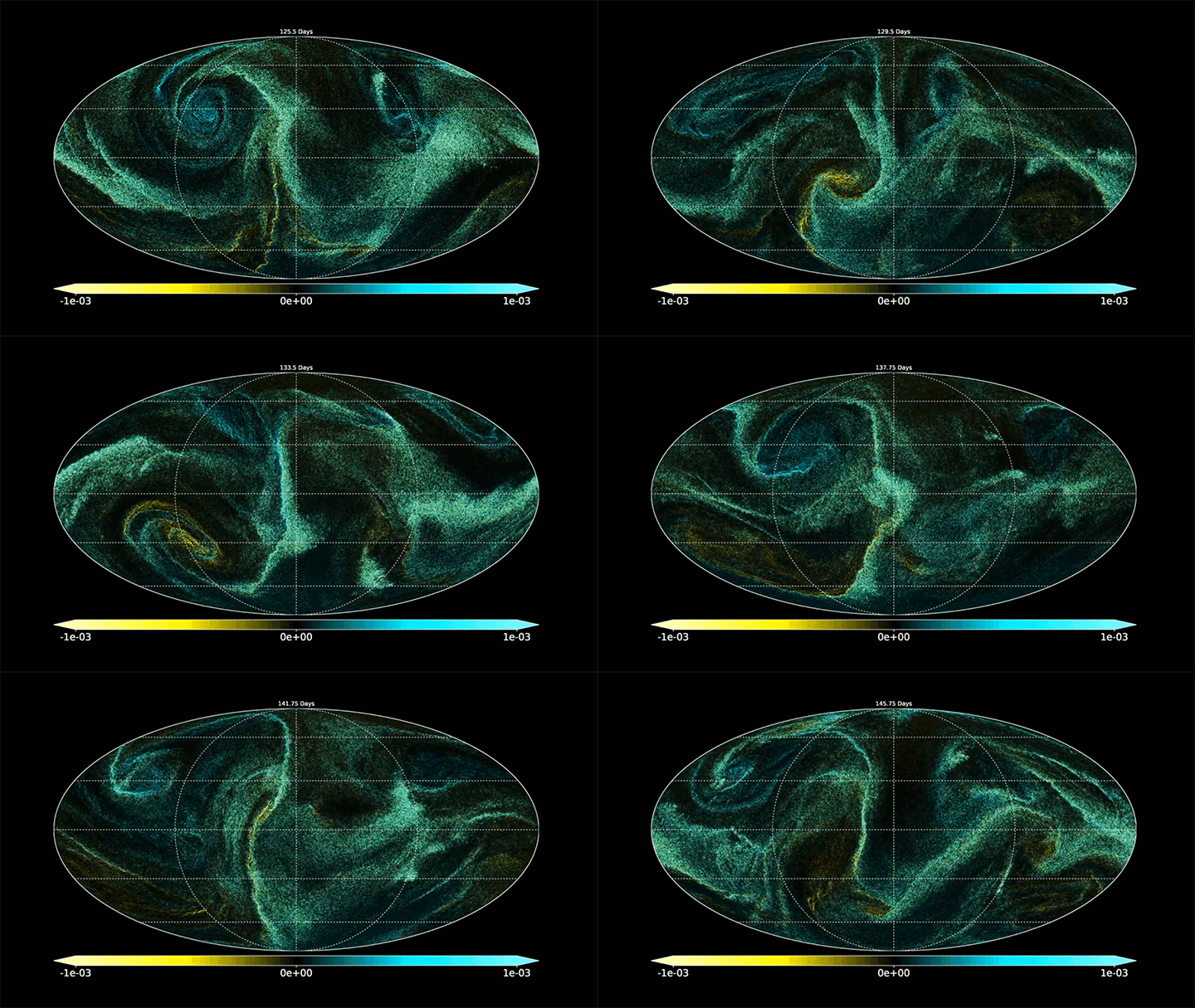
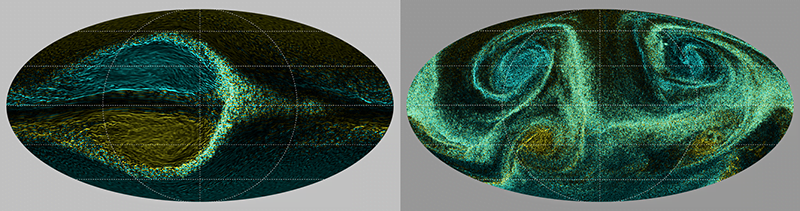
Using numerical simulations, researchers took a detailed look at the possible atmospheric dynamics on this planet. When the atmosphere absorbed heat at a shallow depth — near the outer layers of the planet — a coupled vortex pair formed (left, below). These vortices promenaded westward and completed a circuit around the planet every 11-15 days.

Shallow heating on a hot Jupiter produces a pair of coupled vortices (left), but deeper heating in the atmosphere generates four more-chaotic vortices (right). In contrast, deeper heating produced a more-chaotic pattern of four vortices (right, above) that each lasted 3 to 15 days before disappearing, replaced by a new vortex. This atmosphere, they found, was very turbulent, with smaller-scale vortices as well.
Since each weather pattern is visually distinct and carries its own brightness signature, the authors predict that additional observations of WASP-96b with the current generation of telescopes will show which type of heating dominates on the exoplanet. (Image and research credit: J. Skinner et al.; via APS Physics)

Snapshots from a simulation of a deep-heated hot Jupiter. Each image shows the planet on a different consecutive day. 
Dust Storms
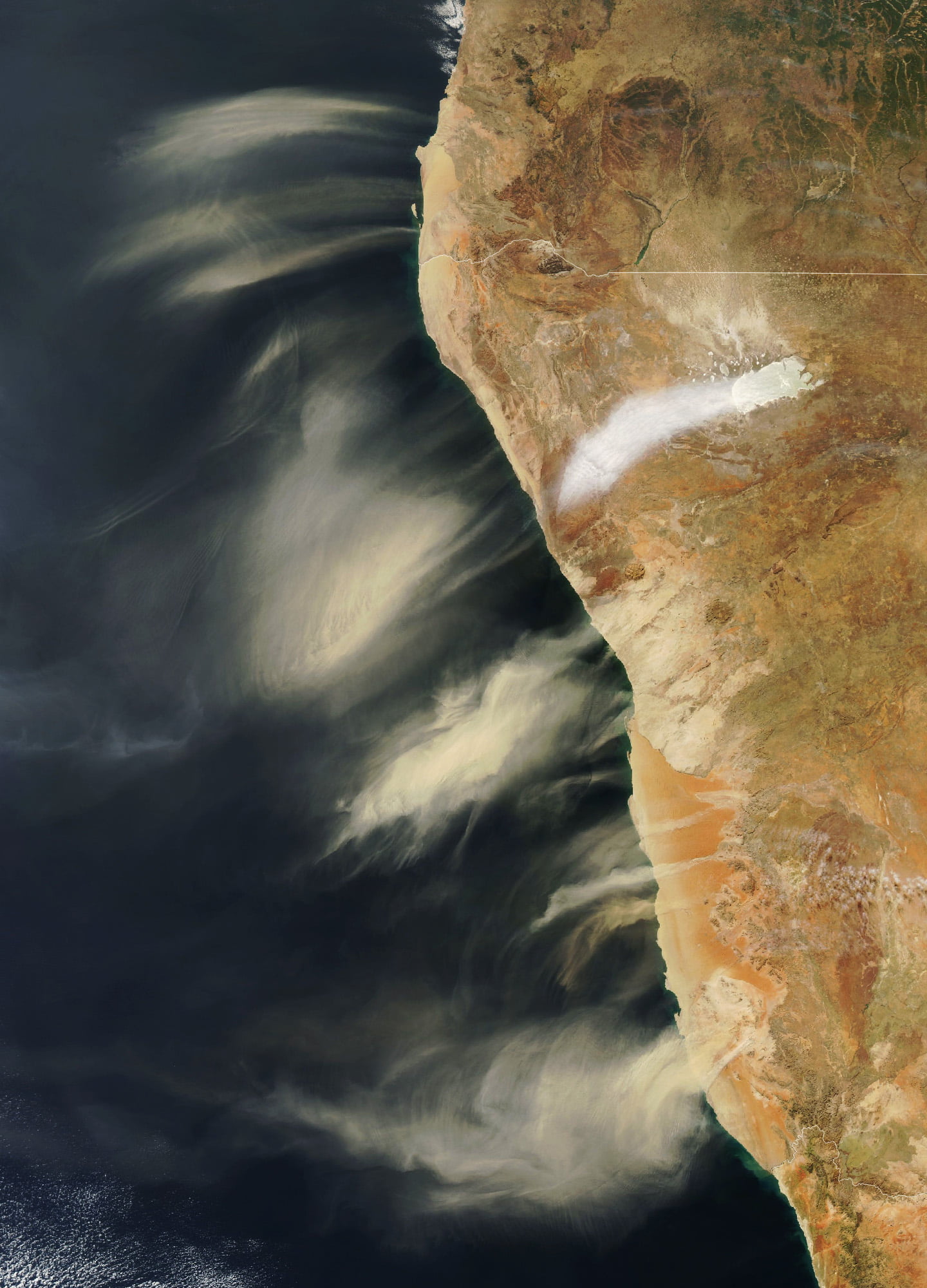
Hot, dry berg winds swept down from the Namibian highlands and sent these plumes of dust flying out to the Atlantic coast. Another plume — white instead of brown — marks salt dust from the Etosha Pan salt flat. The dust and salt become aerosol particles in the atmosphere — seeds for raindrops to form. Coastal towns sometimes need construction equipment to deal with the drifting sand from these storms, but these storms are small compared to Saharan dust storms. Those storms are so large that their dust influences the weather on the other side of the Atlantic. (Image credit: W. Liang; via NASA Earth Observatory)