
In sandy deserts, winds can build a vast network of dunes whose shapes depend on the winds that built them. This photograph, taken by an astronaut aboard the International Space Station, shows part of a Saharan dune field known as the Grand Erg Oriental. Of the five basic types of sand dunes, this field features all but one. The predominant winds of the region build most of the dunes into long, straight chains separated by interdune flats some 150 meters lower in elevation. Within the chains, there are linear dunes, created by winds blowing nearly parallel to the dune’s long axis. In places where winds tend to change directions, several linear dunes may merge to form star dunes, like the one just below and right of center in the image. Transverse dunes form perpendicular to the predominant wind direction. The one shown in the upper left of this image may have formed when multiple crescant-shaped barchan dunes merged. (Image credit: NASA, via NASA Earth Observatory)
Tag: physics

Bouncing, Floating, and Jetting


Get inside some of the latest fluid dynamics research with the newest FYFD/JFM video. Here researchers discuss oil jets from citrus fruits, balls that can bounce off water, and self-propelled levitating plates. This is our third entry in an ongoing series featuring interviews from researchers at the 2017 APS DFD conference. Missed one of the previous ones? Not to worry – we’ve got you covered. (Video and image credit: N. Sharp and T. Crawford)

Auroras


Beautiful auroras are the result of ions in the solar wind exciting atoms in our atmosphere. This example of magnetohydrodynamics is typically only visible in the far northern and southern reaches of the globe. But in recent years, citizen scientists noticed a new aurora outside the polar regions. It looked like a narrow purple streak with occasional fingers of green. It got nicknamed Steve. Recent satellite measurements show that the aurora seems to be a visible emission from a known phenomenon, subauroral ion drift, which features a rapid flow of charged ions. In Steve’s case, this flow moves nearly 6 km/s and is around 6000 degrees Celsius. Scientists have dubbed the aurora S.T.E.V.E., Strong Thermal Emission Velocity Enhancement, to honor the original nickname. Learn more from NASA and Science magazine. (Image credit: K. Trinder; NASA GSFC/CIL/K. Kim, source)

Wrapping Droplets
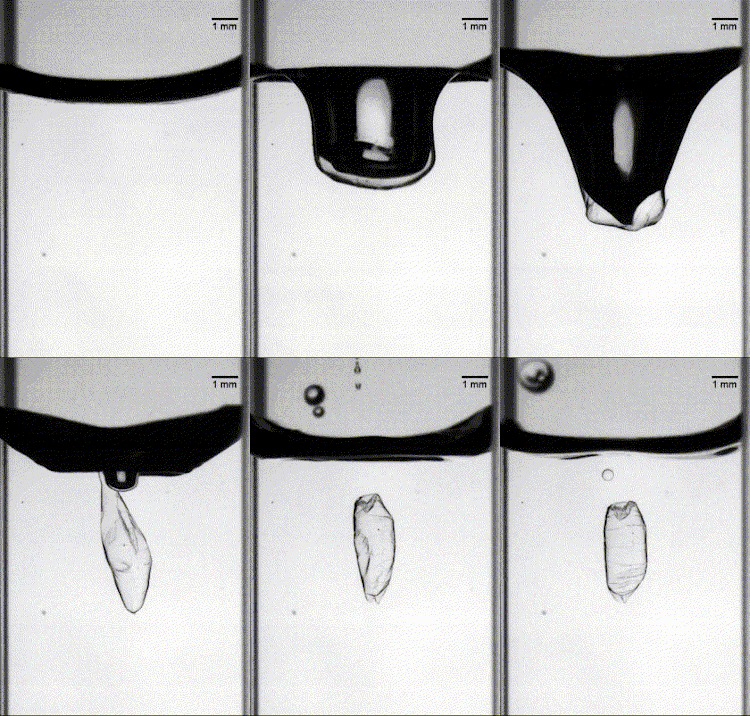


Future efforts for targeted drug delivery may require encapsulating droplets before transporting them to their final location. One method for encapsulation is wrapping a drop in a thin, solid sheet. Previously, we saw that drops can wrap themselves with a little outside assistance, but here the drops achieve that same feat on their own, using the energy of droplet impact to wrap liquids.
Here’s how it works: float a thin sheet on a bath of a liquid like water, then let an oil drop fall into the bath. Its impact deforms the air-water interface and, with a sufficiently energetic impact, causes the oil droplet to pinch off. The flexible sheet wraps around the droplet, and the encapsulated droplet sinks due to gravity. The shape of the final drop depends on the sheet’s initial geometry. The researchers have successfully used circular, triangular, and cross-shaped sheets to wrap droplets. Check out the original paper or the video below for more. (Image and research credit: D. Kumar et al.; video credit: Science)

Sunset Flow
Day and night mix in this flow visualization of watercolor pigments and ferrofluid. The former, as suggested by their name, are water-based, whereas ferrofluids typically contain an oil base. This means the two fluids are immiscible. Like oil and vinegar in salad dressing, the only way to mix them is to break one into tiny droplets floating in the other. This is what happens near their boundary, where brightly-colored paint droplets float in a network of dark channels. To the right, the paint and ferrofluid have been swirled around to create viscous mixing patterns among the paint colors with occasional intrusions of thin ferrofluid fingers. (Image credit: G. Elbert)

Cloud Chambers
Cloud chambers were one of the first methods used to study radioactive decay and cosmic particles. Such chambers are filled with a cool, supersaturated cloud of alcohol vapor. When high-energy particles pass through, they collide with atoms in the chamber, ionizing them. Those ions then serve as nucleation sites for the alcohol vapor, creating a condensation streak that marks the particle’s passage. In some respects, they’re similar to the contrails that form behind airplanes. What you’re seeing is not the particle itself but evidence that it went by. YouTuber Nick Moore built his own cloud chamber. Learn more about it and see lots more great footage of it in action in the full video below. (Image and video credit: N. Moore)

Visualizing Acoustic Levitation
The schlieren photographic technique is often used to visualize shock waves and other strong but invisible flows. But a sensitive set-up can show much weaker changes in density and pressure. Here, schlieren is used to show the standing sound wave used in ultrasonic levitation. By placing the glass plate at precisely the right distance relative to a speaker, you can reflect the sound wave back on itself in a standing wave, seen here as light and dark bands. The light bands mark the high-pressure nodes, where the pressure generated by the sound waves is large enough to counteract the force of gravity on small styrofoam balls. This allows them to levitate but only in the thin bands seen in the schlieren. Move the plate and the standing wave will be disrupted, causing the bands to fade out and the balls to fall. (Video and image credit: Harvard Natural Sciences Lecture Demonstrations)

Water on Mars
Recurring slope lineae (RSL) are seasonal features on Mars that leave behind gullies similar to those left by running water on Earth. Their discovery a few years ago has prompted many experiments at Martian conditions to determine how these features form. At Martian surface pressures and temperatures, it’s not unusual for water to boil. And that boiling, as some experiments have shown, introduces opportunities for new transport mechanisms.
Researchers found that water in “warm” (T = 288 K) sand boils vigorously, ejecting sand particles and creating larger pellets of saturated sand. Water continues boiling out of the pellets once they form, creating a layer of vapor that helps levitate them as they flow downslope. The effect is similar to the Leidenfrost effect with drops of water sliding on a hot skillet; there’s little friction between the pellet and the surface, allowing it to travel farther.
The mechanism is quite efficient in experiments under Earth gravity and would be even more so under Mars’ lower gravity. It also requires less water than alternative explanations. The pellets that form are too small to be seen by the satellites we have imaging Mars, but the tracks they leave behind are similar to the RSL seen above. (Image credit: NASA; research credit: J. Raack et al., 1, 2; via R. Anderson; submitted by jpshoer)
Paint Balloons


The Slow Mo Guys have a history of personal sacrifice in the name of cool high-speed footage, and their Super Slow Show is no exception. In a recent segment, both Dan and Gav were knocked flat by giant swinging balloons of paint, and, as you might expect, the splashes are spectacular. The speed is just right for some of the paint to form nice sheets before momentum pulls them into long ligaments. Eventually, that momentum overcomes surface tension’s ability to keep the paint together, and the paint separates into droplets, which, as you see below, rain down on the hapless victims. (Video and image credit: The Slow Mo Guys)

The Hairyflower Wild Petunia
Dispersing seeds is a challenge when you’re stuck in one spot, but plants have evolved all sorts of mechanisms for it. Some rely on animals to carry their offspring away, others create their own vortex rings. The hairyflower wild petunia turns its fruit into a catapult. As the fruit dries out, layers inside it shrink, building up strain that bends the fruit outward. Once a raindrop strikes it, the pod bursts open, flinging out around twenty tiny, spinning, disk-shaped seeds. That spin is important for flight. The best-launched seeds may spin as quickly as 1600 times in a second, which helps stabilize them in a vertical orientation that minimizes their frontal area and reduces their drag. Researchers found that these vertically spinning seeds have almost half the drag force of a spherical seed of equal volume and density. That means the hairyflower wild petunia is able to spread its seeds much further without a larger investment in seed growth. (Image and research credit: E. Cooper et al., source; via NYTimes; submitted by Kam-Yung Soh)


.gif)