Tag: physics

  • When Sound Makes You Vertiginous

    When Sound Makes You Vertiginous

    For some people, a musical tone is enough to induce vertigo and feelings of being drunk. These individuals often have a small hole or defect in the bone that surrounds the canals of the inner ear. Normally, the fluid inside these canals reacts when we rotate our heads, triggering a counterrotation of our eyes that helps stabilize the image on our retinas. But when there’s a defect in the bone surrounding the canal, certain acoustic tones may pump that fluid directly. The patient’s eyes then try to correct for a rotation that’s not occurring, thereby inducing dizziness and vertigo. (Image credit: M. Moiner; research credit: M. Iversen et al.; submitted by Marc A.)

  • Breaking With a Wave

    Breaking With a Wave

    For rocket combustion and other applications, like watering your lawn with a hose, a stream of fluid may need to be broken up into droplets. While simply spraying a liquid jet will make it break up, waving that jet back and forth will break it up faster. A recent study simulated this problem numerically to determine the exact mechanisms driving that break-up. The researchers found two major culprits.

    The first is a Kelvin-Helmholtz, or shear-based, instability. When a jet leaves the nozzle, there’s friction between it and the comparatively still air surrounding it. This creates tiny ripples in the surface that eventually grow into the distortions we can see, and it’s found in all jets, regardless of their side-to-side motion.

    The second culprit, which is only found in the oscillating jet, is a Rayleigh-Taylor instability. By moving the jet side-to-side, you’re driving the dense liquid into less dense air, which creates a different set of disturbances that also help break up the jet. The final result: swinging the jet side-to-side breaks it into smaller droplets faster. (Image and research credit: S. Schmidt et al.)

  • Folding Fluids

    Folding Fluids

    Highly viscous liquids – like cake batter, lava, or the spider silk above – fold as they fall. Several factors impact this instability including the fluid’s density, viscosity, surface tension, and how thin the falling sheet is. As with the coiling of falling honey, this behavior is actually a form of buckling. It’s also fascinating to watch how persistent the layers are. Even out near the edge of the puddle, you can still see individual folds. This is a sign of just how incredibly viscous the spider silk is. Imagine if this were cake batter instead: we’d see folding just like we do with the spider silk proteins, but the individual folds would quickly fade as the batter flowed to fill its container. The spider silk is more viscous, so it’s more resistant to flowing. (Image credit and submission: D. Breslauer, source)

  • Forming Europa’s Bands

    Forming Europa’s Bands

    Jupiter’s icy moons, Europa and Ganymede, are home to subsurface oceans. These moons also experience strong tidal forces from their parent planet and sibling moons that squeeze and deform them over time. A new study focuses on the bands, seen in red in the top image of Europa, that form as a result of these deformations. By simulating (bottom image) both the convective currents within the Europan ocean and the deformation of the ice over time, scientists are able to study how these geological surface features may have formed. Over the course of about a million years, material from the interior ocean works its way up into the center of a band. Because this process takes so long, the researchers point out that any attempt to collect material from the bands will yield “fossil” ocean material – essentially a glimpse of Europa’s ocean as it existed a million years ago rather than how it exists today! (Image credit: NASA; image and research credit: S. Howell and R. Pappalardo, source; submitted by Kam-Yung Soh)

  • Featured Video Play Icon

    Tornadoes, Fire, and Ice

    It’s time for another look at breaking fluid dynamics research with the latest FYFD/JFM video! This time around, we tackle some geophysical fluid dynamics, like listening to the sounds newborn tornadoes make below the range of human hearing; studying how melting ice affects burning oil spills; and how salt sinking from sea ice affects the ocean circulation. Check out the full video below for much more! If you’ve missed any of the previous videos in the series, you can check them out here. (Image and video credit: T. Crawford and N. Sharp)

  • Manipulating Droplets Remotely

    Manipulating Droplets Remotely

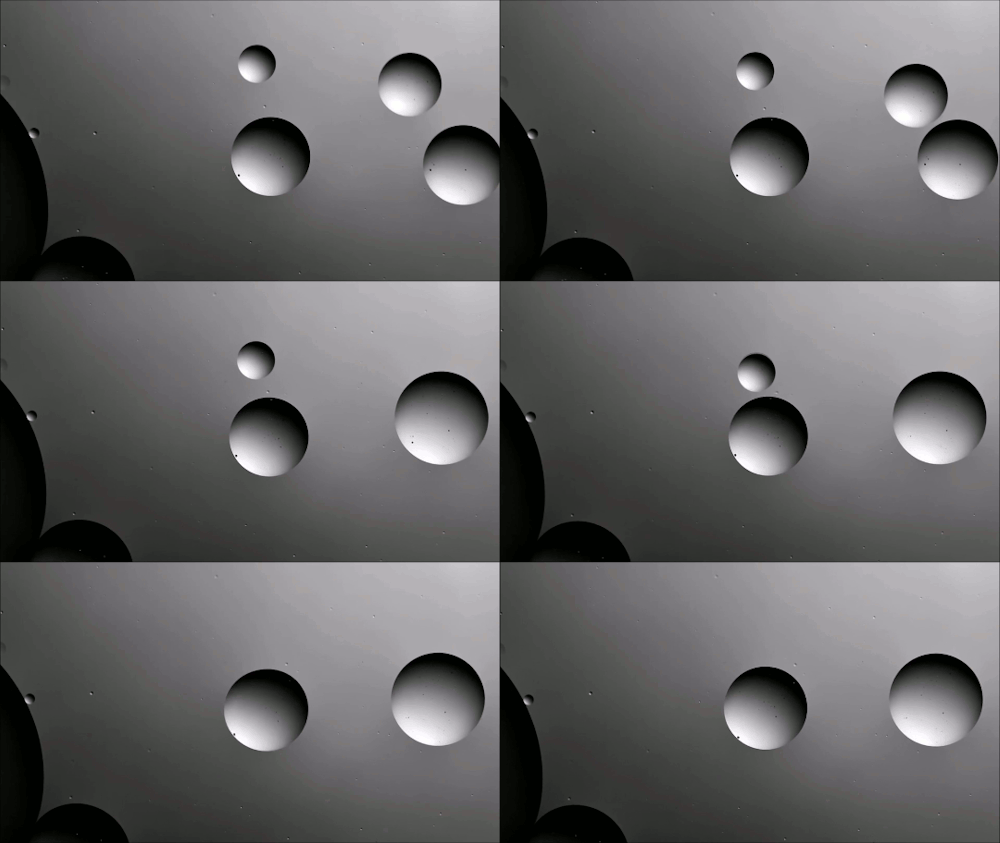
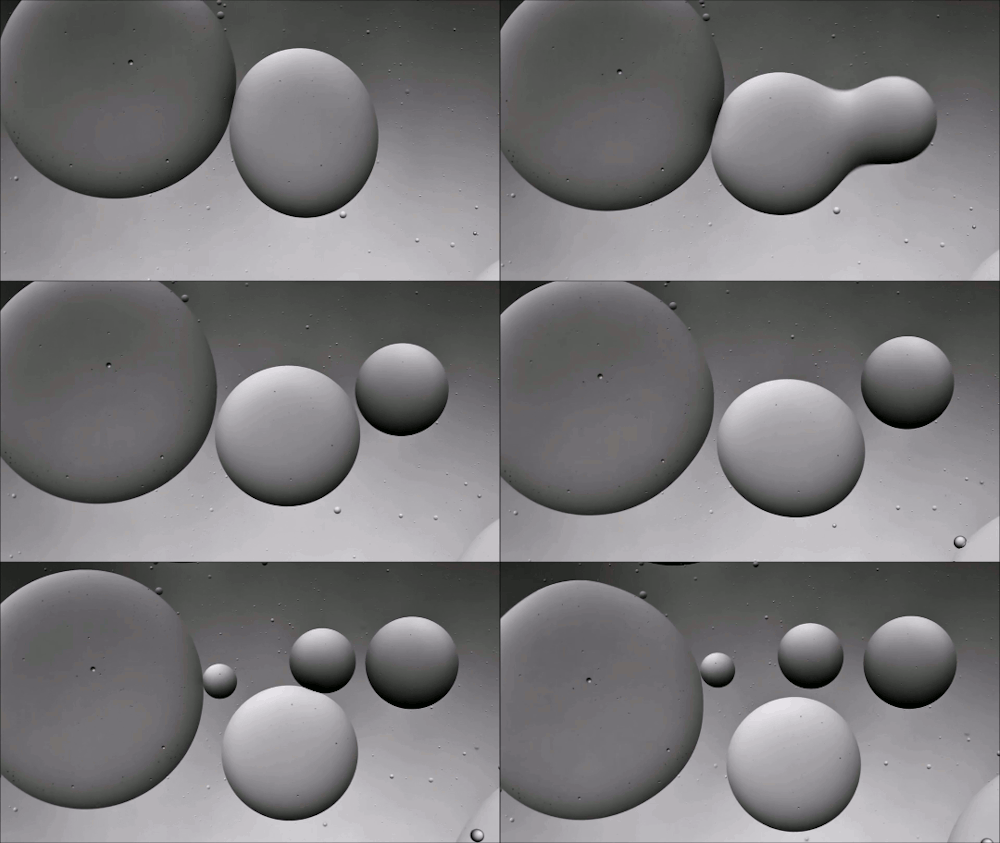
    Using acoustic levitation and an array of carefully-placed speakers, researchers can manipulate droplets without touching them. This lets scientists study the physics of droplet coalescence (top) without interference from solid surfaces, but it also provides opportunities for mixing two different substances in the final droplet. 

    On the bottom left, we see a droplet formed from the coalescence of a dyed droplet (visible as gray) and an undyed droplet. The swirling and mixing in the levitating droplet is fairly slow. By contrast, the droplet on the right is vibrated by manipulating the sound waves holding it aloft. This mixes the droplet quite efficiently, allowing it to reach a uniform state more than six times faster than the other droplet. (Image and research credit: A. Watanabe et al., source)

  • The Swimming of a Dead Fish

    The Swimming of a Dead Fish

    When I was a child, my father would take me trout fishing, and I spent hours marveling from the riverbank at the trouts’ ability to, seemingly effortlessly, hold their position in the fast-moving water. As it turns out, those trout really were swimming effortlessly, in a manner demonstrated above. The fish you see here swimming behind the obstacle is dead. There’s nothing powering it, except the energy its flexible body can extract from the flow around it.

    The obstacle sheds a wake of alternating vortices into the flow, and when the fish is properly positioned in that wake, the vortices themselves flex the fish’s body such that its head and its tail point in different directions. Under just the right conditions, there’s actually a resonance between the vortices and the fish’s body that generates enough thrust to overcome the fish’s drag. This means the fish can actually swim upstream without expending any energy of its own! The researchers came across this entirely by accident, and one of the questions that remains is how the trout is able to sense its surroundings well enough to intentionally take advantage of the effect. (Image and research credit: D. Beal et al.; via PhysicsBuzz; submitted by Kam-Yung Soh)

  • Meteoroids

    Meteoroids

    Meteoroids are debris from earlier eras in our solar system. They can be leftovers from planets that never formed or remains of ancient collisions. When these bits rock and metal enter our atmosphere, they become meteors. Since they travel at speeds of several kilometers per second, they create incredibly strong shock waves off their bow once they’re in the atmosphere. These shock waves are so strong that they rip the air molecules apart and create a hot plasma that can scorch the outside of the meteor. That plasma also glows, which is why meteors look like a streak of light from the ground. Any remains that make it to the ground are known as meteorites, and they have some pretty awesome features. Check out the full Brain Scoop episode below to learn some of the typical (and not so typical!) characteristics of meteorites. (Image and video credit: The Brain Scoop/Field Museum)

  • The Telstar 18

    The Telstar 18

    Every four years, Adidas creates a newly designed ball for the World Cup. This year’s version is the Telstar 18, which features six glued panels (no stitching!) with a slightly raised texture. That subtle roughness is an important feature for the ball’s aerodynamics. It helps ensure that flow around the ball will become turbulent at relatively low speeds. Some previous designs, notably the 2010 Jabulani, were so smooth that flow near the ball would not become turbulent until much higher speeds. In fact, one side of the ball might have laminar flow while the other was turbulent, causing the ball to wobble and misbehave. To learn more about World Cup aerodynamics and the importance of a little surface roughness to the ball’s behavior, check out the Physics Girl video below.    (Image credit: Adidas; via APS News; video credit: Physics Girl)

  • Featured Video Play Icon

    The Fluid Dynamical Sewing Machine

    If you’ve drizzled viscous liquids like honey or syrup, you’ve no doubt witnessed their ability to coil. Combine that coiling with a moving platform and you form a system known as the fluid dynamical sewing machine, which creates different consistent patterns of loops and curves depending on the speed at which the liquid falls and the velocity of the moving platform. The predictability of these patterns makes them especially useful for 3D printing. Previously a group at MIT developed a glass printer that could use the instability, and here a group from Montreal demonstrates how they can build solid coils at various scales. Their video also explores what the structural properties of such coils are after they solidify. (Image, video, and research credit: R. Passieux et al.)