Tag: physics

  • Tea Physics

    Tea Physics

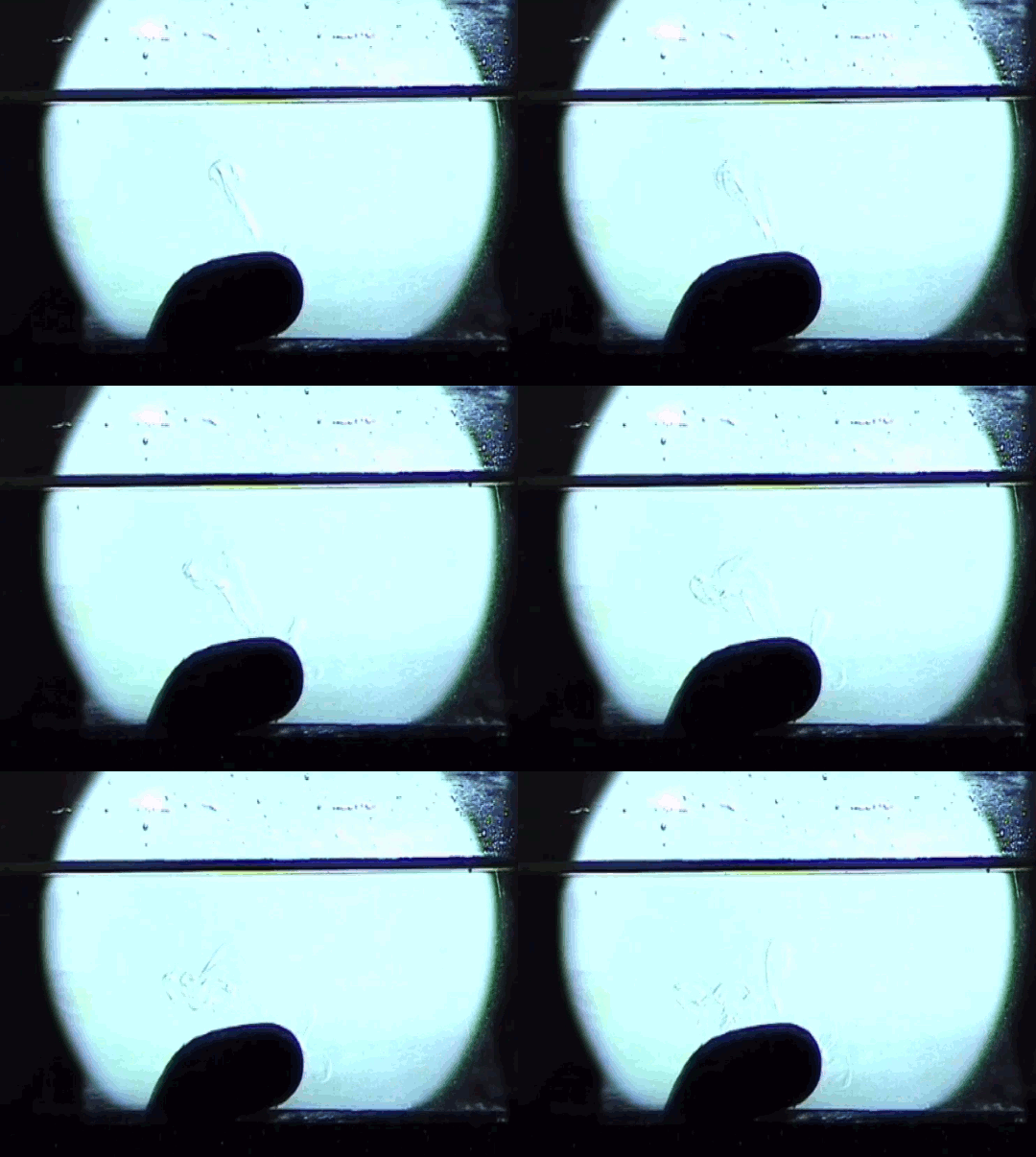
    Tea is a popular beverage around the world, and nearly everyone has their own method for making the perfect cup. Perhaps unsurprisingly, scientists have studied tea physics as well. One such study used both experiments and numerical simulations to study tea infusion from teabags. The authors looked at round, two-dimensional teabags in two configurations – one in which the bag was left still during infusion and one in which the bag was dunked up and down in the water.

    In the static case, as the hot water leeches solutes out of the tea leaves, it forms a buoyant convection current. In this case, the convection is driven by solute concentration, not temperature. The convection creates a re-circulation in the cup that helps slowly distribute the tea solutes.

    The dunking method, unsurprisingly, distributes tea solutes much faster. In addition to stirring the cup’s contents, dunking helps drive flow through the tea leaves, releasing solutes faster. Although the authors study the two methods in detail, they decline to pass judgement on what method is “the best”. (Photo credit: T. Foster, source; research credit: G. Lian and C. Astill; submitted by Marc A.)

  • Featured Video Play Icon

    360 Fireball

    Flames are inherently fascinating to watch. Most of the ones we see regularly, like candle flames and campfires, tend to flicker unsteadily due to their turbulence. But larger fires have a spell-binding nature all their own, one that’s highlighted in slow motion. Here the Slow Mo Guys take flame-gazing to a new level by circling a fireball with a high-speed camera. In the resulting footage, you can admire the incredible expansion of the flame front, and the beautiful, detailed turbulence that creates all the myriad tiny eddies you see in the slow motion. It’s well worth watching more than once! (Video and image credit: The Slow Mo Guys)

  • The Dangerous Clatter of Dishes

    The Dangerous Clatter of Dishes

    Have you ever noticed how loud dishes are when you’re handling them? Under the right (or, perhaps more accurately, wrong) circumstances, the clatter of ceramics like porcelain can be dangerously loud, as engineer Phil Metzger discovered when repairing his toilet. At one point the lid to his tank slipped from his hands and fell about 20 centimeters to strike the edge of the toilet. The lid did not break, but Metzger stumbled away stunned from the loud noise. He immediately noticed that his hearing was distorted – he described his own voice as sounding “like talking through a kazoo”. Upon further experiment, he found that the distortion occurred at specific, regularly-spaced frequencies. Like any engineer, therefore, he turned to physics to analyze the accident.

    Since the lid didn’t break, he knew that the energy from the lid’s fall went into two places: the sound he heard and a small amount of dissipated heat. Using the speed of sound in a ceramic and the dimensions of the lid, he was able to calculate the frequency of sound produced by the impact, and with a little more work, he could estimate that the sound, as transmitted to his nearby ear, had been about 138 dB. Permanent damage from brief sounds can occur at 140 dB, so this was well inside the danger zone. The pressure from sounds this loud is enough to severely bend the tiny hairs in your cochlea that are responsible for sensing these vibrations. Luckily for Metzger, his hearing did recover after a few days, but it’s a good reminder to be careful. Sometimes everyday physics can be surprisingly dangerous! (”Research” credit: P. Metzger; image credit: comedynose/Flickr; via Motherboard via J. Ouellette)

  • Featured Video Play Icon

    Bubble Art

    Everyone loves soap bubbles, and bubble artist Melody Yang reveals how to make some pretty awesome ones in this video for Wired. The surface tension of bubbles makes them naturally seek a shape that minimizes their surface area relative to the volume they contain. For a single bubble, that’s a sphere. But once you start joining multiple bubbles, as Yang demonstrates, that minimal surface area can change, even to something unexpected like a cube.

    Bubbles also have an impressive ability to self-heal. As long as whatever passes through them is wet – whether it’s a hand, a straw, or even a ball bearing – the soap film will probably heal itself rather than break. This is a key feature for many of Yang’s tricks, including the impressive planetary bubble. (Video credit: Wired; image credits: Wired/Colossal; via Colossal)

  • Collecting Fog

    Collecting Fog

    In some parts of the world, fog is a major source of freshwater, but collecting it is a challenge. Most systems use a wire mesh to capture and collect droplets, but the process is highly inefficient, pulling only 1-3% of droplets from the fog. Researchers found that this is due largely to aerodynamic effects. The presence of the wire deflects droplets around it (bottom left). To solve this, engineers introduced an electric charge into the fog. The subsequent electric field actually pulls droplets to the wires (bottom right). When applied to a mesh (top), the efficiency of fog capture improves dramatically. 

    The technique can also be used to capture water vapor that would otherwise escape from the cooling towers of power plants. The MIT researchers who developed the technique will conduct a full-scale test at the university’s power plant this fall. They hope the technique will recapture millions of gallons of water that would otherwise drift away from the plant. (Image credits: MIT News, source; image and research credits: M. Damak and K. Varanasi, source)

  • Night Shine

    Night Shine

    Noctilucent – literally night-shining – clouds are a phenomenon unique to high latitudes during the summer months. Too dim and sparse to see in daylight, these clouds shine at night because their altitude of around 80 km allows them to catch sunlight long after dusk has fallen at the surface. They form when temperatures in the summer mesosphere drop to nearly -150 degrees Celsius, driven by perturbations that can originate in lower layers of the atmosphere on the opposite side of the Earth. Complex interactions and feedback between atmospheric waves, buoyancy, and Coriolis effect circulate those disturbances in such a way that the summer mesosphere can reach temperatures colder than any other place on Earth. Those frigid temperatures allow clouds to form even in this dry region near the edge of space. (Image credit: S. Stephens; see also: B. Karlsson and T. Shepard)

  • Sandy Splashes

    Sandy Splashes

    Sand and other granular materials can be strikingly fluid-like. Here the impact of a solid sphere on sand generates a splash remarkably similar to what’s seen with water. When the ball hits, it creates a crater in the surface and sends up a bowl-like spray of sand. As the ball continues falling through the sand, the grains try to fill the empty space left behind. The walls of sand collapsing around the void meet somewhere between the surface and the depth of the ball. This generates the tall jet we observe, as well as a second one under the surface that we can’t see. We know that collapse traps an air bubble under the surface because of the eruption that occurs as the jet falls. That’s the air bubble reaching the surface. (Image credit: T. Nguyen et al., source; see also R. Mikkelsen et al.)

  • Dust Envelopes Mars

    Dust Envelopes Mars

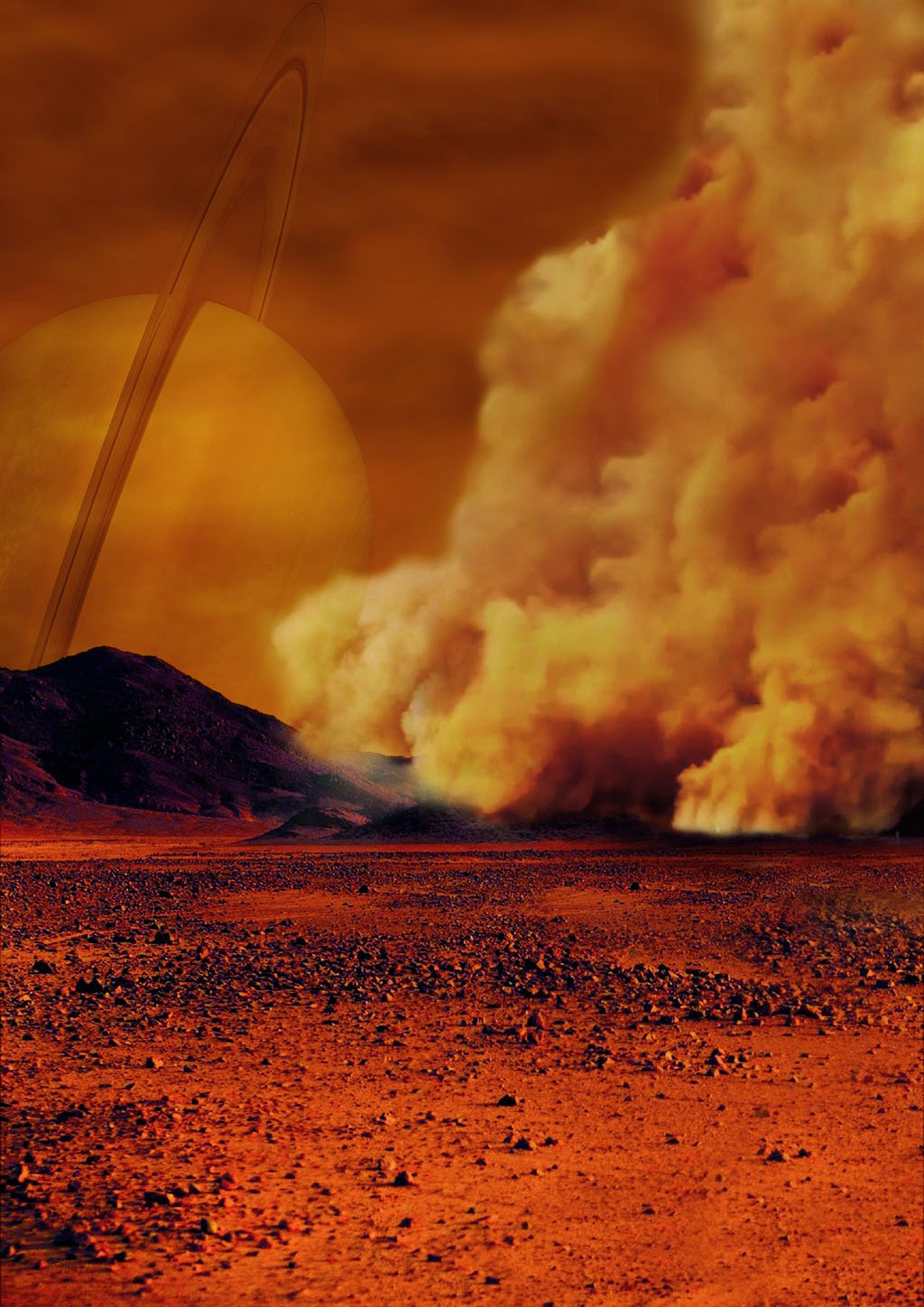
    Day has turned into night for NASA’s Opportunity rover as a massive dust storm envelopes Mars. The first signs of the dust storm were reported May 30th, and over the last two weeks, the storm has grown to an area larger than North America and Russia combined. Despite the low pressure and density of Mars’ atmosphere, solar heating can create fairly strong winds – they don’t reach hurricane-force speeds, but they’d qualify as a very windy day here on Earth. With the lower gravity on Mars, this can lift dust well into the atmosphere, choking out the sunlight Opportunity needs to continue operating. The rover has entered a low-power mode and is no longer responding to communications. Martian dust storms have been known to last for weeks or even months, and this may be the last we hear from the intrepid rover on its fifteen year journey. Here’s hoping that Opportunity makes it through the storm and can eventually get the solar power needed to phone home again. (Image credit: NASA JPL)

  • Giving Droplets a Kick

    Giving Droplets a Kick

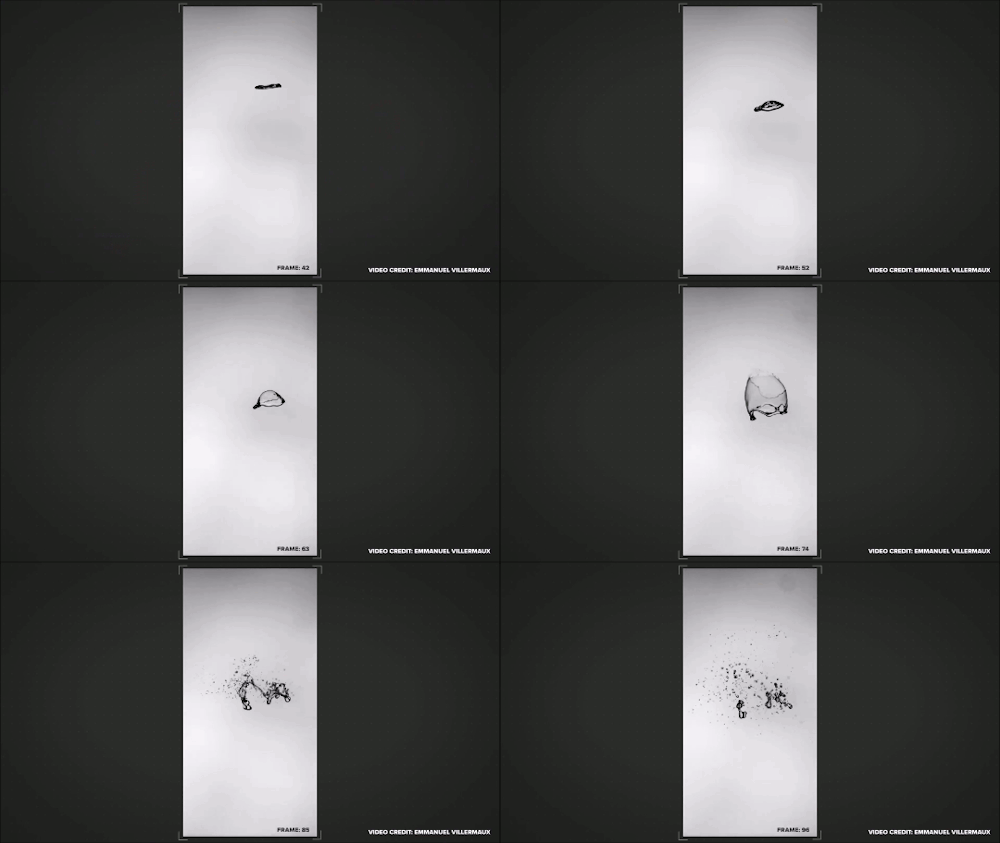
    Giving droplets a kick by accelerating the surface they sit on creates elaborate shapes as the drops respond. As the surface accelerates upward, the droplet flattens into a pancake. When the plate slows down, the droplet continues rising, stretching into a cone as its rim flies upward and its lower surface adheres to the surface. The rim retracts with a constant acceleration while the drop detaches with a constant velocity. That velocity depends on how well it adheres to the surface. The interplay between those two variables determines how conical or cylindrical the drop appears. See more in the full video below. (Image and video credit: P. Chantelot et al.)

  • Using Embolisms to Fight Cancer

    Using Embolisms to Fight Cancer

    Blocking blood vessels by creating embolisms is, under most circumstances, very bad. But researchers are exploring ways to fight cancer by intentionally and strategically creating these blockages. In gas embolotherapy, researchers inject fluid droplets, which can carry chemotherapy drugs, into the bloodstream. Once they circulate into a cancerous tumor, they use ultrasound to vaporize the droplet and create a gas bubble. Those bubbles lodge inside the capillaries of the tumor, starving it of fresh blood and trapping the chemotherapy drugs inside. It’s a one-two punch to the cancer. Without blood flow, the cancer cells die, and, since the cancer-killing drugs get mostly trapped inside the tumor, patients may require lower dosages and endure fewer side effects. The technique is currently in animal testing, but hopefully it will be a valuable therapy for human patients in the future. (Image credit: Chemical & Engineering News; research credit: Y. Feng et al.; via AIP)