Clouds spiral behind the islands of Tenerife and Gran Canaria in this nighttime satellite imagery. Although it’s not entirely unusual to see these von Karman vortex street clouds in the wakes of islands, this is the first time I’ve seen them at night. They form when winds off the ocean are forced up and around rocky islands. Like air moving past a cylinder, the flow forms a swirling vortex off one side of the island, which separates and moves downstream while another forms on the island’s opposite side. When the resulting flow mixes with a cloud layer, we can see the pattern from space. (Image credit: J. Stevens; via NASA Earth Observatory)
Tag: physics

The Disappearing Cotton Candy


Moisture is cotton candy’s natural enemy. The spun sugar dissolves incredibly quickly under the influence of even a couple drops of water. Why that’s so is clearer when looking at a single fiber. Inside the droplet there’s a gradient in the sugar concentration. The more sugary water sinks, and the sugar fiber dissolves more quickly in the upper part of the droplet, where the less sugary water can more easily take up new sugar.
Once the fiber breaks, capillary forces draw the droplet upward, giving it a fresh section of fiber to dissolve. In a web of fibers, this process can pull droplets apart and together as they quickly eat through the spun sugar. (Image and video credit: S. Dorbolo et al.; submitted by Alexis D.)

Reader Question: Cross Sea
Reader Matt G asks:
[What’s] going on here?
Why’s the pattern square? Just a special case of waves traveling in different directions, and this photo happened to catch some at right angles to one another?
You’re not far off, Matt! This is an example of cross sea, where wave trains moving in different directions meet. Like most ocean waves, these waves originated from wind moving over the water. As the wind blows, it transfers energy to the water, disturbing what would otherwise be a smooth surface and setting up a series of waves. Oftentimes, these waves can outlast the wind that generates them and travel over long distances of open water as a swell.
Cross seas occur when two of these wave systems collide at oblique angles. They’re most obvious in shallow waters like those seen here, where the depth makes their criss-cross pattern clearer. Another name for them is square waves, and although the pattern isn’t a perfect square, it’s usually fairly close. If the waves aren’t separated by a large angle, they’re more likely to merge than to create this sort of pattern.
Neat as cross seas look, they’re quite dangerous, both to ships and swimmers. Ships are built to tackle waves head-on and don’t fare well when they’re forced to take waves from the side. For swimmers, the danger is a little different. Cross seas create intense vorticity under the surface and can generate stronger than usual riptides that sweep the unwary out to sea. (Image credit: M. Griffon)

Galileo’s Descent
In December 1995, the Galileo probe made its dramatic descent into Jupiter’s atmosphere at a velocity of more than 47 km/s. In 30 seconds, it decelerated from Mach 50 to Mach 1, undergoing incredible heating as it did so. Anytime an object moves through a fluid faster than the local speed of sound, it creates a leading shock wave that compresses the fluid, heats it, and redirects it around the object. The faster the speed, the hotter the fluid will be after passing through the shock wave.
Above about five times the speed of sound, the heating effect is so strong that it’s able to rip molecules apart, creating a chemically reactive mixture that will ablate away material from the object. For this reason, Galileo and other planetary entry vehicles carry heat shields made to sacrifice themselves while protecting the cargo and (in some cases) crew onboard. Data from Galileo showed that, although the heat shield survived the brunt of its descent, it experienced worse conditions than expected. Near the heat shield’s shoulder, almost all of its material ablated away.
Scientists continue to study Galileo’s descent even now, using it to test and inform their models of the flow and chemistry that occurs at these hypersonic speeds. The better we can understand and predict these flows, the better our designs will become. Mass that’s currently spent on overly-conservative heat shields can instead go toward additional instruments or supplies. (Image credit: Chop Shop Studio; research credit: L. Santos Fernandes et al.; via AIP)

Supercooling Thermodynamics


In the latest Gastrofiscia episode, Tippe Top Physics takes on thermodynamics and the complicated truth behind certain phase changes. Although we’re accustomed to thinking of water freezing at 0 degrees Celsius and boiling at 100 degrees Celsius, reality is more complex, and temperature is only one of the factors that goes into a change of phase. Pressure and purity also play an important role.
This is why it’s possible, for instance, to supercool purified water to below 0 degrees Celsius without freezing it. Liquid water needs a nucleus to serve as a seed for its freezing. Without dust or other impurities, it takes a lot of energy for water to spontaneously generate its own nucleus. Check out the full video to see how and why that’s so. (Image and video credit: Tippe Top Physics)

Sliding Down a Pitcher Plant
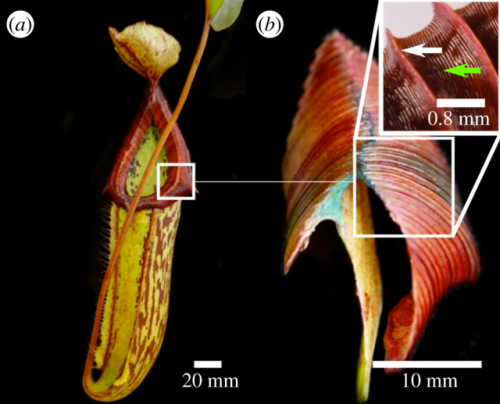
Carnivorous pitcher plants supplement their nutrient-poor environments by capturing and consuming insects. The viscoelastic fluid inside them helps trap prey, but fluid dynamics plays a role elsewhere on the plant as well. The inner and outer surfaces of the pitcher are covered in macroscopic and microscopic grooves, seen above, oriented toward the interior of the plant.
Researchers found that these grooves trap droplets on the slippery plant through capillary action. Once adhered, the droplet cannot easily move across the grooves, but it can slip along them, carrying the droplet and any insect stuck to it, into the plant. By replicating pitcher-plant-inspired grooves on manmade surfaces, researchers found they were able to better control droplet motion on slippery, lubricant-infused surfaces than in previous work. (Image and research credit: F. Box et al.; via Royal Society; submitted by Kam-Yung Soh)

Bay of Fundy Tides


Canada’s Bay of Fundy has some of the wildest tidal flows in the world. Every six hours, the flow direction through the strait shifts and tidal currents rise to several meters per second. This creates distinct jets a couple kilometers long that pour from one side of the strait to the other.
What you see here is a numerical simulation of the flow using a technique called Large Eddy Simulation (or LES, for short). It’s one method used by fluid dynamicists to model turbulent flows without taking on the complexity of the full Navier-Stokes equations. At large lengthscales, like those of the jets and eddies we see above, LES uses the exact physics. But when it comes to the smaller scales – like the flow nearest the shores or the bottom of the strait – the simulation will approximate the physics in order to make calculations quicker and easier. Models like these make large-scale problems – including modeling our daily weather patterns – possible. (Image credit: A. Creech, source)
A Broken Monitor’s Fingers


In this short video, the artists of Chemical Bouillon explore a broken LCD monitor and its liquid crystals. By sandwiching the fluid between thin, transparent sheets, they create dendritic shapes as the liquid crystals and other fluids (air? ink?) push into one another. There’s a lot here that’s likely connected to the Saffman-Taylor instability, but without knowing more details on the ingredients and set-up, it’s hard to speculate beyond that. (Video and image credit: Chemical Bouillon)

Energy-Efficient Deicing
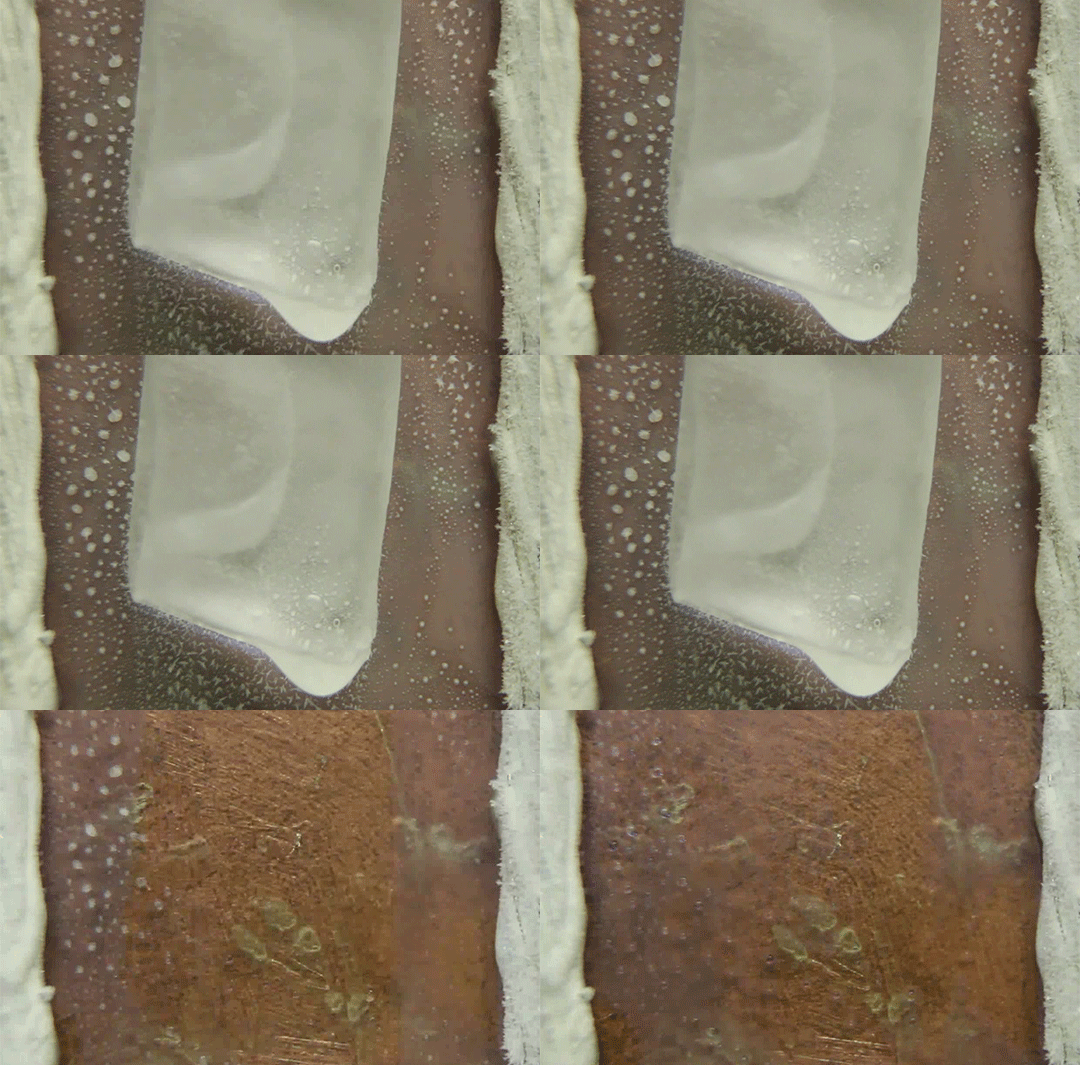
Defrosting and deicing surfaces is an energy-intensive affair, with lots of heat lost to warming up system components rather than the ice itself. In a new study, researchers explore a faster and more efficient method that focuses on heating just the interface. They coated their working surface in a thin layer of iridium tin oxide, a conductive film used in defrosting. Then, once the surface was iced over, they applied a 100 ms pulse of heating to the film. That localized heat melted the interface, and gravity pulled away the detached ice. Compared to conventional defrosting methods, this technique requires only 1% of the energy and 0.01% of the time. If the method scales reliably to applications like airplane deicing, it would provide enormous savings in time and energy. (Image and research credit: S. Chavan et al.)

Boiling in Microgravity
In the playground of microgravity, every day processes can behave much differently. This photo comes from the RUBI experiment, the Reference mUltiscale Boiling Investigation, aboard the International Space Station. Freshly installed and switched on, the apparatus is now generating bubbles like this one. On the left, you see temperature sensors used to measure bubble temperatures. High-speed and infrared cameras are also part of the experiment.
The advantage of studying boiling in space is a lack of gravity that can mask or overwhelm subtler effects. It effectively slows down the process, making it easier to observe. And since boiling is such an important part of heat transfer in many manmade devices, it shows us how we have to adapt when operating in an environment where heat – and bubbles – don’t automatically rise. (Image credit: ESA; submitted by Kam-Yung Soh)