It’s not always easy to imagine how waves travel, but with this demonstration, you can see sound waves and how they reflect and defract. The set-up uses schlieren optics that show light and dark bands where strong changes in density take place. This, combined with a stroboscopic light, makes it possible to see the wave fronts from the acoustic transducer on the left side of the screen. Once the wave is apparent, introducing a reflective object lets us see exactly how sound waves bounce, reflect, and interfere. (Image and video credit: Harvard Natural Sciences Lecture Demonstrations)
Tag: physics

Making Giant Soap Bubbles
Making soap bubbles is fun, but there’s something about gigantic soap bubbles that brings out the child in everyone. The world’s largest freestanding soap bubble had more than 100 square meters of surface area, which begs an important question: how can such a thin film stay stable at that size?
The solutions used for giant bubbles have a few main ingredients: water, naturally; detergent, used for its surfactants; and polymers like polyethylene glycol that help stabilize the soap film. Exactly why polymers helped was a bit of mystery, but a new pre-print study aims to answer that.
Researchers studied how polymer concentrations affected 1) how much solution could be drawn in as bubbles formed, and 2) how long a film of solution lasted before gravity and evaporation thinned it to breaking. They found that intermediate polymer concentrations actually worked best. This gave the solution the viscoelasticity needed to draw in more solution as bubbles grew without having so much polymer that it negatively affected film lifetime. (Image credit: Pixabay; research credit: S. Frazier et al.; via MIT Tech Review; submitted by Kam-Yung Soh)

How to Build a Lava Moat
If you’re looking for a new and impractical way to protect your home, here’s a great option: a lava moat. Nothing says “Don’t try to knock on my door” like a glowing inferno of molten rock. And Minute Physics – along with xkcd – has put together a short, handy guide to some of the challenges you’ll face in building and maintaining this fearsome fortification. If running your own commercial-scale power plant seems overly daunting but you still want to see what lava’s all about, I have good news; here’s a selection of some of my favorite looks at lava here at FYFD:
– Upstate NY’s homemade lava
– What happens when you step on lava
– A veritable river of lava in action
– What happens when water meets lavaNow, if you’ll excuse me, I’m off to Hawai’i for the next two weeks. There will be lava. (Video credit: Minute Physics)
“Emergence”


Artist Susi Sie explores fluidic worlds through her macro lens. In “Emergence,” her focus is on ferrofluids immersed in other liquids. Beginning with tiny droplets traversing the thin fluid channels of a foam, she allows the unique qualities of ferrofluids to slowly take center stage. Dark blobs grow into curvy labyrinths as a magnetic fields come into play. Until ultimately the magnetic nature of the fluid becomes undeniable as scattered droplets elongate into miniature compass needles and swing around to follow the field lines. (Video and image credit: S. Sie)

Escaping the Limits of Viscosity
For large creatures, it’s not hard to feel the evidence of someone else swimming nearby. But to tiny swimmers water is incredibly viscous and hard to move. These creatures have to swim very differently than their larger cousins, and evidence of their motion dies out quickly. But at least one microorganism, Spirostomum ambiguum, has discovered a method for overcoming the limits of size and viscosity.
The single-celled swimmer, when threatened, contracts its body in milliseconds, generating accelerations greater than those seen by fighter pilots. That acceleration is strong enough that it generates a burst of turbulence powerful enough to overcome the natural damping of its viscous surroundings. Within their colonies, S. ambiguum seem to use contraction to send out hydrodynamic signals to neighbors, who pass on the call to arms. To see the colonies in action, check out this previous article. (Image and research credit: A. Mathijssen et al.; via Physics Today; submitted by Kam-Yung Soh)
Why Do Backwards Wings Exist?


Over the years, there have been many odd airplane designs, but one you probably haven’t seen much is the forward-swept wing. While most early aircraft featured straight wings, rear-swept wings are fairly common today, especially among commercial airliners. A rear-swept wing has its forward-most point at the root of the ring, where it attaches to the fuselage. The sweep breaks up the incoming flow into a chordwise component that flows from the leading edge to the trailing edge of the wing and a spanwise component that flows along the wing. Compared to straight wings, a swept wing provides better stability and control when flying at transonic speeds where shock waves can form on the wing (even though the plane itself is not supersonic).
The trouble with rear-swept wings is that when they stall, they do so from the wingtips inward. Since the ailerons that control the plane’s orientation are out near the wingtips, that’s a problem. Forward-swept wings were supposed to solve this issue because they would stall from the root outward. But they came with a whole new set of problems, which included the need for robust onboard computers controlling them constantly to keep them in stable flight. In the end, the disadvantages outweighed any gains and so, for the most part, the forward-swept wing design has seen little flight time. (Image and video credit: Real Engineering)
Diamond-Shaped Waves
Strong winds blowing across Lake Michigan created this diamond-shaped wave pattern after the incoming waves reflected off the breakwater on the right. The formal name for these waves are clapotis gaufré, meaning “waffled standing waves”. As seen in the animation above, the waves aren’t perfect standing waves; otherwise they would stay in one place rather than propagating toward shore. This happens because the angle of reflection is not exactly 90 degrees.
As neat as clapotis gaufré waves look, they’re a significant problem for the builders of coastal infrastructure. The waves generate vortices underwater that are extremely good at eroding underlying sediment. (Image and video credit: T. Wenzel; via EPOD; submitted by Vince D.)

Arctic Swirls
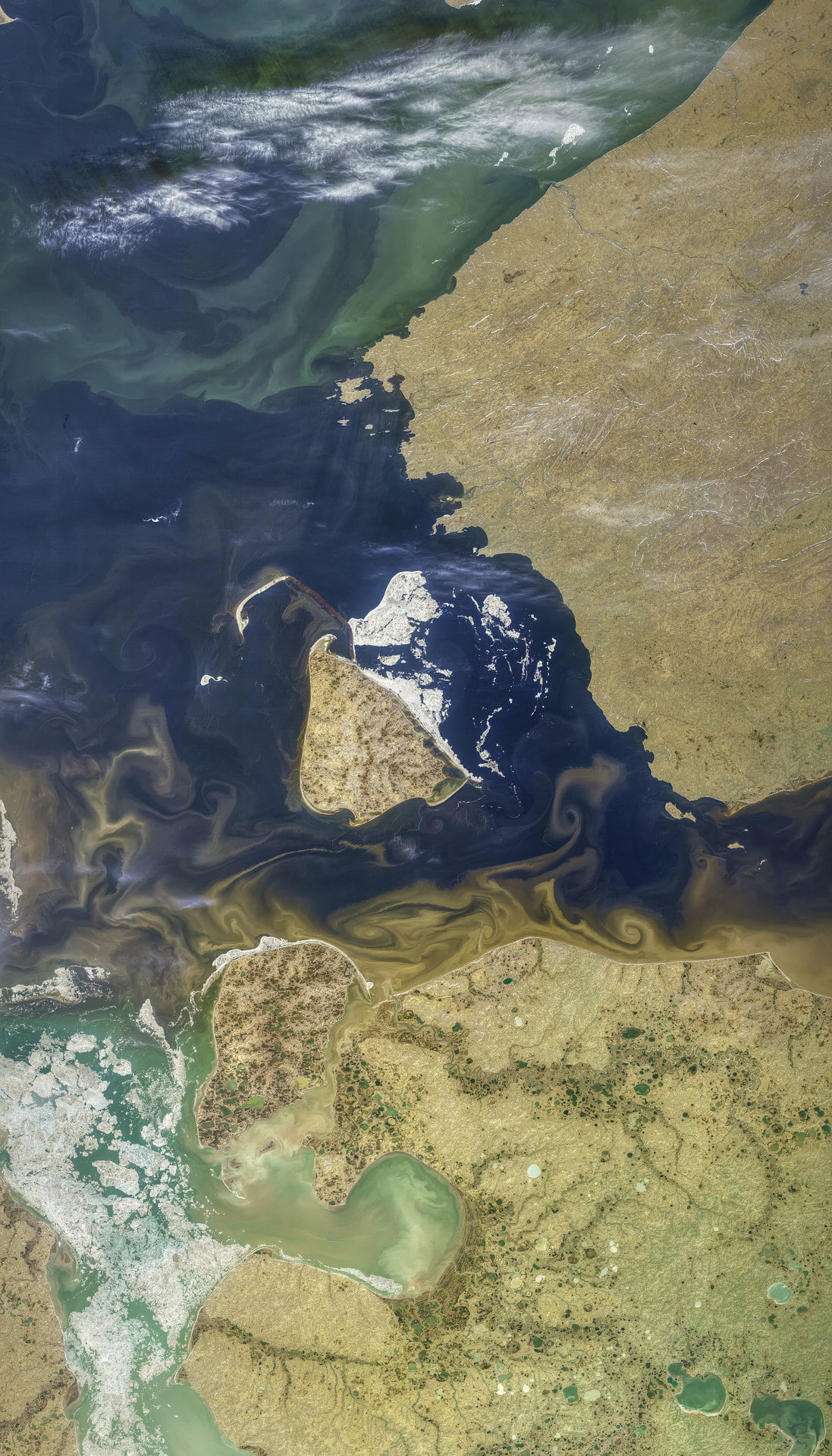
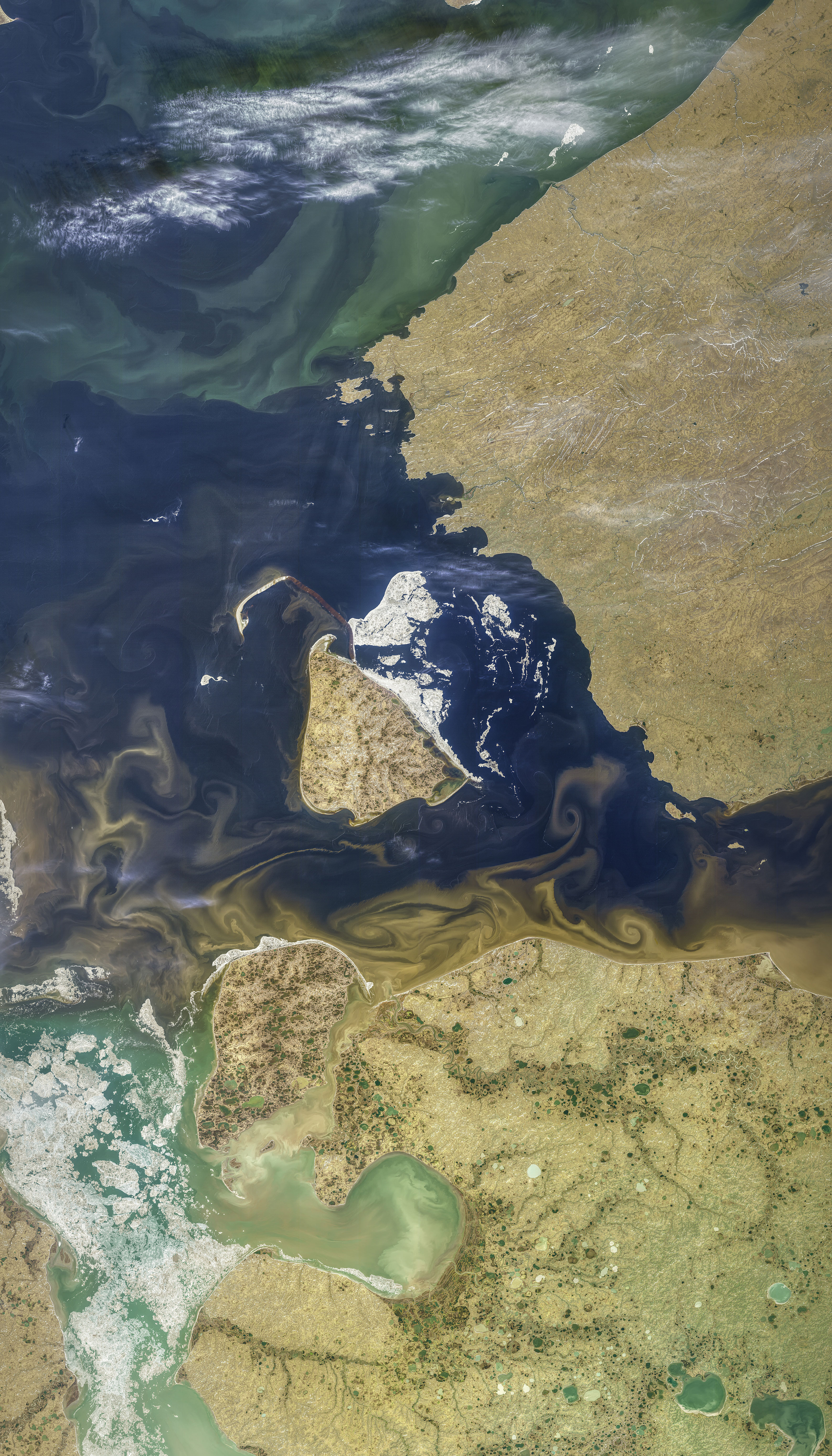
These colorful swirls show sediment and organic matter carried into the Arctic Ocean. Like dyes or tracer particles in a lab experiment, this run-off reveals the complicated patterns of mixing where freshwater and salt water mix. Delicate as they appear, these eddies are tens of kilometers across. Zoom in on the full resolution image to really appreciate the details, like the feathery edges between layers. (Image credit: N. Kuring; via NASA Earth Observatory)
If You Teach a Goose to Fly
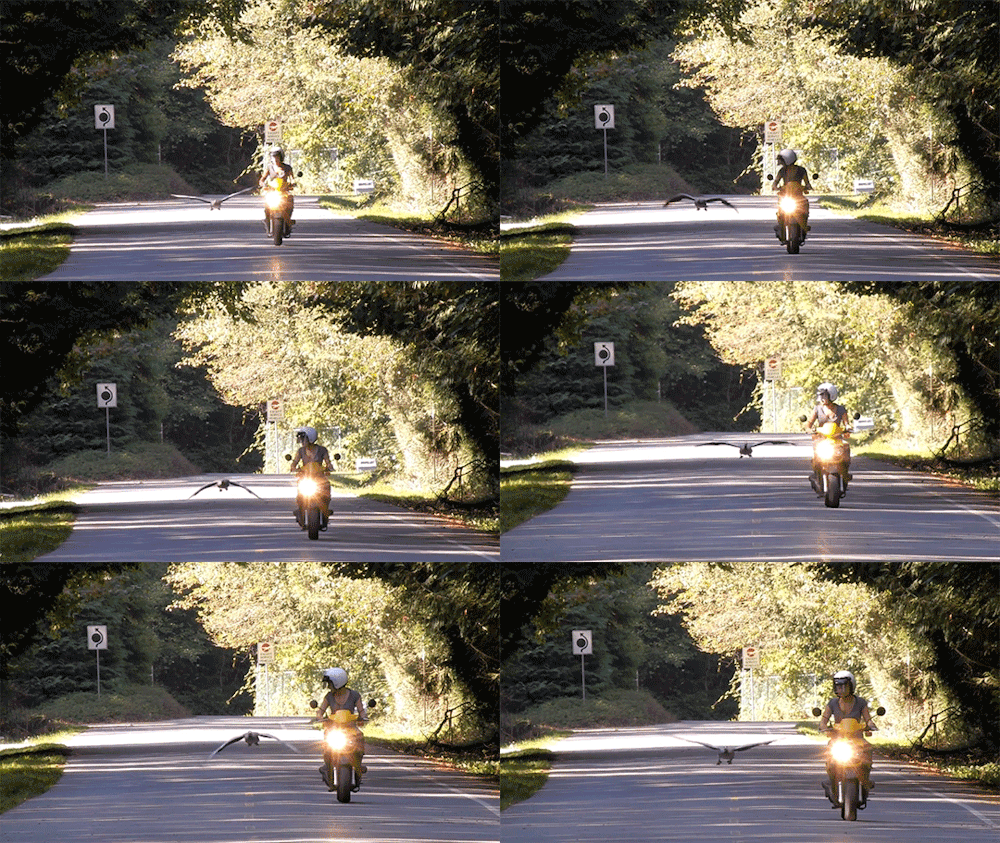

Scientists do all manner of odd things in the name of science. To teach bar-headed geese – birds capable of flying at the altitude of Everest – to fly in a wind tunnel, one group of researchers fostered a group of geese from the moment they hatched. They taught them to fly, first by chasing their bicycling parent and then following her on a motor scooter. Only then could they train the geese to fly in a wind tunnel designed to test how these birds manage to keep flying with only 30% of the oxygen found at sea level*.
The birds’ secret, it turns out, is metabolic. As the oxygen dropped, so did the temperature of the geese’s blood. Hemoglobin, which binds oxygen in blood cells, is more efficient at lower temperatures, allowing the birds to get more oxygen. At the same time, though, their overall metabolism slowed down, meaning that they required less oxygen overall to function. Taken together, these adaptations make the geese excellent fliers in conditions most animals cannot tolerate. (Image and research credit: J. Meir et al.; via WashPo; submitted by Marc A.)
* Occasionally I get comments pointing out that drag decreases with altitude, thereby making it easier to cut through the air. While this is true, I can say from my own experience of living and exercising at altitude that, for most of us, the effects of low oxygen levels far outweigh the savings in drag. It’s hard to appreciate a tiny drop in drag when your heart rate is sky high!

Anak Krakatoa Landslide


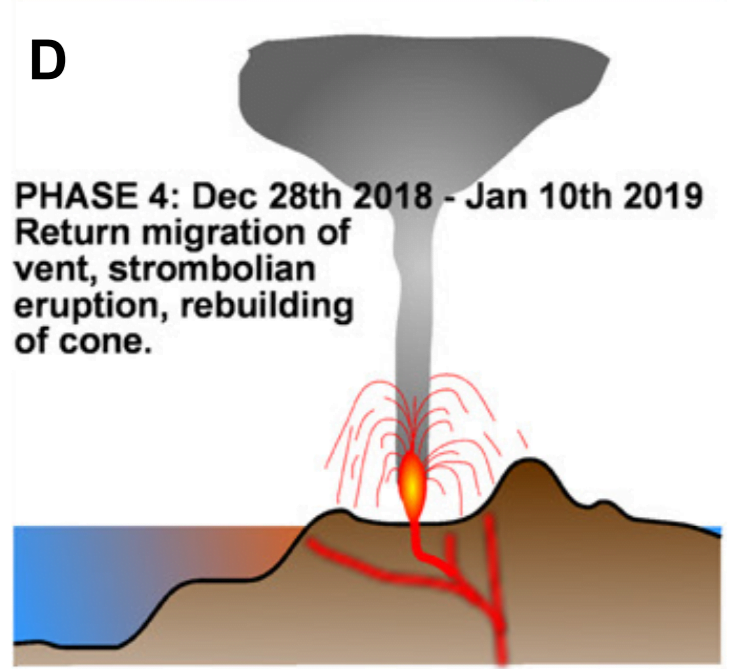
Last December, the collapsing flank of the Anak Krakatoa volcano caused a deadly tsunami in Indonesia. Using satellite imagery, scientists have now constructed a timeline of the island’s dramatic restructuring. In the process, they found that the landslide that triggered the tsunami was likely much smaller than originally estimated.
Their evidence shows that the landslide and tsunami (Image B) occurred before the eruption that destroyed the volcano’s cone. In fact, the landslide seems to have created a vent that opened directly underwater, which explains the increased violence of the eruption in late December and the eventual destruction of the volcano’s cone (Image C). After that, the underwater vent closed off and the eruption returned to its quieter state as the volcano began rebuilding its cone (Image D).
The key finding here is that the initial landslide contained roughly a third of the material originally estimated. That means our tsunami models have been seriously underestimating the catastrophic potential of smaller volcanic landslides. Hopefully the lessons we learn from Anak Krakatoa will help us avoid future tragedies. (Image and research credit: R. Williams et al.; via BBC; submitted by Kam-Yung Soh)