Artist D. A. Siqueiros sometimes used a technique he referred to as “accidental painting” in his work, in which he would pour a layer of one color of paint and then pour a second color over it. The two colors would mix in striking patterns. Here researchers recreate the technique and analyze the fluid dynamics of it. Each paint has a slightly different density thanks to the pigments used to color them. When a denser paint is poured over a less dense one (as in the white on black in the video), this activates the Rayleigh-Taylor instability. The white paint will tend to sink down below the black paint due to gravity. At the same time, the spreading of the two paints also affects the shapes and patterns through mixing and diffusion. (Video credit: S. Zetina and R. Zenit)
Tag: mixing

Viscous Fingers
When less viscous fluids are injected into a more viscous medium, the low-viscosity fluid forms finger-like protrusions into the background fluid. This is known as the Saffman-Taylor instability. The video above shows this effect but in a more dynamic setting. Blue-dyed water and a clear solution of water and glycerol fifty times more viscous than the water are injected in alternating fashion to a microfluidic channel. The blue water spreads into the clear glycerol solution via fingers that quickly diffuse, creating a homogeneous–or uniform–mixture. (Video credit: Juanes Research Group)

Surf’s Up
Diffusion of ink in water + Lego minifigs = an awesome example of fluid mechanics as art. (Photo credit: Alberto Seveso; via io9; thanks to Jennifer for the link!)
Science off the Sphere: Thin Films
Stuck here on Earth, it’s hard to know sometimes how greatly gravity affects the behavior of fluids. Fortunately, astronaut Don Pettit enjoys spending his free time on the International Space Station playing with physics. In his latest video, he shows some awesome examples of what is possible with a thin film of water–not a soap film like we make here on Earth–in microgravity. He demonstrates vibrational modes, droplet collision and coalescence, and some fascinating examples of Marangoni convection.
Reversing a Flow
The reversibility of laminar mixing often comes as a surprise to observers accustomed to the experience of being unable to separate two fluids after they’ve been combined. As you can see above, however, inserting dye into a highly viscous liquid and then mixing it by turning the inner of two concentric cylinders can be undone simply by turning the cylinder backwards. This works because of the highly viscous nature of Stokes flow: the Reynolds number is much less than 1, meaning that viscosity’s effects dominate. In this situation, fluid motion is caused only by molecular diffusion and by momentum diffusion. The former is random but slow, and the latter is exactly reversible. Reversing the rotation of the fluid undoes the momentum diffusion and any distortion remaining is due to molecular diffusion of the dye.

Oceanic Swirls
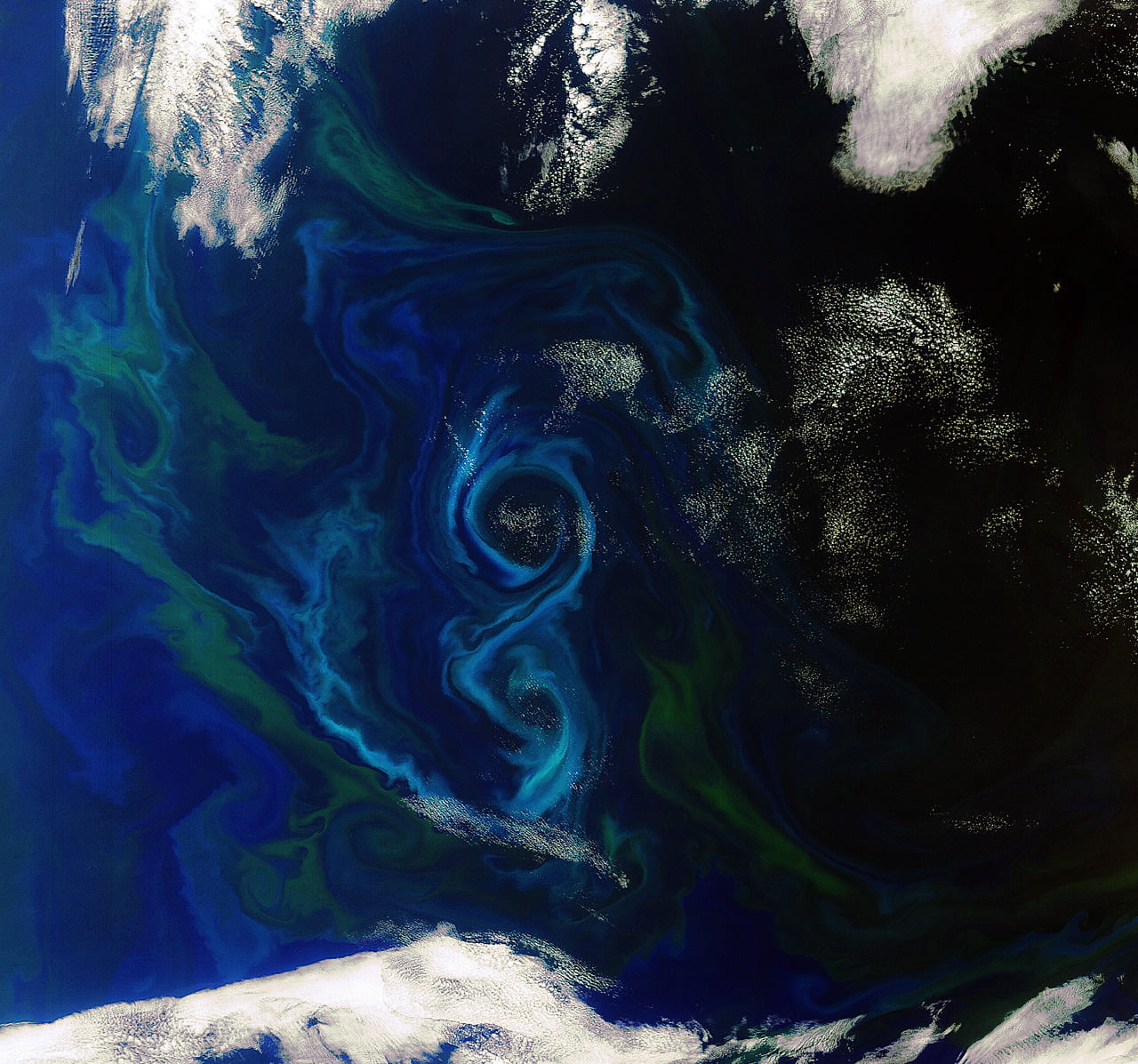
Mixing of surface waters with deeper ocean currents brings together the minerals and nutrients used by phytoplankton, resulting in gorgeous swirls of color in the ocean. These phytoplankton blooms are most common in the spring and summer, and while lovely, can be harmful to other marine life, either through the production of toxins or by depleting the waters of oxygen. Because the phytoplankton move according to the wind and waves, they can also form a sort of natural flow visualization. (Photo credit: ESA)
———-
While FYFD is not blacking out for SOPA/PIPA, we would like to take a moment to register our protest and encourage those of you who are Americans to take a moment to let Congress know that you don’t approve of these bills. Although we agree that protection of copyright holders rights is important, the measures proposed in these bills reach far beyond that line. FYFD, as a site that reposts photos and videos primarily created by others, could be taken down as a result of these bills, despite the purpose of the website as a tool for educational outreach and dissemination of science. Please support a free and uncensored Internet!
Inside a Blender
[original media no longer available]
High-speed video visualizes the complicated flow field inside a blender. Note that the video is placed in reverse for artistic effect. This flowfield is clearly too turbulent for reversible flow. That said, it is possible to mix two fluids and then unmix them, under the right circumstances.

Worthington Jet
A drop of sugar syrup falls into a pool of methylated spirits, producing a Worthington jet and several ejected droplets. Although surface tension holds the jet in a smooth shape, the refractive index of the spirits reveals the turbulent mixing within the jet. (Photo credit: Rebecca Ing)

Star-Shaped Nozzles
Efficient mixing of fluids is vital for many applications, including fuel injection for all types of combustion and masking the exhaust of stealth fighters. Star-shaped lobed nozzles can produce jets that mix more effectively than conventional jets. This photo shows cross-sections of the jet at several downstream distances from the nozzle exit. (Photo credit: H. Hu et al)

Wave Clouds Over Alabama
Last week, Birmingham, Alabama got treated to a special cloudy day, thanks to some Kelvin-Helmholtz waves, shown above. When a layer of faster moving fluid shears a slower moving fluid, this instability can form and cause some spectacular mixing. In this case, the lower, slower fluid was cool and moist enough to contain clouds, enabling us to see the effect with the naked eye. The same mechanism is responsible for the shape of breaking ocean waves and can even be seen in the atmospheres of gas giants like Saturn and Jupiter. (submitted by David B)