Tag: microfluidics

  • Featured Video Play Icon

    Swinging Jets

    In the tiny realm of microfluidics, flows are, in general, completely laminar. That makes mixing a challenge. But it turns out that pumping water steadily into multiple inlets can spontaneously generate oscillations between the jets, allowing dramatic mixing even at low Reynolds numbers. Two inlets in a parallel channel (first image) oscillate steadily over a small range of conditions, but widening the channels (second image) allows the jets to switch back and forth over a larger range. And adding additional inlets (third image) can create even more complex fluid oscillators! (Image, video, and research credit: A. Bertsch et al.)

  • Featured Video Play Icon

    Waltzing Defects

    Liquid crystals are a peculiar state of matter with both liquid and crystalline properties. In this video, a microfluidic device breaks water into droplets surrounded by a shell of liquid crystal. Because the molecular structure of the liquid crystals is helical and cannot pack neatly in a spherical shell, there are visible defects in the liquid crystal shells. Given time, those defects can merge as the liquid crystal shell thickens. (Image and video credit: The Lutetium Project)

  • Fast-Switching Multi-Material 3D Printer

    Fast-Switching Multi-Material 3D Printer

    For 3D printers to reach their potential, they need to handle more than one material and be able to swap quickly and seamlessly between them. That’s a tall order given how different materials like silicone and wax are. But a new 3D printer tackles that challenge using microfluidic nozzles designed extrude multiple fluids in quick succession. 

    The nozzle controls which fluid it ejects by pressurizing individual fluids, allowing it to switch from one to another up to 50 times a second (first image). Multiple nozzles, each containing multiple fluids, can be used to print periodically-patterned designed more quickly than previously possible (second image). The system can even directly print air-powered robots with both soft and hard components (third image). (Image and video credit: Nature, with M. Skylar-Scott et al.; research credit: M. Skylar-Scott et al.; via Nature; submitted by Kam-Yung Soh

  • Turning a Corner in Microfluidics

    Turning a Corner in Microfluidics

    Over the past couple decades, microfluidic devices have become a staple of medical and biological diagnostics and analysis. Tests that once required large and specialized equipment can now be completed closer to a patient, using only a few drops of sample fluid. Running multiple tests on a single chip can become difficult, though, since flow through the device tends to dissolve and mix the dried reagents used for tests. But a new method cleverly uses fluidic forces to keep reagents separated without the need for complicated microfluidic structures.

    The basic concept is outlined in the illustration above. You’re looking down on a microfluidic channel that’s long and very thin. A shallow groove down the middle serves as a barrier by pinning the contact line of the incoming fluid. So when the sample fluid flows in through the inlet on the left, it will only fill the top half of the cell. When it reaches the far right side, it turns the corner and flows to the left, encountering the first of the dried reagents it must dissolve for the device’s tests. The fluid will fill the lower channel quickly and then come to rest while the reagents dissolve. 

    With both sides of the channel full of liquid, the shallow barrier can no longer hold, and the fluid will take up the full width of the channel, with two well-dispersed – but separated – regions of reagents. Once that’s happened, a valve – represented by the pale blue line near the right side of the illustration – releases the fluid into the next section of the chip, allowing the analysis to proceed. (Image credit: Nature; research credit: O. Gökçe et al.; submitted by Kam-Yung Soh)

  • Escaping the Limits of Viscosity

    Escaping the Limits of Viscosity

    For large creatures, it’s not hard to feel the evidence of someone else swimming nearby. But to tiny swimmers water is incredibly viscous and hard to move. These creatures have to swim very differently than their larger cousins, and evidence of their motion dies out quickly. But at least one microorganism,  Spirostomum ambiguum, has discovered a method for overcoming the limits of size and viscosity.

    The single-celled swimmer, when threatened, contracts its body in milliseconds, generating accelerations greater than those seen by fighter pilots. That acceleration is strong enough that it generates a burst of turbulence powerful enough to overcome the natural damping of its viscous surroundings. Within their colonies, S. ambiguum seem to use contraction to send out hydrodynamic signals to neighbors, who pass on the call to arms. To see the colonies in action, check out this previous article. (Image and research credit: A. Mathijssen et al.; via Physics Today; submitted by Kam-Yung Soh)

  • Testing Vesicles

    Testing Vesicles

    In biology, vesicles contain a liquid surrounded by a lipid membrane. The characteristics of that membrane – like its stiffness – can change over time in ways that indicate other changes. For example, vesicles carrying HIV become stiffer as they grow more infectious. In the past, to observe these properties scientists used atomic force microscopes, which require removing the vesicles from the liquid in which they naturally reside. That’s problematic because it potentially changes how the vesicle responds. 

    Now researchers have developed a new method: a microfluidic system that subjects vesicles to electric fields in order to deform them and measures their properties without removing them from their carrier fluid. This provides a faster and more reliable method of testing a vesicle’s deformation, capable of testing hundreds of samples at a time. (Image credit: Wikimedia; research credit: A. Morshed et al.; submitted by Eric S.)

  • Catching Fire

    Catching Fire

    Citrus fruits like oranges house tiny pockets of oil in their peels. When squeezed, the oils jet out in tiny micro-jets that are about the width of a human hair. Despite their small size, the jets reach speeds of about 30 m/s and quickly break into a stream of droplets. When exposed to the flame of a lighter, like in the animation above, those microdroplets combust easily, creating a momentary fireball used to augment some cocktails. For more on how the citrus peel generates these jets, check out this previous post. (Image credit: Warped Perceptionsource; research credit: N. Smith et al.)

  • Transporting Droplets

    Transporting Droplets

    Transporting droplets easily and reliably is important in many microfluidic applications. While this can be done using electric fields, those fields can impact biological characteristics researchers are trying to measure. As an alternative, a group of researchers have developed the concept of “mechanowetting,” a technique that uses surface tension forces to hold droplets on a traveling wave.

    Now visually, it’s a bit tough to see what’s going on here. In the animations, it looks like the droplets are just sticking to a moving surface, but that’s an illusion. The surface the droplet is sitting on is fixed and unmoving. It’s a thin silicone film that covers a ridged conveyor belt. The belt underneath can (and does) move. This creates a traveling wave. Instead of that wave simply passing beneath the droplet, it triggers an internal flow and restoring force that helps the drop follow the wave. The effect is strong enough that small droplets are even able to climb up vertical walls or stick upside-down. (Image, research, and submission credit: E. de Jong et al.)

  • Artificial Microswimmers

    Artificial Microswimmers

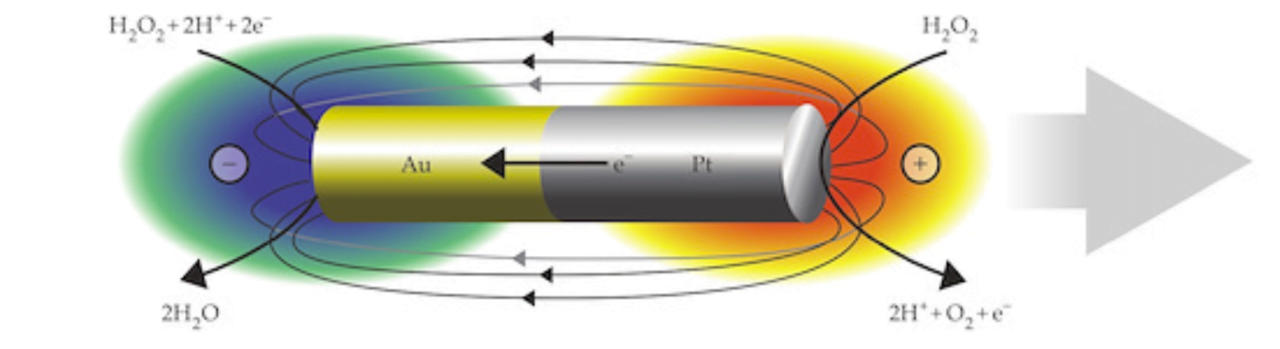
    In a 1959 lecture entitled “There’s Plenty of Room at the Bottom”, Richard Feynman challenged scientists to create a tiny motor capable of propelling itself. Although artificial microswimmers took several more decades to develop, there are now a dozen or so successful designs being researched. The one shown above swims with no moving parts at all.

    These microswimmers are simple cylindrical rods, only a few microns long, made of platinum (Pt) on one side and gold (Au) on the other. They swim in a solution of hydrogen peroxide, which reacts with the two metals to generate a positively-charged liquid at the platinum end and a negatively-charged one at the gold end. This electric field, combined with the overall negative charge of the rod, causes the microswimmer to move in the direction of its platinum end. 

    Depending on the hydrogen peroxide concentration, the microswimmers can move as quickly as 100 body lengths per second, and they’re capable of hauling cargo particles with them. One planned application for artificial microswimmers is drug delivery, though this particular variety is not well-suited to that since the salty environment of a human body disrupts the mechanism behind its motion. (Image credits: swimmers – M. Ward, source; diagram – J. Moran and J. Posner; see also Physics Today)

  • Plant Week: Citrus Jets

    Plant Week: Citrus Jets

    Bartenders and citrus lovers the world over are familiar with the mist of oil that bursts from a bent citrus peel. These microjets are about the width of a human hair, but they can spray at nearly 30 m/s in some citrus species. That’s an acceleration g-force of more 5,100, comparable to a bullet fired from a gun!

    The key to the jets is the structure of the fruit’s peel. Citrus fruits have a relatively thick, soft inner material, known as the albedo, which houses the oil reservoirs. The thin, stiff outer layer of the peel, called the flavedo or zest, covers that. When the peel is bent, the albedo compresses, increasing the pressure inside the oil reservoirs up to an additional atmosphere’s worth. Meanwhile, the flavedo is stretched. When that outer layer fails, it releases the oil pressure and a jet spurts out. For more on this work, including some awesome high-speed videos, check out my interview (starting at 2:59) with one of the authors in the video below. (Image and research credit: N. Smith et al.; video credit: N. Sharp and T. Crawford)

    FYFD is celebrating Plant Week all this week. Check out our previous posts on how moisture lets horsetail plant spores walk and jump, the incredible aerodynamics of dandelion seeds, and the ultra-fast suction bladderworts use to hunt.