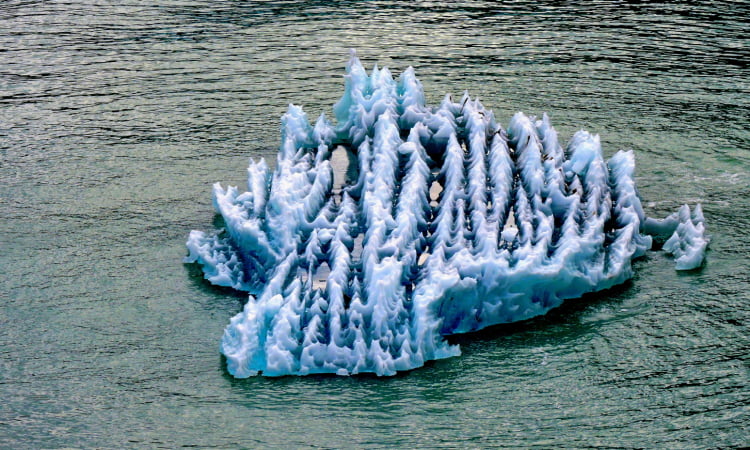
Pattern formation is extremely common in nature, from the dendritic growth of trees and snowflakes to the stripes of a tiger. A new paper describes how a thin layer of ice in a liquid can form labyrinthine patterns when illuminated with near-infrared light. Both the liquid and ice are maintained at a constant temperature below the melting point, but the ice absorbs the near-infrared light more effectively than the water. This means that parts of the ice that are far from the liquid warm and melt faster, creating holes that can then allow a pocket of liquid to seep in and reduce the absorption rate. The ice crystals themselves thin and expand across the surface at the expense of more holes, which eventually create larger channels that pock the ice. (Image and research credit: S. Preis et al.; via Nature; submitted by Kam-Yung Soh)
Tag: ice

As Ice Flows
The movement of glaciers is driven by gravity. The immense weight of the ice causes it to both slide downhill and deform – or creep. As glacier melting speeds up, scientists have debated how glacier flow will respond: will the loss of ice cause the glaciers to move more slowly since they have less mass, or will the increase in meltwater help lubricate the underside of glaciers and make them flow even faster?
By analyzing satellite image data of Asian glaciers collected between 1985 and 2017, researchers are finally answering that question. Their research shows that these glaciers are slowing down as they lose mass and speeding up as they gain mass. Nearly all – 94% – of the flow changes they observed can be accounted for solely from ice thickness and slope. This is valuable information as scientists continue to monitor and predict the changes we must expect as the world continues to warm. (Image credit: J. Stevens; research credit: A. Dehecq et al.; via NASA Earth Observatory)

Enormous Ice Disk
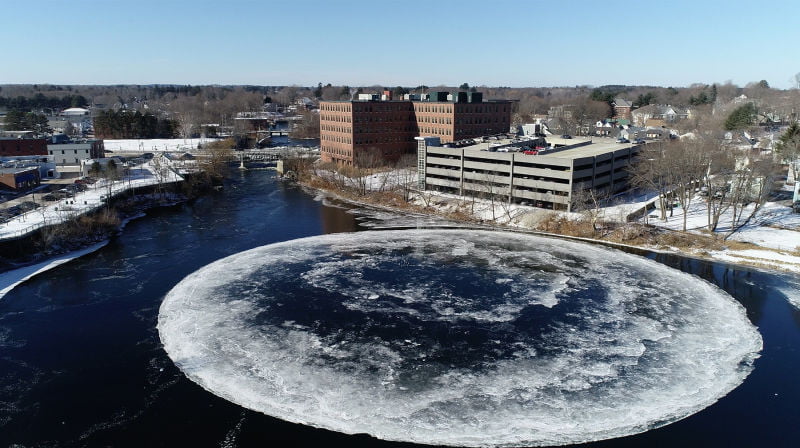
We’ve seen spinning ice disks before, but this month Westbrook, Maine has developed the largest one I’ve ever seen. A research paper from 2016 indicates that this seemingly alien formation spins due to an oddity of water. Water is at its densest around 4 degrees Celsius, so as the ice of the disk melts in the warmer waters of the river, it sinks. That downward plume sets up a vortex in the water beneath the disk. And as the water spins, it drags the ice with it, causing the disk’s rotation. The warmer the water is, the faster the disk spins. (Image credit: T. Radel/City of Westbrook; research credit: S. Dorbolo et al.; via Gizmodo; submitted by jpshoer)

“Ice Formations”
As perfect as ice can appear, it always starts with a defect. Without a speck of dust or soot to act as a seed, supercooled water simply will not freeze. But these imperfections can lead to beauty. In “Ice Formations,” photographer Ryota Kajita captures some of the oddities of ice in Alaska’s interior swamps and ponds. In Kajita’s images bubbles are frozen in suspension, plates of ice form strange shapes, and star-shaped cracks peek through the snow. Whether the ice formed too quickly or too slowly, there are interesting signatures left behind. See the full set of images, spanning the last eight years, here. (Image credit: R. Kajita; via Colossal)

Forming Europa’s Bands
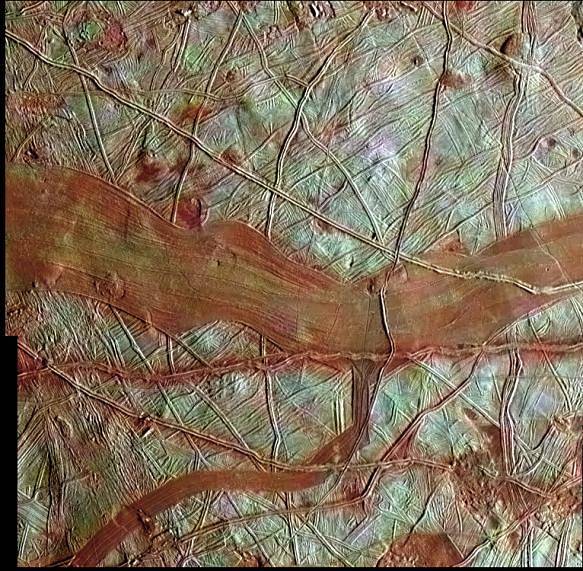
Jupiter’s icy moons, Europa and Ganymede, are home to subsurface oceans. These moons also experience strong tidal forces from their parent planet and sibling moons that squeeze and deform them over time. A new study focuses on the bands, seen in red in the top image of Europa, that form as a result of these deformations. By simulating (bottom image) both the convective currents within the Europan ocean and the deformation of the ice over time, scientists are able to study how these geological surface features may have formed. Over the course of about a million years, material from the interior ocean works its way up into the center of a band. Because this process takes so long, the researchers point out that any attempt to collect material from the bands will yield “fossil” ocean material – essentially a glimpse of Europa’s ocean as it existed a million years ago rather than how it exists today! (Image credit: NASA; image and research credit: S. Howell and R. Pappalardo, source; submitted by Kam-Yung Soh)

Tornadoes, Fire, and Ice
It’s time for another look at breaking fluid dynamics research with the latest FYFD/JFM video! This time around, we tackle some geophysical fluid dynamics, like listening to the sounds newborn tornadoes make below the range of human hearing; studying how melting ice affects burning oil spills; and how salt sinking from sea ice affects the ocean circulation. Check out the full video below for much more! If you’ve missed any of the previous videos in the series, you can check them out here. (Image and video credit: T. Crawford and N. Sharp)

PyeongChang 2018: Curling
Curling is a deceptively engrossing sport with some unique physics among Winter Olympic events. Athletes slide 19kg granite stones at a target 28 meters away. Along the way, teammates sweep the pebbled ice with brooms, melting it with frictional heating to help the stone slide further. The underside of the stones is concave, so they only touch the ice along a narrow ring. Researchers think roughness in the leading edge of the sliding stone cuts into the ice, leaving scratches that the trailing edge tries to follow. This is what causes the stone’s trajectory to curl. By melting the ice, sweeping also prevents curling, so competitors must know exactly when and how much to sweep. Ice conditions shift throughout a match, and the best players can read the ice to keep their stones where they want them. (Image credit: AP; W. Zhao/GettyImages)

PyeongChang 2018: Ice-Making
When it comes to winter sports, not all ice is created equal. Every discipline has its own standards for the ideal temperature and density of ice, which makes venue construction and maintenance a special challenge. Figure skating, for example, requires softer ice to cushion athletes’ landings, whereas short-track speed skating values dense, smooth ice for racing. The Gangneung Ice Arena hosts both and can transition between them in under 3 hours. Gangneung Oval hosts long-track speed skating and makes its ice layer by layer, spraying hot, purified water onto the rink. This builds up a particularly dense and therefore smooth ice.
The toughest sport in terms of ice conditions is curling, which requires a finely pebbled ice surface for the stones to slide on. Forming those tiny crystals on the ice sheet can only be done at precise temperature and humidity conditions. This is a particular challenge for Gangneung Curling Center due to its coastal location. To keep the temperature and humidity under control at full crowd capacity, officials even went so far as to replace all the lighting at the facility with LEDs! (Image credit: Pyeongchang 2018, 1, 2, 3)

PyeongChang 2018: Ice’s Watery Sublayer
The Olympic Charter declares that winter sports must be practiced on snow or ice. Both are frozen forms of water, which despite its ubiquity, is one of the strangest substances around. In addition to its tendency to expand as it freezes, ice is inherently slippery, and no one’s quite certain yet why.
Most people have heard the theory that ice skating is possible due to high pressure melting the ice beneath the narrow blade. But realistically, pressure melting should only work for ice down to about -3.5 degrees Celsius. By contrast, the ideal temperatures for figure skating and ice hockey are -5.5 and -9 degrees Celsius, respectively. Melting due to friction might account for slipperiness a few more degrees below freezing, but it doesn’t explain why ice can be slippery when you’re just standing on it.
When physicist Michael Faraday suggested in 1850 that ice has a thin liquid-like layer at its surface, many discounted the theory. But modern experimental techniques and computer simulations have shown that Faraday was right. Ice has a liquid-like layer some 1 to 100 nanometers thick at its surface, and this layer persists to temperatures below -30 degrees Celsius. The process is known as surface pre-melting and what causes it is an area of active research for physical chemists. Current theories include hydrogen bonding and even quantum mechanical effects. (Image credit: AP Photo/B. Armangue; research credit: R. Rosenberg; Y. Li and G. Somorjai; F. Paesani and G. Voth)
This opens FYFD’s two-week series on the physics and fluid dynamics of the Winter Olympics. Stay tuned! – Nicole

Glacial Remains
The high walls of this alpine canyon were cut by flowing glacial ice. This type of amphitheater-shaped valley is known as a cirque. The photo shows one of the Chicago Lakes on Mount Evans in the Colorado Rockies. The glacier that once sat here carved the steep walls you see in the background but also hollowed out a series of depressions like the ones shown in the figure below. When temperatures warmed and the glacier melted, it left behind a series of three small lakes, or tarns, like the one in the photo above. Cirques are found throughout the mountain ranges of the world. (Image credit: Mt. Evans – J. Shoer; cirque formation – DooFi)