Winter weather in northern latitudes sometimes brings with it unusual phenomena like this ice disk spinning in the Middle Fork Snoqualmie River in Washington state. Photographer Kaylyn Messer ventured out to capture photos and videos of the event over the weekend. There are a couple theories as to how such disks form, but swirling river eddies are a key ingredient. One theory posits that chunks of ice forming on the river get caught up by the spinning eddy and slowly freeze together to form the disk. Another theory proposes that the disks occur when an existing chunk of ice breaks away, gets caught in the spinning eddy and slowly has its edges ground down into a circle. Personally, I lean toward the former explanation, though there is likely grinding at the edges either way. See more about this ice circle over at Messer’s blog. (Image credit: K. Messer; GIF by @itscolossal; via Colossal)
Tag: ice

Why Ice is Slippery
Ice is slippery. This is a fundamental fact we humans have dealt with so often that we rarely take the time to ask why. Other solids aren’t inherently slippery, so what is it that makes ice so? Remarkably, scientists only began to ask this question and propose theories within the past couple hundred years. One common suggestion is that the high pressure of an ice skate on ice locally melts the ice, creating a thin liquid layer a skater glides across. But this does not explain why ice is slippery for shoes or tires, nor why it’s possible to ice skate at more than a few degrees below freezing. Several other effects may be in play, such as frictional heating or the peculiar molecular forces between water molecules. Current research suggests that ice has a thin liquid layer tens or hundreds of nanometers thick that causes its slippery nature. For a great review of the subject, see Robert Rosenberg’s Physics Today article. (Video credit: SciShow)

Fluids Round-up
Time for another look at some of the best fluids content out there. It’s the fluids round-up – with a special focus this week on oceans!
– Ryan Pernofski spent two years filming the ocean in slow motion with his iPhone to make the short film “Slowmocean” seen above. It’s a gorgeous ode to the beauty of breaking waves.
– Oceans with higher salinity than Earth’s could drive global circulation that would make exoplanets more hospitable to life.
– Speaking of alien oceans that could harbor signs of life, there’s discussion afoot of how future missions to icy moons like Europa or Enceladus could collect samples from plumes ejected from beneath the ice.
– Wind and waves make harsh, erosive environments. This photo essay from SFGate shows how greatly the sands of Pacifica shift over time. (submitted by Richard)
Bonuses:
– New research explores how Martian mountains may have been carved out by the wind.
– Ever listened to an orchestra made from ice? You should! Learn about Tim Linhart, who builds and maintains ice instruments. (submitted by ashketchumm)
– MIT has demonstrated a new 3D-printing technique that allows for printing liquid and solid parts simultaneously, allowing would-be creators to rapid-prototype hydraulically-driven robotics.
Even more bonus bonus!
– ICYMI, the new FYFD video made Gizmodo!
If you’re a fan of FYFD, please consider becoming a patron. As a bonus, you’ll get access to this weekend’s planetary science webcast!

(Video credit: R. Pernofski; via Flow Visualization; Pluto image credit: NASA/APL)

Freezing Soap Bubbles
I’m not a winter person, but there’s something almost magical about the way water freezes. From instant snow to snow rollers and weird ice formations to slushy waves, winter brings all kinds of bizarre and unexpected sights. The video above is an artistic look at one of my favorites – freezing soap bubbles. Normally, the thin film of a soap bubble is in wild motion, convecting due to gravity, surface tension differences, and the surrounding air. Such a thin layer of liquid loses its heat quickly, though, and, as ice crystals form, the bubble’s convection and rotation slow dramatically, often breaking the thin membrane. Happily photographer Paweł Załuska had the patience to capture the beautiful ones that didn’t break! (Video credit: P. Załuska; via Gizmodo)
If you enjoy FYFD and want to help support it, please consider becoming a patron!

Melting Ice Sheets From Below
A new study of ice sheets in West Antarctica has made major news this week with the announcement that the ice melt in this region is unstoppable and may raise sea levels by more than 1.2 meters. Part of what makes the ice sheet so unstable is the local topography, shown schematically in the animation above. The land on which the glacier sits lies well below sea level, and the grounding line marks where the ice, sea, and land meet. Part of the glacier projects outward as a sheet, with seawater between it and the land; this is not unusual, but it can encourage melting if the water under the ice sheet is warmer. A major problem for this region, though, is that the slope of the underlying land tilts downward. This means that, as warmer water begins circulating under the ice sheet, it causes the grounding line to retreat and expose a greater volume for warm water to fill beneath the ice. More warm water melts more ice and the process continues unabated. (Video credit: NASA/JPL; h/t to jtotheizzoe, jshoer)

Freshwater Flux
These satellite images show the effects of a sudden influx of warm freshwater on sea ice in the Arctic Ocean. On the left are natural color satellite images of Canada’s Mackenzie River delta where it enters the Beaufort Sea. On the right are temperature maps of the ice and water surface temperatures for the same regions. In June 2012, the coastal sea ice that had been blocking the river’s delta broke, releasing a massive discharge of river water. The natural color images show brown and tan sediment reaching far out from the river delta, but the temperature maps on the right are even more dramatic. Warmer river water has spread many hundreds of kilometers from the delta, melting sea ice and raising the open water surface temperatures by an average of 6.5 degrees Celsius. The effects of river discharge on sea ice melt are increasing as inland Arctic areas warm more in the summers and the sea ice becomes thinner and more vulnerable each year. (Image credits: NASA Earth Observatory)

Glacier Flows

These astronaut photos show Patagonian glaciers as seen from space. Glaciers form over many years when snow accumulates in larger amounts than it melts or sublimates. Over time the snow collects and is compacted into a dense ice which slowly flows downslope due to gravity. Many of the dark streaks in the photos are moraines, sediment formations deposited by the movement of the ice. Lateral moraines often line the edges of a glacier, and when two or more glaciers flow together, like in the lower left corner of both photos, the lateral moraines of each of the glaciers combine to form a medial moraine running through the combined glacial flow. (Photo credits: M. Hopkins and K. Wakata)

Sochi 2014: Why is Ice Slippery?
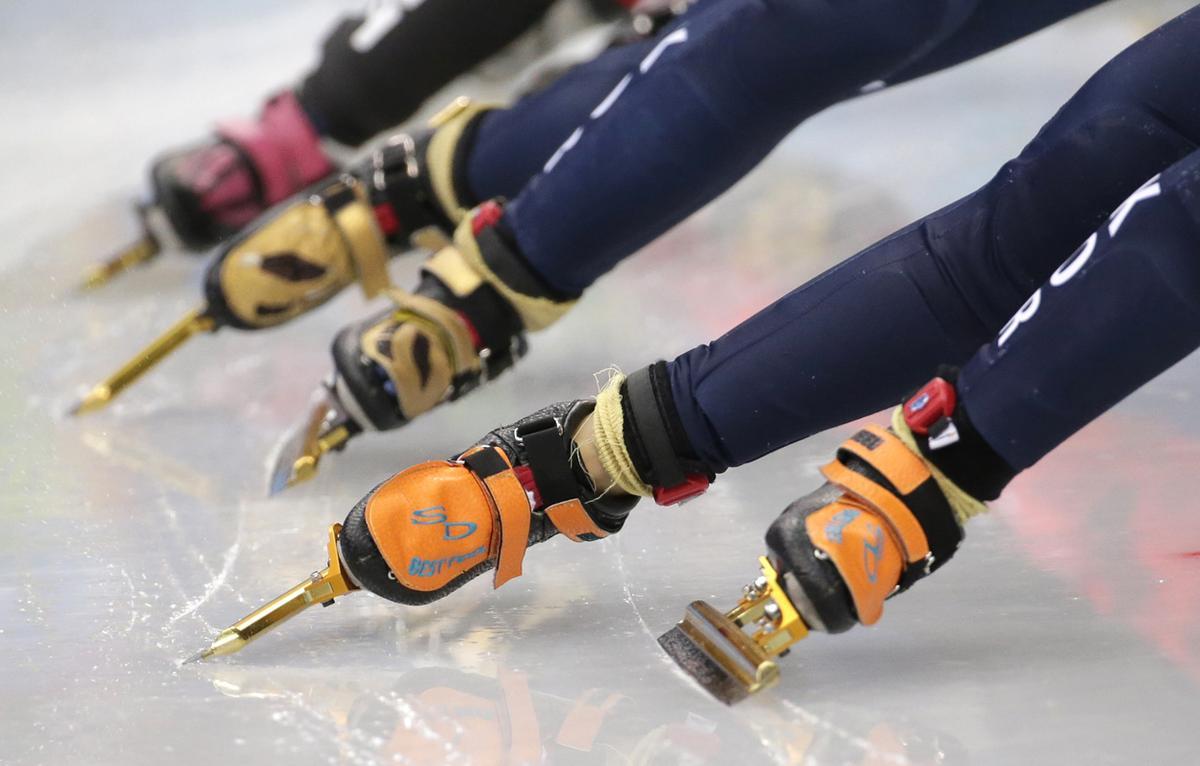
Ice is a key component of many Winter Olympic disciplines, including figure skating, hockey, speed skating, curling, and the sliding sports. The low friction and slippery nature of the ice are vital to the events, but oddly enough, scientists don’t yet fully understand why ice is slippery. A common explanation is that the narrow blades on which athletes compete cause extremely high pressures that locally melts the ice, creating a thin layer of water upon which the athlete glides. The trouble with this explanation is that it only accounts for ice being slippery within a few degrees of its melting point. Not only that, anyone who has fallen when walking on ice knows that it is slippery even without ice skates. In 1859 physicist Michael Faraday suggested that ice may be covered in a thin liquid-like layer even at temperatures well below freezing. Experiments since then suggest that this layer is tens or hundreds of nanometers thick, depending on the purity of the surface film. Robert Rosenberg has an excellent review of the subject in Physics Today. (Image credit: Reuters/D. Gray via The Big Picture)
This post opens up our series on fluid dynamics in the Winter Olympics. Stay tuned for more over the next two weeks. Got a question in mind? Seen a great article? Feel free to ask questions or submit links on Tumblr, Twitter, or by email.

Lenticular Clouds Over Ice

Lenticular clouds, like the one shown above, often attract attention due to their unusual shape. These stationary, lens-shaped clouds can form near mountains and other topography that force air to travel up and over an obstacle. This causes a series of atmospheric gravity waves, like ripples in the sky. If the temperature at the wave crest drops below the dew point, then moisture condenses into a cloud. As the air continues on into a warmer trough, the droplets can evaporate again, leaving a stationary lenticular cloud over the crest. This particular lenticular cloud was captured by Michael Studinger during Operation IceBridge in Antarctica. The line of ice in the foreground is a pressure ridge of sea ice formed when ice floes collided. (Photo credit: M. Studinger; via NASA Earth Observatory)

Cracks in Sea Ice
Arctic sea ice often appears as a single extensive sheet when, in reality, it is made up of many smaller sections of ice shifting and grinding against one another under the influence of winds and ocean currents. This can cause cracks–known as leads–to open up between sections of the ice. This animation, constructed from infrared satellite images, shows the growth of several cracks, leading to extensive break-up of the ice sheet from late-January through March. The fracturing was driven by a high-pressure system that parked over the region, bringing warmer temperatures and southwesterly winds that fueled the Beaufort Gyre, a large-scale, wind-driven, clockwise circulation in the sea that helped pull the ice apart. For more, see NASA EO’s explanation. (Video credit: NASA Earth Observatory)