Antlion larvae dig sandpits to catch their prey, and, according to a new study, they rely on the physics of granular materials to do so. The antlion digs in a spiral pattern (bottom), beginning from the outside and working its way inward. As it digs, it ejects larger grains and triggers avalanches that cause large grains to fall inward. This leaves the walls of the final pit lined with small grains, which have a shallower angle of repose and will slip out from under any prey that wander in. The subsequent avalanche will carry the victim to the antlion lying in wait at the center of the pit. (Image credits: antlion larva – J. Numer; antlion digging – N. Franks et al.; research credit: N. Franks et al.; submitted by Kam-Yung Soh)
Tag: granular material

Collective Motion: Crowds
It’s sometimes taken for granted that, in groups, people can behave a lot like a fluid or a granular material. This allows scientists to adapt models developed for those materials to understand how crowds move. But in doing so, it’s always important to test just how far the comparison holds; in other words, just how much does a crowd of people behave like a fluid or granular material?
That’s the purpose behind the experiment you see above, where a dense crowd of people shift in response to a “cylindrical intruder”. This is a classic experiment for something like a granular material, and there are clear similarities. Most of the crowd’s shifting comes only a short way from the intruder, and their passage leaves a small, empty wake that slowly fills back up.
But other aspects of the experiment are very different from the granular equivalent. Instead of moving only when contact forces cause them to, the crowd shifts in anticipation of the intruder’s passage. They also use a more confined motion; crowd members primarily shift to the side to allow the intruder by, whereas grains tend to follow a more circular pattern of motion. Interestingly, if the intruder approaches from behind – and thus crowd members cannot anticipate them – the crowd’s motions will actually better match a granular material. (Image and research credit: A. Nicholas et al., source)
All this week at FYFD we’re looking at collective motion. Check out our previous posts here and here.

Stress Between Grains
Granular materials like sand and beads can shift and flow in fluid-like ways, but they’re much harder to predict. Part of this is due to the way friction between individual grains transmits force through the network. Here, we see photoelastic beads responding to the intrusion of a narrow rod. The lightning-like flashes show how stress is traveling between neighboring grains. Notice how the lower grains are essentially frozen into a state of high stress, but the movable upper grains shift and readjust themselves to try and relieve stress.
This experiment took place under lunar gravitational conditions. Lower gravity means that it takes a larger pile of grains on top to create a given stress. But it also means it’s easier for those movable top grains to shift or even get thrown up by a hastily applied force. The purpose of experiments like this is to better understand how rovers and probes should dig in low-gravity environments without kicking up a cloud of regolith and dust. (Image credit: K. Daniels et al., source)

Forming Asteroids
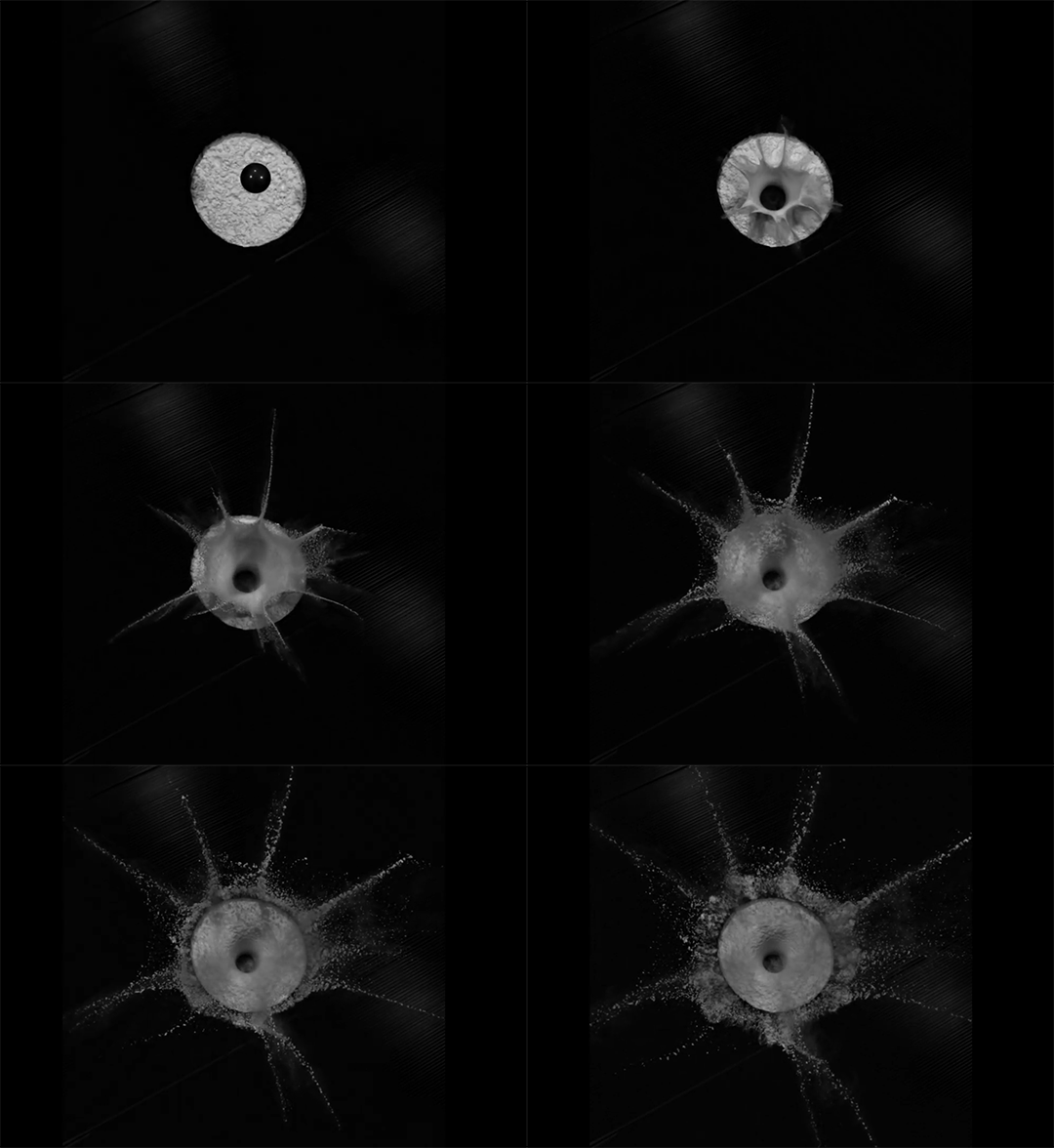
Amidst the swirling gas and dust surrounding young stars, asteroids and planets form. Just how these bodies come together – especially before they are massive enough to exert any significant gravitational potential – is an open question. Researchers are trying to better understand the physics involved by studying how clusters of granular material behave when impacted.
Above you see footage from two experiments. Both take place in a drop tower under vacuum conditions. That means the effects of air drag and gravity are removed, just like in space. On the left, the cluster is made up of soft clumps of dust; on the right, the cluster contains hard glass beads. Surprisingly, the researchers found that the two different materials behave the same way. They were able to describe both sets of impacts with exactly the same model. This suggests there may be an underlying universal behavior behind all of these granular materials, though the researchers note more experiments are needed. (Image and research credit: H. Karsuragi and J. Blum; via APS Physics)

Ants Avoid Traffic Jams by Giving Up
Both ants and traffic are well-connected to fluid dynamics, even if they are not, strictly speaking, fluids. As it happens, ant traffic has interesting implications not only for human transit but for avoiding clogs in crowds or when pouring granular materials.
Ants tend to dig narrow tunnels. This helps individual ants recover from potential slips, but it also makes clogging more likely. Researchers studying the behavior of individual ants during tunnel digging found that ants entering the tunnel often turn around without collecting a grain and carrying it away. When they encounter heavy traffic, they simply reverse direction and give up. So 70% of the work of digging was done by only 30% of the ants. This seemingly unfair division of labor actually optimizes the overall traffic flow and work output for the ants as a whole. Without this instinct to turn around and ease the jam, incoming ants would cascade the traffic and worsen the jamming. (Image and research credit: J. Aguilar et al.; see also Physics Today)

Flowing Flowers
Granular mixtures with particles of different sizes will often segregate themselves when flowing. In this half-filled rotating drum large red particles and smaller white ones create a stable petal-like pattern. As the drum turns, an avalanche of small particles flows down, forming each white petal. When the avalanche hits the drum wall, a second wave – one of the larger, red particles – flows uphill toward the center of the drum. If the uphill wave has enough time to reach the center of the drum before the next avalanche of smaller particles, then the petal pattern will be stable. Otherwise, the small particles will tend to fall between the larger ones, disturbing the pattern. (Image and research credit: I. Zuriguel et al., source; via reprint in J. Gray)

Swirling the Wrong Way
When you swirl wine, you create a rotating wave that travels in the direction that you’re moving the glass. You would expect that anything floating atop that fluid would travel in the same direction of rotation. But it turns out, for a large, thin raft floating atop the rotating fluid, that’s not the case.
Above you can see a swirling container, rotating counter-clockwise, with a raft of foam. This is from a timelapse where only one photo is taken per rotation, so that it’s easier to see how the foam is rotating relative to the container. And, once enough foam covers the surface, it starts rotating in a clockwise direction – opposite the container! It works for more than foam, too. The researchers show that the same holds for powders or beads. The key to the counter-rotation is that the raft needs to be coherent; it has to be able to transmit friction and internal stress among its constituents. Otherwise, the raft will just drift along with the swirling wave. (Image and research credit: F. Moisy et al., source, arXiv; via Improbable Research; submitted by David H. and Kam-Yung Soh)

Grain Networks
Granular materials are complicated beasts. When packed, forces between grains create a network (above) that shifts as force is applied. And, while grains can stick and resist that force, push a little further and they may slip and avalanche. A new study of this stick-slip behavior monitors disks similar to those above by listening for changes leading up to the slip. Researchers found that vibrations inside a granular material changed measurably before the grains slipped. The scientists hope this will one day allow for monitoring of landslide and avalanche-prone areas. While the changes are not enough to definitively predict when a slide will occur, they may provide valuable estimates of when one is likely. (Research credit: T. Brzinski and K. Daniels; image credit: OIST, source; via J. Ouellette)

Craters and Rays
The history of our solar system is written in impact craters, but these craters have been remarkably mysterious for years. Scientists knew that you could recreate many of their features by dropping solid objects into granular materials like sand, but this did not produce the distinctive rays that we see around many real craters (bottom image, Mars). It was only by watching videos of schoolchildren recreating these experiments that scientists discovered what they’d been doing wrong: they’d smoothed the sand’s surface first.
It turns out that when you smooth the sand before impact (top left), you get an even ejecta curtain with no rays. But when the surface is uneven, as it is in kids’ experiments or on actual planetary bodies, suddenly rays form (top right). The object’s impact creates a shock wave in the granular medium, which becomes a rarefaction (i.e., expansion) wave when it reaches the surface. This is what actually ejects material. The uneven surface focuses those rarefaction waves, creating the distinctive ejecta rays. (Image credit: T. Sabawala et al., source; NASA; research credit: T. Sabawala et al.; via Jennifer O.)

Sandy Splashes
Sand and other granular materials can be strikingly fluid-like. Here the impact of a solid sphere on sand generates a splash remarkably similar to what’s seen with water. When the ball hits, it creates a crater in the surface and sends up a bowl-like spray of sand. As the ball continues falling through the sand, the grains try to fill the empty space left behind. The walls of sand collapsing around the void meet somewhere between the surface and the depth of the ball. This generates the tall jet we observe, as well as a second one under the surface that we can’t see. We know that collapse traps an air bubble under the surface because of the eruption that occurs as the jet falls. That’s the air bubble reaching the surface. (Image credit: T. Nguyen et al., source; see also R. Mikkelsen et al.)