Tag: granular flow

  • Flowing Flowers

    Flowing Flowers

    Granular mixtures with particles of different sizes will often segregate themselves when flowing. In this half-filled rotating drum large red particles and smaller white ones create a stable petal-like pattern. As the drum turns, an avalanche of small particles flows down, forming each white petal. When the avalanche hits the drum wall, a second wave – one of the larger, red particles – flows uphill toward the center of the drum. If the uphill wave has enough time to reach the center of the drum before the next avalanche of smaller particles, then the petal pattern will be stable. Otherwise, the small particles will tend to fall between the larger ones, disturbing the pattern. (Image and research credit: I. Zuriguel et al., source; via reprint in J. Gray)

  • Grain Networks

    Grain Networks

    Granular materials are complicated beasts. When packed, forces between grains create a network (above) that shifts as force is applied. And, while grains can stick and resist that force, push a little further and they may slip and avalanche. A new study of this stick-slip behavior monitors disks similar to those above by listening for changes leading up to the slip. Researchers found that vibrations inside a granular material changed measurably before the grains slipped. The scientists hope this will one day allow for monitoring of landslide and avalanche-prone areas. While the changes are not enough to definitively predict when a slide will occur, they may provide valuable estimates of when one is likely. (Research credit: T. Brzinski and K. Daniels; image credit: OIST, source; via J. Ouellette)

  • Featured Video Play Icon

    Sandy Wrinkles

    Water flowing back and forth over sand quickly forms a field of dune-like wrinkles. On the upstream side, the flow is a little faster, and it picks up grains of sand. When the flow slows on the downstream side of a bump, the sand gets deposited. In this way, small bumps in the sand continue growing larger. A similar process between wind and sand forms enormous dunes here on Earth and on Mars. These smaller water-driven wrinkles are very common in tidal areas and in sandy creeks. They can even build up and break down such that they create periodic waves that surge down the stream. (Image and video credit: amàco et al.)

  • The Catherine Wheel

    The Catherine Wheel

    When particles of different sizes fall in an avalanche, they separate out by size. Smaller particles form one layer with another layer of larger particles over the top. This happens because the smaller particles tend to fall in between the larger ones, similar to the percolation theory in the Brazil nut effect. In a slowly rotating drum, this size segregation during an avalanche forms a distinctive pattern (above) called a Catherine wheel pattern. Here, the gray layers form from smaller iron particles, while the white layers are large particles of sugar. Notice that the pattern starts to form during each avalanche, but it freezes in place after grains pile up against the drum wall and cause a shock wave to run back up the avalanche. (Image credit: J. Gray and V. Chugunov, reprinted in J. Gray, source)

  • Dune Networks

    Dune Networks

    In sandy deserts, winds can build a vast network of dunes whose shapes depend on the winds that built them. This photograph, taken by an astronaut aboard the International Space Station, shows part of a Saharan dune field known as the Grand Erg Oriental. Of the five basic types of sand dunes, this field features all but one. The predominant winds of the region build most of the dunes into long, straight chains separated by interdune flats some 150 meters lower in elevation. Within the chains, there are linear dunes, created by winds blowing nearly parallel to the dune’s long axis. In places where winds tend to change directions, several linear dunes may merge to form star dunes, like the one just below and right of center in the image. Transverse dunes form perpendicular to the predominant wind direction. The one shown in the upper left of this image may have formed when multiple crescant-shaped barchan dunes merged. (Image credit: NASA, via NASA Earth Observatory)

  • Water on Mars

    Water on Mars

    Recurring slope lineae (RSL) are seasonal features on Mars that leave behind gullies similar to those left by running water on Earth. Their discovery a few years ago has prompted many experiments at Martian conditions to determine how these features form. At Martian surface pressures and temperatures, it’s not unusual for water to boil. And that boiling, as some experiments have shown, introduces opportunities for new transport mechanisms.

    Researchers found that water in “warm” (T = 288 K) sand boils vigorously, ejecting sand particles and creating larger pellets of saturated sand. Water continues boiling out of the pellets once they form, creating a layer of vapor that helps levitate them as they flow downslope. The effect is similar to the Leidenfrost effect with drops of water sliding on a hot skillet; there’s little friction between the pellet and the surface, allowing it to travel farther.

    The mechanism is quite efficient in experiments under Earth gravity and would be even more so under Mars’ lower gravity. It also requires less water than alternative explanations. The pellets that form are too small to be seen by the satellites we have imaging Mars, but the tracks they leave behind are similar to the RSL seen above. (Image credit: NASA; research credit: J. Raack et al., 1, 2; via R. Anderson; submitted by jpshoer)

  • PyeongChang 2018: Moguls

    PyeongChang 2018: Moguls

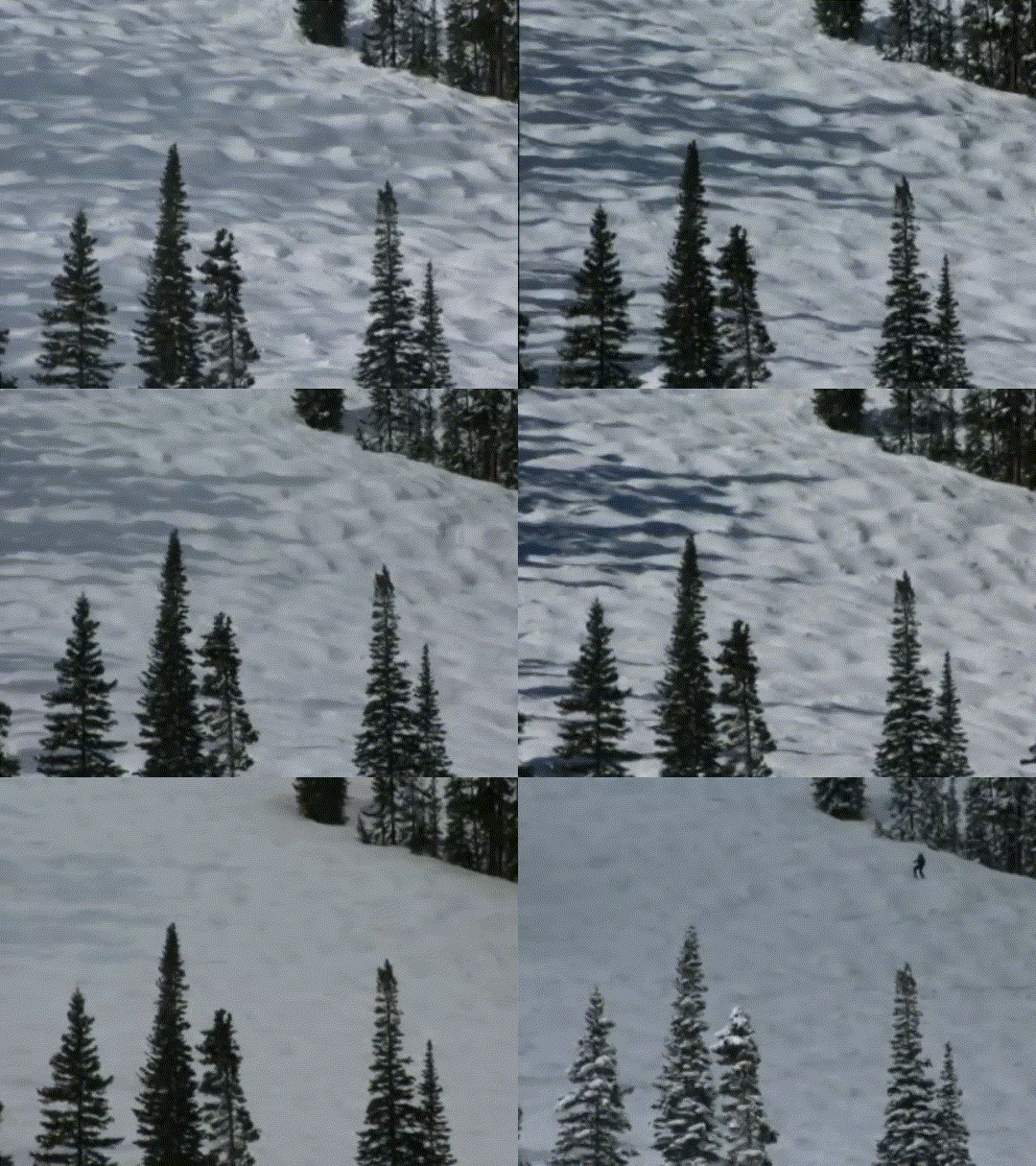
    Moguls are bump-like snow mounds featured in freestyle skiing competitions and also frequently found on recreational ski courses. Although competition runs are man-made, most mogul fields form naturally on their own. As skiiers and snowboarders carve S-shaped paths down the slope, their skis and snowboards remove snow during sharp turns and deposit it further downhill. Over a surprisingly short amount of time, these random, uncoordinated actions form bumps large enough that they force skiers and snowboarders to begin turning on the downhill side of the bump. That action continues to carve out snow on the uphill side and deposit it downhill, effectively causing the downhill bumps to migrate uphill, as seen in the timelapse animation below. As more moguls form, their motion organizes them into a checkerboard-pattern that moves in lockstep. Observations show that mogul fields can move about 10 meters uphill over the course of a season. Seemingly, the only way to prevent mogul formation on steep slopes is to regularly groom them back to a flat state! (Image credits: J. Gruber/USA Today; J. Huet; D. Bahr; research credit:  D. Bahr et al.)

    image
  • Flowing Through Tight Spaces

    Flowing Through Tight Spaces

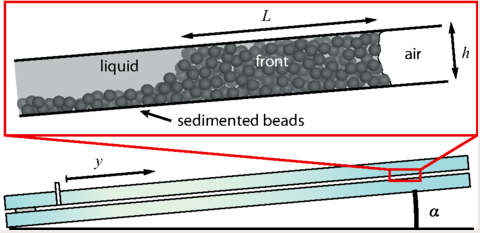
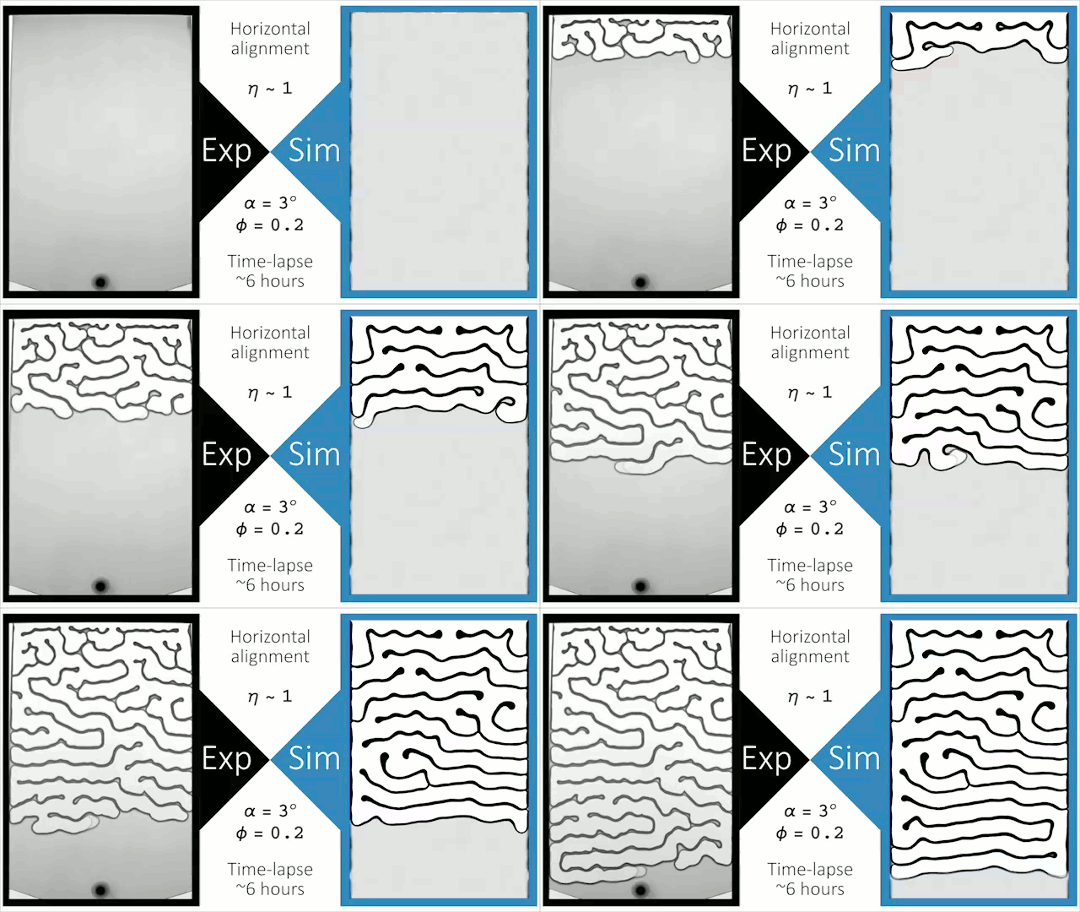
    Fluid flow through porous media inside confined spaces can be tough to predict but is key to many geological and industrial processes. Here researchers examine a mixture of glass beads and water-glycerol trapped between two slightly tilted plates. As liquid is drained from the bottom of the cell, air intrudes. Loose grains pile up along the meniscus and get slowly bulldozed as the air continues forcing its way in. The result is a labyrinthine maze formed by air fingers of a characteristic width. The final pattern depends on a competition between hydrostatic pressure and the frictional forces between grains. Despite the visual similarity to phenomena like the Saffman-Taylor instability, the authors found that viscosity does not play a major role. For more, check out the video abstract here. (Image and research credit: J. Erikson et al., source)

  • An Armored Bed

    An Armored Bed

    A river’s flow constantly changes its underlying bed. The rocks and particulates beneath a flowing river can typically be divided into two zones: an upper layer called the bed-load zone where the flow moves particles with it and a lower layer where particles are mostly trapped but may creep over long periods. In gravelly river-beds this upper bed-load zone tends to accumulate more large particles, a phenomenon known as armoring. Experiments show that, in this region, large particles have a net vertical velocity moving upward, while smaller particles tend to move downward. Exactly why large particles are more prevalent in the bed-load zone in unknown; several theories have been offered. One suggests that the size segregation is similar to the Brazil nut effect and that smaller particles have a tendency to fall into gaps and sink more easily than larger ones. (Image and research credit: B. Ferdowsi et al., source)

  • Featured Video Play Icon

    Build Your Own Fluidized Bed

    Previously, we featured some GIFs of bubbling, fluidized sand (below). Inspired by the same video, Dianna from Physics Girl decided to build her own set-up, discovering along the way that it’s a little tougher than you might think. To work well, you’ll need very fine, dry particles and a good way to uniformly distribute the air so it doesn’t simply bubble up in one spot. And if you accidentally apply too much air pressure, you may get a face full of sand. The final results are very fun, though, and hopefully Dianna’s lessons learned will help any other DIYers interested in trying this experiment at home. For a little more on the physics here and in related topics, check out some of our previous posts on fluidization, soil liquefaction, quicksand, and dam failures. (Video credit: Physics Girl; image credit: R. Cheng, source)