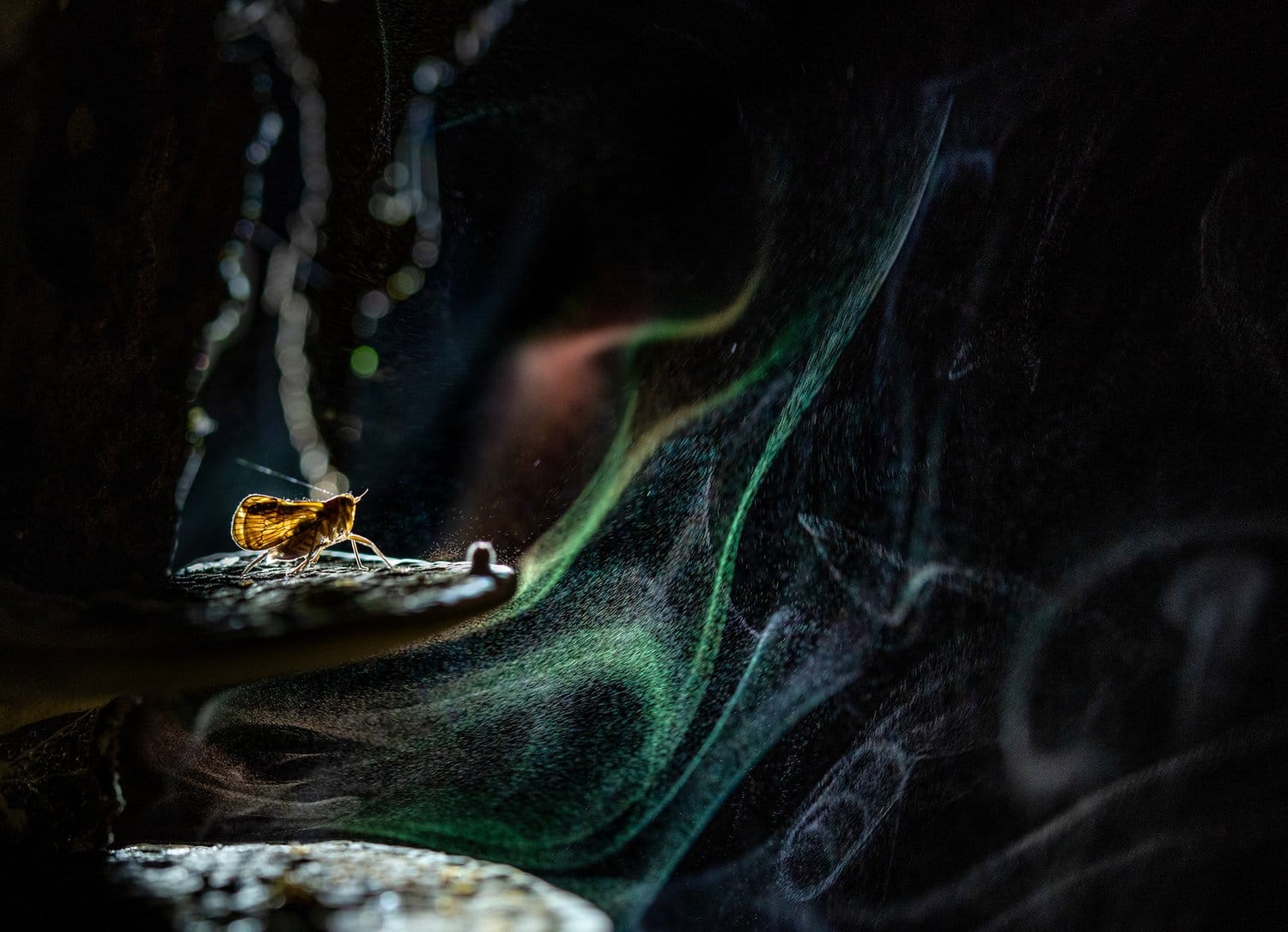
Fungal spores sketch out minute air currents in this shortlisted photograph by Avilash Ghosh. The moth atop a mushroom appears to admire the celestial view. In the largely still air near the forest floor, mushrooms use evaporation and buoyancy to generate air flows capable of lifting their spores high enough to catch a stray breeze. (Image credit: A. Ghosh/CUPOTY; via Colossal)
Tag: fluids as art

“Lively”


In “Lively,” filmmaker Christopher Dormoy zooms in on ice. He shows ice forming and melting, capturing bubbles and their trails, as well as the subtle flows that go on in and around the ice. By introducing blue dye, he highlights some of the internal flows we would otherwise miss. (Video and image credit: C. Dormoy)

“Waterfall Wonder”
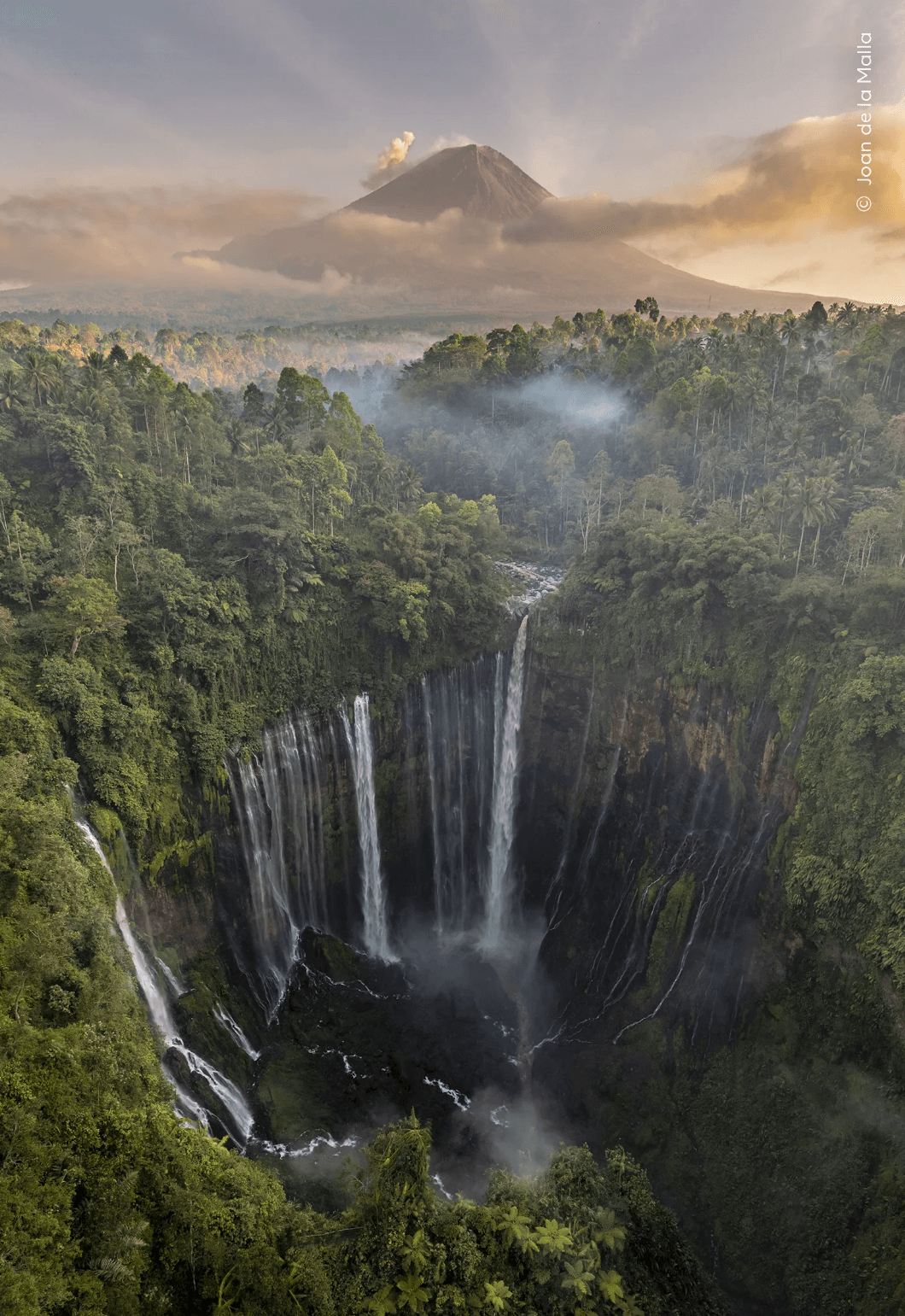
The Semeru volcano rises in the background of this photo of Java’s Tumpak Sewa waterfall by Joan de la Malla. Rain that falls on the volcano slides down its flank and wanders through the jungle on its way to the spectacular 120-meter-high waterfall. From the clouds wreathing the mountain through the jungle’s drifting fogs to the mists of the falls, this portrait highlights the many forms water takes on its journey. (Image credit: J. de la Malla/WPOTY; via Colossal)
Fediverse Reactions
-

Instabilities in Competition
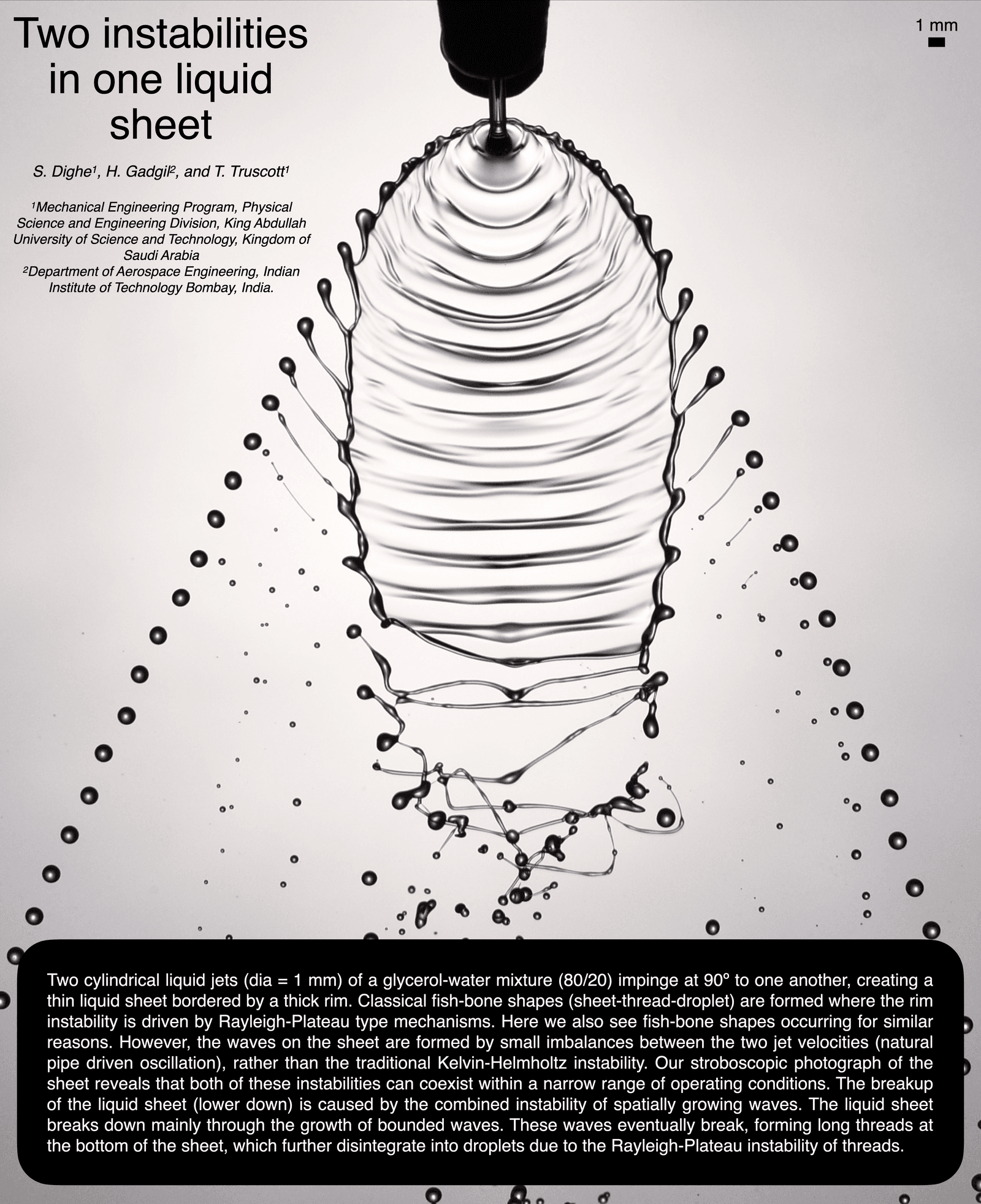
When two liquid jets collide, they form a thin liquid sheet with a thicker rim. That rim breaks into threads and then droplets, forming a well-known fishbone pattern as the Plateau-Rayleigh instability breaks up the flow. This poster shows a twist on that set-up: here, the two colliding jets vary slightly in their velocities. That variability adds a second instability to the system, visible as the wavy pattern on the central liquid sheet. The sheet’s rim still breaks apart in the usual fishbone pattern, but the growing waves in the center of the sheet eventually that structure apart as well. (Image credit: S. Dighe et al.)
Fediverse Reactions
-

Bubbling Up
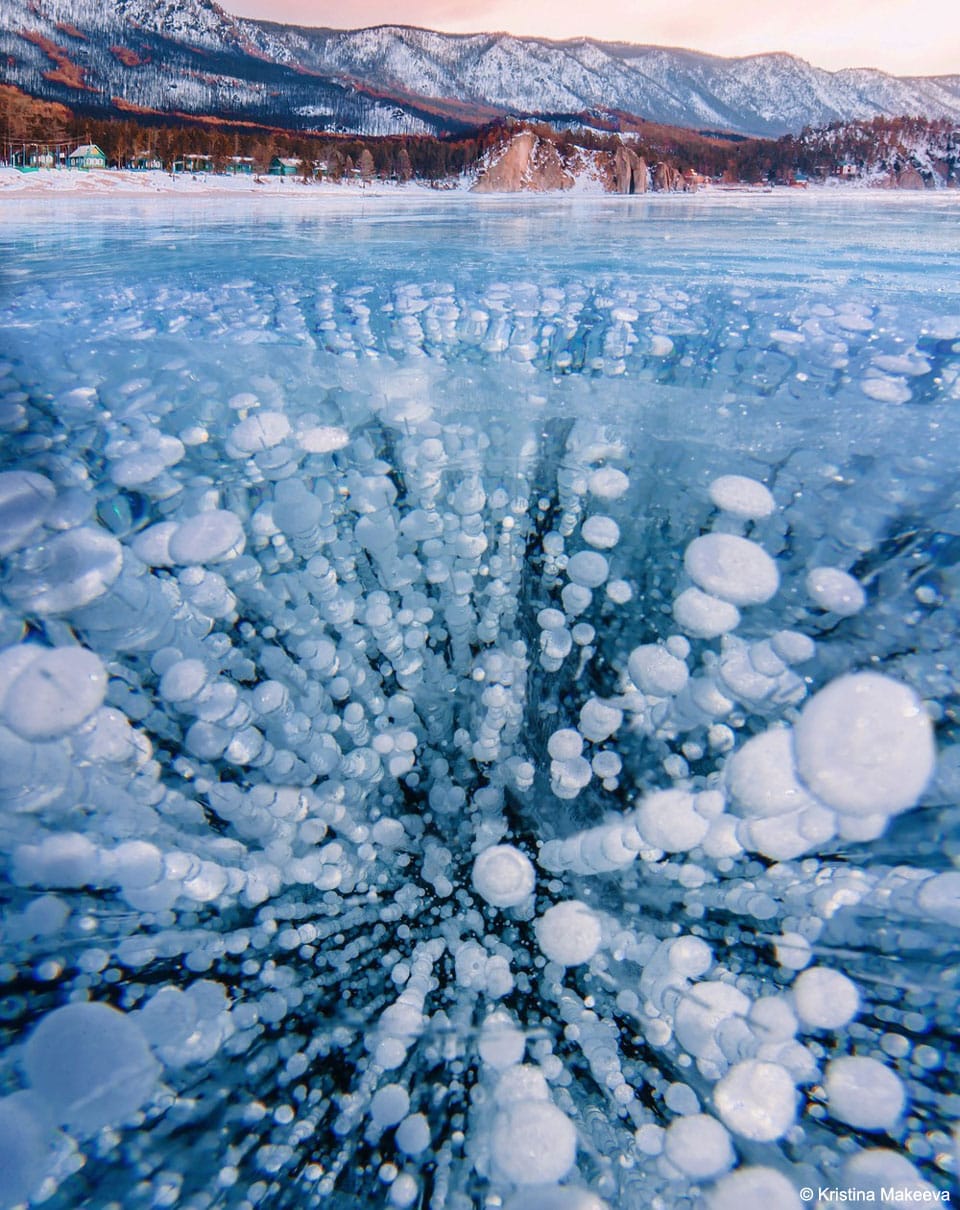
By volume, Lake Baikal is the world’s largest lake, holding over 20% of the planet’s fresh water. It’s also a major carbon sink, holding large amounts of methane. That’s the gas trapped in the frozen bubbles seen here. Baikal’s ice is exceptionally clear, making long trails of frozen bubbles visible during the winter. (Image credit: K. Makeeva; via APOD)
Fediverse Reactions
-
Within a Drop
In this macro video, various chemical reactions swirl inside a single dangling droplet. Despite its tiny size, quite a lot can go on in a drop like this. Both the injection of chemicals and the chemical reactions themselves can cause the flows we see here. Surface tension variations and capillary waves on the exterior of the drop can play a role, too. Just because a flow is tiny doesn’t mean it’s simple. (Video and image credit: B. Pleyer; via Nikon Small World in Motion)

Chemical reactions swirl within a single, hanging droplet. Fediverse Reactions
-

Strata of Starlings


Starlings come together in groups of up to thousands of birds for the protection of numbers. These flocks form spellbinding, undulating masses known as murmurations, where the movement of individual starlings sends waves spreading from neighbor to neighbor through the group. One bird’s effort to dodge a hawk triggers a giant, spreading ripple in the flock.
To capture the flowing nature of the murmuration, photographer and scientist Kathryn Cooper layers multiple images of the starlings atop one another. The birds themselves become pathlines marking the murmuration’s motion. The final images are surprisingly varied in form. Some flocks resemble a downpour of rain; others the dangling branches of a tree. (Image credit: K. Cooper; via Colossal)
Fediverse Reactions
-

“Flowing Kelp”
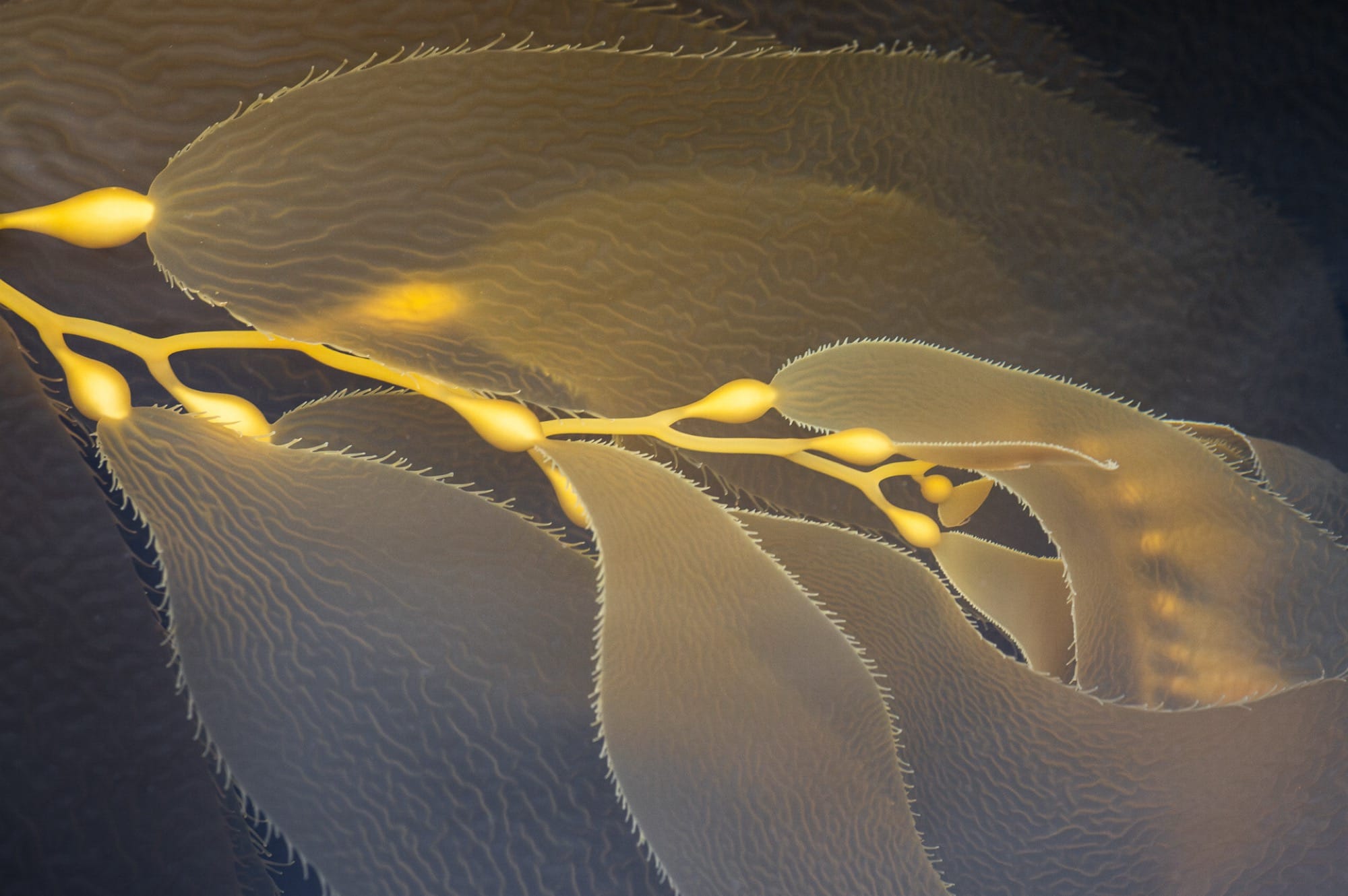
This CUPOTY-shortlisted photo by Sigfrido Zimmerman shows giant kelp drifting in the current. At the base of each blade is an inflated bladder that helps keep the algae buoyant. The blades themselves are furrowed on their surface, with patterns reminiscent of sand ripples. Though giant kelp can grow to as large as 60 meters, the species lives in constant flux, pushed and pulled by the currents that run along its length. (Image credit: S. Zimmerman/CUPOTY; via Colossal)
Fediverse Reactions
-

The Best of FYFD 2024


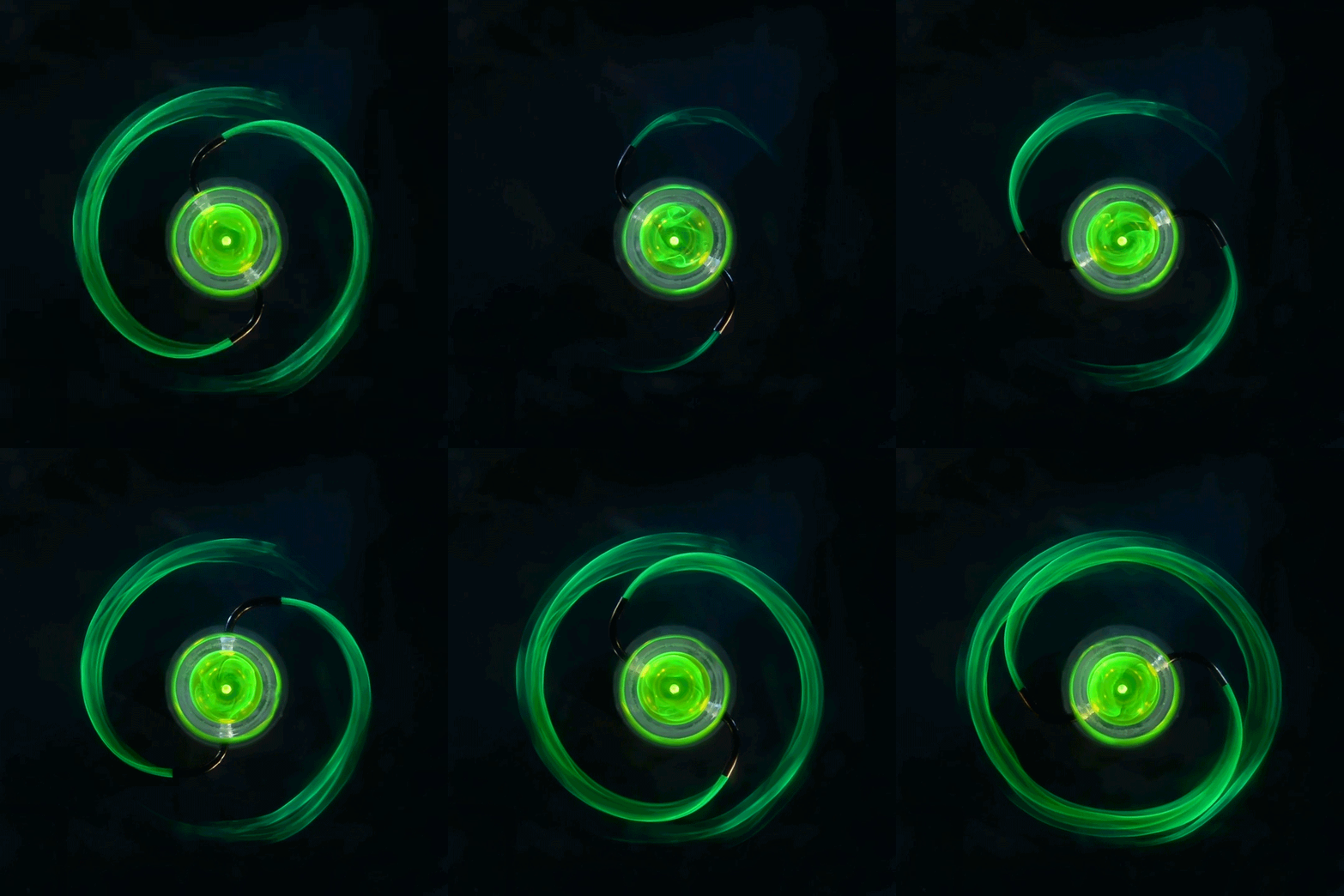
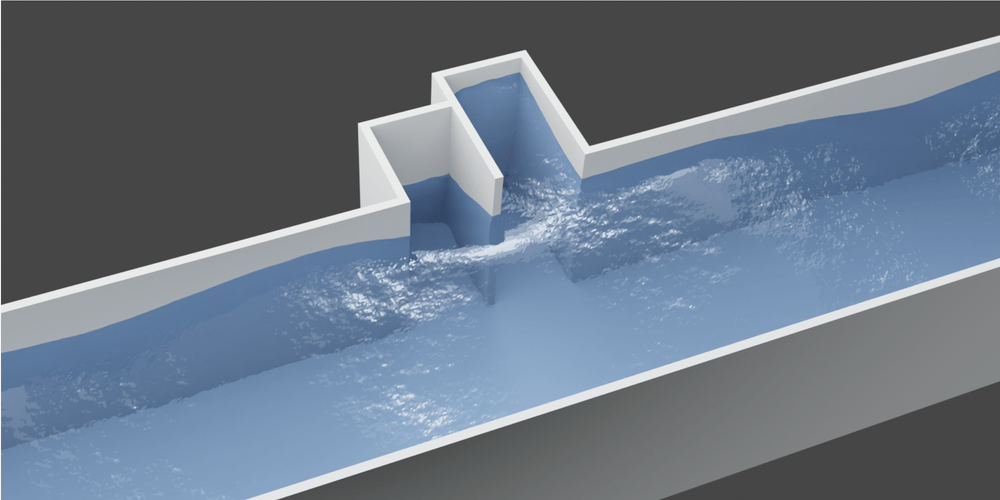


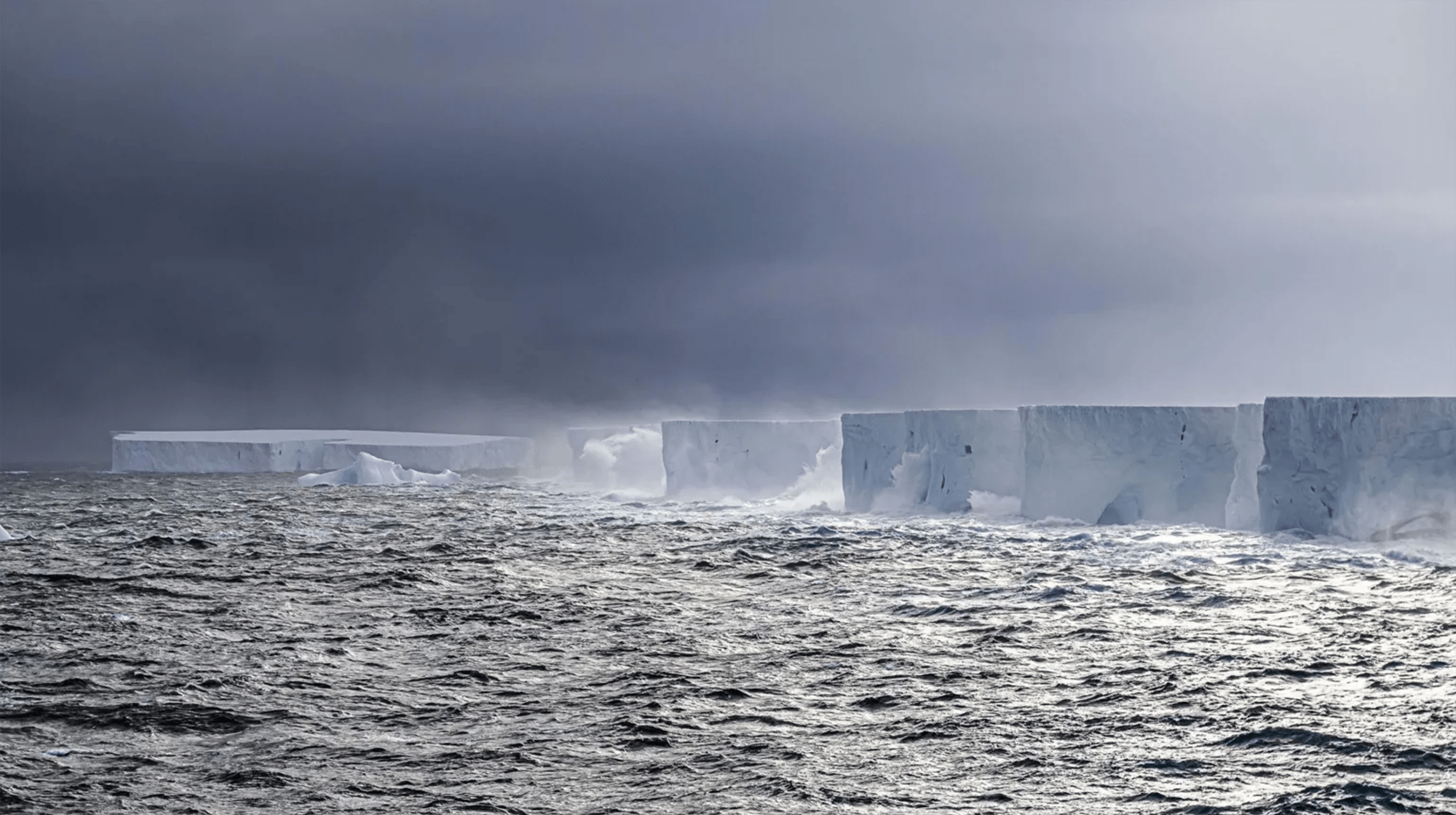

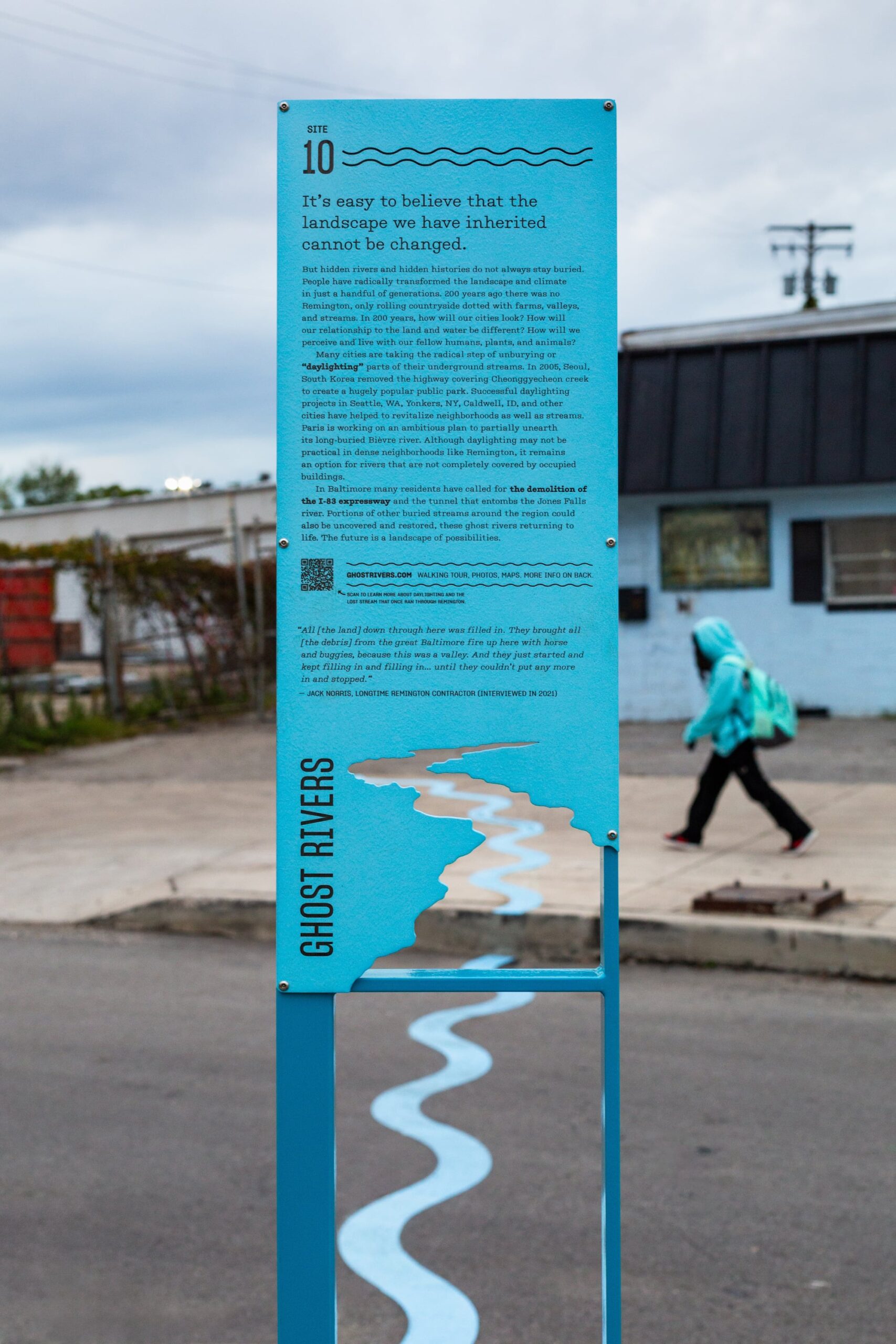


Welcome to another year and another look back at FYFD’s most popular posts. (You can find previous editions, too, for 2023, 2022, 2021, 2020, 2019, 2018, 2017, 2016, 2015, and 2014. Whew, that’s a lot!) Here are some of 2024’s most popular topics:
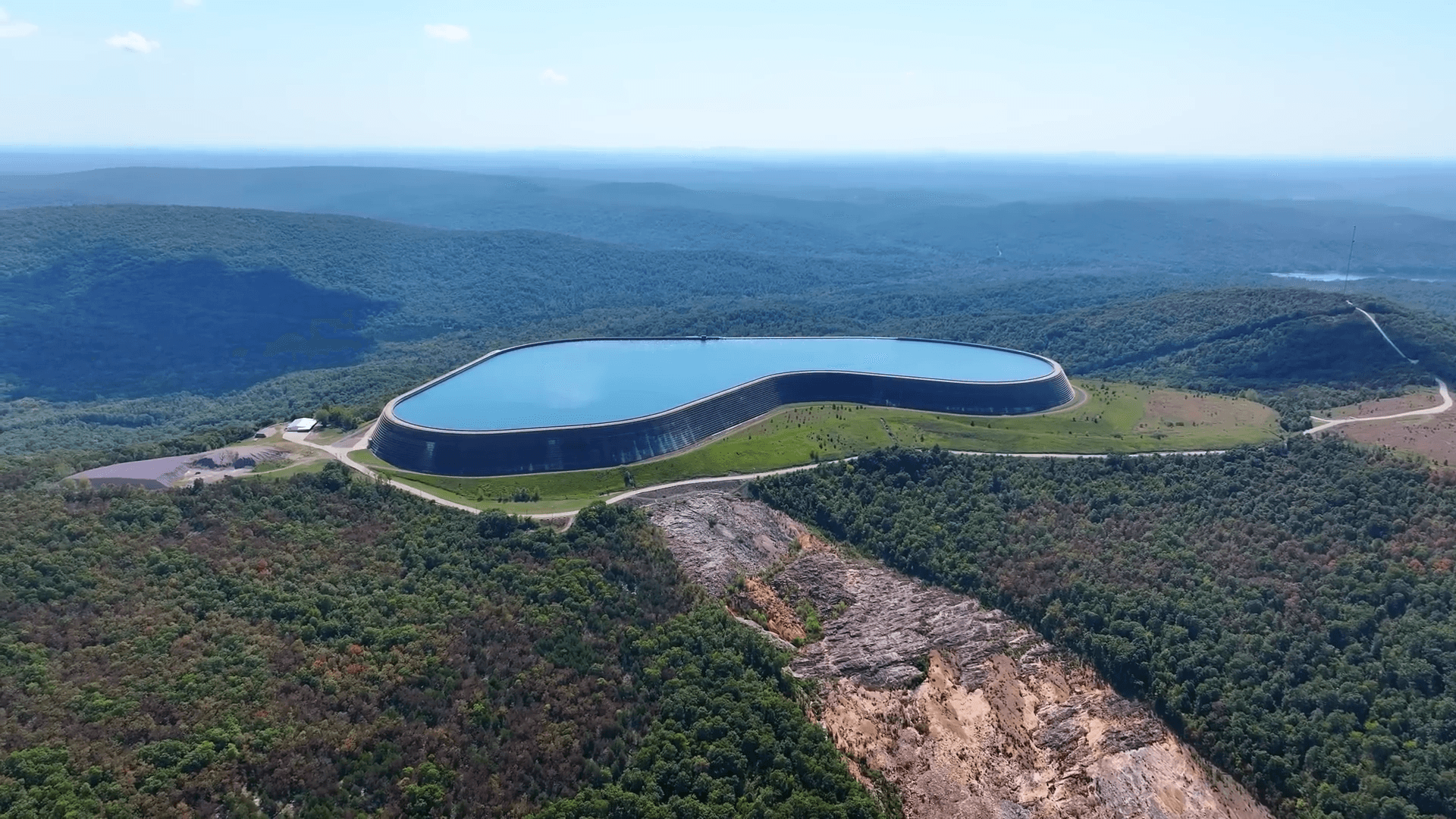
- The Taum Sauk Dam Failure and Its Legacy
- Stretching Ant Rafts
- Gigapixel Supernova
- Feynman’s Sprinkler Solved
- Calming the Waves
- “Dew Point” Deposits Droplets
- Drying Unaffected by Humidity
- Trapped in a Taylor Column
- Exciting a Flame in a Trough
- Remembering Rivers Past
- A Comet’s Tail
- Light Pillars
- Liquid Metal Printing
- The Miscible Faraday Instability
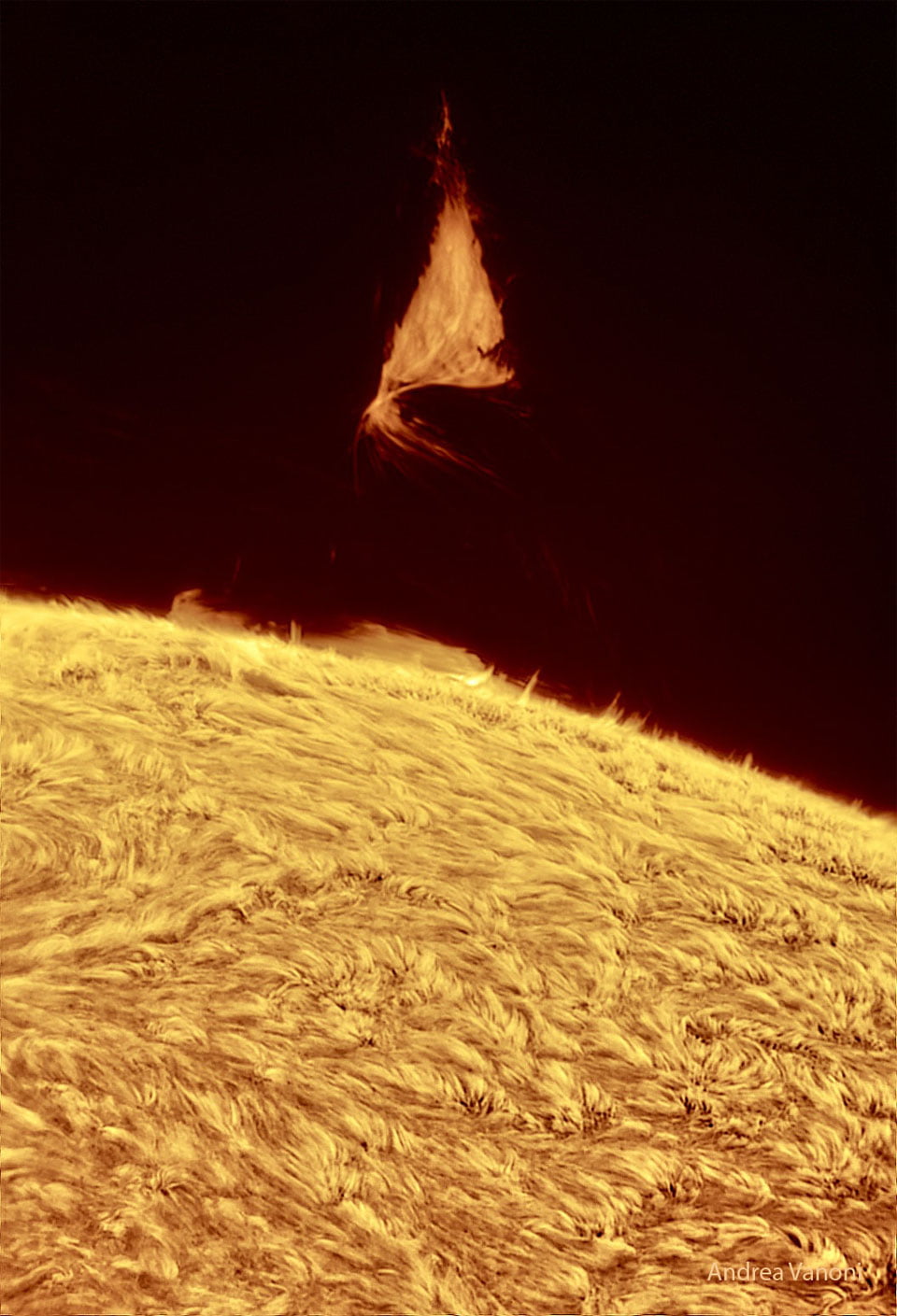
- A Triangular Prominence
This year’s topics are a good mix: fundamental research, civil engineering applications, geophysics, astrophysics, art, and one good old-fashioned brain teaser. Interested in what 2025 will hold? There are lots of ways to follow along so that you don’t miss a post.
And if you enjoy FYFD, please remember that it’s a reader-supported website. I don’t run ads, and it’s been years since my last sponsored post. You can help support the site by becoming a patron, buying some merch, or simply by sharing on social media. And if you find yourself struggling to remember to check the website, remember you can get FYFD in your inbox every two weeks with our newsletter. Happy New Year!
(Image credits: dam – Practical Engineering, ants – C. Chen et al., supernova – NOIRLab, sprinkler – K. Wang et al., wave tank – L-P. Euvé et al., “Dew Point” – L. Clark, paint – M. Huisman et al., iceberg – D. Fox, flame trough – S. Mould, sign – B. Willen, comet – S. Li, light pillars – N. Liao, chair – MIT News, Faraday instability – G. Louis et al., prominence – A. Vanoni)
Fediverse Reactions

“Magic of the North”
Fires glow above and below in this award-winning image from photographer Josh Beames. In the foreground, lava from an Icelandic eruption spurts into the air and seeps across the landscape as it slowly cools. Above, the northern aurora ripples through the night sky, marking the dance of high-energy particles streaming into our atmosphere, guided by the lines of our magnetic field. Throw in some billowing turbulent smoke, and it’s hard to get more fluid dynamical (or beautiful!) than this. (Image credit: J. Beames/NLPOTY; via Colossal)
Fediverse Reactions
-