This timelapse video shows the spreading of food coloring and a ferrofluid through soap suds surrounding a magnet. Capillary action, the same force that enables sap to flow up through a tree against gravity, helps draw the fluids through the interfaces between the soap bubbles without disturbing the suds. The magnet’s field provides a preferred direction for the ferrofluid flow. (via Gizmodo)
Tag: fluids as art

Spiky Ferrofluid
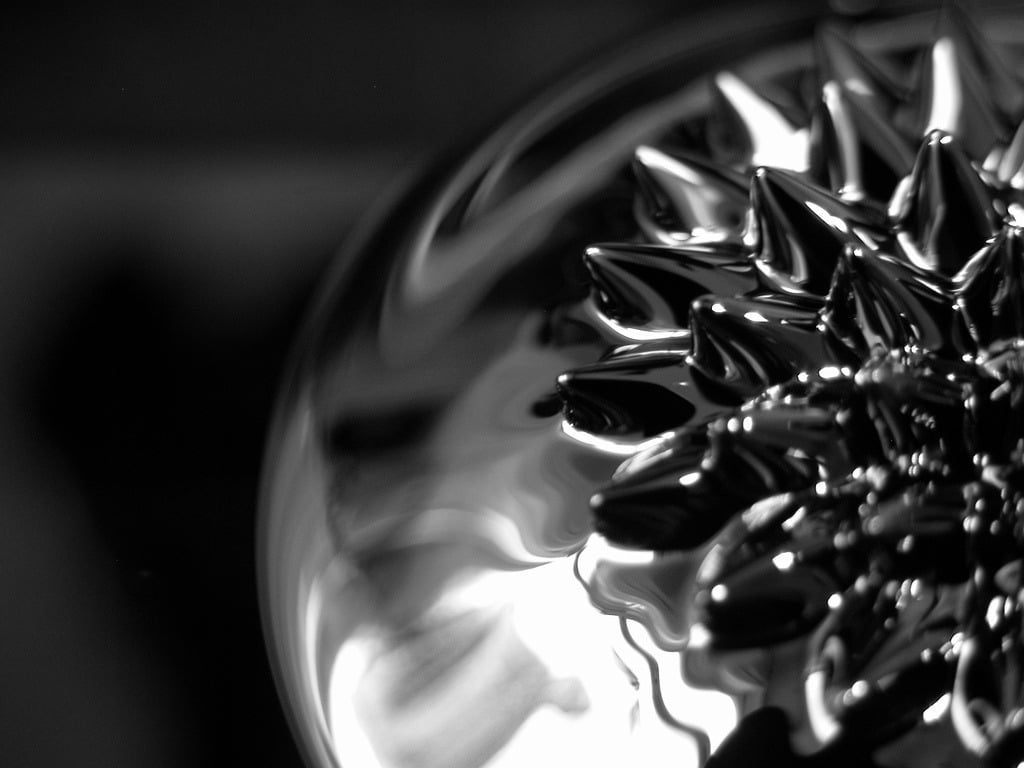
Ferrofluids consist of ferromagnetic nanoparticles suspended in a fluid. When subjected to strong magnetic fields, they develop a distinctive peak-and-valley formation due to the normal-field instability. The shape is a result of minimizing the magnetic energy of the fluid. Both gravity and surface tension resist the formation of these peaks. Ferrofluids, in addition to appearing in art exhibits, can be used as liquid seals, MRI contrast agents, and loudspeaker cooling fluids. (Photo credit: Maurizio Mucciola)

Vortex Ring Collisions
Gorgeous color schlieren photography reveals the development and interaction of ring vortices. (Photo credit: Rebecca Ing)
It’s Schlier-tastic!!
These are my invisible wonders! Gas flows and fluid interactions. Nothing but hot air, metho and acetone, yup, humble old nail polish remover.
The images were captured using a colour indicating z-system schlieren optical array, an open shutter and a flash duration of 125 microseconds.

Colliding Jets

Paint Vibrations
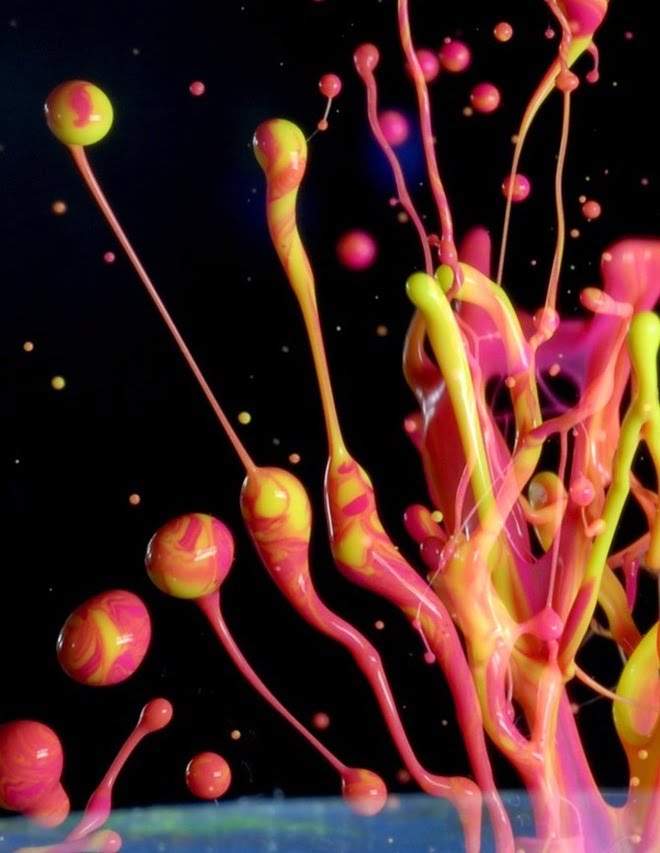
Paint vibrated on a loud speaker explodes in multi-colored jets and droplets. Most paints are shear-thinning non-Newtonian fluids (like ketchup, shampoo, or whipped cream), meaning that their viscosity decreases as they are sheared. This allows them to flow more readily once they are perturbed. #

High Hopes
This gorgeous high-speed video captures bubbles, droplets, wakes, cavitation, coalescence, jets, and lots of surface tension at 7000 fps. The authors unfortunately haven’t indicated whether this is air in water or something more viscous, but regardless there are some great phenomena on display here. # (via Gizmodo)
Rayleigh-Taylor Art
The Rayleigh-Taylor instability occurs when a denser fluid lies atop a lighter fluid (relative to the gravitational field). The interface between the fluids deforms and the two fluids form finger-like protrusions that turn into mushroom caps and mix the dissimilar fluids together. This video, though based on a 2D Rayleigh-Taylor instability numerical simulation, was actually part of an art exhibit. (submitted by Mark S)
Personally, I recommend putting together a playlist of your favorite late 60s/early 70s rock (Pink Floyd, late Beatles, Jimi Hendrix, etc.) and sticking it on in the background while you watch the video in HD. It’s totally worth the 15 minutes. Especially in the later stages of each segment, the mixing between fluid layers really brings to mind cloud patterns on Jupiter or Saturn.

Jet Breakup
A non-cylindrical stream falling through a slit nozzle exhibits the Plateau-Rayleigh instability, which drives a falling jet of fluid to break into droplets due to surface tension. The fingers formed off the falling stream may be a form of Rayleigh-Taylor instability. #
Pouring Paint
In this artwork by Holton Rower, paint (typically a non-Newtonian fluid) is poured down a rectangular prism; the result is a neat demonstration of shearing in laminar flows. Paint is usually shear-thinning, meaning that its viscosity decreases under shear; this is why the color stripes on the vertical panels expand more than those on the horizontal surfaces do. # (submitted by Stephan)
Shock Waves
Flow visualization really can be considered a form of art. Though we fluid mechanicians are looking for physics, we’re quite aware of the beauty of what we study. The clips in this video mostly show transient shockwave behavior, including lots of shock reflection and even a few instabilities. It’s unclear what the speeds are, aside from faster than sound; the medium is air.