Tag: fluid dynamics

  • Featured Video Play Icon

    “The Empire of C”

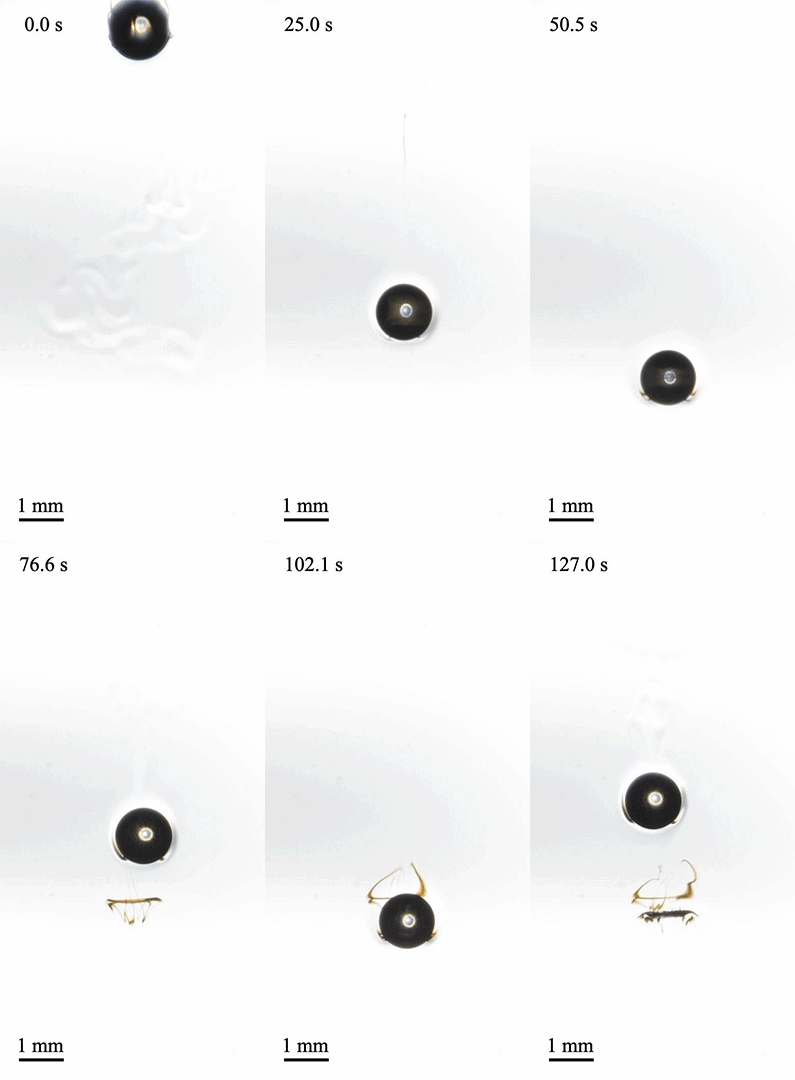
    Filmmaker Thomas Blanchard has once again released a beautiful, fluid-filled short to captivate us. Built from paint, oil, and liquid soap, “The Empire of C” feels like it gives viewers a birds-eye perspective over a fantastical land. I was particularly drawn to two fluid dynamical aspects of the film. The first were the dendritic sequences in the opening, which feel a bit like watching river deltas form in real time. Despite their resemblance to the Saffman-Taylor instability, I think these fingers are interfacially driven – meaning that they result from differences in surface tension between the different liquids Blanchard is using. 

    The second thing that caught my eye and made me rewind the video over and over were the glittery droplets. The glitter acts like tracer particles, allowing you to see the flow inside the droplets. Check out that counter-circulation compared to the paint flowing by outside! It’s a reminder that even inside a seemingly still droplet, there’s lots going on. (Video and image credit: T. Blanchard)

  • Dip Coating

    Dip Coating

    Imagine dipping a rod into a liquid mixture filled with particles. When you pull the rod out, do particles stick to it? The answer depends on the relative importance of two sets of forces: the viscous drag as you lift the rod and adhesive power of surface tension. Scientists express this as a dimensionless ratio known as the capillary number.

    When the capillary number is small, viscous drag dominates, and any particles that try to stick to the rod get pulled away (upper left). But as you increase the capillary number, surface tension helps particles clump together and stick to the rod (lower left and right). If the surface tension forces are strong enough – meaning that the capillary number is high –  you can actually get multiple layers of particles adhering to the dipped surface. (Image and research credit: E. Dressaire et al.)

  • Water Anoles Breathe Underwater

    Water Anoles Breathe Underwater

    Meet the water anole, a small lizard native to the tropics of Central America. While studying these anoles, researchers discovered that they could flee underwater and remain submerged for 16 minutes or more at a time. Curious to see how the lizard manages this feat, they filmed them underwater, discovering that the anole seems to exhale a small bubble that sticks on its face and then re-inhale it.

    How exactly this built-in “scuba gear” works is still under investigation, but here’s my guess. Fresh oxygen can diffuse from water into a bubble; some insects use this to breathe underwater. The natural, random motion of molecules tends to cause chemicals to move from areas of high concentration to those of low concentration. But this molecular diffusion is extremely slow. That tiny bubble you see isn’t around long enough for any significant molecular diffusion of fresh oxygen. But what if the surface of the bubble is actually much larger?

    Notice the silvery shininess we see on the anole. That’s because most of the lizard isn’t actually wet. The anole is superhydrophobic, so its skin has trapped a thin layer of air that appears to extend over a large part of its body. I think perhaps the anole has fresh oxygen diffusing into the air layer across most of its skin, and the large bubble it inhales and exhales serves as a sort of pump to help draw that fresh oxygen through the air layer and into its body. That could help explain how the anole can stay submerged for so long.

    As researchers continue to investigate this little aquanaut, it will be interesting to discover just what its secrets are! (Image and video credit: L. Swierk; via Gizmodo)

  • Featured Video Play Icon

    Sonic Tractor Beam

    Acoustic levitation uses the radiation forces generated by sound waves to trap small, lightweight particles at the nodes of standing waves. We’ve seen this a number of times previously, both with solid objects and liquid droplets. What makes this example particularly impressive, though, is that these researchers use an array of speakers to manipulate multiple objects at once. Check out the video above for a whole series of clips from the research. (Video credit: Science; research credit: A. Marzo and B. Drinkwater)

  • Finding New Shapes in Foam

    Finding New Shapes in Foam

    In the summer of 2018, a group of researchers announced they’d discovered a new geometrical shape, the scutoid. They found the scutoid, a sort of twisted prism, in the shape of epithelial cells packed between curved surfaces. Having heard of this new geometry, a different group of physicists wondered if they could find scutoids elsewhere, specifically, in the cells of a foam. As shown in the picture above, they did.

    To visualize a scutoid, first image a prism. Take two polygons with an equal number of sides and connect them. But if you imagine packing such prisms between two curved surfaces, you’ll quickly see that it won’t work. They just don’t fit together. Instead, one face may adopt, say, six sides, while the other takes on five. To join those two end faces, one of the sides will have to have a Y-shaped junction and a triangular face. This is a scutoid.

    You can see two such shapes in the image above. In the left bubble, the far side forms a pentagon, while the near face is a hexagon. On the right, the bubble has six faces in the background and eight in the foreground. And between them, you can just see the triangular face that connects the two scutoids.

    It’s not only exciting to find scutoids in a new, non-biological medium; it suggests a physical mechanism behind their formation. Foams are a well-known example of energy minimization. The fact that scutoids are found in a curved foam suggests that the shape itself is connected to energy minimization, something that could help us understand how biological scutoids grow and form. (Image and research credit: A. Mughal et al.; via Physics World; submitted by Kam-Yung Soh)

  • Vortices and Ground Effect

    Vortices and Ground Effect

    Though typically unseen, the vortices that swirl from the tips of aircraft wings are powerful. Here you see a Hawker Sea Fury equipped with a smoke system used to visualize the vortices that form at the wingtip as high-pressure air from the bottom of the wing and low-pressure air from the top swirl together. As you can see, the vortices persist in the wake long after the plane passes. The size and strength of the vortices depend on the size and speed of the aircraft; this is why air traffic control requires smaller planes to wait longer to take off or land if there was just a larger aircraft on the runway.

    The other cool thing to note here is how the wingtip vortices move apart from one another in the animation above. In flight, wingtip vortices usually stay roughly parallel to one another, but they drift downward in the aircraft’s wake. Near the ground, though, the vortices cannot move down, so instead ground effect forces them apart from one another, as seen here. (Image and video credit: E. Seguin; via Kelsey C.)

  • Sniffing Underwater

    Sniffing Underwater

    Star-nosed moles – tiny mammals native to the northeastern United States – have an underwater superpower: sniffing. To seek prey underwater, the moles blow bubbles and suck them back into their nostrils in about a tenth of a second. Their eponymous noses seem to be key to this, as seen in newly published research. Researchers built model star noses from plastic (lower right) to explore how well different shapes could hold the bubble in place, a necessary ingredient for the mole to sniff them back up. 

    With a perfectly flat plate, any small tilt makes the bubble slide toward the edge and float away. Star-shaped ones, on the other hand, can hold a bubble even up to a 7-degree tilt angle, a 40% improvement. The spacing of the gaps is also important. If they’re too wide, buoyancy can pull the bubble up through them. But if they’re too narrow for the bubble to deform upward through them, they make poor anchors. 

    Understanding the mechanics of underwater sniffing is good for more than just appreciating this funny-looking mammal, though. The researchers hope their findings will help develop underwater chemical sensors that use bubble sniffing instead of exposing their components directly to sea water, which would significantly extend their usable life. For more, check out the paper and my interview with the lead author in the video below. (Image credits: top and lower left – K. Catania; lower right – A. Lee; research credit: A. Lee and D. Hu; video credit: N. Sharp and T. Crawford)

  • Stress Between Grains

    Stress Between Grains

    Granular materials like sand and beads can shift and flow in fluid-like ways, but they’re much harder to predict. Part of this is due to the way friction between individual grains transmits force through the network. Here, we see photoelastic beads responding to the intrusion of a narrow rod. The lightning-like flashes show how stress is traveling between neighboring grains. Notice how the lower grains are essentially frozen into a state of high stress, but the movable upper grains shift and readjust themselves to try and relieve stress.

    This experiment took place under lunar gravitational conditions. Lower gravity means that it takes a larger pile of grains on top to create a given stress. But it also means it’s easier for those movable top grains to shift or even get thrown up by a hastily applied force.  The purpose of experiments like this is to better understand how rovers and probes should dig in low-gravity environments without kicking up a cloud of regolith and dust. (Image credit: K. Daniels et al., source)

  • The Best of FYFD 2018

    The Best of FYFD 2018

    2018 was a busy year for me with over 40 days of business travel, 10 invited talks, and a whole slew of new YouTube videos on top of regular FYFD posts. But now it’s time for the traditional look back at the top 10 FYFD posts of 2018, according to you:

    1. Swimming so easy a dead fish can do it
    2. The wall of lava lamps that helps secure the Internet
    3. Jellyfish versus vortex ring
    4. Crushing crayons in a hydraulic press shows off the sharkskin instability
    5. Vortex ring from an exploding meteor
    6. Starburst patterns form when avalanching materials size separate 
    7. Kelp change shape depending on their currents
    8. The creepy hydraulics of a spider’s gait
    9. Pneumatically-driven, 3D-printed plants of the future
    10. Exothermic chemistry visualized in infrared

    This year’s list is an interesting mix – some biology, vortex rings, non-Newtonian and granular physics; it’s a good list for some of the more unexpected sides of fluid dynamics. 

    If you’d like to see more great posts like these, please remember that FYFD is primarily supported by readers like you. You can help support the site by becoming a patron, making a one-time donation, or buying some merch. Happy New Year!

    (Image credits: fish – D. Beal et al.; lava lamps – T. Scott; vortex ring – V. de Valles; crayons – Hydraulic Press Channel; meteor – P. Horálek; rotating drum – I. Zuriguel et al.; kelp – J. Hildering; spider – R. Miller; hydrophytes – N. Hone; chemistry – Beauty of Science)

  • Waves

    Waves

    Photographer Ray Collins is known for his striking portraits of waves, some of which I’ve featured on previous occasions. Collins is colorblind, so he focuses heavily on shape and texture in the wave, which produces some stunningly dramatic views of moving water frozen in time. There’s great power and beauty in breaking waves, and researchers are still actively learning just how significant they are to our planet’s cycles. 

    Note the spray blurring the edges of every wave here; these are some of the largest droplets the wave will make. As it crashes forward, the wave traps pockets of air, and, as those bubbles burst, they will create a spray of tinier droplets that carry moisture and salt into the atmosphere to seed clouds and, eventually, rain.

    Collins’ work reminds us both of the ocean’s power and its fragility as it undergoes rapid changes due to humanity’s influence. For more photos as well as a great interview with Collins, check out My Modern Met. (Image credit: R. Collins; via My Modern Met and James H.)