Tag: fluid dynamics

  • Forming a Waterfall

    Forming a Waterfall

    Many factors can affect a waterfall’s formation – changes in bedrock structure, tectonic shifts, and glacial motion, to name a few. But a new study suggests that some waterfalls may be self-forming. Using a lab-scale experiment, researchers created a homogeneous “bedrock” out of polyurethane foam, which they eroded with a combination of constant water flow and particulates. Even without external perturbations, the flow carved out a series of steps.

    As a pool deepened, particles built up inside, armoring the bed against further erosion. But further downstream, the chute continued to erode, steepening the area between them until a waterfall formed. On the timescale of the experiment, the waterfalls lasted only 20 minutes or so, but that’s equivalent to up to 10,000 years in geological time. (Image credit: M. Huey; research credit: J. Scheingross et al.; via EOS News; submitted by Kam-Yung Soh)

  • Water Impacts

    Water Impacts

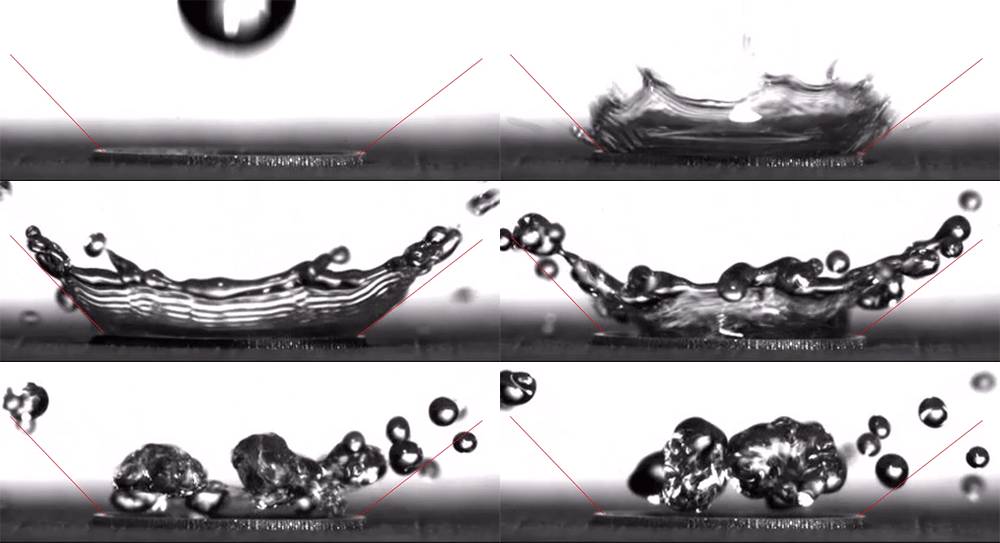
    In the clean and simplified world of the laboratory, a droplet’s impact on water is symmetric. From a central point of impact, it sends out a ring of ripples, or even a crown splash, if it has enough momentum. But the real world is rarely so simple.

    Here we see how droplets impact when the wind is blowing against them. The drops fall at an angle, creating an oblique cavity. Rings of ripples spread from the impact, but the ligaments of a splash crown form only on the leeward side. As the wind speed increases, so does the violence of the impact, eventually beginning to trap tiny pockets of air beneath the surface. Those miniature bubbles can spray droplets and aerosols into the air when they finally pop. (Image and video credit: A. Wang et al.)

  • Rogue Waves

    Rogue Waves

    After centuries of tales from sailors, in 1995 the Draupner off-shore platform recorded the first ever evidence of a freak wave – a single, wall-like wave steeper and taller than any other waves around it. Theories have been tossed back and forth for the last quarter century as to how the Draupner wave formed, but now a group of researchers report they have recreated a lab-scale version of this is famous wave. 

    They did so in a wave pool by making two smaller groups of waves cross one another at about 120 degrees (top). The interaction of those wave packets generated a much larger, steeper wave (bottom image sequence) that matched the profile of the Draupner wave. Recreating this past freak wave confirms that wave-crossing can lead to freak waves, which will hopefully help us forecast when conditions may be right for more to occur. (Image credit and research credit: M. McAllister et al., source; via Motherboard; submitted by Kam-Yung Soh)

  • Moving Droplets

    Moving Droplets

    Microfluidic devices – such as those used by individuals with diabetes to monitor their blood glucose levels – are all about transport. Typically, these devices use some kind of externally applied force, like a temperature gradient or electrical field, to force liquids through the device’s narrow channels. But a new study describes a way to move droplets without an external force.

    The researchers built their devices using two slips of glass, coated with an oil-attracting, water-repellent mixture. They attached the glass slips with a narrow spacer at one end, leaving the other end free. This made a narrow, but slightly flexible gap. When the scientists placed an oil drop inside the closed end, it spread on the glass, pulling the two sides closer to one another. Water drops, on the other hand, tried to force the walls apart, in an effort to minimize contact. Both sets of drops, interestingly, moved toward the open end of the device.

    The researchers found that the shapes assumed by the droplets create an internal pressure gradient, which, in both cases, slowly moves the drops. They call this method bendotaxis, a type of self-propulsion driven by the drops’ ability to bend the material they’re touching. It’s not a fast way to transport fluids – the drops moved only a few micrometers per second – but it may be useful for applications like drug deliveries where the liquid needs to be administered slowly over a longer period. (Image credit: TesaPhotography; research credit: A. Bradley et al.; via APS Physics; submitted by Kam-Yung Soh)

  • Featured Video Play Icon

    Freezing Drop Impact

    At the altitudes where aircraft fly, it’s often cold enough for water drops to freeze in seconds or less. Once attached to a wing, such frozen drops disrupt the flow, reducing lift and increasing drag. To help understand how such droplets freeze, scientists study droplet impact on cold surfaces. Starting at room temperature (counter-clockwise from upper left), a drop will spread on the surface, then retract. When the temperature is colder, parts of the droplet freeze before retraction completes, leaving a thin sheet with a thicker center. At even colder temperatures, the droplet’s rim destabilizes and freezing occurs before the droplet has time to retract fully. And at the coldest temperatures, the droplet breaks apart into a frozen splash. (Image and video credits: V. Thievenaz et al.)

  • Featured Video Play Icon

    Sniffing

    In many ways, smell is a strange sense. The very act of sniffing – pulling air and odor molecules into our noses – changes what remains behind in a way that sight and sound do not. Humans aren’t great sniffers, but dogs have an exquisite sense of smell, and in this video, Deep Look describes how and why that is. From special scent organs to their experimental protocols, dogs are well-adapted to reading the world by smell. (Image and video credit: Deep Look)

  • Putting a Spin on Splashes

    Putting a Spin on Splashes

    Researchers put a spin on splashing droplets with selective wetting. When a drop impacts on a water-repellent, superhydrophobic surface, it will spread circularly, then pull back together and rebound off the surface. That’s because the surface coating resists actually touching – or being wetted by – the water. But just as there are surface coatings that resist water, there are those that attract it.

    Above, researchers have coated a surface so that it’s mostly superhydrophobic, but it also has narrow pinwheel-like arms that are hydrophilic. As the drop impacts, it spreads across the surface and then retracts. But where the hydrophilic arms are, the drop lingers. This creates the four lobes we see on the droplet, and the asymmetric retraction gives the drop angular momentum. As it leaves the surface, the spin continues. In some configurations, the researchers could make the drop spin at more than 7300 rpm. (Image and research credit: H. Li et al; via Science; submitted by Kam-Yung Soh)

  • Catching Prey

    Catching Prey

    The skinny, freshwater alligator gar can grow to more than 2 meters in length, giving it a distinct resemblance to its namesake. But this fish’s history traces back more than a hundred million years to the Early Cretaceous. And a new (pre-printed) study, combining live observations and numerical models built from CT-scans, is shedding new light on how the gar and its prehistoric ancestors feed.

    The gar uses a lateral strike (top) to come at its prey from the side. But hydrodynamically speaking, that’s a tough way to catch dinner. As soon as the gar’s snout accelerates toward its prey, it pushes a bow wave ahead of it, like an early warning signal. To counter that disadvantage, the gar has a complex bone structure in its skull (bottom) that helps it generate suction. Note how the gar’s jaw and throat open sequentially from front to back. Each expansion sucks in water, and by timing them just right, the gar produces suction throughout its entire attack. The bow wave warning does its prey no good if both are already getting sucked into the gar’s mouth! (Image and research credit: J. Lemberg et al., bioRxiv pre-print; via Science; submitted by Kam-Yung Soh)

  • Magma Mixing

    Magma Mixing

    Magmas typically consist of a mixture of molten liquid, bubbles, and solid crystals. As they mix, those crystals can sink from one viscous layer into another. To investigate this sort of process, researchers studied solid particles sinking across an interface between two viscous liquids. This is what we see above. One fluid is clear; the other is dyed red, and gravity points toward the left so the particles fall from right to left.

    What happens when the particle reaches the interface between fluids depends on three main factors: the gravitational force acting on the particle, the surface tension at the interface, and the ratio of the viscosities of the two fluids. The researchers observed two main outcomes. In one (top), the particle slows at the interface and breaks through slowly, its surface wetted by the second fluid so that it drags little to none of the previous fluid with it. The researchers named this the film drainage mode. It tends to occur when the viscosity ratio between fluids is large.

    The second method, shown in the bottom image, is the tailing mode. As the particle approaches, the interface deforms. A thick layer of the first fluid coats the particle even as it pass through, forming a tail that destabilizes behind the falling particle. This mode occurs when the viscosity ratio is small or the gravitational force is large compared to the surface tension. (Image and research credit: P. Jarvis et al.)

  • Featured Video Play Icon

    Slow Mo Geyser

    Geysers are one of the most surreal wonders of our planet – pools of turquoise that periodically erupt into towers of water and steam. But what we see from the surface is only a small part of the story. Geysers require two main ingredients: an intense geothermal heat source and the right plumbing. Below ground, that plumping needs both a reservoir for water to gather and narrow constrictions that encourage the build-up of pressure.

    A cycle begins with water filling the reservoir; this can be both geothermally heated water and groundwater seeping in. As the geyser fills, the pressure at the bottom increases. Eventually, the water becomes superheated, meaning that it’s hotter than its boiling point at standard atmospheric pressure. That’s when the steam bubbles you see above rise to the surface. When they break through, it causes a sudden drop in the reservoir pressure. The superheated water there flashes into steam, causing the geyser to erupt. Check out the full video below for some awesome high-speed video of those eruptions, and, if you’re curious what the inside of an active geyser looks like check out Eric King’s video. (Image and video credit: The Slow Mo Guys; submitted by @eclecticca)