This swirling grayscale image shows a spring aurora over the Hudson Bay, as seen by the Suomi NPP satellite. As energetic particles from the sun zip past Earth, they interact with our magnetosphere, which tends to channel particles toward the poles. At these higher latitudes, some of the particles get trapped along Earth’s magnetic field lines and crash into the upper atmosphere where they excite oxygen and nitrogen molecules. It’s this molecular bombardment that creates the distinctive colors of the aurora. (Image credit: J. Stevens; via NASA Earth Observatory)
Tag: fluid dynamics

Splashes on Hairy Surfaces


The question of whether a droplet will splash is a complicated one, even for smooth surfaces, but researchers are also interested in what happens to hairy surfaces when droplets strike. By varying the droplet viscosity and speed, along with the spacing of the hairs, researchers sketched out the variety of impacts one can get.
What happens during impact depends largely on how the kinetic energy of the droplet compares to the dissipation caused by interaction with the hairs. When the two balance, the droplet gets captured, like in the upper right image. If the hairy dissipation wins, you get a drop that stays mostly on the surface of the hairs. And if the kinetic energy outweighs the dissipation, you end up with a star-shaped splash that spreads between the hairs. (Image and research credit: A. Nasto et al.)

Hiding From Waves


Ocean waves can be dangerous for boats, particularly when operating near off-shore platforms. But a new study, inspired by electromagnetic waveguides, demonstrates a lab-scale water waveguide capable of damping out a range of waves experienced by any ship inside its protected area. The water waveguide sits below the surface, changing the water depth and therefore the propagation of surface waves.
When properly positioned, the waveguide nearly eliminates wave motion in a protected channel. You can see this in the right image, where waves are clearly present in the foreground but the toy boat hardly moves. Contrast this with the image on the left, where the boat bobs and rocks under the same wave conditions without the waveguide. The researchers hope their waveguide concept can help protect ships in wharves and harbors soon. (Image and research credit: S. Zou et al.; via APS Physics; submitted by Kam-Yung Soh)

Seeing with Sound
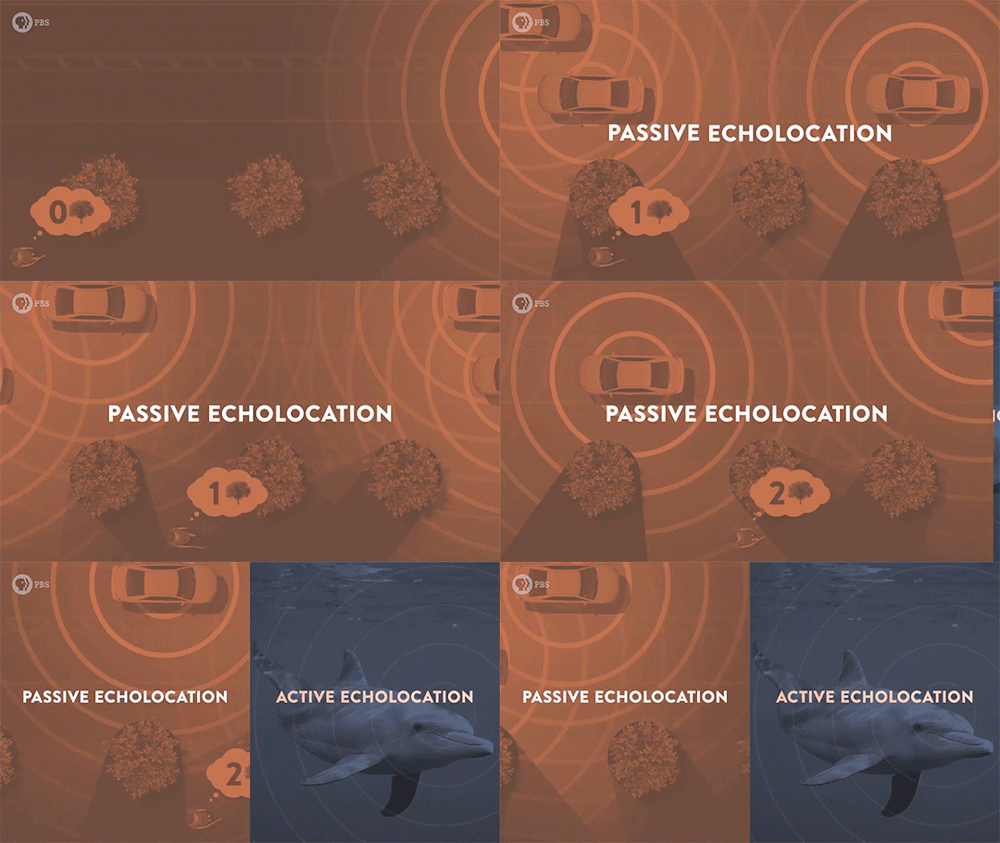
Sound carries rich information about the environment through which it’s traveled. And while many sighted people never take the time to notice this, using sound to build a mental picture of the surrounding world is something many blind people do constantly, either by studying how sounds produced by others change (passive echolocation) or by using their own sounds to pinpoint what’s around them (active echolocation).
In the latest It’s Okay to Be Smart video, you have a chance to learn some of the basics of active echolocation and how you can train your brain to recognize and process this extra environmental information.
Personally, I am not very good at this. I can hear edges but it turns out I’m very bad at figuring out where they are. That said, having spent time recently in a few anechoic chambers – where sound reflection is almost completely damped out – I’ve come to realize that even as a sighted person, I rely on sound a lot more than I think I do! (Video and image credit: It’s Okay to Be Smart)


Blowing Smoke
It’s unusual – but not entirely unheard of – to see volcanoes blowing smoke rings during inactive periods. But given their unpredictability, scientists had not studied this phenomenon in much depth. In a recent presentation, though, a group unveiled results from numerical studies of volcanic vortex rings. They found that the decreasing pressure on rising magma allows dissolved gases to emerge as bubbles. If the magma has the right viscosity, those bubbles can merge into one big pocket that depressurizes explosively in the vent. As the hot gases burst upward, the walls of the vent cause them to curl up into a vortex ring, provided the vent is fairly circular and uniform. That sends the roiling vortex up into the atmosphere, where it cools, condenses, and becomes visible.
The need for a circular vent matches observations of volcanic vortex rings in nature, like the infrared image shown above. Volcano watchers find that vortex rings only form from some vents, and the more circular the vent, the more likely it can produce vortex rings. (Image credit: B. Simons; research credit: F. Pulvirenti et al.; via Nat Geo; submitted by Kam-Yung Soh)
How Ant Stingers Work
Anyone who’s felt the sting of a fire ant knows it only takes an instant for this species to deliver a painful blow. Scientists are uncovering why that is using some of the first-ever high-speed footage of ant stingers in action. Stingers are actually made up of multiple separate pieces, including a central stylet and a pair of lancets that move up and down along the stylet. This lancet motion pulls the stinger deeper and helps form and deliver droplets of venom. The back-and-forth motion helps ants release up to 13 venom droplets per second, a level of speed that’s key for some of its high-speed, small-scale battles. (Image and video credit: Ant Lab; research credit: A. Smith)

Plasma Shock Waves
Solar flares and coronal mass ejections send out shock waves that reverberate through our solar system. But shock waves through plasma – the ionized, high-energy particles making up the solar wind – do not behave like our typical terrestrial ones. Instead of traveling through collisions between particles, these astrophysical shock waves are driven by interactions between moving, charged particles and magnetic fields.
A driving burst of plasma accelerated into ambient plasma creates electromagnetic forces that accelerate ambient ions to supersonic speeds, pushing the shock wave onward even without particles directly colliding. Thus far, piecing together the physics of these interactions has been a challenge because spacecraft are limited in what and where they can measure. But a group here on Earth has now recreated and observed some of this process in the lab. (Image credit: NASA Solar Dynamics Observatory; research credit: D. Schaeffer et al.; via phys.org)

Collecting Dew
In areas of the world where fresh water is scarce, one potential source is dew collection. Scientists have been working in recent years on making overnight dew collection more efficient. The challenge is that drops won’t begin to slide down an inclined surface until they are large enough for gravity to overcome the surface tension forces that pin the drop. Most efforts have focused on reducing the critical size where drops begin to slide through surface treatments and chemical coatings.
A recent study, however, uses a different tactic. Instead of aiming to reduce the critical drop size, these researchers built a grooved surface designed to encourage drops to grow faster. By helping the droplets coalesce quickly, their surface (right side) is able to start shedding droplets much faster than a smooth surface (left side). Under test conditions, the grooved surface was shedding droplets after only 30 minutes, whereas the smooth surface shed its first drops after 2 hours. (Image and research credit: P. Bintein et al.; see also APS Physics)
“In Perpetual Motion”


“In Perpetual Motion” follows adventure photographer Krystle Wright underwater where the roiling of the ocean sometimes makes time seem to stop, transporting her to another place entirely. To me, the underside of the ocean’s surface evokes storm clouds and memories of sitting at the bottom of the pool staring up at the way light played on the surface. How about you? What do you see when the waves roll overhead? (Video and image credit: K. Wright et al.)
Lensing in a Straw
While doing the sort of experiment only a kid or a scientist would pursue – namely, staring down a straw – Dianna noticed that water in a straw creates a lens-like magnification effect as the straw moves or down. This happens thanks to the curvature of the air-water-straw interface. Because water has strong surface tension, it curves dramatically as it meets the wall of the straw, and moving the straw up or down will drag some of the fluid with it, enhancing the curvature. When light refracts across that interface, it gets bent the same way it would through a lens, thereby shrinking or magnifying the objects beneath. (Video credit: D. Cowern/Physics Girl)