New research using free-flying northern bald ibises shows that during group flights the birds’ positioning and flapping maximize aerodynamic efficiency. In flight, a bird’s wings generate wingtip vortices, just as a fixed-wing aircraft does. These vortices stretch in the bird’s wake, creating upwash in some regions and downwash in others as the bird flaps. According to theory, to maximize efficiency a trailing bird should exploit upwash and avoid downwash by flying at a 45-degree angle to its leading neighbor and matching its flapping frequency. The researchers found that, on average, this was the formation and timing the flock assumed. In situations where the birds were flying one behind the next in a straight line, the birds tended to offset their flapping by half a cycle relative to the bird ahead of them–another efficient configuration according to theory. Researchers don’t yet know how the birds track and match their neighbors; perhaps, like cyclists in a peloton, they learn by experience how to position themselves for efficiency. For more information, see the researchers’ video and paper. (Photo credit: M. Unsold; research credit: S. Portugal; via Ars Technica; submitted by M. Piedallu van Wyk)
Tag: flapping flight

Falcon vs. Raven
Earth Unplugged has posted some great high-speed footage of a peregrine falcon and a raven in flight. Notice how both birds draw their wings inward and back on the upstroke. By doing so, they decrease their drag and thus the energy necessary for flapping. On the downstroke, they extend their wings fully and increase their angle of attack, creating not only lift but thrust. The falcon boasts an incredibly streamlined shape, not only along its body but also along its wings. In contrast, the raven has broader wings with large primary feathers that fan out near the tips. Splaying these large feathers out decreases the strength of the bird’s wingtip vortices, thereby reducing downwash and increasing lift, much the same way winglets do on planes. That extra lift and control the big primaries provide is important for the raven’s acrobatic skill. (Video credit: Earth Unplugged; via io9)

Fluids Round-up – 13 July 2013
Prepare yourselves for lots of links in today’s fluids round-up!
- Longtime FYFD favorite Mark Stock (see here, here, and here) and his collaborator James Susinno have unveiled a new interactive art piece, “Everything is Made of Atoms” that utilizes some impressive real-time fluids simulation. NVIDIA’s blog has some details on the computing.
- ScarbsF1 takes a detailed look at the F-duct used to stall an F1 car’s rear wing to reduce drag. (submitted by Vinnie)
- Just in time for summer fun, National Geographic talks about the physics of water slides.
- SpaceX’s reusable Grasshopper rocket has set a new altitude test of over 1000 ft. Check out this feat of aerodynamic control over at io9.
- Stanford engineers are using high-speed video of birds in the wild to study the mechanics of flapping flight. If you check out their video, you’ll notice how the birds rotate their wings as they flap in order to maximize lift throughout the flapping cycle. (via io9)
- Speaking of io9, they highlighted a couple of great examples of meteorological fluid dynamics recently: roll clouds and water spouts.
- New research suggests that thresher sharks may whip their tails quickly enough to produce cavitation-induced shockwaves to stun their prey. If so, they join the pistol and mantis shrimp in utilizing this technique for hunting.
- If you’re looking for some casual games, Liquid Sketch is a fun fluids puzzle game for iOS (submitted by Keri B)
- Finally, congratulations to Toronoto’s AeroVelo for capturing the AHS Sikorsky Prize with their human-powered helicopter. Check out this video from their historic flight (submitted by Chris R).
(Photo credit: AeroVelo)
Flapping Foil Wake
This gorgeous visualization shows the flow behind a flapping foil. Flow in the water tunnel is from right to left, with dye introduced to show streamlines. A flapping foil is a good base model for most flapping flight as well as finned swimming – anything that oscillates to create thrust. As the foil flaps, vorticity is generated and shed along the trailing edge, creating a regularly patterned wake of trailing vortices. (Video credit: R. Godoy-Diana)
(Source: https://player.vimeo.com/)
Imitating Flapping Flight

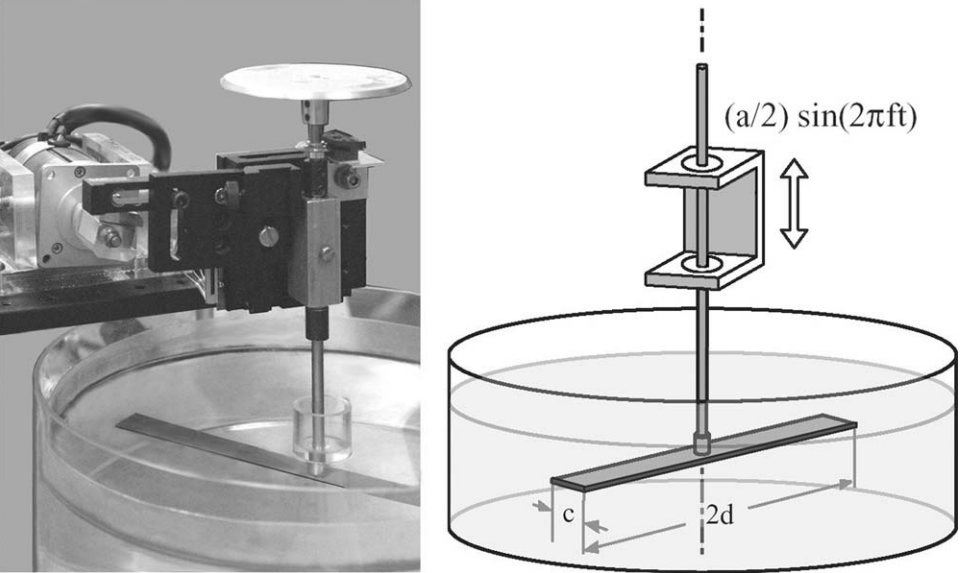
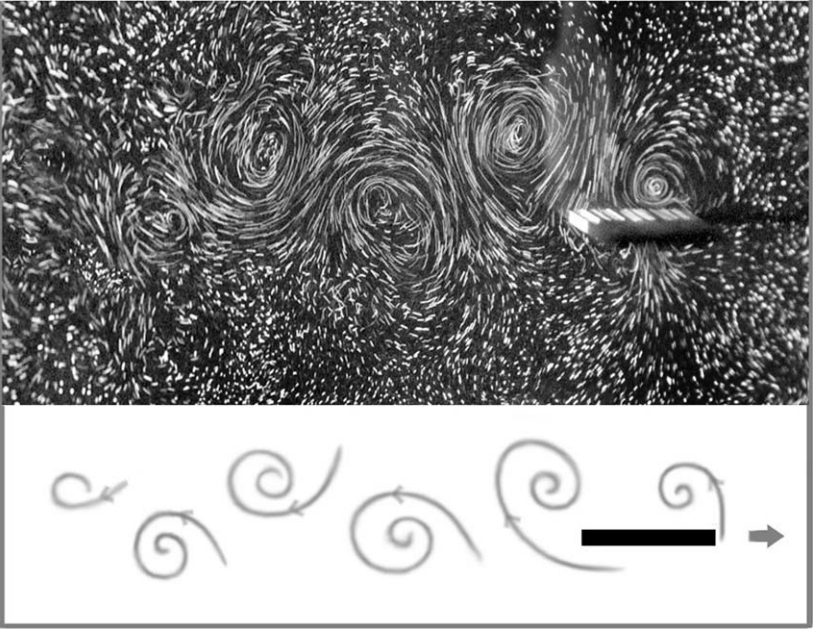
Flapping flight, despite being utilized by creatures of many sizes in nature, remains remarkably difficult to engineer. In this experiment, a simple rectangular wing is flapped up and down sinusoidally. Above a critical flapping frequency, the wing–which is free to rotate–accelerates from rest to a constant speed. This rotation is equivalent to forward flight. The upper image shows a photo and schematic of the setup, while the lower images shows flow visualization of the wing’s wake. The wing moves to the right, shedding thrust-providing periodic vortices in its wake. (Photo credits: N. Vandenberge et al.)
Countertop Fliers
In this video, researcher Leif Ristroph and his colleagues have used a clever way to simulate flapping flight, not by actuating their fliers but by oscillating the flow. The flow is driven by a speaker, which causes the air above it to move up and down. Using straws to simulate the honeycomb flow conditioners often used in wind tunnels helps smooth flow. The end result is a great table-top set-up for testing and refining miniature flier designs. The best fliers stay aloft thanks to asymmetry in the streamwise direction; when the air moves upward, the flier catches the air, maximizing drag so that it is carried upward. When the flow reverses, however, the shape of the flier is more streamlined, so the drag is reduced, helping the flier stay aloft. (Video credit: Science Friday/Leif Ristroph et al.)
How Mosquitoes Fly in the Rain
One might think that rainfall would keep the mosquitoes away, but it turns out that rain strikes don’t bother these little pests much. Because the insect is so small and light compared to a falling raindrop, the water bounces off instead of splashing. This results in a relatively small transfer of momentum, although the mosquito does get deflected quite strongly. Researchers estimate that the insects endure accelerations up to 300 times that of gravity, which is more than 10 times what a human can withstand. (Video credit: A. Dickerson et al; submitted by Phillipe M.)
Flapping to Fly Efficiently
High-speed video shows that bats achieve some of their efficiency in flight by pulling their wings inward on the upstroke, as seen above. While this does affect drag forces on the wing slightly, the primary energy savings comes from the inertial ease of lifting the folded wing. Much the way it is easier to lift your arm when it is folded than when you stretch it outright, it takes less energy for the bat to lift a folded wing than one that is fully extended. (via Wired Science)
Hawk Moth Hovering
The hawk moth (Manduca sexta) flies quite similarly to a hummingbird, able to hover over the flowers from which it feeds by rotating its wings as it flaps. This constant change in angle of attack allows it to maintain lift while remaining stationary in space. Researchers study the stability of such miniature hovering flight by destabilizing the moths and studying how they react to disturbances like being struck with a miniature clay cannonball. By testing how the moths recover from disturbances, we can learn how to build better robots and micro air vehicles (MAVs). (via supercuddlypuppies)
Dove in Flight
This spectacular high-speed video shows a dove in flight. Note how its wings flex through its stroke and the way the wings rotate over the course of the downstroke and reversal. There is incredible beauty and complexity in this motion. The change in wing shape and angle of attack is what allows the bird to maximize the lift it generates. Note also how the outer feathers flare during the downstroke. This promotes turbulence in the air moving near the wing, which prevents separated flow that would cause the dove to stall. (See also: how owls stay silent. Video credit: W. Hoebink and X. van der Sar, Vliegkunstenaars project)