Flow visualization can be a valuable tool for understanding fluid dynamics. In this video, we see how it can help elucidate the mechanisms of flapping flight. By dyeing vortices from the leading edge in red rhodamine and vortices from the trailing edge in green fluorescein, it’s possible to distinguish their competing effects for wings of different size. The speed and efficiency of a flapping wing depends on the vortices it sheds–these provide its lift and thrust. On a short wing, the leading edge vortex is significant and spins in a counter-clockwise (positive) direction. When it reaches the trailing edge, it meets a vortex spinning clockwise (negative). The interference of the two vortices weakens the shed vortex, thereby slowing the wing. Lengthening the wing weakens the leading edge vortex, which reduces its interference at the trailing edge and makes the longer wings more efficient. (Video credit: T. Mitchel et al.; via @AlbanSauret)
Tag: flapping flight

Hummingbird Hovering
Hummingbirds have a unique way of flying among birds. By flapping in a figure-8 motion, they generate lift on both the upstroke and the downstroke, which enables them to fly forward, backward, and even hover for extended periods. Such mid-air acrobatics are necessary for a species that feeds on flower nectar. What is especially impressive about the birds, though, is how they hold up even in adverse conditions like wind or rain. By placing birds in a wind tunnel and filming with high-speed video, researchers can see how hummingbirds maintain their feeding position even in 20 mph (32 kph) winds. By fanning out their tail feathers like a rudder, they can control their body orientation despite turbulent gusts. Not even rain stops them. The birds will periodically shake themselves dry, much like a dog if a dog could manage to fly while shaking itself. (Video credit: Deep Look; submitted by entropy-perturbation)

Fine-Tuning Flight
We humans generally use fixed wings for flight, but in nature, flapping flight dominates. As an animal flaps, it extends or draws in its wings during key points of the cycle in order to change its aerodynamics. But this control can be more than just a matter of stretching their wings. Recent work on bats shows that they can fine-tune the stiffness of their wings’ membrane using tiny, hair-thin muscles. Each muscle is too slight to change a wing’s shape on its own, but by firing synchronously–tensing on the downstroke and relaxing on the upstroke–the bat can manipulate its membrane stiffness and thereby affect its wing shape. Moreover, the timing of the muscles’ action changes with flight speed, suggesting that the bats are actively controlling their aerodynamics during flight. (Video credit: Swartz-Breuer lab/Brown University; via Futurity; submitted by Boris M)

Hovering
Designer Eleanor Lutz used high-speed video of five different flying species to create this graphic illustrating the curves swept out in their wingbeats. The curves are constructed from 15 points per wingbeat and are intended more as art than science, but they’re a fantastic visualization of several important concepts in flapping flight. For example, note the directionality of the curves as a whole. If you imagine a vector perpendicular to the wing curves, you’ll notice that the bat, goose, and dragonfly would all have vectors pointing forward and slightly upward. In contrast, the moth and hummingbird would have vectors pointing almost entirely upward. This is because the moth and hummingbird are hovering, so their wing strokes are oriented so that the force produced balances their weight. The bat, goose, and dragonfly are all engaged in forward flight, so the aerodynamic force they generate is directed to counter their weight and to provide thrust. (Image credit: E. Lutz; via io9)

Hummingbird Hovering
The hummingbird has long been admired for its ability to hover in flight. The key to this behavior is the bird’s capability to produce lift on both its downstroke and its upstroke. The animation above shows a simulation of hovering hummingbird. The kinematics of the bird’s flapping–the figure-8 motion and the twist of the wings through each cycle–are based on high-speed video of actual hummingbirds. These data were then used to construct a digital model of a hummingbird, about which scientists simulated airflow. About 70% of the lift each cycle is generated by the downstroke, much of it coming from the leading-edge vortex that develops on the wing. The remainder of the lift is creating during the upstroke as the bird pulls its wings back. During this part of the cycle, the flexible hummingbird twists its wings to a very high angle of attack, which is necessary to generate and maintain a leading-edge vortex on the upstroke. The full-scale animation is here. (Image credit: J. Song et al.; via Wired; submitted by averagegrdy)

Tiny Fliers
There’s an apocryphal story claiming that, aerodynamically speaking, honeybees should not be able to fly. Obviously, they can, but it’s true that a small, flapping creature and a large, fixed-wing aircraft will not generate lift exactly the same way. NYU professor Leif Ristroph has a lot of projects exploring flapping flight on smaller scales, as seen in this video. His oscillatory fliers and rotating flapping flight simulator have both been featured previously. Part of the beauty of these projects is their size; in a field that’s historically required giant wind tunnels and room-length wave tanks, Ristroph’s work provides insight into long-standing problems using apparatuses that fit on a countertop. (Video credit: Cool Hunting/L. Ristroph et al.)

Hawk in Flight
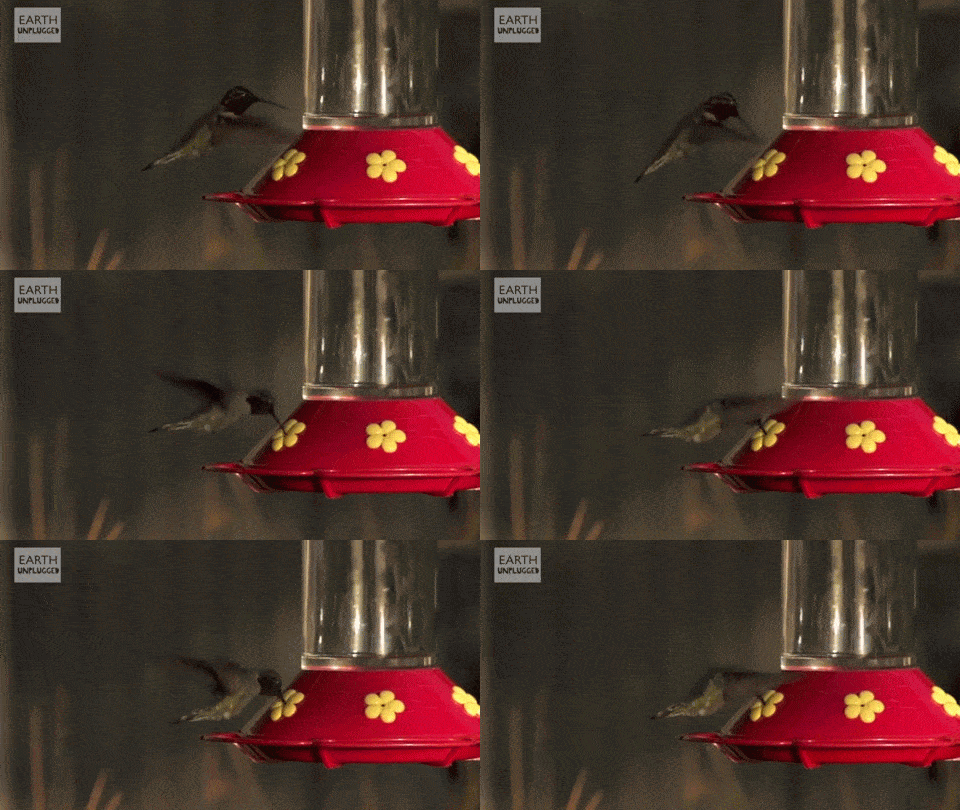
For a little more than century, mankind has taken flight in fixed-wing aircraft. But other species have flown for much longer using flapping techniques, the details of which humans are still unraveling. To really appreciate flapping flight, it helps to have high-speed video, like this beautiful footage of a goshawk attacking a water balloon. The motion of the hawk’s wings is far more complex than the simple up and down flapping we imitate as children. On the downstroke, the wings and tail stretch to their fullest, providing as large an area as possible for lift. During steady flight, the bird flaps while almost horizontal for minimal drag, but as it approaches its target, it rears back, allowing the downstroke to both lift and slow the bird. In the upstroke, the bird needs to avoid generating negative lift by pushing air upward. To do this, it pulls its wings in and simultaneously rotates them back and up. Its tail feathers are also pulled in but to a lesser extent. Leaving them partially spread probably maintains some positive lift and provides stability. At the end of the upstroke, the hawk’s wings are ready to stretch again, and so the cycle continues. (Video credit: Earth Unplugged/BBC; h/t to io9)

The Physics of a Flying-V
New research using free-flying northern bald ibises shows that during group flights the birds’ positioning and flapping maximize aerodynamic efficiency. In flight, a bird’s wings generate wingtip vortices, just as a fixed-wing aircraft does. These vortices stretch in the bird’s wake, creating upwash in some regions and downwash in others as the bird flaps. According to theory, to maximize efficiency a trailing bird should exploit upwash and avoid downwash by flying at a 45-degree angle to its leading neighbor and matching its flapping frequency. The researchers found that, on average, this was the formation and timing the flock assumed. In situations where the birds were flying one behind the next in a straight line, the birds tended to offset their flapping by half a cycle relative to the bird ahead of them–another efficient configuration according to theory. Researchers don’t yet know how the birds track and match their neighbors; perhaps, like cyclists in a peloton, they learn by experience how to position themselves for efficiency. For more information, see the researchers’ video and paper. (Photo credit: M. Unsold; research credit: S. Portugal; via Ars Technica; submitted by M. Piedallu van Wyk)

Falcon vs. Raven
Earth Unplugged has posted some great high-speed footage of a peregrine falcon and a raven in flight. Notice how both birds draw their wings inward and back on the upstroke. By doing so, they decrease their drag and thus the energy necessary for flapping. On the downstroke, they extend their wings fully and increase their angle of attack, creating not only lift but thrust. The falcon boasts an incredibly streamlined shape, not only along its body but also along its wings. In contrast, the raven has broader wings with large primary feathers that fan out near the tips. Splaying these large feathers out decreases the strength of the bird’s wingtip vortices, thereby reducing downwash and increasing lift, much the same way winglets do on planes. That extra lift and control the big primaries provide is important for the raven’s acrobatic skill. (Video credit: Earth Unplugged; via io9)

Fluids Round-up – 13 July 2013
Prepare yourselves for lots of links in today’s fluids round-up!
- Longtime FYFD favorite Mark Stock (see here, here, and here) and his collaborator James Susinno have unveiled a new interactive art piece, “Everything is Made of Atoms” that utilizes some impressive real-time fluids simulation. NVIDIA’s blog has some details on the computing.
- ScarbsF1 takes a detailed look at the F-duct used to stall an F1 car’s rear wing to reduce drag. (submitted by Vinnie)
- Just in time for summer fun, National Geographic talks about the physics of water slides.
- SpaceX’s reusable Grasshopper rocket has set a new altitude test of over 1000 ft. Check out this feat of aerodynamic control over at io9.
- Stanford engineers are using high-speed video of birds in the wild to study the mechanics of flapping flight. If you check out their video, you’ll notice how the birds rotate their wings as they flap in order to maximize lift throughout the flapping cycle. (via io9)
- Speaking of io9, they highlighted a couple of great examples of meteorological fluid dynamics recently: roll clouds and water spouts.
- New research suggests that thresher sharks may whip their tails quickly enough to produce cavitation-induced shockwaves to stun their prey. If so, they join the pistol and mantis shrimp in utilizing this technique for hunting.
- If you’re looking for some casual games, Liquid Sketch is a fun fluids puzzle game for iOS (submitted by Keri B)
- Finally, congratulations to Toronoto’s AeroVelo for capturing the AHS Sikorsky Prize with their human-powered helicopter. Check out this video from their historic flight (submitted by Chris R).
(Photo credit: AeroVelo)


