Tag: flapping flight

  • Mosquito Flight

    Mosquito Flight

    Mosquitoes are unusual fliers. Their wings are long and skinny, and they beat at around 700 strokes a second – incredibly quickly for their size. Examining how they move has uncovered some interesting mechanics. Despite their short stroke length, the mosquito generates a lot of lift on both its upstroke (when the wing is moving backward) and its downstroke (when the wing moves forward). Some features of the mosquito’s flight are highlighted in the images above. In the animation, blue indicates areas of low pressure and red indicates high pressure.

    Like most flapping fliers, the mosquito generates a leading-edge vortex during its downstroke (and its upstroke). This vortex helps concentrate low pressure on the upward-facing wing surface, thereby creating lift. One of the things that makes the mosquito unique, however, is that it also creates trailing-edge vortices on both half-strokes. To do this, the mosquito rotates its wings precisely to catch the wake of its previous half-stroke. The flow gets trapped near the trailing edge of the wing and forms a vortex and low-pressure region. Like the leading-edge vortex, this low-pressure area on the upward-facing wing surface creates lift. For more secrets of mosquito flight, check out this video from Science or the original paper. (Image credit: R. Bomphrey et al., source)

  • Water Skiing Beetles

    Water Skiing Beetles

    Waterlily beetles employ an unusual method of getting around: they skim across the water surface. The beetles are mostly covered in tiny hairs that help make their body hydrophobic (water-repellent) – a common adaptation for insects that spend their time sitting on the water’s surface – but the beetles also have hydrophilic claws on their legs that help anchor them to the water’s surface. When they need to move quickly, the beetles lean upright and start flapping their wings, creating thrust that helps push them along the interface. Between water’s viscosity and drag from the waves the insect generates, it has to expend a lot of energy for this method of travel – more than these insects do flying in air – but researchers suspect that staying at the surface could remain beneficial for the beetles because it’s easier to locate their floating food sources this way. (Image credit: H. Mukundarajan et al., source; via New Scientist)

  • Laser Goggles for Parrotlets

    Laser Goggles for Parrotlets

    Many experimental techniques in fluid dynamics use lasers. One such technique, particle image velocimetry (PIV), introduces tiny particles into the flow and uses a laser to illuminate the particles. By taking pictures in rapid succession and comparing them, researchers can measure the velocity in different parts of the flow. This technique is incredibly powerful but it’s rarely used to study topics like animal flight, except using mechanical substitutes for live animals.

    Part of the reason researchers don’t typically use live animals in this type of experiment is that these very powerful lasers can blind people or animals that aren’t properly protected. So to protect their test subject, Stanford researchers designed and built a special pair of laser safety goggles for their parrotlet. This let the bird fly safely despite the lasers and enabled the researchers to measure flow around realistic bird flight conditions. (Image credit: Stanford News, source, and E. Gutierrez; research credit: E. Gutierrez et al.; submitted by Simon H. via Wired)

  • The Seabird That Can’t Get Wet

    The Seabird That Can’t Get Wet

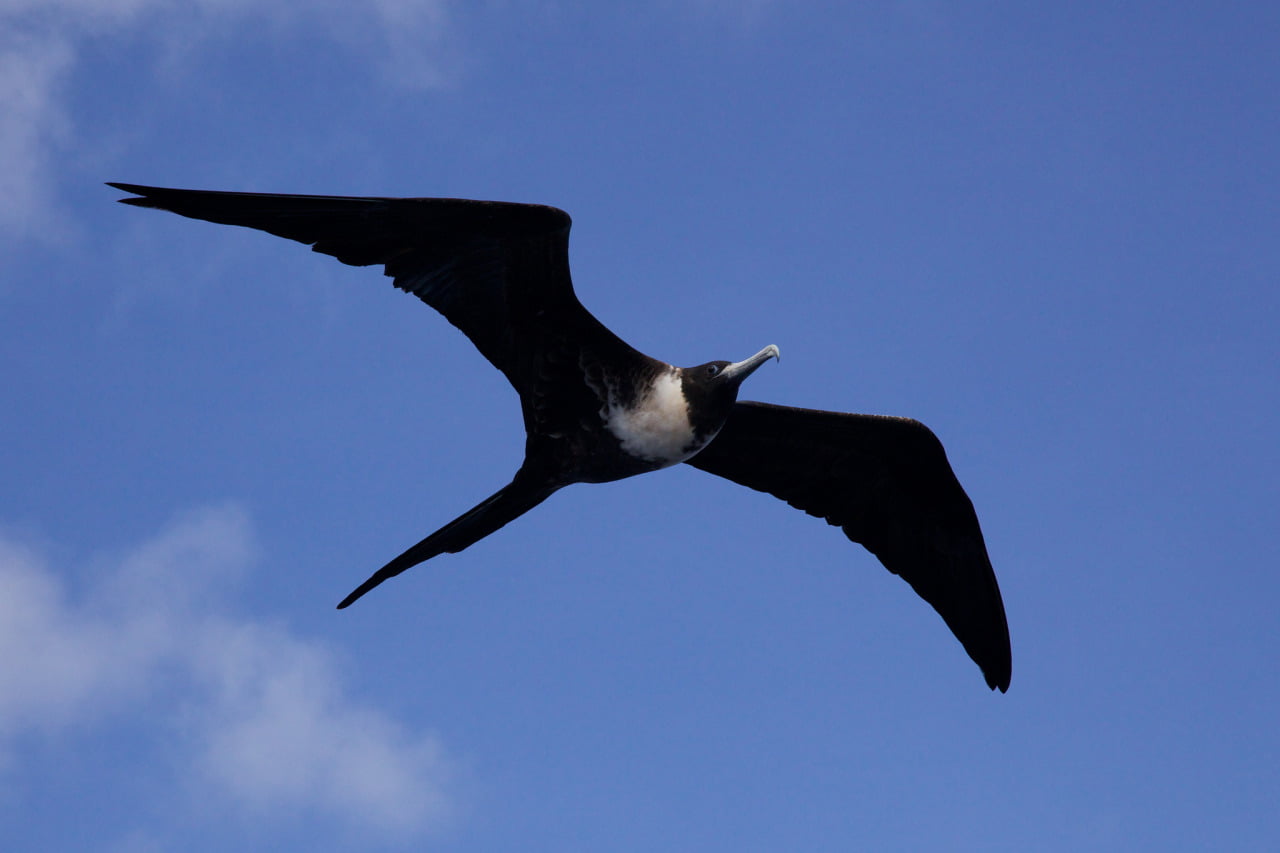
    Unlike most seabirds, the frigatebird does not have waterproof feathers. Landing in the water during a transoceanic flight would quickly drown the bird, so instead they stay aloft. But until recently, scientists did not realize just how adept the birds are. Studying tagged frigatebirds in flight, researchers found that the birds could reach altitudes of 4000 meters and that they could soar without flapping for up to 64 kilometers! They achieve these heights by seeking out clouds, which mark strong atmospheric updrafts. The birds ride these thermals up to the cloud tops – well into freezing conditions – and then glide slowly back down.

    Their bodies are impressively built for slow glides. Frigatebirds boast a low body weight for their large wing area. This ratio is known as wing loading, and it’s a fundamental characteristic of any flier, avian or otherwise. Low wing loading is key to gliding longer because it reduces the speed at which a glider loses altitude. (Image credit: D. Brossard; research credit: H. Weimarskirch et al.; via @skunkbear)

  • Flying in Cramped Quarters

    Flying in Cramped Quarters

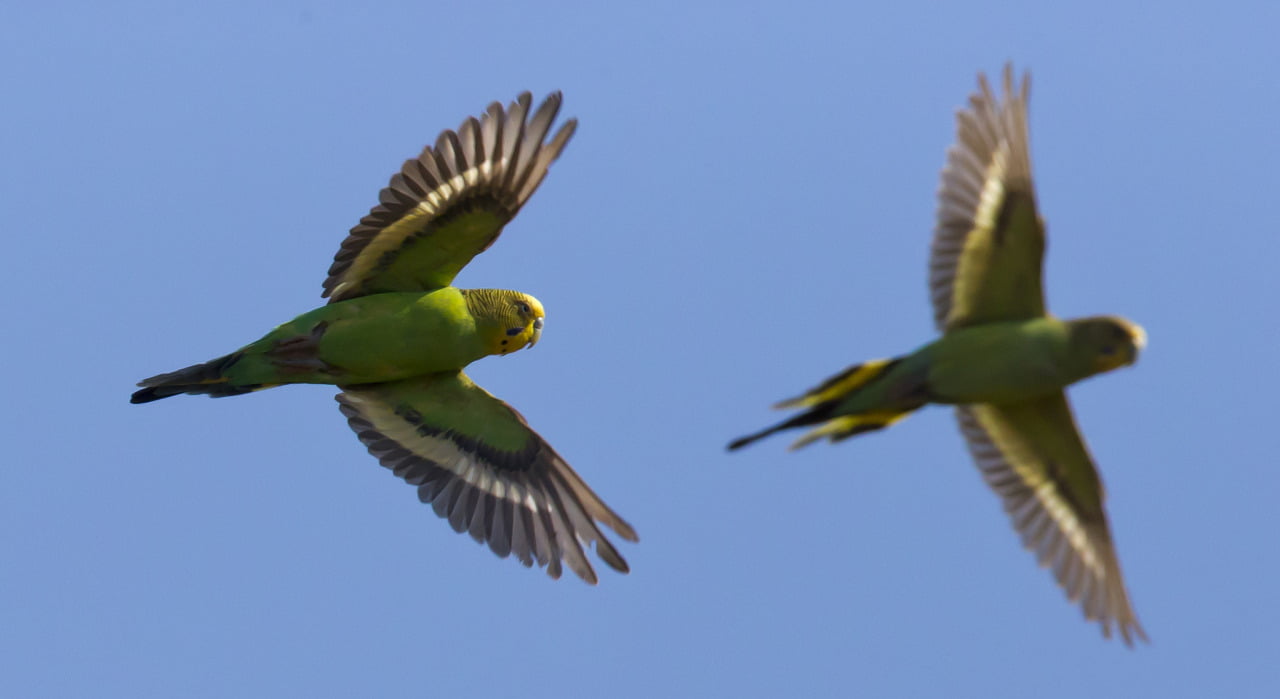
    A new study has found that budgerigars (also commonly known as parakeets or budgies) fly at only two distinct speeds. The researchers flew the birds in a tapered tunnel to see how they navigated in response to widening or narrowing paths. What they found, regardless of the flight direction in the tunnel, is that the birds fly at approximately 9.5 m/s in areas wider than 2.5 times their wingspan and drop suddenly to a speed about half that when in narrower areas. The higher speed falls within the bird’s most energy-efficient range, suggesting that the birds may prefer flying at this condition. Insects like bumblebees also change speeds when entering cluttered environments, but the insects do so gradually, not suddenly like the budgerigars. The reason for this difference is not yet known, but it could relate to how the animals sense their environment or to differences in their flight efficiency when varying speed. (Image credit: J. Bendon; research credit: I. Schiffner and M. Srinivasan; submitted by Marc A.; h/t to Irmgard B.)

  • Flying with Large Ears

    Flying with Large Ears

    Evolution often requires compromise between competing effects. Large-eared bats, for example, rely on the size of their ears to aid their echolocation, but such large ears can hurt them aerodynamically, thus limiting their flight. Results from a recent experiment, however, suggest that large ears are not a total loss aerodynamically speaking. Researchers used particle image velocimetry to study the wakes behind free-flying, large-eared bats and found significant downward flow behind the bats’ bodies. This indicates that the bats generate some lift with their ears, body, and/or tail. The position and tilt of the ears in flight is similar to forward swept wings, which the authors suggest could help contract the wake behind the ears and reduce its negative influence on flow over the wings. Although the evidence is not yet conclusive, the study does suggest that large ears may be more aerodynamically beneficial than they appear. (Image credit: L. Johansson et al./Lund University, source; via Jalopnik)

    The next FYFD webcast will be this Saturday, May 21st at 1pm EDT. My guests will be Professor Jean Hertzberg of the University of Colorado at Boulder and Professor Kate Goodman of the University of Colorado at Denver. Dr. Hertzberg is the creator of the course Flow Visualization, an interdisciplinary course combining engineering, art, and fluid dynamics. It’s a class (and website) that’s been an inspiration for me and FYFD since the early days! Dr. Goodman, an expert in engineering education, earned her PhD studying the Flow Viz course and its impact. This will be wide-ranging discussion – with everything from experimental fluid dynamics and engineering education to art, photography, and hopefully even cardiac fluid dynamics!

    (Original images: P. Davis et al.; B. Moore; L. Swift et al.)

  • Featured Video Play Icon

    Silent Flying

    As nocturnal hunters, owls are aerodynamically optimized for stealthy flying. This clip from BBC Earth demonstrates just how quiet a barn owl is in flight compared to a pigeon or a peregrine falcon. The owl’s large wingspan relative to its body size gives it enough lift that it does not have to flap often, allowing it to glide instead, but this is far from its only stealthy adaptation. Owl feathers feature a serrated leading edge that helps break flow over the wing into smaller, quieter vortices. Their fringe-like trailing edge breaks flow up even further and acts to damp noise from airflow. The downy feathers of the owl’s body also help muffle any noise from the bird’s movement, allowing the barn owl to fly almost silently. (Video credit: BBC Earth; via Gizmodo)

  • Bumblebees in Turbulence

    Bumblebees in Turbulence

    Bumblebees are small all-weather foragers, capable of flying despite tough conditions. Given the trouble that micro air vehicles have when flying in gusty winds, bumblebees can help engineers to understand how nature successfully deals with turbulence. Under smooth laminar conditions like those shown in the animation above, bumblebees stay aloft by beating their wings forward and backward in a figure-8-like motion. On both the forward downstroke and the backward upstroke, you’ll notice a blue bulge near the front of the bee’s wing. This is a leading-edge vortex, which provides much of the bee’s lift.

    Researchers were curious how adding turbulence would affect their virtual bee’s flight. The still image above shows the bee in moderate freestream turbulence (shown in cyan). Surprisingly, this outside turbulence has very little effect on the flow generated by the bee, shown in pink. In fact, the researchers found that the bees could fly through turbulence without a significant increase in power. Too much turbulence does make it hard for the bee to control its flight, though. The bee’s shape makes it prone to rolling, and the researchers estimated, based on a bee’s 20 ms reaction time, that bumblebees can probably only correct that roll and maintain controlled flight at turbulence intensities less than 63% of the mean wind speed. (Image credits: T. Engels et al., source; via Physics Focus)

  • Hovering Hummingbirds

    Hovering Hummingbirds

    Hummingbirds are incredible flyers, especially when it comes to hovering. To hover stationary and stable enough to feed, the hummingbird’s flapping pattern not only has to generate enough lift, or vertical force, to counteract their weight, but the bird must balance any forward or backward forces generated during flapping.

    As you can see in the animations above, when hovering the hummingbird’s wings move forward and back rather than up and down. When slowed down even further, the figure-8 motion of the wings becomes apparent. This careful motion is key to the hover; it allows the bird to generate about 70% of its lift on the downstroke when the wings move forward and creates the remainder of the lift needed on the upstroke. For much more high-speed footage of hummingbirds, check out the full BBC Earth Unplugged video, but be warned: you may experience a cuteness overdose! (Image credit: BBC Earth Unplugged, source)

  • Featured Video Play Icon

    Perching Physics

    Compared to birds, manmade aircraft tend to be quite limited and inelegant. Fixed-wing aircraft, for example, require long, flat areas for take-off and landing, whereas birds of all sizes are adept at maneuvers like perching. This video examines the perching behaviors of large birds and extends the physics to a small unmanned aerial vehicle (UAV). As a bird approaches a perching location, it pitches its body and wings upward. This places the bird in what’s known as deep stall, where air flowing over the upper surface of the wing separates just after the leading edge. This move dramatically increases drag on the bird, slowing it for landing. At the same time, the speed of the pitch maneuver generates a vortex on the wing that helps the bird maintain lift despite the drop in speed. With the help of both forces, the bird can make a graceful, controlled landing in only a short distance. (Video credit: J. Mitchell et. al.)