Researchers studying the use of fire whirls to burn off oil spills have discovered a new type of fire whirl – the blue whirl. Their results are currently reported in a pre-print paper on arXiv and await peer-review. In their experiment, the scientists ignited a puddle of fuel floating atop water. Compared to a typical flame, they observed that a tightly-spinning fire whirl burns hotter and produces less soot by burning more of the fuel. To the researchers’ surprise, their lab-scale yellow fire whirl evolved into a compact, bright blue whirl. The blue whirl has a laminar flame and makes little to no noise. Its bright blue color indicates even more efficient combustion than the yellow fire whirl. The lack of yellow color means the whirl is burning without producing any soot, a by-product of incomplete combustion. The authors hope a better understanding of blue whirls will lead to better methods for responding to oil spills. (Image credit: H. Xiao et al.)
Tag: fire

Water in Oil
Pouring water on an oil fire is a quick way to cause almost explosive results. Since water is denser than oil, it quickly sinks to the bottom of a container, heating up as it does. When the water reaches its boiling point, it evaporates and expands as steam. That phase change involves a huge change in volume, a fact made especially clear in the video below. The steam expands and rises, throwing droplets of oil upward and outward. These smaller atomized droplets are easier to combust, which, in the case of the video above, causes a veritable cloud of flames if a fire has already started.
(Video credits: The Slow Mo Guys and N. Moore)

Extinguishing Fires With Sound
Engineering students from George Mason University have built a fire extinguisher that uses sound to put out flames. Since sound waves are mechanical pressure waves, they can move the air surrounding a burning material. Through trial and error the students found the high-frequency sound had little effect, but at frequencies between 30-60 Hz the sound waves could jostle enough oxygen away from the flame to extinguish the fire. They’re hoping the solution is scalable and can be applied to larger fires. For other wild ideas for chemical-less fire extinguishers, check out how researchers put out fires with explosions. (Video credit: George Mason University; submitted by @isanaht)

Fire-Breathing
In this high-speed video, the Slow Mo Guys demonstrate fire-breathing. Rather than using a liquid fuel like kerosene, they utilize cornstarch, which is both easily flammable and non-volatile thanks to its powdered form. Blowing out the cornstarch creates a turbulent jet of cornstarch and air. Combine that with a combustion source, and the cornstarch quickly deflagrates, meaning that the flame propagates via heat transfer. When neighboring regions of cornstarch become hot enough, they ignite and the flame front expands. You can observe this in the flame growth shown in the video; just after ignition the cornstarch jet is much wider than the fire and it takes some time for the flames to catch up with the jet. Although a liquid-fueled fireball operates by the same principles, it can look rather different. For comparison, check out this high-speed video of a WD-40 fireball. And, hopefully it goes without saying, but don’t try this stuff at home. (Video credit: The Slow Mo Guys)

Flames in Space
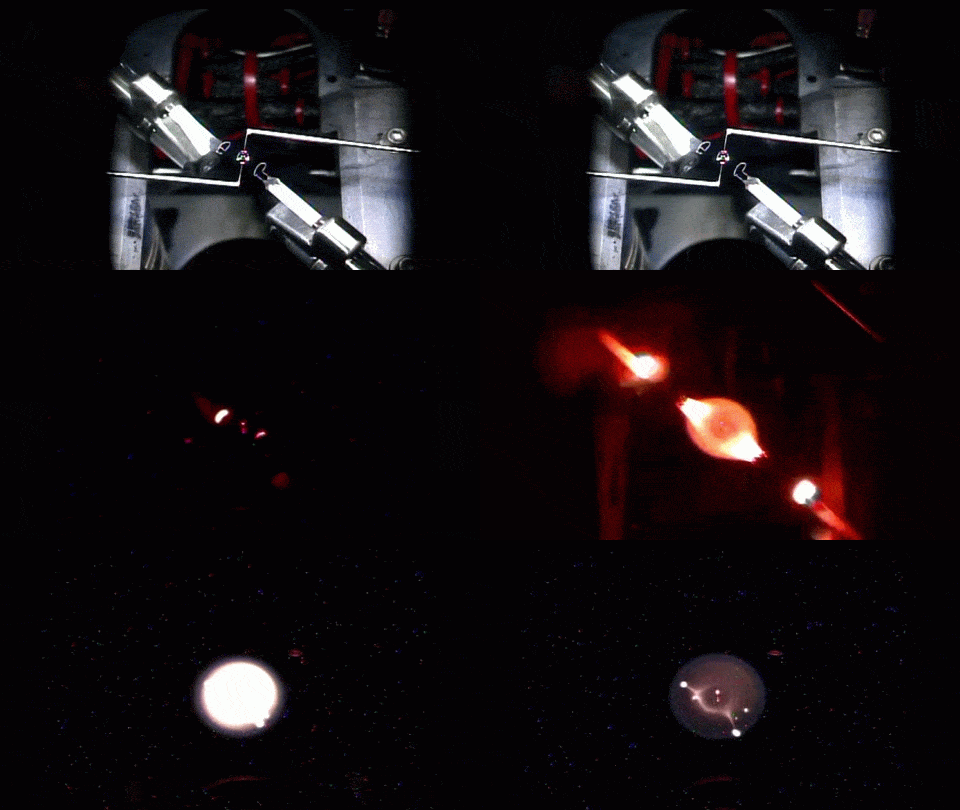
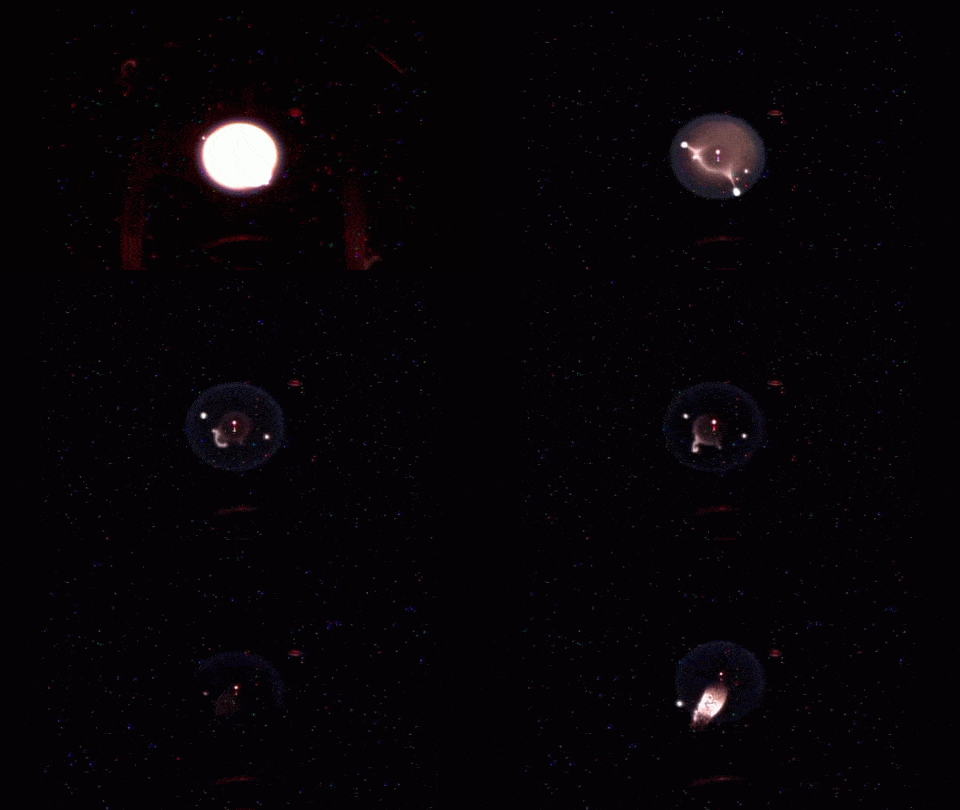
The jellyfish-like light show in the animations above shows the life and death of a flame in microgravity. The work is part of the Flame Extinguishment Experiment 2 (FLEX-2) currently flying aboard the International Space Station. When ignited, the fuel droplet creates a blue spherical shell of flame about 15 mm in diameter. The spherical shape is typical of flames in microgravity; on Earth, flames are shaped like teardrops due to the effects of buoyancy, which exists only in a gravitational field. The bright yellow spots and streaks that appear after ignition are soot, which consists mainly of hot-burning carbon. The uneven distribution of soot is what causes the pulsating bursts seen in the middle animation. When soot products drift back onto the fuel droplet, it causes uneven burning and flame pulses. The final burst of flame in the last animation is the soot igniting and extinguishing the flame. Fires are a major hazard in microgravity, where oxygen supplies are limited and evacuating is not always an option. Scientists hope that experiments like FLEX-2 will shed light on how fires spread and can be fought aboard spacecraft. For more, check out NASA’s ScienceCast on microgravity flames. (Image credits: NASA, source video; submitted by jshoer)

Pyrocumulus Clouds

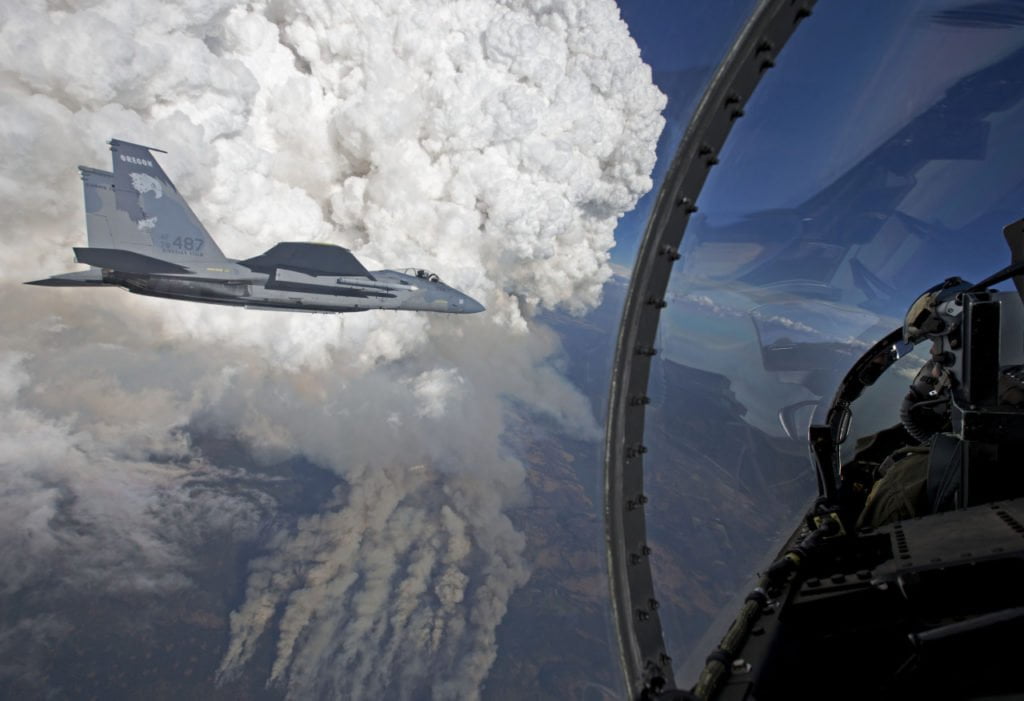
Pyrocumulus clouds tower tall above a wildfire in these photos taken last week from an Oregon National Guard F-15C. Most cumulus clouds form when the sun-warmed surface heats air, causing it to rise and carry moisture upward where it condenses to form clouds. In pyrocumulus clouds, the driving heat is supplied by a forest fire or volcanic eruption. The hot, rising air carries smoke and soot particles upward, where they become nucleation sites for condensation. Pyrocumulus clouds can be especially turbulent, and the gusting winds they produce can exacerbate wildfires. In some cases, the clouds can even develop into a pyrocumulonimbus thunderstorm with rain and lightning. (Photo credit: J. Haseltine; via NASA Earth Observatory)

Fire in Microgravity
In the movie “Gravity” Sandra Bullock’s character battles a fire aboard the International Space Station. Combustion is a huge concern in space habitats. Microgravity fires are challenging to detect and fight because they behave very differently in the absence of buoyancy. On Earth, buoyancy makes hot air rise from a flame while cooler air is pulled in near the base. This feeds fresh oxygen to the teardrop-shaped flame. In space, there is no buoyancy and flames are spherical. They also burn at lower temperatures and lower oxygen concentrations–so low, in fact, that the oxygen depletion necessary to extinguish a fire is lower than what humans require to survive.
No buoyancy makes it harder for fires to spread, but it also makes them harder to detect since smoke doesn’t rise toward a detector on the ceiling. Instead, fire detectors aboard the Space Station are housed in the ventilation system that moves air through the modules constantly. In the event of a fire, astronauts use a three-step fire suppression system. First, they shut off the ventilation system to delay the fire’s spread. Then they shut off power to the affected unit, and, finally, they use fire extinguishers on the flames. The Russian module is equipped with a foam extinguisher and the others use CO2 units. (Image credit: Warner Brothers)

Flame Feedback
When a flame is enclosed in a combustion chamber, it can create violent oscillations in the pressure field. Flames have a natural unsteadiness in their heat release. These temperature fluctuations create pressure waves in the chamber. In the right enclosure, those pressure waves resonate and feed energy back into the initial perturbation. This creates a self-exciting oscillation, not dissimilar from aeroelastic flutter. This combustion instability is known as a thermoacoustic instability because of the coupling between temperature and pressure (acoustic) waves. The quick demo above lets you see and hear such an instability; here’s the same setup in high-speed, which makes the oscillating flame even clearer. The violence of this instability can be great enough to destroy engines. Famously, the F1 engine used in the Saturn V rocket had a history of instability issues before the fuel-injector was redesigned. For another great demo of this effect, check out this video from T. Poinsot. (Video credit: V. Anandan)

Fire-Breathing Physics
One of the most dangerous stunts for any fire-eater is breathing fire. Dr. Tim Cockerill explains some of the science behind the feat in this video. Volatility–the tendency of the liquid fuel to vaporize–is actually the enemy of a fire-eater. Use a fuel that is too volatile and it will catch fire too easily when the vaporous fuel mixes with the air. Instead fire-eaters use less volatile fuels and spray a mist of fine droplets to mix the air and fuel. This atomization of the fuel creates a spectacular fireball without endangering the fire-eater (as much). To see a similar fireball in high-speed, check out this post. (Video credit: T. Cockerill/The Ri Channel; via io9)

Turbulent Flames
The flames surrounding a burning tree stump flicker and billow in this image from photographer Serdar Ozturk. The chaotic motion of the flames is indicative of turbulence, a state of fluid flow known for its many scales. Note the range of lengthscales and structures in the fire. In turbulent flows, kinetic energy cascades from large scales, like the width of the top of the plume, down to the small scales, which may be even smaller than the wisps of flame at the edges of the fire. At the largest scales, the structures and behaviors we observe are all flow- and geometry-dependent, but theory predicts that, at the smallest scales, all turbulent flows look the same. (Photo credit: trashhand/Serdar Ozturk)