Tag: evaporation

  • Featured Video Play Icon

    Bursting Droplets

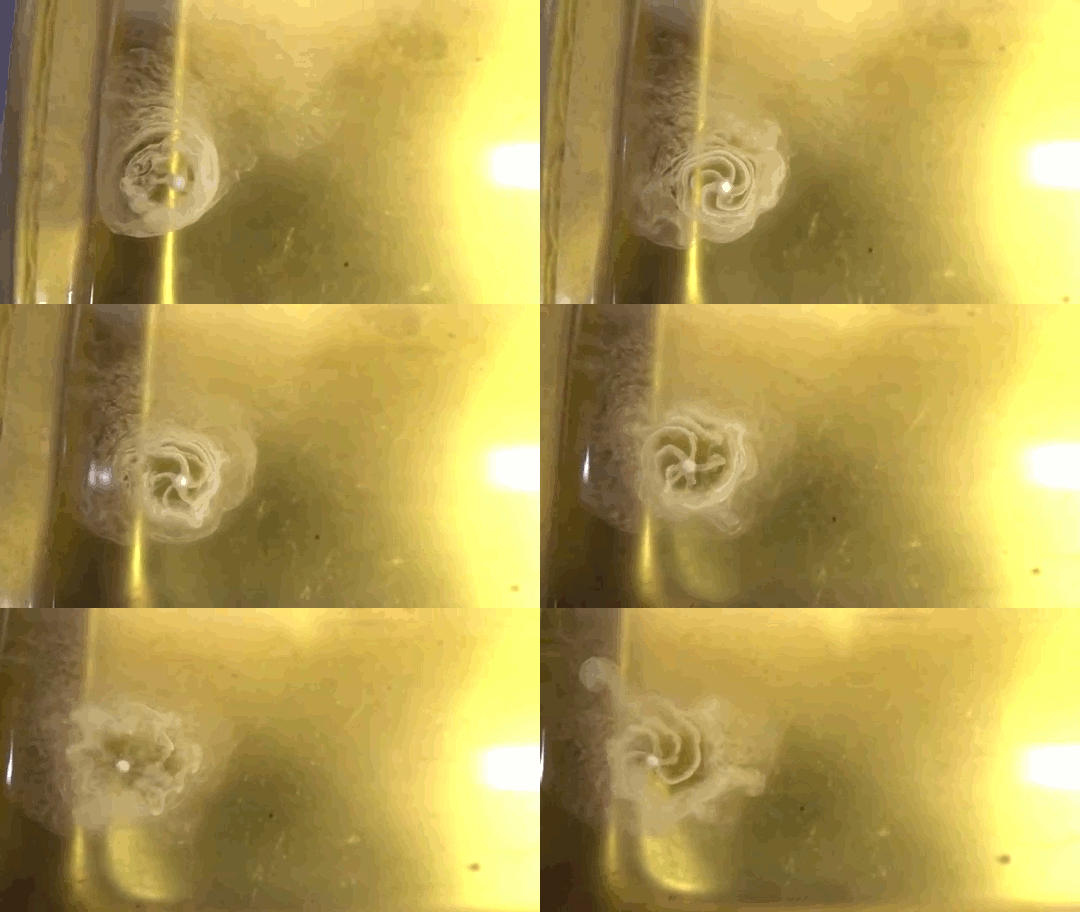
    Mixing multiple fluids can often lead to surprising and mesmerizing effects, whether it’s droplets that dance or tears along the walls of a wine glass. A recent paper highlights another such mixture-driven instability – the bursting of a water-alcohol droplet deposited on an oil bath. The Lutetium Project tackles the physics behind this colorful burst in the short video above. The behavior is driven by the quick evaporation rate of alcohol in the droplet and the way this changing chemical concentration affects surface tension in the droplet. Alcohol evaporates more quickly from the edges of the drop, creating a region of higher surface tension around the edge. This pulls fluid to the rim of the drop, where it breaks up into droplets that get pulled outward as the inner drop shrinks.

    The oil bath plays an important role in the instability, too. Without it, friction between the drop and a wall is too high for the droplet to “burst”. A thick layer of oil acts as a lubricant, allowing the escaping satellite drops to speed away. (Video and image credit: The Lutetium Project; research credit: L. Keiser et al.; submitted by G. Durey)

  • Featured Video Play Icon

    Coarsening in a Soap Film

    Flow in a soap film is driven by gravity’s efforts to thin the film and surface tension’s attempts to stabilize variations in thickness. Because evaporation guarantees that the soap film will eventually dry out, gravity typically wins the battle and causes a soap film to rupture. This video takes a close look at what happens in the film just before it ruptures. Black dots form in the thinnest region of the flow. These areas are not holes, but they appear black because they are thinner than any wavelength of visible light. Before rupture, the black dots begin coalescing with one another, first due to diffusion and later more rapidly due to convection in the soap film. Ultimately, the black dots are the harbingers of doom for the fragile bubble. (Video credit: L. Shen et al.)

  • Frost Spreading

    Frost Spreading

    Frost typically forms when supercooled droplets of water scattered across a surface freeze together. The freezing spreads via tiny ice bridges that link droplets together into a frozen network. The animation above shows this process in action. Freezing starts in a droplet off-screen on the right and quickly spreads. Watch carefully, and you can see the ice bridges growing toward the unfrozen droplets. This is because the ice bridges are fed by water vapor evaporating from the droplets. If one can spread the droplets far enough from one another, it’s possible for a droplet to evaporate completely before the ice bridge reaches it, thereby disrupting the spread of frost.  (Video credit: J. Boreyko et al.; research paper)

  • Leidenfrost Atop Gasoline

    Leidenfrost Atop Gasoline

    The animations above show a little of what happens when you pour a spoonful of liquid nitrogen onto a container of gasoline. A couple of things are happening simultaneously here. First of all, the liquid nitrogen is experiencing the Leidenfrost effect. Because of the extreme difference in temperature between the gasoline (~20 degrees C) and the liquid nitrogen (-196 degrees C), part of the nitrogen is evaporating immediately, creating a vapor layer that insulates the remainder of the liquid nitrogen and allows it to float above the gasoline surface. The same thing happens to water drops on a very hot skillet.

    The extreme cold of the nitrogen also seems to have formed some ice that’s further protecting the nitrogen drop. I’m not 100% sure what that would be made of, though – a mixture of water and gasoline?

    Finally, there’s the simultaneous evaporation of the liquid nitrogen and the sublimation of the ice. This is the white vapor we see propelling and spinning the ice/drop. Note the “bounce” that happens in the top animation. The drop never actually impacts the wall. When it gets close, the escaping vapors are affected by the wall and start pushing the drop in a new direction! Check out the whole video below. (Image credit: carsandwater; via Gizmodo)

  • The Evaporation of Ouzo

    The Evaporation of Ouzo

    Ouzo is an aperitif made up of ethanol (alcohol), water, and anise oil. This three-part, or ternary, mixture undergoes an intriguing evaporation process thanks to the characteristics of its components. An ouzo drop’s evaporation can be divided into four phases, each shown above. Initially, the drop is well-mixed and transparent (upper left). 

    Since ethanol is the most volatile of ouzo’s components, it evaporates the most quickly. As the ethanol evaporates, the drop becomes oversaturated with oil (upper right). Oil droplets form, giving the ouzo a milky appearance. At the same time, the ethanol evaporating causes gradients in surface tension, which drive a vigorous Marangoni flow inside the drop. 

    Eventually, the ethanol finishes evaporating and the oil drops collect in a ring around the outside of the drop (lower left). Slowly, the water inside the drop evaporates. Eventually, a tiny microdroplet of water is left to dissolve in the anise oil (lower right). (Image and research credit: H. Tan et al., source; via Inkfish)

  • Whiskey Stains

    Whiskey Stains

    Photographer Ernie Button discovered that whiskey left behind intriguing patterns after it evaporated. Unlike coffee rings, the whiskey leaves behind a more uniform residue. Curious, he contacted researchers at Princeton, who were eventually able to explain why whiskey and coffee dry so differently. They observed three major effects in drying whiskey mixtures. Firstly, the alcohol in whiskey evaporates faster than other components, creating differences in concentration and, therefore, surface tension along the droplet. These variations in surface tension create Marangoni flow, which tends to mix the droplet. Coffee, being non-alcoholic, does not do this.

    Whiskey also contains surfactants, low surface tension chemicals, which help pull particulates away from the edge of the droplet so they aren’t trapped there like in coffee. And finally, they found that the polymers in whiskey helped glue particles to the glass so that they were less likely to be carried by the flow. Taken together, these three ingredients – alcohol, surfactants, and polymers – all help make the whiskey stain more uniform. For more, watch the video below, see Button’s website, or check out the research paper. (Image credit: E. Button; research credit: H. Kim et al.; video credit: C&EN; submitted by @tommyjwilson)


  • Featured Video Play Icon

    Mediterranean Currents

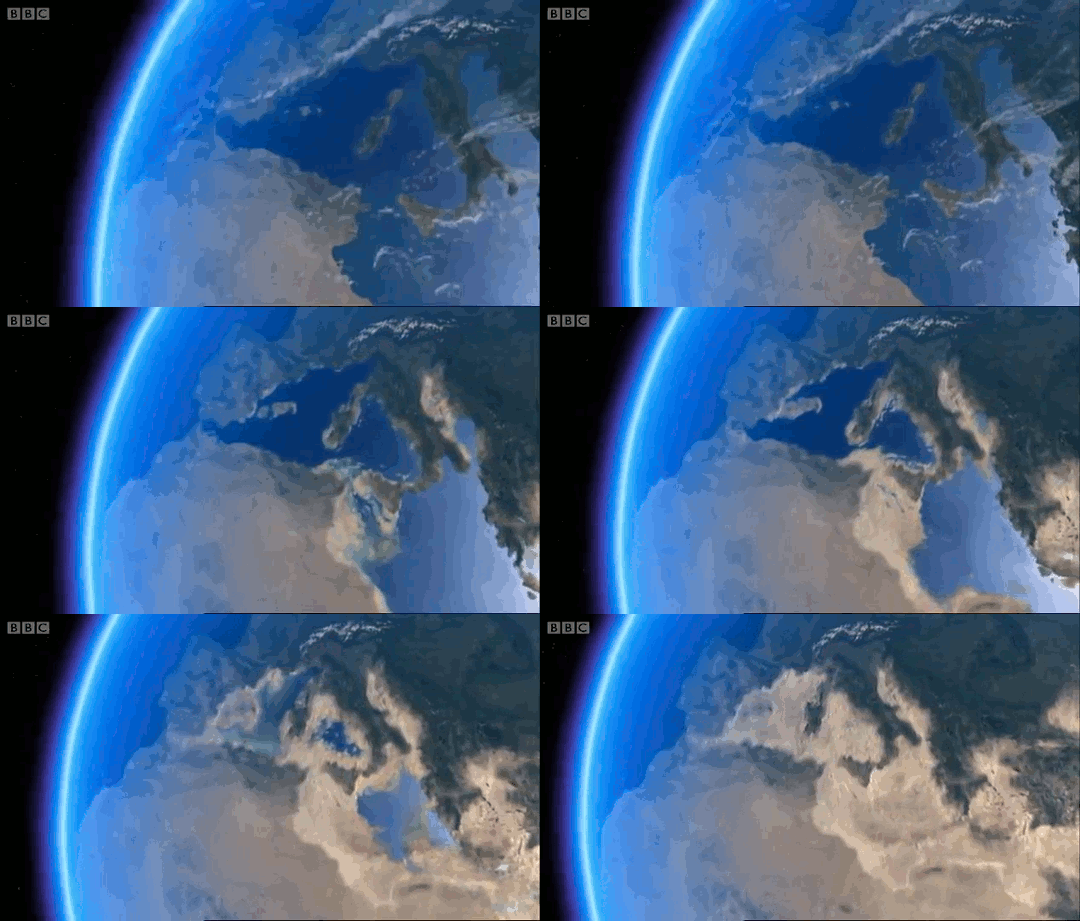
    Ocean currents play a major role in the weather and climate of our planet. This video shows a simulation of the surface ocean currents in the Mediterranean and Atlantic over an 11-month period. Each second corresponds to 2.75 days. You’ll see many swirling eddies in the Mediterranean and more flow along the coastlines in the Atlantic. One observation worth noting: near the end of the video, you’ll notice that flow through the Strait of Dover between England and France changes its direction, flowing back and forth depending on tidal forces. In contrast, flow through the Strait of Gibraltar is always into the Mediterranean (within the timescale of the simulation, at least). This net in-flow to the Mediterranean is due in part to the warm waters there evaporating at a higher rate than the cooler Atlantic. (Video credit: NASA; via Flow Viz; h/t to Ralph L)

  • Pinning a Drop

    Pinning a Drop

    The shape of a droplet sitting on a surface depends, in part, on its surface tension properties but also on the nanoscale roughness of the surface. Small variations in the height and shape of the surface will change the area a drop contacts as well as the contact angle the edge of the drop makes with the surface. If the contact line between the drop and surface stays the same as a droplet evaporates into the surrounding gas or dissolves into the surrounding liquid, then we say the drop is pinned. A pinned drop’s contact angle will decrease as the drop’s volume decreases. This strains the ability of the nanoscale roughness to keep the drop’s edge pinned. As individual points of contact fail, the drop’s edge may jump inward to a new contact point. This set of discrete jumps between pinned states is called a stick-jump or stick-slip mode. (Image credit: E. Dietrich et al., source; see also: E. Dietrich et al. 2015)

  • Mushrooms Make Their Own Breeze

    Mushrooms Make Their Own Breeze

    Plants and other non-motile organisms have developed some clever methods to disperse their seeds and spores for reproduction. Some plants use vortex rings for dispersal; others make their seeds aerodynamic. Low ground-dwellers like mushrooms must contend with a lack of wind to lift their spores and carry them away. Instead, they use evaporative cooling to generate their own air currents.

    Mushroom caps contain a lot of water and, as that water evaporates, it cools air near the mushroom, just as sweat evaporating off your skin cools you. That cooler, denser air tends to spread, carrying the spores outward. At the same time, the freshly evaporated water vapor is less dense than the surrounding air, so it rises. This combination of rising and spreading is capable of carrying spores tens of centimeters into the air, where the wind is stronger and able to carry spores further.  (Image credit: New Atlantis, source; research credit: E. Dressaire et al.)

  • Featured Video Play Icon

    Dancing Droplets

    The seemingly-alive dancing droplets are back in a new video from Veritasium. These droplets of food coloring attract, merge, and chase one another due to evaporation and surface tension interactions between their two components: water and

    propylene glycol. Because the droplets are constantly evaporating, they are surrounded by a cloud of vapor that helps determine a drop’s surface tension. These localized differences in surface tension are what causes the drops to attract. The chasing is also surface-tension-driven. Like any liquid, the drops will flow from areas of low surface tension to those of higher surface tension due to the Marangoni effect. Thus drops of different concentration appear to chase one another. This is a relatively simple experiment to try yourself at home, and Derek outlines what you need to know for it.  (Video credit: Veritasium; research credit: N. Cira et al.; submitted by @g_durey)