
As a follow-up to last week’s “dancing droplet” post, here’s a video that describes how to recreate the experiment yourself at home. The droplet motion is driven by the two-component structure of the droplets, where differing evaporation rates and surface tension values between the two fluids in the drop cause the attractions and chasing behavior you see. To demonstrate this at home, you’ll need glass, fire (for sterilization), tweezers, a pipette, water, and food coloring. Looks like a fun way to spend a weekend afternoon! (Video credit: M. Prakash et al.; via io9)
Tag: evaporation

Dancing Droplets


What makes drops of food coloring able to dance, chase, sort themselves, or align with one another? This unexpected behavior is a consequence of food coloring consisting of two mixed liquids: water and propylene glycol. Both have their own surface tension properties and evaporation rates, which ultimately drives the behavior you see in the animations above. Both long-range and short-range interactions are observed. The former are due to vapor from each droplet adsorbing onto the glass around the droplet, thereby changing the local surface tension and causing nearby drops to feel an attractive force. The short-range effects are also surface-tension-driven. Droplets with lower surface tension will naturally try to flow toward areas of higher surface tension, which causes them to “chase” dissimilar adjacent drops. You can learn more about the research in the videos linked below (especially the last two), or you can read about the work in this article or the original research paper. (Image credit: N. Cira et al., source videos 1, 2, 3, 4; GIFs via freshphotons; submitted by entropy-perturbation)

How Eyelashes Work
New research shows that eyelashes divert airflow around the eye, serving as a passive filter that reduces dust collection and controls evaporation. Mammal hairs in places like the nose act as ram filters that trap the particles that hit them and which require regular cleaning via sneezing. Eyelashes, on the other hand, prevent dust collection by altering airflow at the surface of the eye. At the optimal length of roughly 1/3rd the width of an eye, eyelashes create a stagnation zone near the eye surface that forces air to travel above rather than through the eyelashes. This results in lower shear stress and lower flow speeds at the eye surface, both of which help reduce evaporation and shield the eye from dust. Lashes can get too long, though; the researchers found that longer lashes tended to channel higher flow speeds toward the eye surface, leading to faster evaporation rates. Thus, donning longer fake eyelashes may dry out your eyes. (Image credit: G. Diaz Fornaro; research credit: G. Amador et al.; via skunkbear)

Hand Dryers and Atomization
Some newer electric hand dryers, like the Dyson Airblade, use jets of high-speed air to dry hands faster than traditional models. Much of their effectiveness comes from the rapid atomization–or break-up into tiny droplets–of water on one’s hands. This is demonstrated in the animation above, which comes from a high-speed video of a water drop falling through the jets of a homemade dryer. Breaking up the water quickly disperses the microdroplets but it also speeds up evaporation by greatly increasing the exposed surface area of the water. This is similar to how you can get instant snow from throwing boiling water if it’s cold enough outside. (Image credit: tesla500, source video; submitted by Nick)

Zesty Fireballs
Zesting the skin of a citrus fruit like oranges releases a spray of tiny oil droplets. Citrus oil has several volatile components, meaning that it evaporates quickly at room temperature. It is also a liquid with a relatively low flash point, meaning that only modest temperatures (~40-60 degrees Celsius) are needed to generate enough vapor to ignite a vapor/air mixture. With volatile and flammable liquid fuels, a spray of droplets is an ideal platform for combustion because the essentially spherical droplets have a high surface area from which they can evaporate and provide vaporous fuel. (Video credit: ChefSteps)

Bead-Infused Droplet
A Leidenfrost droplet impregnated with hydrophilic beads hovers on a thin film of its own vapor. The Leidenfrost effect occurs when a liquid touches a solid surface much, much hotter than its boiling point. Instead of boiling entirely away, part of the liquid vaporizes and the remaining liquid survives for extended periods while the vapor layer insulates it from the hot surface. Hydrophilic beads inserted into Leidenfrost water droplets initially sink and are completely enveloped by the liquid. But, as the drop evaporates, the beads self-organize, forming a monolayer that coats the surface of the drop. The outer surface of the beads drys out, trapping the beads and causing the evaporation rate to slow because less liquid is exposed. (Photo credit: L. Maquet et al.; research paper – pdf)

Does Liquid in a Vacuum Boil or Freeze?
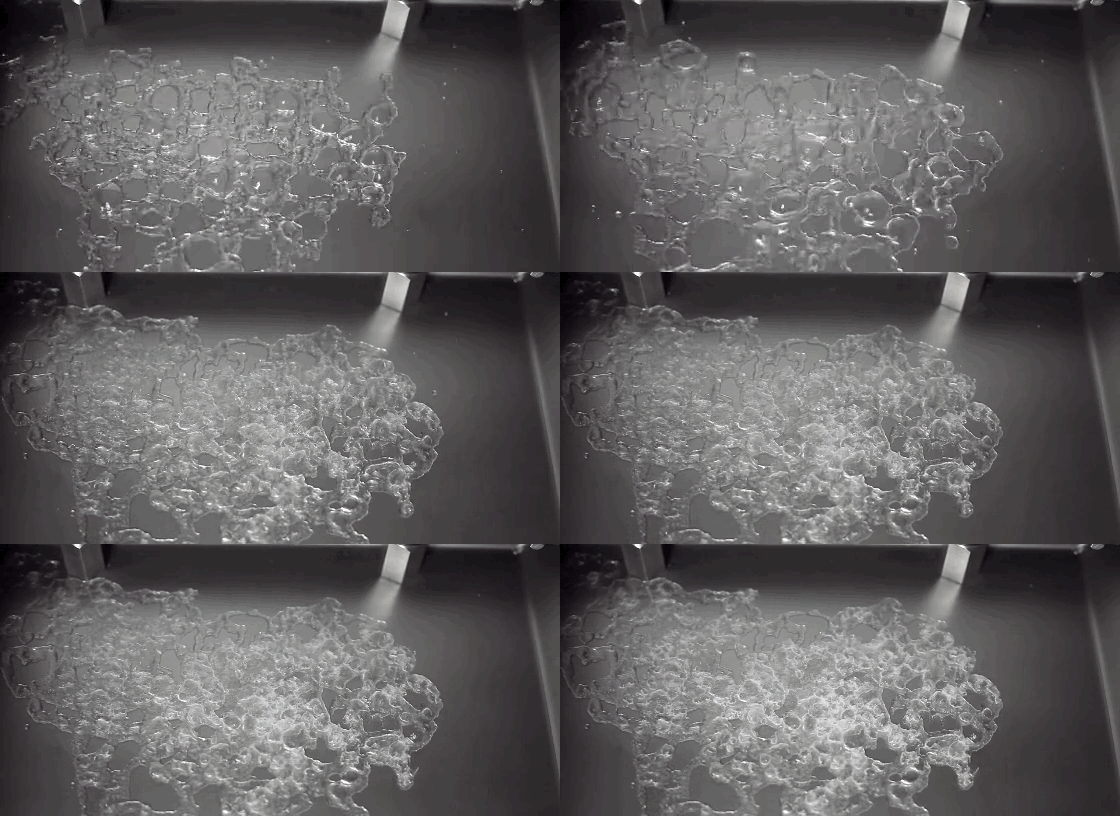


What happens to a liquid in a cold vacuum? Does it boil or freeze? These animations of liquid nitrogen (LN2) in a vacuum chamber demonstrate the answer: first one, then the other! The top image shows an overview of the process. At standard conditions, liquid nitrogen has a boiling point of 77 Kelvin, about 200 degrees C below room temperature; as a result, LN2 boils at room temperature. As pressure is lowered in the vacuum chamber, LN2’s boiling point also decreases. In response, the boiling becomes more vigorous, as seen in the second row of images. This increased boiling hastens the evaporation of the nitrogen, causing the temperature of the remaining LN2 to drop, the same way sweat evaporating cools our bodies. When the temperature drops low enough, the nitrogen freezes, as seen in the third row of images. This freezing happens so quickly that the nitrogen molecules do not form a crystalline lattice. Instead they are an amorphous solid, like glass. As the residual heat of the metal surface warms the solid nitrogen, the molecules realign into a crystalline lattice, causing the snow-like flakes and transition seen in the last image. Water can also form an amorphous ice if frozen quickly enough. In fact, scientists suspect this to be the most common form of water ice in the interstellar medium. (GIF credit: scientificvisuals; original source: Chef Steps, video; h/t to freshphotons)
The Inside of an Evaporating Drop
[original media no longer available]
Evaporating droplets may not look like much to the naked eye, but they contain complicated flow patterns. The type of pattern observed depends strongly on the contact line, the place where the liquid, solid, and air meet. When the contact line is pinned–kept unchanged–during evaporation, any particulates in the drop get pulled toward the edges as the drop evaporates. This is what leaves the classic coffee ring stain. It is also what is shown in the first clip in the video above. Contrast this with the second clip, in which the contact line is unpinned and varies irregularly as the drop evaporates. In the unpinned drop, particles are drawn inward during evaporation. The flow patterns are very different as well, complicated by swirling that is the result of force imbalances caused by the irregularly receding contact line. (Video credit: H. Kim)
Mushrooms Make Their Own Breeze
Mushrooms don’t rely on a stray breeze to spread their spores; they generate their own air currents instead. The key is evaporation. The mushroom cap contains large amounts of water, and, as this water evaporates, it cools the mushroom and the air next to it. This cool air is denser than the surrounding air, and so tends to spread out and convect. At the same time, though, the water vapor that evaporated from the mushroom is less dense than nearby air, which helps it rise. This combination of spreading and rising air carries spores away from the mushroom cap and, as seen in the video above, can combine to form beautiful and complex currents that spread the spores. (Video credit: E. Dressaire et al.)
Evaporating Drops
When still drops evaporate from a surface, they do so in several phases, as illustrated in the video above. Initially, the drop forms a spherical cap. At this point the velocity within the droplet is so small that it is difficult to resolve, but particles within the drop move outward toward the contact line. As the drop evaporates, they form a circle of sediment – the familiar coffee ring. As the drop flattens, radial velocity increases, drawing more and more particles to the coffee ring. Eventually the drop pulls away from the ring, leaving surface tension and evaporation to compete in driving the internal flow. During this phase, some parts of the contact line try to re-establish the flow pattern that made the first ring; this leaves behind circular segments broken up by the increasing instabilities in the contact line. In the final stage, surface tension smooths some of the irregularities and drives an inward velocity that leaves behind radial sediment segments. (Video credit: G. Hernandez-Cruz et al.)


