Tag: evaporation

  • Featured Video Play Icon

    The Drinking Bird

    At first glance, the drinking bird is a simple desk toy, but the physics and engineering behind the device is clever enough to have challenged many great minds. In this video, Bill Hammack dissects the drinking bird, revealing the heat engine beneath the felt and feathers. The bird’s drinking is driven by thermodynamics and the relative pressures of fluids in its head and body. When the beak is wetted, fluid wicks up the felted head and slowly evaporates, thereby cooling the vapor inside the head. Some of that vapor condenses, lowering the vapor pressure in the head and allowing liquid to rise from the body. When enough fluid reaches the head, the bird tips forward. This allows vapor to rise up the liquid column into the head, equalizing the pressure between the two ends. The bird sits up with a freshly wetted head and starts the cycle over. Check out the full video for more detail, including a look at what other methods can drive the bird, including bourbon and light bulbs. (Video and image credit: B. Hammack; via J. Ouellette)

  • Rolling Along

    Rolling Along

    Leidenfrost drops – droplets deposited onto a surface much hotter than their boiling point – are known for their mobility. With the right surface, they can be propelled, trapped, and even guided through a maze, typically by directing the vapor layer that cushions them. But new work shows that these drops have internal dynamics that also contribute to their propulsion.

    By adding tracer particles to each droplet, researchers can visualize flows inside the droplet. Large drops tend to have a flatter shape and contain two or more rotating vortices. Such drops won’t propel themselves without another force in play. But smaller droplets are more spherical and contain only a single rotating flow. Once these drops detach, they roll away! Despite the similarity to wheels, these liquid drops aren’t moving the same way. Remember that the drop is not actually in contact with the surface. To see what sets the drop’s direction, researchers examined the shape of the bottom of the drop. They found that it sits at a slant on its vapor cushion. That pushes evaporating gases out one side, propelling the drop the other way. (Image and video credit: A. Bouillant et al., source)

  • Surfing Mists

    Surfing Mists

    Watch your hot cup of coffee or tea carefully, and you may notice a white mist of tiny micron-sized droplets hovering near the surface. These microdroplets are a little understood part of evaporation. They form over a heated liquid, levitating on vapor that diffuses out from them and reflects off the liquid surface. (This is similar to the Leidenfrost effect, but the authors note it occurs at much lower temperatures. Unrelated research has suggested the Leidenfrost effect can occur at lower temperatures when there is very little surface roughness.)

    One of the particularly peculiar behaviors of these tiny levitating microdroplets is that they can exist over dry surfaces as well. The image above shows microdroplets migrating from a liquid surface (right) to a dry surface (center and left). When the droplets near the contact line, they encounter a strong upward flow due to increased evaporation there. This launches the droplets upward and they sail to the dry area. There, their vapor layers continue creating levitation and provide a cushion between them and their neighbors, causing the drops to self-organize into arrays. (Image credit: D. Zaitsev et al.; via Physics World; submitted by Kam-Yung Soh)

  • Convection

    Convection

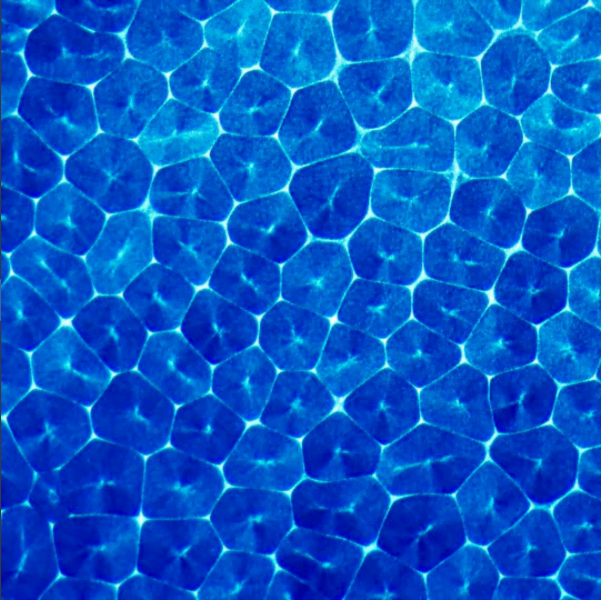
    Blue paint in alcohol forms an array of polygonal convection cells. We’re accustomed to associating convection with temperature differences; patterns like the one above are seen in hot cooking oil, cocoa, and even on Pluto. In all of those cases, temperature differences are a defining feature, but they are not the fundamental driver of the fluid behavior. The most important factors – both in those cases and the present one – are density and surface tension variations. Changing temperature affects both of these factors, which is why its so often seen in Benard-Marangoni convection.

    For the paint-in-alcohol, density and surface tension differences are inherent to the two fluids. Because alcohol is volatile and evaporates quickly, its concentration is constantly changing, which in turn changes the local surface tension. Areas of higher surface tension pull on those of lower surface tension; this draws fluid from the center of each cell toward the perimeter. At the same time, alcohol evaporating at the surface changes the density of the fluid. As it loses alcohol and becomes denser, it sinks at the edges of the cell. Below the surface, it will absorb more alcohol, become lighter, and eventually rise at the cell center, continuing the convective process. (Image credit: Beauty of Science, source)

  • Creating Clouds

    Creating Clouds

    Despite their ubiquity and importance, we know surprisingly little about how clouds form. The broad strokes of the process are known, but the details remain somewhat fuzzy. One challenge is understanding how nucleation – the formation of droplets that become clouds or rain – works. A recent laboratory experiment in an analog cloud chamber suggests that falling rain drops may help spawn more rain drops.

    The experiment takes place in a chamber filled with sulfur hexafluoride and helium. The former acts like water in our atmosphere, appearing in both liquid and vapor forms, while the latter takes the place of dry components of our atmosphere, like nitrogen. The bottom of the chamber is heated, forming a liquid layer of sulfur hexafluoride, seen at the bottom of the animation above. The top of the chamber is cooled, encouraging sulfur hexafluoride vapor to condense and form droplets that fall like rain. A top view of the same apparatus during a different experiment is shown in this previous post.

    When droplets fall through the chamber, their wakes mix cold vapor from near the drop with warmer, ambient vapor. This changes the temperature and saturation conditions nearby and kicks off the formation of microdroplets. These are the cloud of tiny black dots seen above. Under the right conditions, these microdroplets grow swiftly as more vapor condenses onto them. In time, they grow heavy enough to fall as rain drops of their own. (Image credits: P. Prabhakaran et al.; via APS Physics; submitted by Kam-Yung Soh)

  • Featured Video Play Icon

    Songs in Soap

    There are many beautiful ways to visualize sound and music – Chris Stanford’s fantastic “Cymatics” music video comes to mind – but this is one I haven’t seen. This visualization uses a soap film on the end of an open tube with music playing from the other end. You can see the set-up here. The result is a fascinating interplay of acoustics, fluid dynamics, and optics. As sound travels through the tube, certain frequencies resonant, vibrating the soap film with a standing wave pattern (3:20). At the same time, interference between light waves reflecting off the front and back of the soap film create vibrant colors that show the film’s thickness and flow.

    When the frequency and amplitude are just right, the sound excites counter-rotating vortex pairs in the film (0:05), mixing areas of different thicknesses. With just a single note, the vortex pairs appear and disappear, but with the music, their disappearance comes from the changing tones. Watching the patterns shift as the film drains and the black areas grow is pretty fascinating, but one of the coolest behaviors is how the acoustic interactions are actually able to replenish the draining film (2:15). Because the tube was dipped in soap solution, some fluid is still inside the tube, lining the walls. With the right acoustic forcing, that fresh fluid actually gets driven into the soap film, thickening it.

    There are several more videos with different songs here – “Carmen Bizet” is particularly neat – as well as a short article summarizing the relevant physics for those who are interested. (Video and research credit: C. Gaulon et al.; more videos here)

  • Graphene Swirls

    Graphene Swirls

    Graphene powder swirls in alcohol in this prize-winning photo from this year’s Engineering and Physical Sciences Research Council photography competition in the UK. The image was captured while producing graphene ink that can print circuits directly onto paper. According to the researcher’s description, this ink is forced through micrometer-sized capillaries at high pressure to rip the layers apart and produce a smooth, conductive ink in solution. In this photo, we seem to see more conventional mixing driven by the powder’s injection and the variations in surface tension due to the alcohol and its evaporation. The graphene leaves behind beautiful streaklines that highlight its path as it mixes. (Image credit: J. Macleod; via Discover)

  • Featured Video Play Icon

    Ferrofluid Microlandscapes

    Ferrofluids are an ever-fascinating topic. Consisting of ferromagnetic nanoparticles suspended in a carrier fluid, ferrofluids are known for their bizarre behaviors in the presence of a magnetic field, like their tendency to form pointed peaks reminiscent of Bart Simpson’s hair. In a new Concept Zero video, photographer Linden Gledhill creates fascinating micro-landscapes using ferrofluids suspended in solvents. Driven by magnetic fields, the ferrofluids take on many shapes that change as the solvent and eventually the ferrofluid’s carrier fluid evaporate. Check out the full video above and, if you’re looking for some new decorations for your walls, you can check out the project’s fine art gallery.   (Video and image credit: L. Gledhill and Concept Zero; submitted by L. Gledhill)

  • When the Mediterranean Flooded

    When the Mediterranean Flooded

    Around 6 million years ago, the African and Eurasian plates moved together, cutting the Mediterranean Sea off from the Atlantic. Without an influx of water from the Atlantic, evaporation began removing more water from the Mediterranean than rivers could replace. The sea dried out almost completely over the course of a couple thousand years.

    About 5.3 million years ago, the Straits of Gibraltar reopened, creating a massive flood into the Mediterranean known as the Zanclean Flood. Water rushed down the straits and into the Mediterranean at speeds as high as 40 m/s (90 mph). At its peak, the Zanclean Flood is estimated to have reached rates 1000 times greater than the volumetric flow rate of the Amazon River.

    A similar breach flood occurred in the Black Sea within the past 10,000 years when the Bosporus became unblocked. That flood likely had a devastating impact on Neolithic societies in the area and may be the inspiration for the floods described in the Epic of Gilgamesh and the Bible. (Image credit: BBC, source)

  • Featured Video Play Icon

    Staying Cool in the Outback

    Daytime temperatures in the Australian outback can soar, creating a harsh environment for life. Red kangaroos use several methods to regulate their body temperature during the hottest part of the day. They shelter under trees to escape the sun, they dig away the solar-heated topsoil and flop down in cooler soil, and they lick their forearms. Like our wrists, kangaroo forearms have a network of blood vessels near the surface. As their saliva evaporates, it cools the skin and the blood vessels beneath it. Humans are cooled the same way when our sweat evaporates, but a more kangaroo-like trick for cooling off is running cold water over your wrists. (Video credit: BBC/Planet Earth)