Tag: evaporation

  • Marangoni Bursting

    Marangoni Bursting

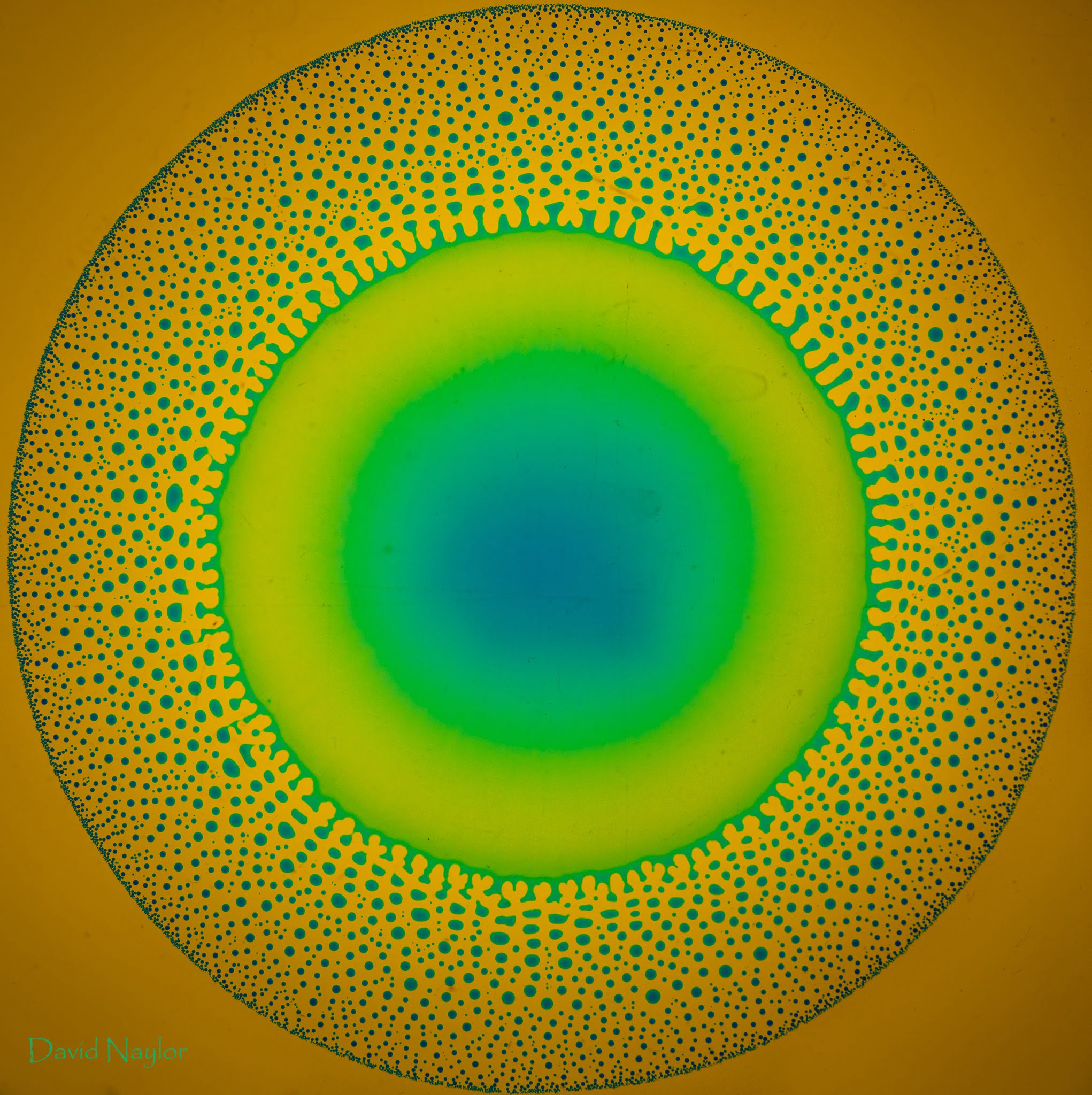
    Placing a mixture of alcohol and water atop a pool of oil creates a stunning effect that pulls droplets apart. The action is driven by the Marangoni effect, where variations in surface tension (caused in this case by the relative evaporation rates of alcohol and water) create flow. David Naylor captures some great stills of the flow, including the only example of a double burst I’ve seen so far. For more on the science behind the effect, check out this previous post or the original research paper. (Image credit: D. Naylor; see also this previous post)

  • Pearls On a Puddle

    Pearls On a Puddle

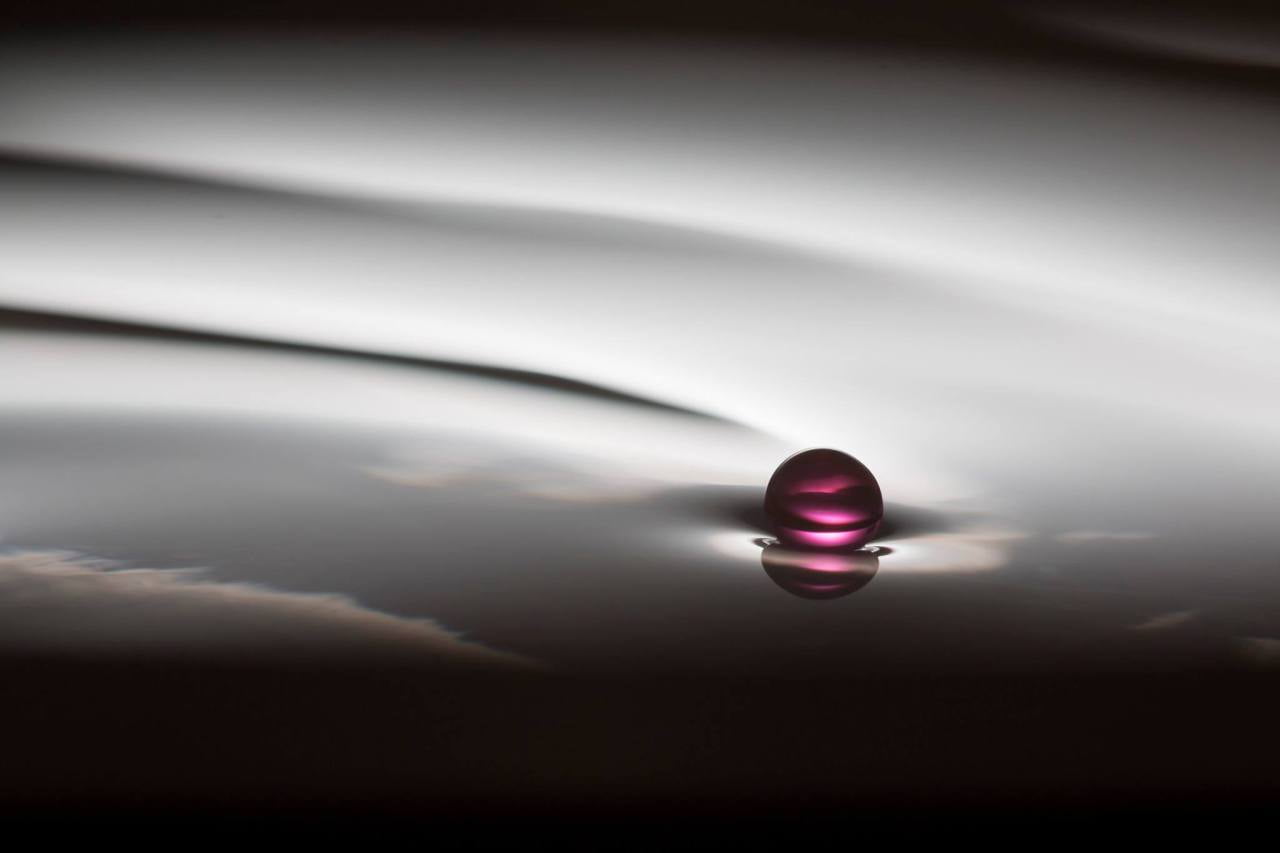
    Leave a drop of coffee sitting on a surface and it will leave behind a ring of particulates once the water evaporates. But what happens to a droplet made up of multiple liquids that evaporate differently? That’s the subject of this new study. Researchers mixed a volatile drop (isopropyl alcohol) with a smaller amount of a non-volatile liquid and observed how this changed the droplet’s splash rim and evaporation pattern.

    When the surface tension difference between the two liquids was large, the researchers found that the splash formed fingers along its rim (Image 1). The fingers consist almost entirely of the non-volatile component, driven to the outskirts of the drop by Marangoni forces. The dark and light bands you see in the image are interference fringes, which the researchers used to track the film’s thickness.

    When the researchers used liquids with similar surface tensions, the droplet rim instead formed pearl-like satellite droplets. Once the volatile liquid evaporated away, the remaining liquid merged into a thick film. (Image and research credit: A. Mouat et al.; via APS Physics; submitted by Kam-Yung Soh)

  • Featured Video Play Icon

    Blooming Deposits

    Evaporate a droplet full of silica nanoparticles, and you’ll get beautiful, flower-like films. As the water evaporates, dry nanoparticles build up in a solid deposit. The evaporation creates a pressure gradient that pulls toward the center of the drop, forcing the deposit to bend. As stress builds in the deposit, cracks form petal-like segments. The number of cracks is indicative of how much of the drop was solid material; the higher the volume fraction of particles is, the fewer cracks form and the less the deposit bends. (Image, video, and research credit: P. Lilin et al.)

  • Drying Out

    Drying Out

    Look closely at old paintings, and you’ll notice arrays of tiny, straight cracks that form as the paint dried. This sort of pattern formation during drying is not unusual. Here we see the patterns formed when a thin layer of hydrogel sandwiched between two glass plates dries. As the water evaporates, stress builds at the interface between the air and gel, causing bubbles to form. The bubble size and shape depend on the size on the gap between the plates and the characteristics of the gel. The resulting patterns can be entirely disordered, or they can form worm-like designs that curl throughout the domain. (Image and research credit: R. Pic et al.)

  • Whiskey Stains

    Whiskey Stains

    Complex fluids leave behind fascinating stains after they evaporate. We’ve seen previously how coffee forms rings and whisky forms more complicated stains as surface tension changes during evaporation drive particles throughout the droplet. Now researchers are considering the differences between traditional Scottish whisky, which ages in re-used, uncharred barrels, and American whiskeys like bourbon, which are required to age in new, charred white oak barrels.

    When diluted, the American whiskeys form web-like patterns – seen above – that vary from brand to brand, like a fingerprint. The charring of the barrels allows American whiskeys to pick up more water-insoluble molecules compared to whisky aged in uncharred barrels. Since the webbed patterns form in American whiskey but not Scotch whisky, it’s likely those molecules play an important role in the evaporation dynamics and subsequent staining. (Image credit: S. Williams et al.; research credit: S. Williams et al.; via APS Physics; submitted by Kam-Yung Soh)

  • Featured Video Play Icon

    Streaming Fire

    I’m just going to start this one with a blanket statement: DO NOT TRY THIS. Instead, enjoy the fact that the Internet enables us to enjoy the sight of burning gasoline in slow mo without any danger to ourselves.

    In this video, Gav and Dan capture a burning bucket of gasoline as it’s thrown against glass. One thing this stunt really highlights is that it’s not the liquid gasoline that burns, it’s the vapor. However, since gasoline is volatile – in other words, it evaporates easily – the fire is quick to spread, especially as the toss atomizes droplets near the edge of the fluid. That’s why you see distinct streaks near the edge of the spreading flame and a non-burning liquid in the center. (Image and video credit: The Slow Mo Guys)

    Flaming gasoline flies toward the viewer and spreads against glass in slow motion
  • Featured Video Play Icon

    Inside Tears of Wine

    Pour wine or liquor into a glass, give it swirl, and you can watch as droplets form and dance on the walls. This well-known phenomena, often called “tears” or “legs” in wine, results from an interplay of surface tension and evaporation. Despite its common occurrence, researchers are still discovering interesting subtleties in the physics, as seen in new research on the subject.  

    Dianna walks you through the phenomenon step-by-step in this video. The key piece of physics is the Marangoni effect, the tendency of regions with high surface tension to pull flow from areas with lower surface tension. In the wine glass, evaporation creates this surface tension gradient by removing alcohol more quickly from the meniscus than the bulk. That sets up the gradient that lets the wine climb the glass. By preventing or delaying that evaporation, we can see other neat effects, too, like shock fronts that travel through the film. (Video credit: Physics Girl; research credit: Y. Dukler et al.)

  • The Leidenfrost Crack

    The Leidenfrost Crack

    In 1756, Leidenfrost reported on the peculiar behaviors of droplets on surface much hotter than the liquid’s boiling point. Such droplets were highly mobile, surfing on a thin layer of their own vapor and were prone to loud cracking noises.

    More recently, scientists have observed that drops with an initially small radius eventually rocket off the hot surface whereas larger drops end their lives in an explosion (above) – the source of Leidenfrost’s crack. Now researchers have explained why drops of different sizes have such different fates. The key is their level of contamination.

    To reach the take-off radius, the drop has to evaporate a significant portion of its volume. For an initially-large drop, that’s tough because any solid contaminants in the drop will build up along the surface of the drop as it shrinks. Eventually, they restrict the liquid from evaporating, which thins the vapor layer the drop sits on. It sinks until a part of it touches the surface. The sudden influx of heat from the surface explosively destroys whatever remains of the drop. (Image and research credit: S. Lyu et al.; via Brown University; submitted by gdurey)

  • Inside an Evaporating Drop

    Inside an Evaporating Drop

    The evaporation of a simple droplet holds far more complexity than one would expect. If you look closely at the edge of the drop, there’s a tiny, beautiful display at work. It begins with small variations in surface tension at the contact line where solid, liquid, and gas meet. These could be caused by local temperature or concentration differences; either way, the gradient in surface tension creates a flow. It starts out as a series of microjets spaced evenly around the contact line (left). 

    As the microjets strengthen, they merge into larger and larger vortical structures (right). This kind of feature – large structures emerging from smaller ones – is known as an inverse cascade. Fluid dynamicists have traditionally studied the classic (turbulent) energy cascade, where kinetic energy moves from large scales into smaller ones, but researchers are beginning to recognize more situations where the inverse cascade occurs, such as in the storms of Jupiter. (Image and research credit: A. Ghasemi et al., source)

  • Freezing Stains

    Freezing Stains

    When they evaporate, drops of liquids like coffee and red wine leave behind stains with a darker ring along the edges, thanks to capillary action and surface tension pulling particles to that outer edge. In contrast, sublimating a frozen droplet leaves a stain pattern that concentrates at the center (top). When droplets freeze from the surface upward, particles within the droplet are driven toward the center as the freeze front pushes toward the drop apex. The final shape of the stain depends on the initial geometry of the droplet, and the concentration of particles toward the center occurs because of the way that the particle freezes, not how it sublimates (bottom). 

    Since many industrial processes rely on droplet evaporation to spread coatings, this work offers a new way to control the final outcome. (Image and research credit: E. Jambon-Puillet, source)