Ferns don’t rely on pollen and pollinators to spread. Instead, they use a little water and a lot of ingenuity, as shown in this video from Deep Look. Peer underneath a fern and you’ll find leaves dotted with spores. As they mature, water evaporates from the sporangium, eventually triggering a catapult that launches the spores. Those spores grow little gametophytes that produce the fern’s sperm and eggs; given a little rain or a nice puddle, the sperm and eggs can find each other and trigger the birth of a new baby fern. (Video and image credit: Deep Look)
Drip some ethanol on a hot surface, and you’d expect it to spread into a thin layer and evaporate. But that doesn’t always happen, and a recent study looks at why.
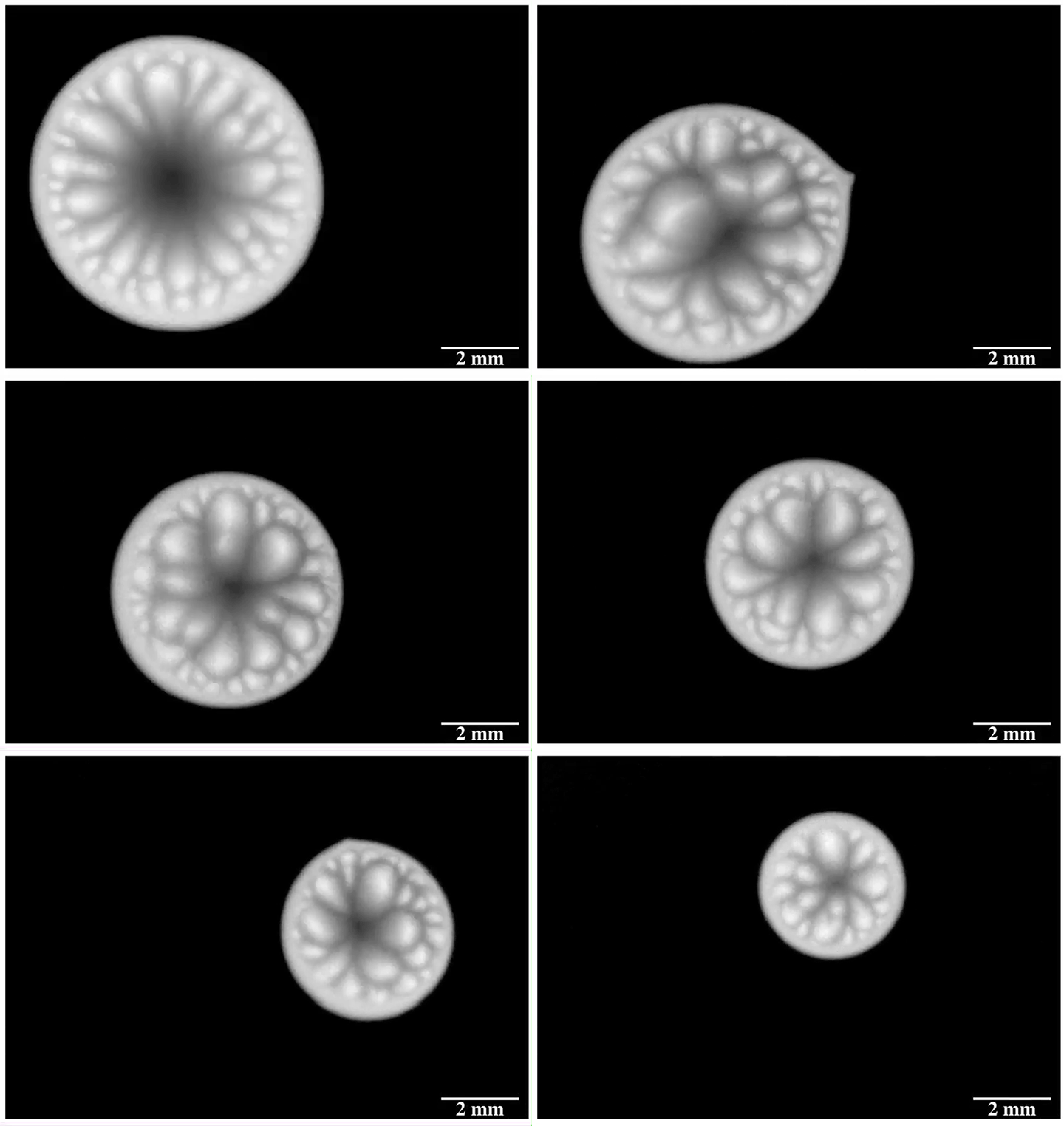
Ethanol is what’s known as a volatile liquid, meaning that it evaporates easily at room temperatures, well below its boiling point. When dropped on a uniformly heated surface above 45 degrees Celsius, the drop contracted into a hemisphere and then began to wander randomly across the surface. Researchers trained an infrared camera on the drop from below (above image), and found an unsteady, roiling motion inside the drop. These asymmetric flows, they concluded, drive the drop’s erratic self-propulsion. They suspect the mechanism may explain why some ink droplets wind up in the wrong place on a page during ink-jet printing. (Image and research credit: P. Kant et al.; via APS Physics)
Water evaporates faster in dry conditions than in humid ones, but the same isn’t true of paint. Instead, paint’s drying time is largely independent of the day’s humidity. That’s because of paint’s long chains of polymers. As water in the paint evaporates, these polymers are drawn to the surface, forming a viscoelastic layer that hinders evaporation and keeps the drying rate independent up to about 80 percent humidity.
Illustration depicting evaporation of water (left) and evaporation of a polymer solution (right). As water evaporates from the polymer solution, it draws polymers to the surface, where they form a layer that hinders evaporation and makes its rate independent of humidity.
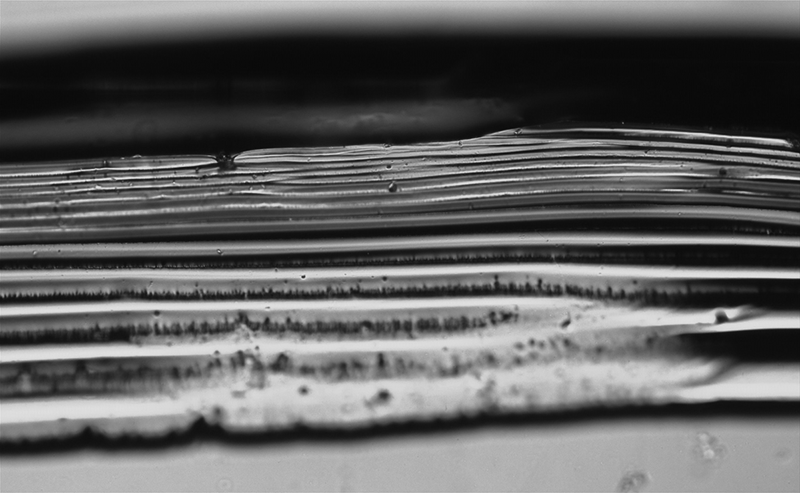
The polymer layer explains why evaporation isn’t affected by humidity at longer times, but researchers also saw humidity-independent evaporation early in their experiments. Under a microscope, they discovered a thin gel layer (top image) covering the air-polymer interface. They propose that this fast-forming layer further hinders evaporation. Their findings may be significant for virus-laden respiratory droplets, which also contain polymers. (Image and research credit: M. Huisman et al.; see also J. Salmon et al.; via APS Physics)
With small droplets, gravity usually has little effect compared to surface tension. An evaporating water droplet holds its spherical shape as it evaporates. But the story is different when you add proteins to the droplet, as seen in this recent study.
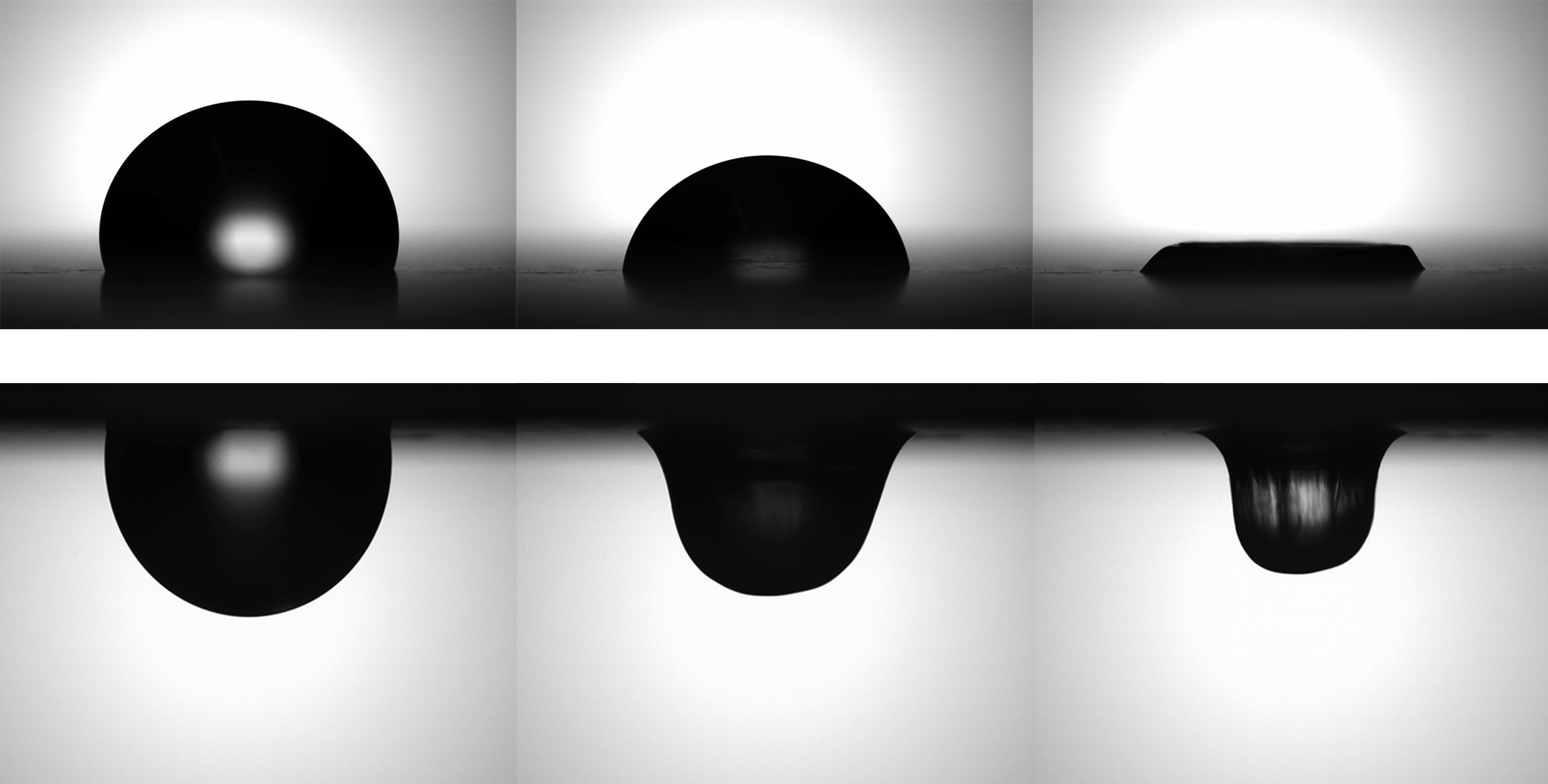
The protein-filled sessile drop starts out largely spherical, but as the drop evaporates, the concentration of proteins reaches a critical point and an elastic skin forms over the drop. From this point onward, the drop flattens.
As a protein-doped droplet sitting on a surface evaporates, it starts out spherical, like its protein-free cousin. But, as the water evaporates, it leaves proteins behind, gradually increasing their concentration. Eventually, they form an elastic skin covering the drop. As water continues to evaporate, the droplet flattens.
For a hanging droplet, the shape again starts out spherical. But as the drop’s water evaporates and the proteins concentrate, it also forms an elastic skin. As the drop evaporates further, the skin wrinkles.
In contrast, a hanging droplet with proteins takes on a wrinkled appearance once its elastic skin forms. The key difference, according to the model constructed by the authors, is the direction that gravity points. Despite these droplets’ small size, gravity makes a difference! (Image, video, and research credit: D. Riccobelli et al.; via APS Physics)
Bright colors mark this slowly draining soap film. The film sits slightly off-horizontal, so flow shifts over time from the top of the frame to the bottom. The fluid is also evaporating. All the faster shifts are caused by ambient air currents from the room. The colors of the film are directly related to the local thickness; as the film thins and evaporates, the bright colors shift to darker ones. Eventually, that black region at the top will expand and the film will break up. (Video credit: B. Sandnes/Complex Flow Lab)
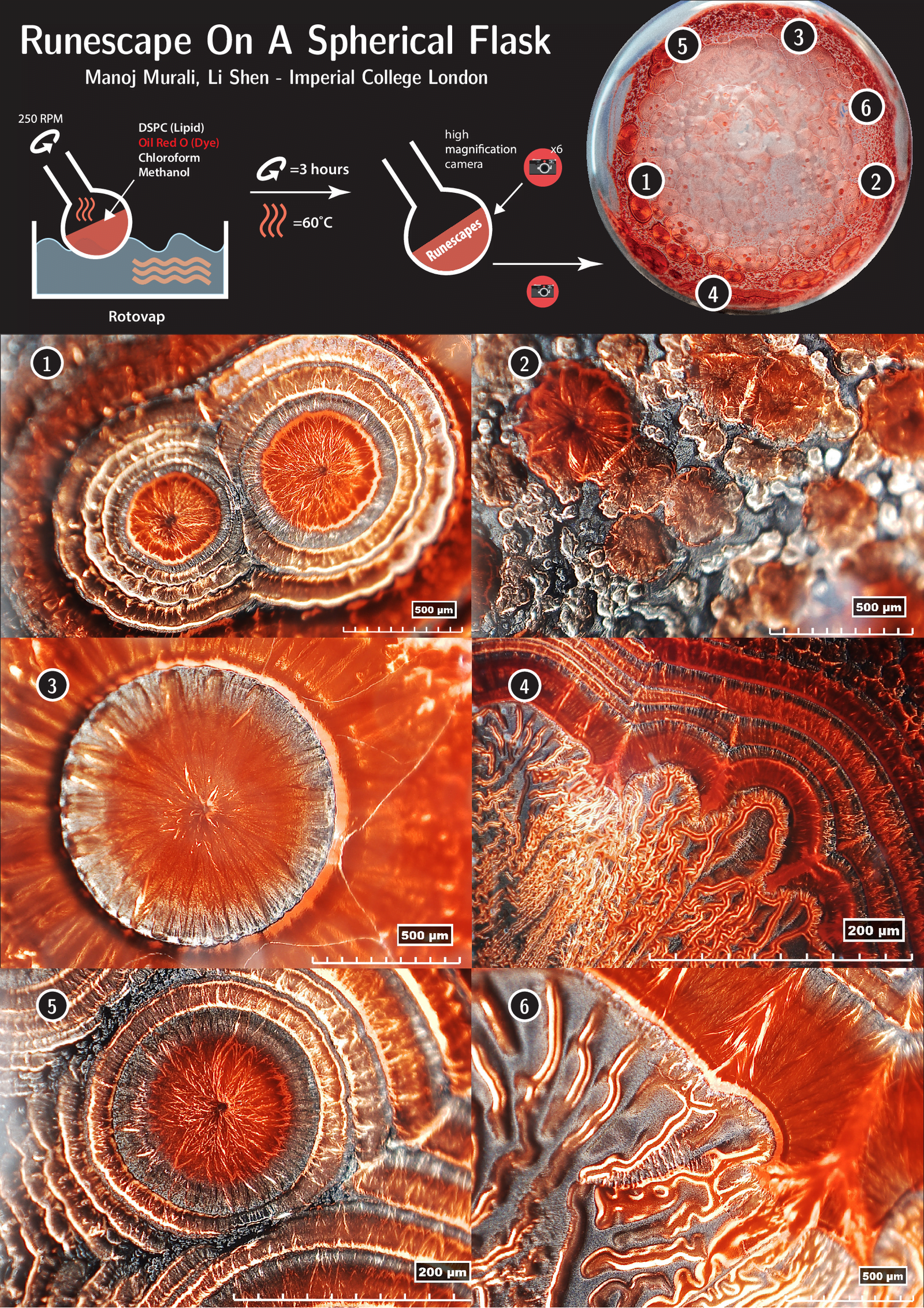
Drying fluids can leave behind all kinds of fascinating patterns, as we’ve seen before with whiskey, coffee, and even blood. Here researchers study patterns left behind by lipids, dyes, and other fluids. They place their mixture in a rotating flask kept in a warm bath. For a few hours, the fluids mix, chemically react, and evaporate. The complex interactions that take place in that time leave behind fascinating, rune-like patterns, seen here under a microscope. It’s a bit like looking at photos of Martian landscapes! (Image credit: M. Murali and L. Shen)
Droplets with particles in them can leave complex stains when they dry — just look at coffee rings and whiskey marks! Here, researchers look at the patterns left on glass by small droplets that evaporated and left behind their nanoparticles. As evaporation takes place, the droplet’s shape changes, adding stress to the growing layer of nanoparticle residue. Cracking is one way to relieve that stress. Another method is delamination — peeling up from the surface. On the leftmost drop, the outer rim of nanoparticles delaminated — as seen from the circular fringes — which released stress without cracking. The rightmost drop, which had a smaller contact angle with the surface, couldn’t delaminate and instead cracked throughout. (Image credit: M. Ibrahim et al.)
Mammatus clouds are fairly unusual and often look quite dramatic. Most clouds have flat bottoms, caused by the specific height and temperature at which their droplets condense. But mammatus clouds have bubble-like bottoms that are thought to form when large droplets of water or ice sink as they evaporate. Although they can occur in the turbulence caused by a thunderstorm, mammatus clouds themselves are not a storm cloud. They appear in non-stormy skies, too. The clouds are particularly striking when they’re lit from the side, as in the image above. (Image credit: J. Olson; via APOD)
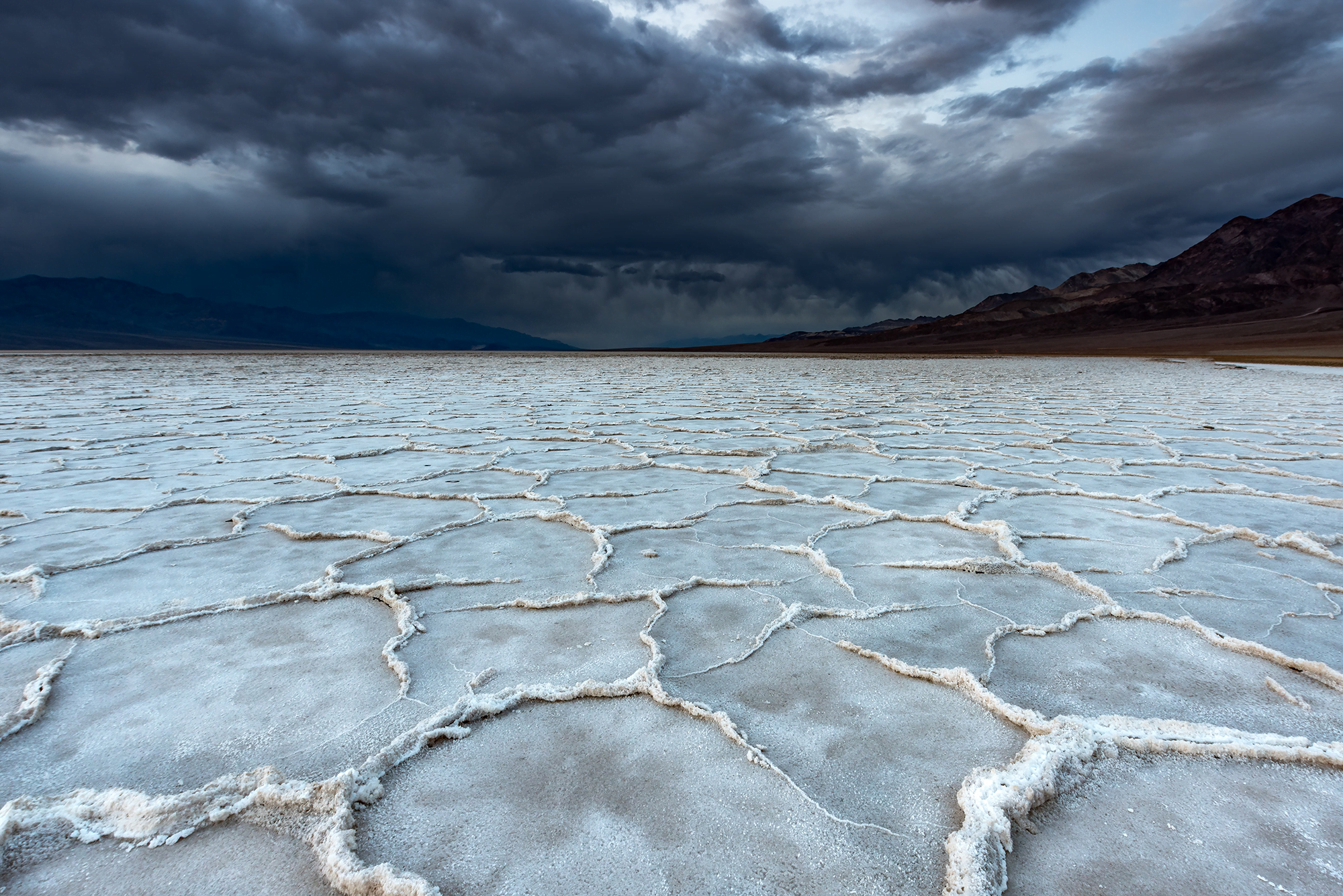
Around the world, salt playas are criss-crossed with meter-sized polygons formed by ridges of salt. The origins of these structures — and the reason for their consistency across different regions of the world — have been unclear, but a new study shows that salt polygons form due to convection happening in the soil underground.
Through a combination of numerical modeling, simulation, lab-scale experiment, and field work, the team revealed the mechanism underlying salt polygons. Areas that form polygons have much greater rates of evaporation than precipitation, and, as water evaporates, these areas draw groundwater from nearby. Salt gets carried with this groundwater.
With strong evaporation, the lake bed forms a highly-concentrated layer of salty water near the surface. Convection cells form, with some regions drawing less saline water upward, while denser, saltier water sinks in other areas. The subsurface convection lines up exactly with the surface structures. The interior regions of polygons are areas where less salty water rises, and salt instead concentrates along the edges of polygons, where saltier water sinks below the surface while evaporation draws solid salt to the surface.
This snapshot shows a numerical simulation of the subsurface convection and surface evaporation that lead to salt polygon formation. Low salinity areas are yellow, while high salinity ones are black. At the surface, blue regions have the maximum upward flow and red regions have the maximum downward flow. The dark, highly saline fingers under the surface align to the red areas on the surface, indicating areas where salty water is sinking.
It’s a beautiful result that matches the size, shape, and development time observed for salt polygons in the real world. The team even excavated below salt polygons in Death Valley to confirm that the salt content below ground matched their model’s patterns. Since salt playas are a major source for dust and aerosols that affect climate, their work will be an important factor in future climate modelling. (Image credit: feature – T. Nevidoma, simulation – J. Lasser et al.; research credit: J. Lasser et al.; via APS Physics; submitted by Kam-Yung Soh)
Many droplets can self-propel, often through the Leidenfrost effect and evaporation. But now researchers have observed freezing droplets that self-propel, too. The discovery came when observing the freezing of supercooled water drops inside a vacuum chamber. The researchers kept losing track of drops that seemingly disappeared. Upon closer inspection, though, they found that the drops weren’t shattering; they were flying away as they froze.
Inside a drop, freezing starts at a point, the nucleation point, and spreads from there. But the nucleation point isn’t always at the center of the drop. This asymmetry, the researchers found, is at the heart of the drop’s propulsion. When ice nucleates, the phase change releases heat that increases the drop’s evaporation rate, which can impart momentum to the drop. For an off-center nucleation, that momentum is enough to send the drop shooting off at nearly 1 meter per second. (Image credit: SpaceX; research credit: C. Stan et al.; via APS Physics)