The Cranston wildfire in California is intense enough that it’s creating its own weather. This timelapse video shows the formation and growth of a pyrocumulus cloud, also associated with volcanoes, over the wildfire. In both instances, the extreme heat causes a massive column of hot, turbulent air to rise. Because ash and smoke are carried upward as well, there are many places for any moisture in the atmosphere to nucleate, forming the cloud we see. In timelapse, the roiling nature of the air’s motion is especially apparent. This turbulence can be dangerous, as it may contribute to high winds and even lightning, both of which can spread the fire further. (Video credit: J. Morris; via James H.)
Tag: electrohydrodynamics

Collecting Fog


In some parts of the world, fog is a major source of freshwater, but collecting it is a challenge. Most systems use a wire mesh to capture and collect droplets, but the process is highly inefficient, pulling only 1-3% of droplets from the fog. Researchers found that this is due largely to aerodynamic effects. The presence of the wire deflects droplets around it (bottom left). To solve this, engineers introduced an electric charge into the fog. The subsequent electric field actually pulls droplets to the wires (bottom right). When applied to a mesh (top), the efficiency of fog capture improves dramatically.
The technique can also be used to capture water vapor that would otherwise escape from the cooling towers of power plants. The MIT researchers who developed the technique will conduct a full-scale test at the university’s power plant this fall. They hope the technique will recapture millions of gallons of water that would otherwise drift away from the plant. (Image credits: MIT News, source; image and research credits: M. Damak and K. Varanasi, source)

The Rose-Window Instability


This polygonal pattern is known as the rose-window instability. It’s formed between two electrodes – one a needle-like point, the other flat – separated by a layer of oil. The pointed electrode’s voltage ionizes the air nearby, creating a stream of ions that travel toward the flat electrode below. Oil is a poor conductor, however, so the ions build up on its surface until they’re concentrated enough to form a dimple that lets them reach the lower electrode. At higher voltages, the electrical forces driving the ions and the gravitational force trying to flatten the oil reach a balance in the form of the polygonal cell pattern seen above. Smaller cells form near the needle electrode, where the electrical field is strongest and the temperature is highest, as revealed in thermal and schlieren imaging (lower images) that shows a warm stream of gas impacting there.
As a final note, I’ll add that the latest in this research comes from a paper by a Pakastani teenager. It’s never too early to start contributing to research! (Image and research credit: M. Niazi; via NYTimes; submitted by Kam-Yung Soh)

Equatorial Streaming

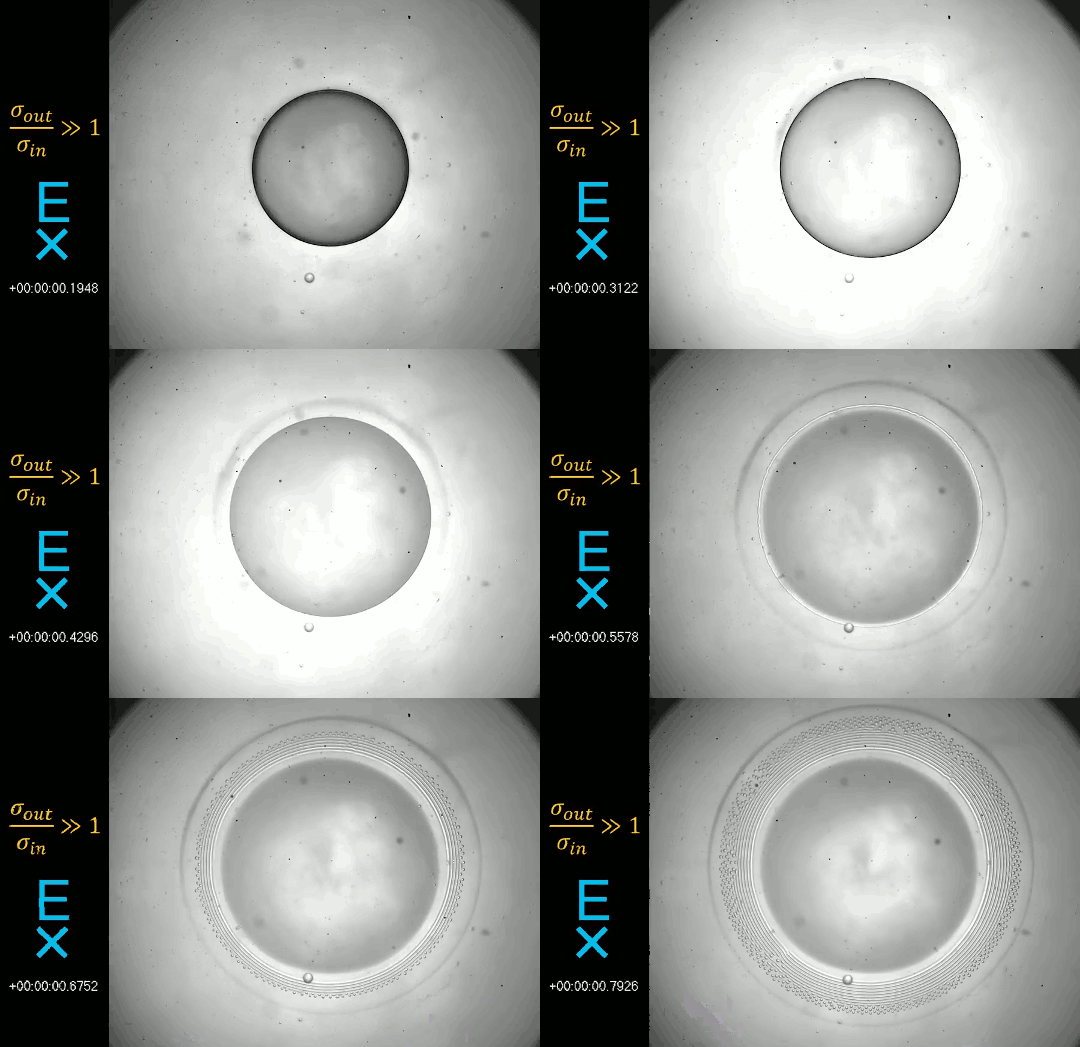
Here you see a millimeter-sized droplet suspended in a fluid that is more electrically conductive than it. When exposed to a high DC electric field, the suspended drop begins to flatten. A thin rim of fluid extends from the drop’s midplane in an instability called “equatorial streaming”. As seen in the close-up animation, the rim breaks off the droplet into rings, which are themselves broken into micrometer-sized droplets thanks to surface tension. The result is that the original droplet is torn into a cloud of droplets a factor of a thousand smaller. This technique could be great for generating emulsions of immiscible liquids–think vinaigrette dressing but with less shaking! (Image credit: Q. Brosseau and P. Vlahovska, source)

Plasma Flow Control

Engineers frequently face the challenge of maintaining control of air flow around an object across a wide range of conditions. After all, wind turbines and airplanes don’t always get to choose the perfect weather. To widen their operating ranges, designers can use active flow control to keep air flowing around an airfoil instead of separating and causing stall. One method of flow control uses plasma actuators on the upper surface of an airfoil. When activated, the plasma actuator ionizes air near the wing surface, producing the purplish glow seen above. That ionized air, or plasma, gets accelerated by the electric field of the device. The acceleration adds momentum to air near the wing surface, which helps it stay attached and flowing smoothly despite the unfavorable pressure conditions near the trailing edge of the wing. Compared to other methods of active flow control, plasma actuation is relatively simple to implement and so is actively being researched for applications in aviation and wind energy. (Image and research credit: I. Brownstein et al., source)

Kelvin’s Thunderstorm
In this video, Derek Muller explains how an experiment known as Lord Kelvin’s thunderstorm generates electricity from falling water. The set-up relies on a positive feedback loop that creates a separation of charge between the two streams of water. Check out the video for a great demonstration and explanation. If you prefer your science with a more dystopian flavor, there’s a second version of the video made in collaboration with the Hunger Games movies. (Video credit: Veritasium; submitted by entropy-perturbation)
Reconfigurable Liquid Metal
Terminator 2’s T-1000, a liquid metal robot capable of changing its shape at will, just became a little less far-fetched. Researchers at NC State have reported a new method for controlling the form of a liquid gallium alloy. Surface tension governs the shape a liquid assumes when it is not confined by a container, and, although adding surfactants can slightly lower the surface tension, it does not substantially alter the liquid’s shape. Adding soap to water lets one make bubbles, but surface tension keeps the bubbles spherical no matter how much soap you add. Instead, these researchers control the surface tension of the liquid metal using a mild voltage. Applying a voltage creates (or removes) an oxide layer on the liquid metal’s surface, thereby altering the surface tension. By controlling the formation of the oxide layer, the researchers can change the surface tension from approximately 7x that of water to nearly zero. The video above demonstrates some of the liquid shape control this lets them achieve. (VIdeo credit: M. Dickey et al.; research: M. Khan et al.; via PopSci)
Liquid Crystal Films
Smectic liquid crystals can form extremely thin films, similar to a soap bubble, that are sensitive to electrically-induced convection. Here an annular smectic film lies between two electrodes. When a voltage is applied across it, positive and negative charges build up on the surface of the film near their respective electrodes. The electrical field surrounding the fluid pushes on the surface charges, causing flow inside the film. Above a threshold voltage, an instability forms and the film develops into a series of counter-rotating vortices, which spin faster as the voltage increases. The color variations in the video above are due to differences in the film’s thickness, much like iridescence of a soap bubble. (Video credit: P. Kruse and S. Morris)
Floating Water Bridges
Water bridges that seem to float on air are an electrohydrodynamic phenomenon. By filling two beakers with extremely pure deionized water and applying a large voltage across them, flow is induced from one beaker to the other, as seen in the first few seconds of the video above. This flow is stable enough that the beakers can then be separated by a few centimeters without disturbing the bridge. Gravity tends to make the water bridge sag and capillary action tries to thin the bridge, but both effects are countered by the polarization forces induced in the water by the electric field. You can learn much more about the effect and see both photos and videos of it in action at Elmer Fuchs’ webpage. The flow visualization videos are especially neat! (Video credit: E. C. Fuchs)
Electrowetting
The electrowetting effect can change the shape of a liquid droplet on a surface by applying a voltage across the surface and droplet. Surface tension is a kind of measure of the energy required to maintain a certain drop shape, and that energy can be both chemical and electrical. In the video above, the droplet maintains a small contact area naturally (with no voltage). It expands and flattens under an electrical charge. Varying the voltage will change the degree to which the droplet flattens, but only to a point. Electrowetting is used to control variable lenses and some types of electronic displays. The technology may be used to replace current generation LCDs. (Video credit: V. Arya/Duke University)