Tag: droplets

  • Miniature Ice Stupas

    Miniature Ice Stupas

    Ice stupas are conical artificial glaciers built with snow cannons; they’re used to store water for spring irrigation. Here, researchers explore a miniaturized lab-grown version made from atomized water droplets. The growing drop breaks and spills, forming frozen fingers in all directions. Further drops flow and freeze as rivulets atop the stupa — or they destabilize and rotate toward another finger, leaving behind a wrinkling shape. Although the formation works very differently (and the scales are completely different) these tiny ice stupas remind me of volcanic flows. (Image credit: D. Papa et al.)

  • Sliding on Fibers

    Sliding on Fibers

    Water drops slide down spiderwebs, along the spines of desert plants, and across the armored exterior of horned lizards. Thin, grooved surfaces like these pop up frequently in nature when organisms need to direct water. A recent study of droplets sliding on fibers suggests why.

    A drop sliding down a fiber is constantly shrinking, leaving a little of itself behind as a thin film that coats the fiber. The thicker a fiber is, the slower the drop moves along it. Similarly, if you bundle multiple fibers together, a drop will travel slower along the thicker bundle. But, to the researchers’ surprise, droplets actually travel faster on bundles than they do along single fibers of the same overall diameter. The key to this result seems to be the tiny grooves between fibers in a bundle. Water fills these areas, creating a “rail” along which the droplets slide more efficiently.

    The team hope to put their new insights to use on a water harvester that could help capture precious moisture in arid environments, much like those desert-dwelling plants and lizards do. (Image and research credit: M. Leonard et al.; via Physics World)

  • Droplet Medusa

    Droplet Medusa

    Vibration is one method for breaking a drop into smaller droplets, a process known as atomization. Here, researchers simulate this break-up process for a drop in microgravity. Waves crisscrossing the surface create localized craters and jets, making the drop resemble the Greek mythological figure of Medusa. With enough vibrational amplitude, the jets stretch to point of breaking, releasing daughter droplets. (Image and research credit: D. Panda et al.)

  • Featured Video Play Icon

    Dancing to Chopin

    Droplets of paint whirl to Chopin’s “Nocturne Op. 9 No. 2” in this short film from artist Thomas Blanchard. The glitter particles in the paints act as seed particles that highlight the flow within and around each drop. It’s a beautiful dance of surface tension, advection, and buoyancy. (Image and video credits: T. Blanchard; via Colossal)

  • Linking Size and Origin in Droplets

    Linking Size and Origin in Droplets

    Respiratory diseases like measles, flu, tuberculosis, and COVID-19 are all transmitted by droplets. Some are tiny and airborne, capable of traveling long distances. Other drops are larger and only capable of traveling short distances. A new review paper consolidates what we know about these droplets and categorizes them by size and origin.

    It turns out that a droplet’s size can tell us where it originated in the body. The largest type of droplets come from our mouths, lips, and tongues. Some form from filaments of saliva that stretch across our mouths and burst during exhalation. Others originate in our nasal passages where a sneeze can destabilize the mucus film there. These types of droplets are best suited to transmitting diseases that reside in the upper respiratory tract. Coughing, sneezing, singing, and speaking all produce these droplets, but breathing does not.

    In contrast, the smallest classes of droplets come from the bronchial passages of the lungs, where films form after exhalation closes a passage. When we inhale again, the passage reopens, the film breaks up, and tiny droplets flow further into the lungs before getting exhaled. Breathing alone is enough to create and spread these tiny droplets, which are well-suited to spreading diseases that reside deep in the lungs, like tuberculosis.

    In between these extremes are medium-sized droplets created from movement around our vocal cords. The formation mechanism for these droplets is least understood, but they are connected to breathing, coughing, speaking, singing, and so on.

    Ultimately, understanding the mechanics of disease transmission is about knowing how to best prevent transmission. Knowing the size of droplets responsible for transmission lets us prioritize responses that work. For example, if large droplets are the primary transmission mechanism, loose-fitting masks and face masks will stop the spread. But for smaller droplets, ventilation measures and well-fitted N-95 respirators are the better choice. (Image credit: Anton; research credit: M. Pöhlker et al.; via APS Physics)

  • Imitating a Cough

    Imitating a Cough

    Coughing and sneezing create violent air flows in and around our bodies. As that fast air rushes over mucus layers in our lungs, throat, and sinuses, the resulting flow breaks up the mucus into droplets. To explore the details of that process, researchers built a “cough machine” that sends a rush of air over a thin film of water mixed with glycerol. The setup allows them to observe the physics in a way that’s nearly impossible in a human cough or sneeze.

    Imitating a cough: high-speed video shows how a thin film made of water and glycerol breaks down in a strong airflow. Parts of the film inflate into hollow bags that form thinner weak spots. When the film breaks in those places, it forms rims and ligaments that break up into droplets.
    Imitating a cough: high-speed video shows how a thin film made of water and glycerol breaks down in a strong airflow. Parts of the film inflate into hollow bags that form thinner weak spots. When the film breaks in those places, it forms rims and ligaments that create a spray of droplets.

    As seen above, air flowing past shears the viscous fluid, stretching it out. The leading edge of the film destabilizes and breaks into large drops, but it’s what comes next that really gets things going. Areas of the film inflate to form hollow bags. When sections of the bag thin to about 1 micron, the film ruptures and the bags burst. This triggers a cascade of instabilities in the film’s rim that ultimately rip the film into a spray of tiny aerosol droplets. The researchers found that, despite their tiny size, these droplets collectively carry a large volume of liquid, making them all the more important for understanding transmission of respiratory illnesses. (Image credit: top – A. Piacquadio, experiment – P. Kant et al.; research credit: P. Kant et al.)

  • Scooting Droplets

    Scooting Droplets

    As a child, I always loved watching rain on the windows as I rode in the car. Hemispherical droplets got stretched by the wind flowing over them. But they never stretched smoothly; instead they seemed to shiver and shake unevenly. A recent study looks at a similar situation: drops of glycerin forced to slide along a horizontal surface under the force of the wind. Like the drops on my parents’ car, the glycerin gets stretched out into an elongated oval. Surface waves develop atop the drop and move downstream. The drops, the authors observe, move a bit like a crawling caterpillar, pilling up and smoothing out as they move. (Image credit: rain – A. Alves, experiment – A. Chahine et al.; research credit: A. Chahine et al.; via APS Physics)

    This series of images shows an elongated droplet subjected to airflow moving from left to right. Waves form on the drop and move downstream in a fashion similar to a caterpillar crawling.
    This series of images shows an elongated droplet subjected to airflow moving from left to right. Waves form on the drop and move downstream in a fashion similar to a caterpillar crawling.
  • Featured Video Play Icon

    “Emerald and Stone”

    “Emerald and Stone” is filmmaker Thomas Blanchard’s tribute to the music of Brian Eno. The short film is made, as Blanchard puts it, with “inks and painting,” but I suspect there’s some oil in there, too, to coat the droplets we see. Much of the movement is likely driven by surface tension variations in the background fluid. I love the effect this has on the droplets. If you watch closely, some of them appear to rotate like a miniature planet; others have counter-rotating sections within the drop. The difference, I suspect, is one of scale: I think the smaller drops rotate altogether while larger ones develop more complex internal flows. (Video and image credit: T. Blanchard)

  • Gravity Changes Droplet Shapes

    Gravity Changes Droplet Shapes

    With small droplets, gravity usually has little effect compared to surface tension. An evaporating water droplet holds its spherical shape as it evaporates. But the story is different when you add proteins to the droplet, as seen in this recent study.

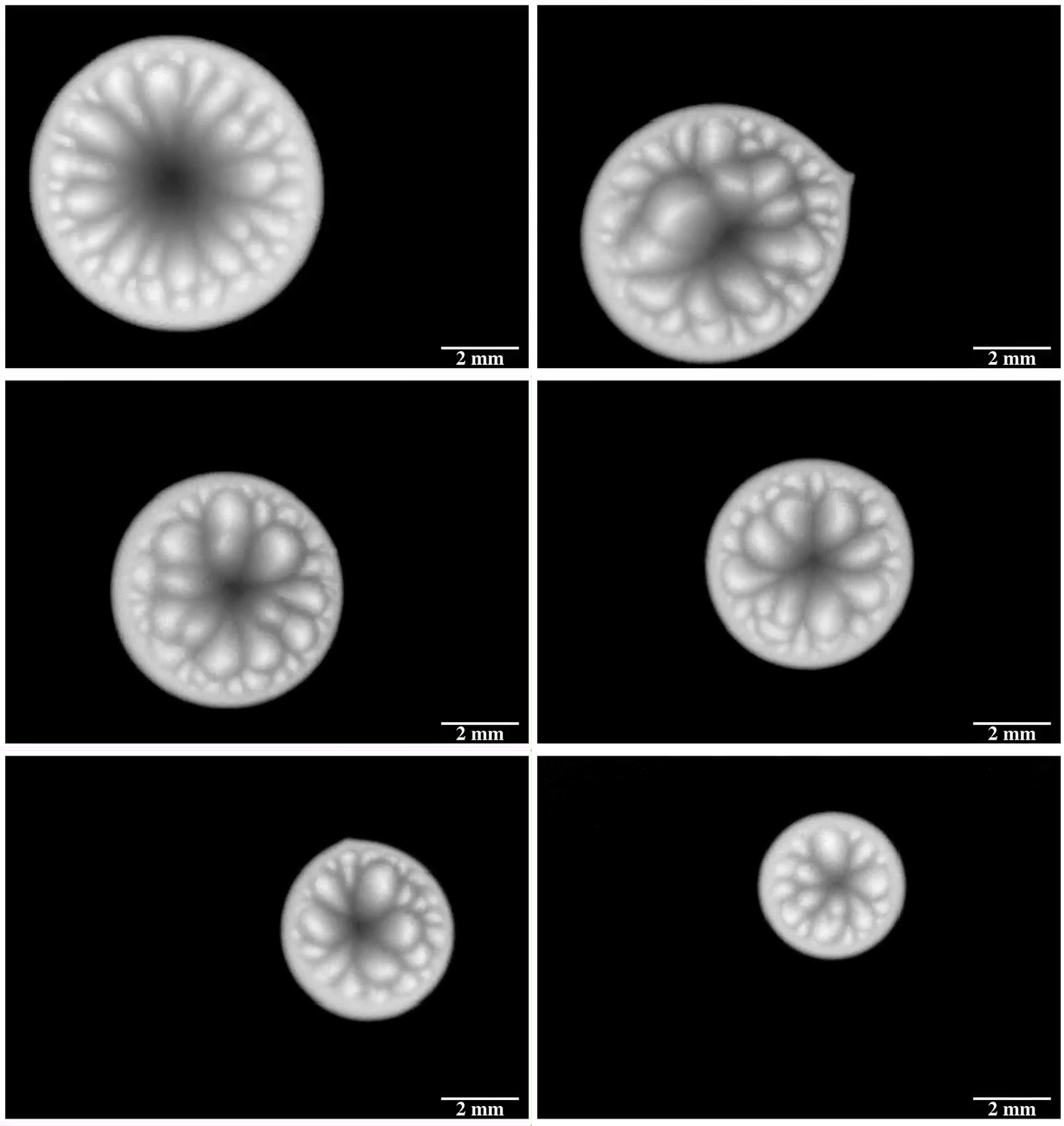
    The protein-filled sessile drop starts out largely spherical, but as the drop evaporates, the concentration of proteins reaches a critical point and an elastic skin forms over the drop. From this point onward, the drop flattens.
    The protein-filled sessile drop starts out largely spherical, but as the drop evaporates, the concentration of proteins reaches a critical point and an elastic skin forms over the drop. From this point onward, the drop flattens.

    As a protein-doped droplet sitting on a surface evaporates, it starts out spherical, like its protein-free cousin. But, as the water evaporates, it leaves proteins behind, gradually increasing their concentration. Eventually, they form an elastic skin covering the drop. As water continues to evaporate, the droplet flattens.

    For a hanging droplet, the shape again starts out spherical. But as the drop's water evaporates and the proteins concentrate, it also forms an elastic skin. As the drop evaporates further, the skin wrinkles.
    For a hanging droplet, the shape again starts out spherical. But as the drop’s water evaporates and the proteins concentrate, it also forms an elastic skin. As the drop evaporates further, the skin wrinkles.

    In contrast, a hanging droplet with proteins takes on a wrinkled appearance once its elastic skin forms. The key difference, according to the model constructed by the authors, is the direction that gravity points. Despite these droplets’ small size, gravity makes a difference! (Image, video, and research credit: D. Riccobelli et al.; via APS Physics)

  • How a Leak Can Stop Itself

    How a Leak Can Stop Itself

    Some leaks can actually stop themselves, and a new analysis shows how. When a vertical pipe has a small hole, water initially spouts out of it, then dribbles, and, finally, drips as the water level in the pipe falls, decreasing the driving pressure of the flow. But the pipe doesn’t have to empty to a level below the hole for the leak to stop. Instead, a final droplet can form a cap over the hole, with its shape providing enough pressure to balance the remaining pressure from fluid in the pipe.

    Water leaking from a vertical pipe transitions from continuous flow to discrete drops (left). Dripping continues until the final droplet forms at t = 0 seconds.
    Water leaking from a vertical pipe transitions from continuous flow to discrete drops (left). Dripping continues until the final droplet forms at t = 0 seconds.

    The researchers found that the final drop’s kinetic energy (as well as its potential energy) was critical to determining which drop would stop the flow. The last drop behaves like a lightly-damped harmonic oscillator; it needs enough potential energy to counter the flow and a small enough inertia that it doesn’t slip away down the pipe. (Image credit: top – G. Crofte, experiment – C. Tally et al.; research credit: C. Tally et al.; via APS Physics)