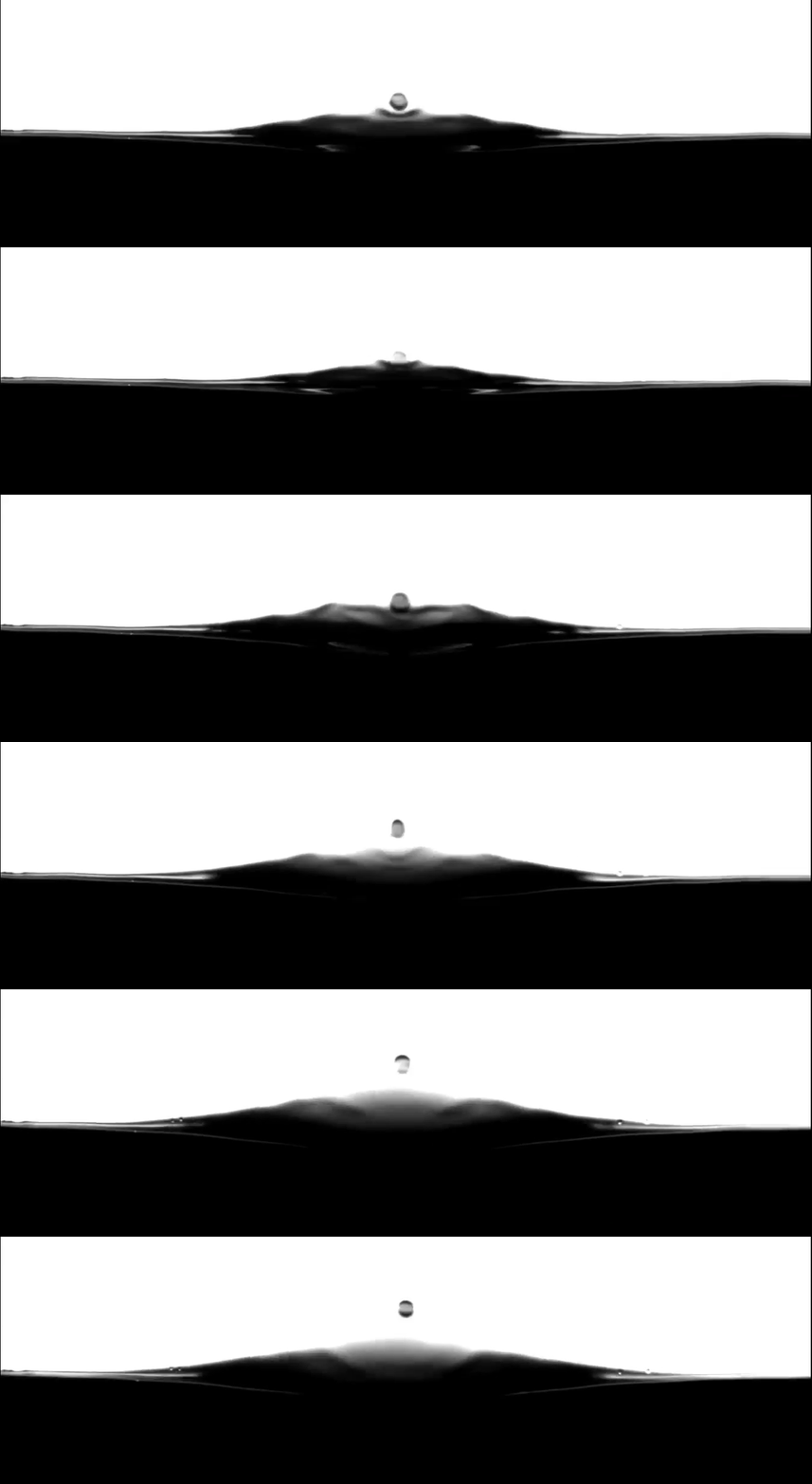
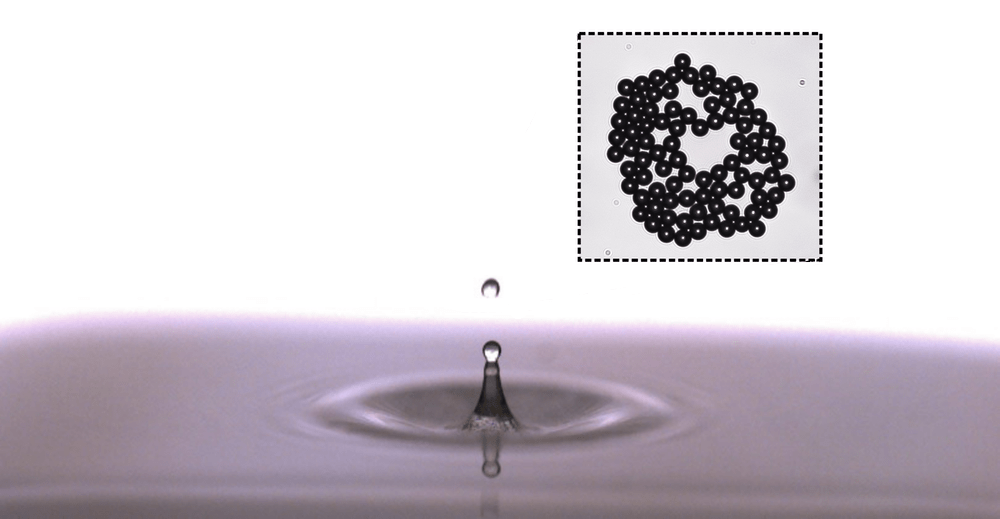
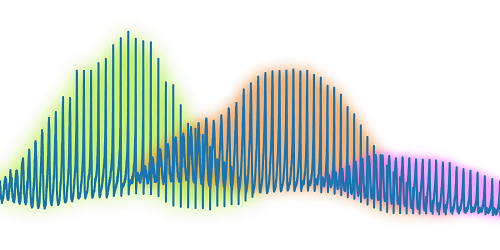
Over the past few years, we’ve seen lots of research in walking droplets, especially as hydrodynamic quantum analogs. But did you know you can replicate this set-up at home and play with it yourself? This video gives an overview of the equipment you’ll need and a simple procedure to follow to get it up and running. From there, your imagination is the limit! (Image and video credit: R. Valani)
Tag: droplets

Cleaning the Skies
Those of us who live in urban environments have experienced the clear, pollution-free air that comes after a rainstorm. But how exactly does rain clean the air? Air pollution typically has both gaseous and particulate components to it. As a raindrop falls, it experiences collision after collision with those particles. Depending on the particle’s surface characteristics — is it hydrophilic or hydrophobic? — and its momentum during impact, it can get trapped in the raindrop, skip off, or even pass through entirely. The physics, it turns out, are identical to those of a rock falling into or skipping off a lake — even though the raindrop and particle might be 1000 times smaller! (Image and video credit: N. Speirs et al.)

Droplet Bounce
A droplet falling on a liquid bath may, if slow enough, rebound off the surface. Its impact sends out a string of ripples — capillary waves — on the bath’s surface and sends the droplet itself into jiggling paroxysms. A new pre-print study delves into this process through a combination of experiment, simulation, and modeling. Impressively, they find that the most of the droplet’s initial energy is not dissipated during impact. Instead it’s fed into the capillary waves and droplet deformation that follow. (Image and research credit: L. Alventosa et al.; via Dan H.)

A droplet falls on a bath, partially coalesces and rebounds. The process repeats until the droplet is small enough to coalesce completely. 
“Titan”
Saturn’s moon Titan is a fascinating foil to our planet. It’s the only other body in our solar system with liquid bodies — lakes and seas — on its surface. But where Earth’s oceans are filled with water, Titan’s frigid lakes are liquid hydrocarbons. This video, “Titan,” is a short film inspired by the moon’s seas and is made up of various liquids and chemical reactions filmed under magnification. Sit back and enjoy the flow! (Image and video credit: S. Bocci/Julia Set Lab)

Inhibiting Marine Lightning
Thunderstorms over the ocean have substantially less lightning than a similar storm over land. Scientists wondered whether this difference could be due to lower cloud bases over the ocean or differences in the cloud droplets’ nuclei. But a new study instead implicates coarse sea spray as the deciding factor. By tracking the full lifetime of storm systems through remote sensing, the team found that fine aerosols can increase lightning activity over both land and ocean. But adding coarse sea salt from sea spray reduced lightning by 90% regardless of fine aerosols. With sea salt in the mix, clouds seem to develop fewer but larger condensation droplets, providing less opportunity for the electrification necessary to generate lightning. (Image credit: Z. Tasi; research credit: Z. Pan et al.)

Asperitas Formation
In 2017, the World Meteorological Organization named a new cloud type: the wave-like asperitas cloud. How these rare and distinctive clouds form is still a matter of debate, but this new study suggests that they need conditions similar to those that produce mammatus clouds, plus some added shear.
Using direct numerical simulations, the authors studied a moisture-filled cloud layer sitting above drier ambient air. Without shear, large droplets in this cloud layer slowly settle downward. As the droplets evaporate, they cool the area just below the cloud, changing the density and creating a Rayleigh-Taylor-like instability. This is one proposed mechanism for mammatus clouds, which have bulbous shapes that sink down from the cloud.
When they added shear to the simulation, the authors found that instead of mammatus clouds, they observed asperitas ones. But the amount of shear had to be just right. Too little shear produced mammatus clouds; too much and the shear smeared out the sinking lobes before they could form asperitas waves. (Image credit: A. Beatson; research credit: S. Ravichandran and R. Govindarajan)

When Seeing a Flow Changes It
Adding dye to a flow is a common technique for visualization. After all, many flows in fluids like air and water are invisible to our bare eyes. But for some classes of flows — especially those driven by variations in surface tension — adding dye can have unforeseen effects. A recent study shows how true this is for bursting Marangoni droplets, where evaporation and alcohol concentration can pull a water-alcohol droplet apart.

As more dye is added to the experiment, the daughter droplets grow larger and more ligaments form. In the first three images, a dashed black line has been added to show the location of the droplet rim. Without dye, it’s nearly impossible to see the phenomenon since the refractive indices of the two component liquids are so close. But the researchers found that, as they added more methyl blue dye, it did more than increase the contrast in the flow. It changed the flow, making the droplets larger and creating ligaments between them. They believe that the dye’s own surface tension creates local gradients that alter the flow. It’s a reminder that experimentalists have to be careful to consider how our efforts to measure and observe a flow can change it. (Image credit: top – The Lutetium Project, bottom – C. Seyfert and A. Marin with modification; research credit: C. Seyfert and A. Marin)

Merging Along Wires
As oil slides down two slowly converging wires, the droplets will merge into a sheet that stretches between both wires. When this happens can vary somewhat but occurs somewhere around the liquid’s capillary length.
In the poster above, the leftmost image (not the illustration) shows three possible merger points. To the right of the image, is a teal curve; this is a probability density function. Essentially, this curve shows where the merger is most likely to occur. The peak of the curve corresponds to the most probable point of merger.
The following two composite images show the same system — same oil flow rate, same wire spacing — with gas blowing upward along the wires. As the gas’s flow rate increase, the oil drops get larger, making the oil films thinner. The result? The wires have to get closer to one another before the oil merges. That’s reflected in the yellow and orange probability density functions, which have peaks further along the wires than the no-gas-flow case. (Image credit: C. Wagstaff et al.)

Self-Stopping Leaks
A leak can actually stop itself, as shown in this video. To demonstrate, the team used a tube pierced with a small hole. When filled, water initially shoots out the hole in a jet. The pressure driving the jet comes from the weight of the fluid sitting above the hole. As the water level drops, the pressure drops, causing the jet to sag and eventually form a rivulet that wets the side of the tube. As the water level and driving pressure continue to fall, the rivulet breaks up into discrete droplets, whose exact behavior depends on how hydrophobic the tube is. Eventually, a final droplet forms a cap over the hole and the leak stops. At this point, the flow’s driving pressure is smaller than the pressure formed by the curvature of the capping droplet. (Image and video credit: C. Tally et al.)