The Leidenfrost effect occurs when a liquid encounters a solid object much hotter than the liquid’s boiling point, like when water skitters on a hot griddle or someone plunges a hand in liquid nitrogen. A thin layer of vapor forms between the liquid and the solid, thereby (briefly) insulating the remaining liquid. The Leidenfrost effect can be static–like a droplet sitting on a pan–or dynamic, like the video above in which a droplet impacts the hot object. The video shows both a top and a side view of a droplet striking a plate that is over five times hotter than the liquid’s boiling point. On impact, the droplet spreads and flattens, and a spray of even tinier droplets is ejected before rebound. (Video credit: T. Tran and D. Lohse, from a review by D. Quere)
Tag: droplets

Leidenfrost Dynamics
When a liquid impacts a solid heated well above the liquid’s boiling point, droplets can form, levitating on a thin film of vapor that helps insulate them from the heat of the solid. This is known as the Leidenfrost effect. Here a very large Leidenfrost droplet is shown from the side in high-speed. A vapor chimney forms beneath the drop, causing the dome in the liquid. When the dome bursts, the droplet momentarily forms a torus before closing. The resulting oscillatory waves in the droplet are spectacular. The same behavior can be viewed from above in this video. (Video credit: D. Soto and R. Thevenin; from an upcoming review by D. Quere)

Liquid Lenses
Here astronaut Andre Kuipers demonstrates fluid dynamics in microgravity. A roughly spherical droplet of water acts as a lens, refracting the image of his face so that it appears upside down. The air bubble inside the droplet refracts the image back to our normal perspective again. (Photo credit: Andre Kuipers, ESA; via Bad Astronomy)
Atomizing
High-speed video reveals the complexity of fluid instabilities leading to atomization–the breakup of a liquid sheet into droplets. A thin annular liquid sheet is sandwiched between concentric air streams. As the velocity of the air on either side of the liquid sheet varies, shear forces cause the sheet to develop waves that result in mushroom-like shapes that break down into ligaments and droplets. Quick breakup into droplets is important in many applications, most notably combustion, where the size and dispersal of fuel droplets affects the efficiency of an engine. (Video credit: D. Duke, D. Honnery, and J. Soria)
Acoustic Levitation
Researchers at Argonne National Laboratory are using acoustic levitation of droplets to further pharmaceuticals. By placing two precisely aligned speakers opposite one another, a standing wave can be created. At nodes along the standing wave, there is no net transfer of energy, but the acoustic pressure is sufficient to cancel the effect of gravity, allowing light objects like droplets to levitate. This is why, in the video, you see the droplets are placed at equally spaced distances and if one is slightly off the node, it vibrates noticeably. The benefit of this levitation to pharmaceutical research comes at the molecular level; drugs formed from solutions kept in a solid container are likely to be crystalline in structure and thus less efficiently absorbed by the body. If the drug can instead be kept in an amorphous state by evaporating the solution without a container, then the resulting drug may be effective at a lower dosage than its crystalline counterpart. (Video credit: Argonne National Laboratory, via Laughing Squid, submitted by @__pj)
Liquid Logic Gates
Researchers have built logic gates–a physical implementation of Boolean logic–using droplets on a superhydrophobic surface. The video above demonstrates their flip-flop memory gate. Incoming droplets travel on a single track, striking a stationary “memory droplet” which then goes into one of the two output tracks according to its memory state. The memory state of the droplet relies on its position; the droplet sits on an infinity-shaped depression. When the incoming droplet strikes the sitting one, the droplet will exit via the track closest to its depression. The droplet that struck it will, as a result of the momentum transfer of the collision, rebound the opposite direction into the other depression, thereby storing the opposite memory state. See here for videos demonstrating other logic gates. (Video credit: H. Mertaniemi et al.; submitted by L. Buss)
Bouncing Off
A water droplet falling onto a superhydrophobic surface will rebound and bounce without wetting the surface. Capillary and internal waves reflect in the drop until it comes to rest at a high contact angle, formed at the boundary where the liquid, solid, and air meet. Such surfaces can have interesting interactions with water, as when two droplets coalesce on a surface and then begin bouncing or when superhydrophobic objects are dropped into a bath. (Video credit: Gangopadhyay Group, University of Missouri)

Falling Oil
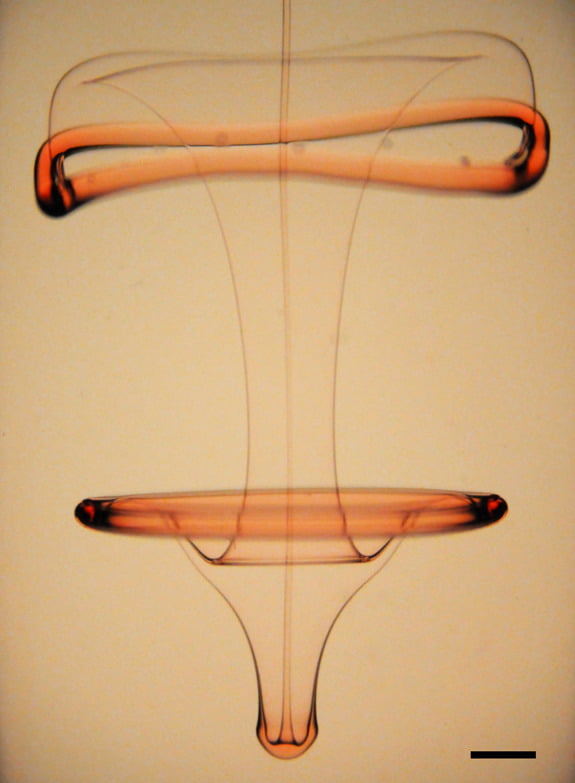
A drop of silicone oil falling through a liquid with lower surface tension distorts into multiple vortex rings connected by thin films. This behavior is caused by the interaction between viscous and capillary forces and is observable for only a narrow range of oil viscosities. (Photo credit: A. Felce and T. Cubaud)
Fireball in Slow Motion
The high-speed video above shows an atomized spray of flammable liquid being ignited using a lighter. It was filmed at 10,000 fps and is replayed at 30 fps. Although uncontained, this demonstration is similar to the combustion observed inside of many types of engines. Automobiles, jet engines, and rockets all break their liquid fuel into a spray of droplets to increase the efficiency of combustion. The turbulence of the flames dances and swirls, with small-scale motions close to the sprayed droplets and larger-scale motions around the vaporized fuel. This variation in size of the scales of motion is a hallmark feature of turbulence and can be used to characterize a flow.
Astro Puffs
Microgravity continues to be a fascinating playground for observing surface tension effects on the macroscale without pesky gravity getting in the way. Here astronaut Don Pettit has created a sphere of water, which he then strikes with a jet of air from a syringe. Initially, the momentum from the jet of air creates a sharp cavity in the water, which rebounds into a jet of water that ejects one or more satellite drops. Surface waves and inertial waves (inside the water sphere) reflect back and forth until the fluid comes to rest as a sphere once more. Note how similar the behavior is to the pinch-off of a water column. Both effects are dominated by surface tension, but on Earth we can only see this behavior with extremely small droplets and high-speed cameras! (Video credit: Don Pettit, Science Off the Sphere)