The electrowetting effect can change the shape of a liquid droplet on a surface by applying a voltage across the surface and droplet. Surface tension is a kind of measure of the energy required to maintain a certain drop shape, and that energy can be both chemical and electrical. In the video above, the droplet maintains a small contact area naturally (with no voltage). It expands and flattens under an electrical charge. Varying the voltage will change the degree to which the droplet flattens, but only to a point. Electrowetting is used to control variable lenses and some types of electronic displays. The technology may be used to replace current generation LCDs. (Video credit: V. Arya/Duke University)
Tag: droplets

Encapsulating Droplets
In applications like drug delivery, it’s often desirable to encapsulate one or more liquid droplets in an additional immiscible fluid. These drops-within-drops, called double emulsions, are typically a multi-step process, created from the innermost drop outward. In this new microfluidic technique, though, researchers are able to create multi-component emulsions in a single step. A double-bored capillary tube creates the two inner droplets (both water, dyed different colors) while oil flows down the outside of the injection tube to encapsulate the droplets. The multi-component double emulsions then flow as one to the right in the outer carrier fluid. The spacing of the capillary tubes is critical to prevent the inner droplets from coalescing with one another. (Video credit: L. L. A. Adams et al.)
Breaking Up a Ferrofluid
Ferrofluids are known for their fascinating behaviors when subjected to magnetic fields, especially for the distinctive peaks they can form. In this video, we see a very thin ferrofluid drop on a pre-wetted surface just as a uniform perpendicular magnetic field is applied. Immediately the droplet breaks up into tiny isolated peaks that migrate out to the circumference. The interface breaks down from center, where the drop height is largest, and moves outward. Simultaneously, the diffusion of ferrofluid from the circumferential droplets into the surrounding fluid lowers the magnetization of those droplets, making it more difficult for them to repel their neighbors. As a result, they drift outward more slowly and get caught by the faster-moving droplets from within. (Video credit: C. Chen)

Evaporation and Surface Effects
Surface properties can have surprising effects on fluid behavior. This image shows the evaporation of several droplets over time. All of the initial droplets are of the same volume, but they are placed on a surface which is a) superhydrophobic, b) hydrophobic, or c) hydrophilic. The more hydrophobic the surface, the larger the initial contact angle between the droplet and surface and the smaller the wetted area of the surface. Yet despite this seemingly large surface area exposure to air, the droplet on the superhydrophobic surface is the slowest to evaporate. (Photo credit: C. Choi)

Bouncing to Mix Oil and Water
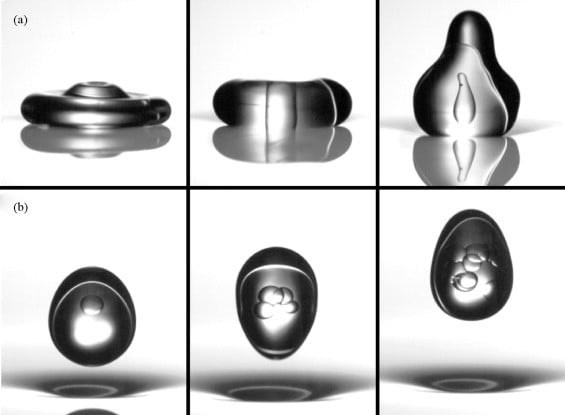
Mixing immiscible liquids–like oil and water–is tough. The best one can usually do is create an emulsion, in which droplets of one fluid are suspended in another. The series of images above shows a double emulsion consisting of oil and water that’s been formed by bouncing the compound droplet on a vibrating bath. The vibration of the liquid surface keeps the droplet from coalescing with the bath and the deformation provides mixing. The top row shows the initial impact while the bottom row of images shows the droplet after many bounces. As time goes on, the layer of oil around the compound drop becomes a cluster of tiny droplets contained within the water portion of the drop. (Photo credit: D. Terwagne et al.)

Colorful Spirals

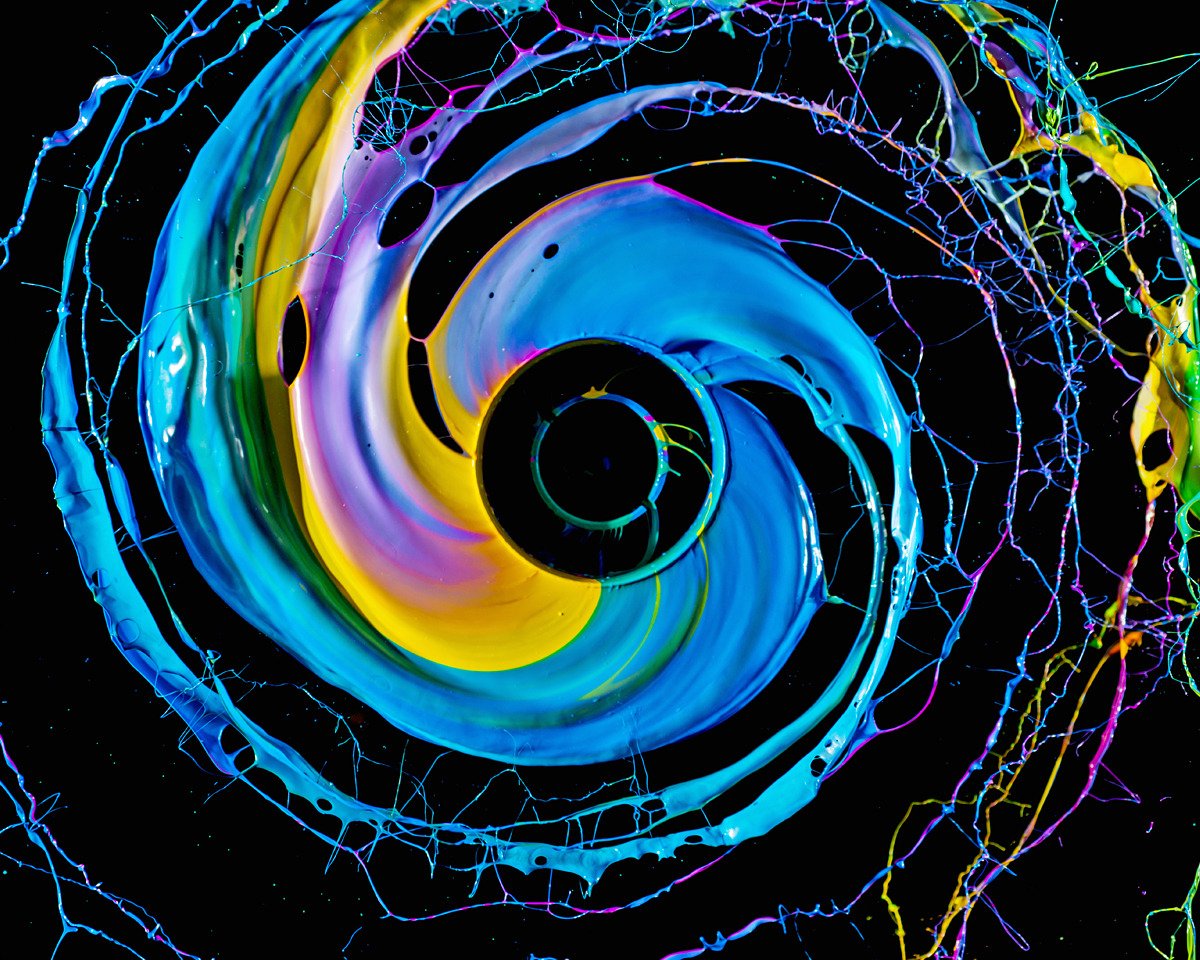
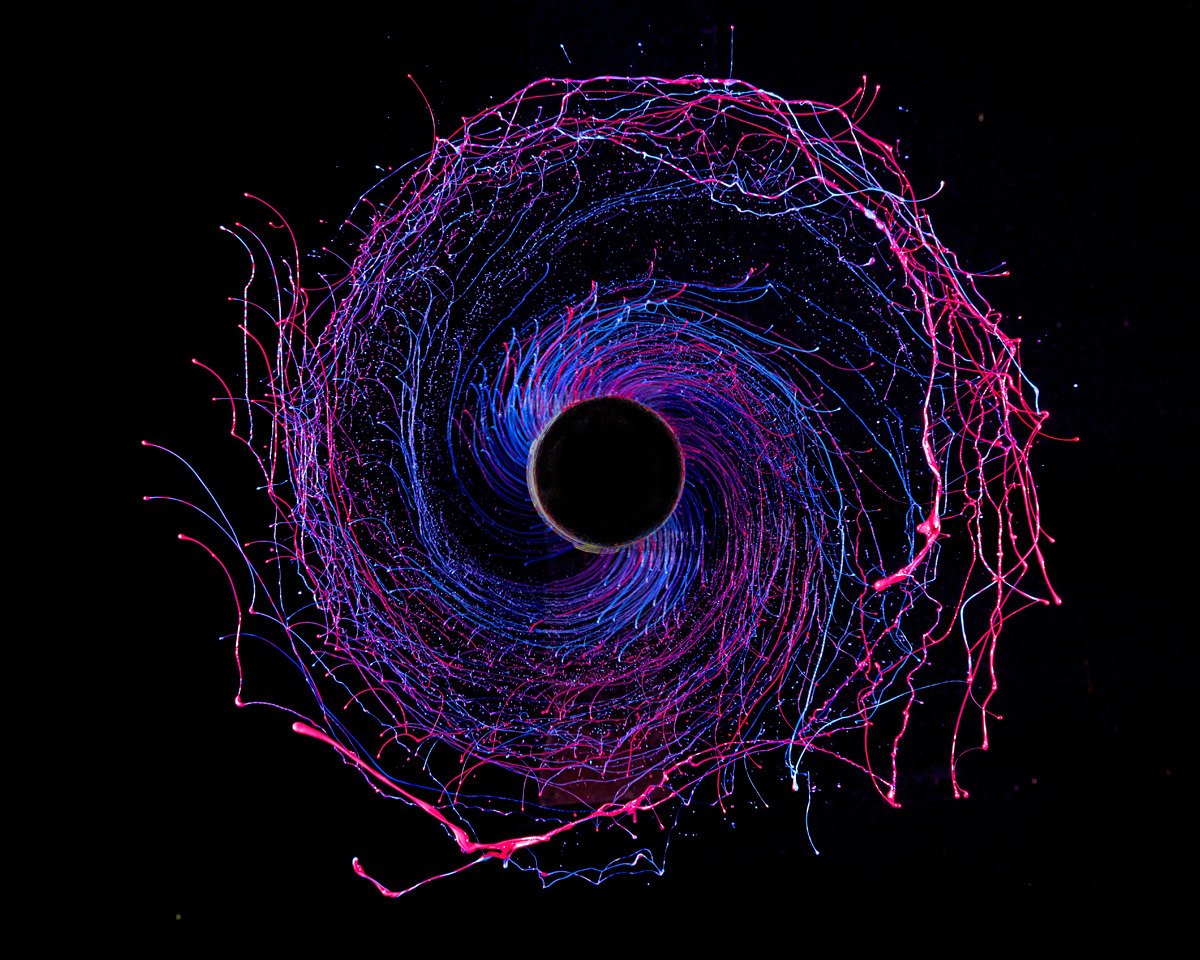
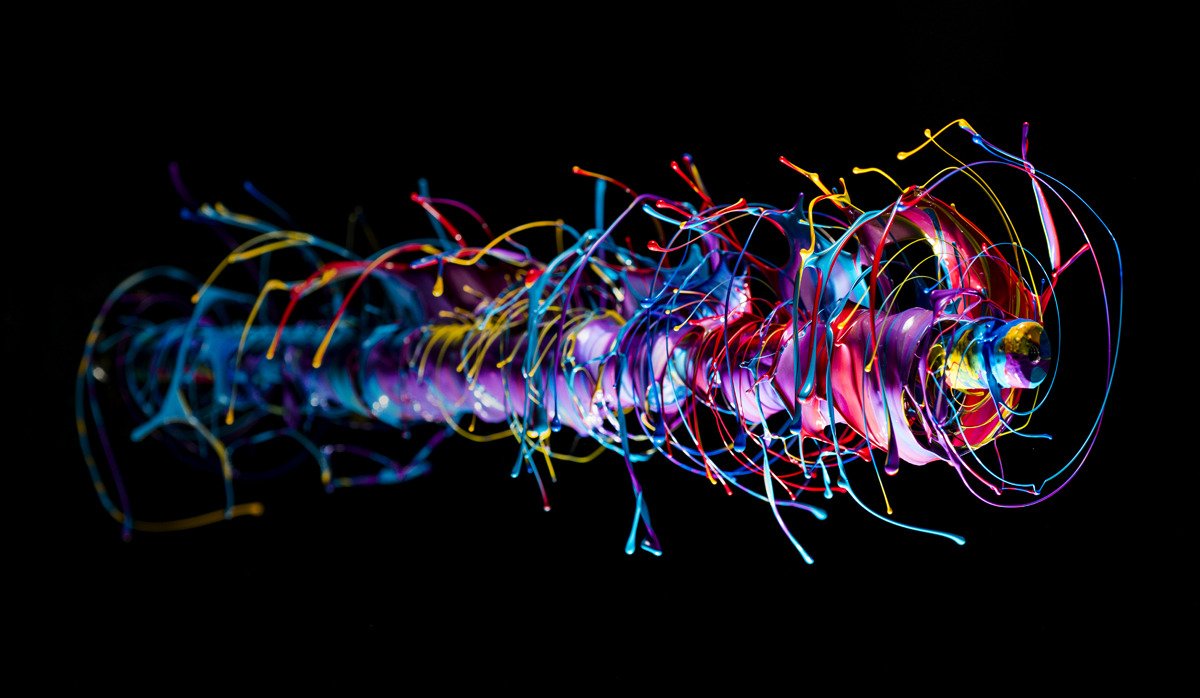
Artist Fabian Oefner captures these colorful portraits of fluid instability by dripping acrylic paints onto a metal rod, which is connected to a drill. When the drill is switched on, paint is flung away from the rod, creating these snapshots of centripetal force and surface tension. Note how droplets gather at the ends of the spiral arms like in a Plateau-Rayleigh or a rimming instability. For more, check out Oefner’s webpage, which includes a video showing how the images are made, or his previously featured work, “Millefiori”. (Photo credit: F. Oefner; submitted by Stephen D.)
When Skittering Becomes Self-Propulsion
When liquids hit a surface much hotter than their boiling point, a thin layer of gas can form between the drop and surface, allowing the drop to glide along. This Leidenfrost effect is what makes drops of water skitter across a hot pan. But what happens when the pan isn’t flat? The video above shows a Leidenfrost drop on a ratchet-like surface. Instead of gliding or skittering randomly, the drop self-propels toward the steepest section of the ratchet This behavior allows researchers to design surfaces that guide the drops on an intended path. (Video credit: G. Lagubeau and D. Quéré)

The Red Crown
A drop of red dye falls into a thin layer of milk, forming a crown splash. Notice the pale edges of the droplets at the rim of the crown; this is milk that has been entrained by the original drop. The rim and satellite droplets surrounding the splash are formed due to surface tension effects, chiefly the Plateau-Rayleigh instability–the same effect responsible for breaking a falling column of liquid into droplets like in a leaking faucet. The instability will have a most unstable wavelength that determines the number of satellite droplets formed. (Photo credit: W. van Hoeve et al., University of Twente)

Liquid Sculptures
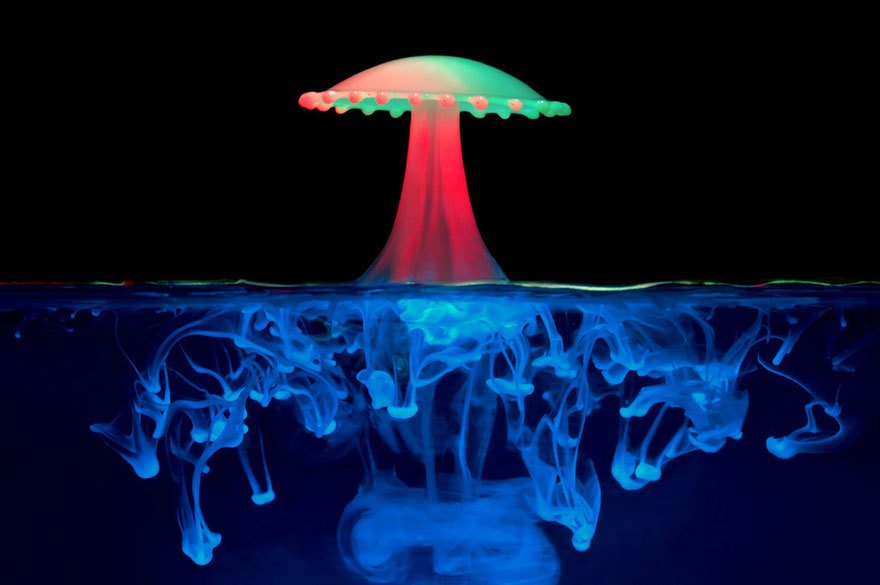
Artist Corrie White uses dyes and droplets to capture fantastical liquid sculptures at high-speed. The mushroom-like upper half of this photo is formed when the rebounding jet from one droplet’s impact on the water is hit by a well-timed second droplet, creating the splash’s umbrella. In the lower half of the picture, we see the remains of previous droplets, mixing and diffusing into the water via the Rayleigh-Taylor instability caused by their slight difference in density relative to the water. There’s also a hint of a vortex ring, likely from the droplet that caused the rebounding jet. (Photo credit: Corrie White)
Droplet Springs
Prior to reaching terminal velocity, a falling droplet typically oscillates between a prolate shape (like an American football about to be kicked) and an oblate one (like that same football when thrown or carried). As explained by Minute Laboratory, this oscillation behaves very similarly to a mass on a spring. For a spring/mass system, the frequency of oscillation is related to the spring’s stiffness; for the falling droplet, it is instead governed by surface tension. If only high schools had high-speed cameras, this would make a fantastic fluids lab experiment! (Video credit: Minute Laboratory; submitted by Pascal W.)
FYFD is sporting a new look and new about and resources pages for those who want more fluidsy goodness.