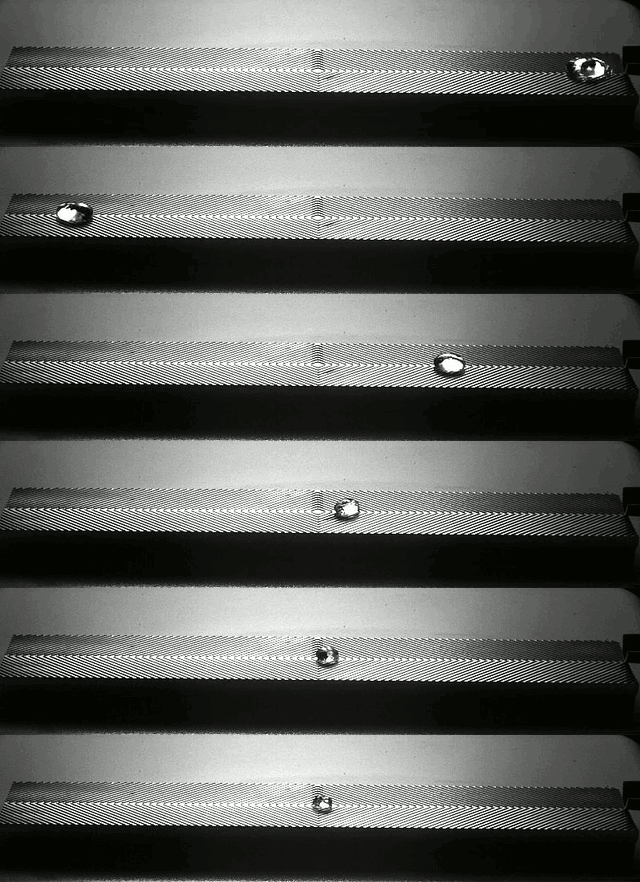
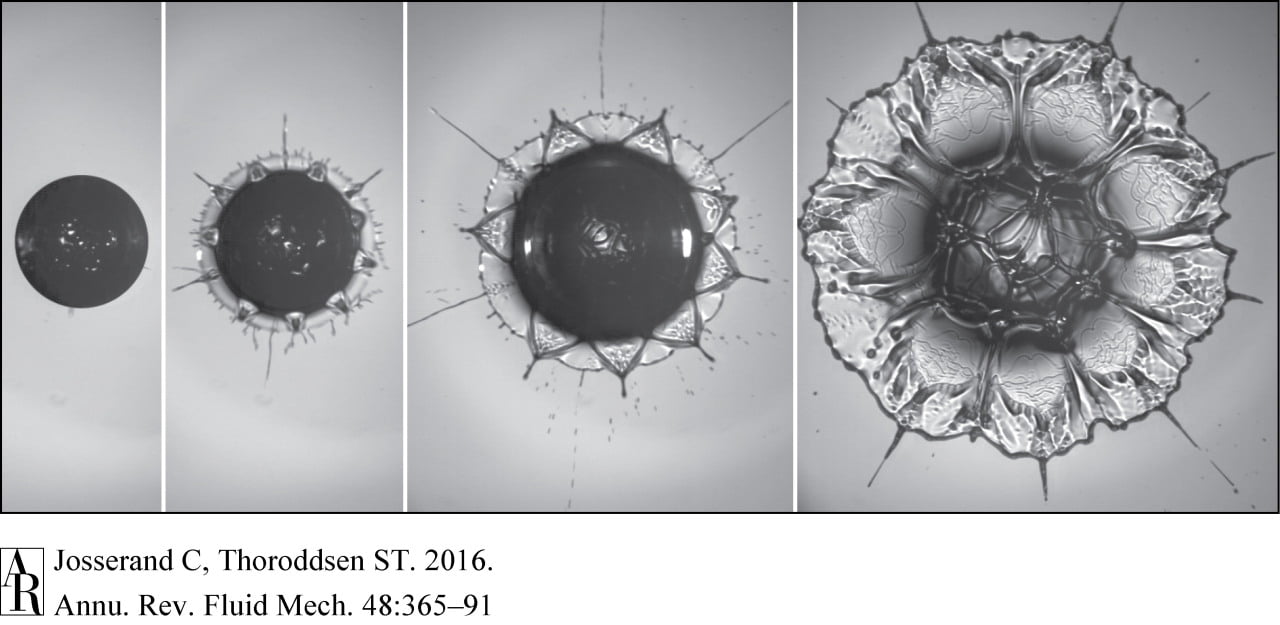
Emulsions – mixtures of two immiscible fluids – are quite common; the oil and vinegar combination used in many salad dressings is one. The image sequence above shows the first 800 microseconds of the impact of a similarly emulsified droplet. The outer drop, seen on the left, consists of a water/glycerin mixture, and inside the drop are 20 smaller perfluorohexane droplets. These smaller droplets are denser and tend to settle toward the bottom of the outer drop. When the compound droplet hits a solid surface, it spreads in a spectacular starburst pattern that depends on the number and location of interior droplets. You can see a similar impact in motion here. (Image credit: J. Zhang and E. Li; source: C. Josserand and S. Thoroddsen)
Tag: droplets

Blowing Through a Straw
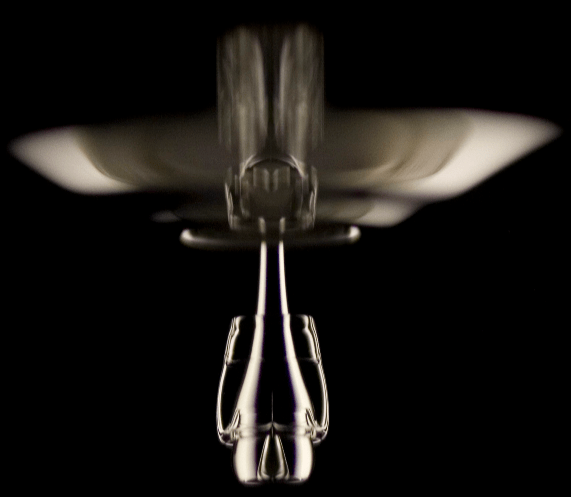
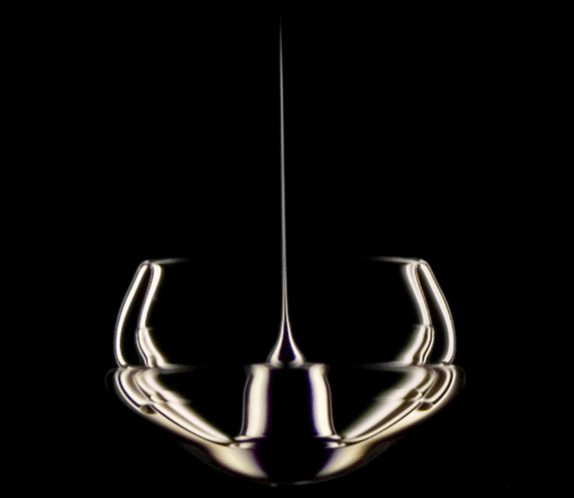
As kids, most of us got in trouble at some point for blowing through a straw into our nearly-empty drinks. What you see here is a consequence of such misbehavior, though in this case the fluid is silicone oil and the straw is a metal needle (not shown) through which helium is continuously injected beneath the liquid surface. Depending on the angle of the straw, different behaviors are observed, as seen in this video. The photo above shows an intermediate regime, in which tiny jets form at the surface and eject a stream of drops. Each drop sails in a little parabolic arc and briefly bounces on the surface, like the drops on the right, before coalescing into the pool. (Image credit: J. Bird and H. Stone; video)

Dancing Droplets
The seemingly-alive dancing droplets are back in a new video from Veritasium. These droplets of food coloring attract, merge, and chase one another due to evaporation and surface tension interactions between their two components: water and
propylene glycol. Because the droplets are constantly evaporating, they are surrounded by a cloud of vapor that helps determine a drop’s surface tension. These localized differences in surface tension are what causes the drops to attract. The chasing is also surface-tension-driven. Like any liquid, the drops will flow from areas of low surface tension to those of higher surface tension due to the Marangoni effect. Thus drops of different concentration appear to chase one another. This is a relatively simple experiment to try yourself at home, and Derek outlines what you need to know for it. (Video credit: Veritasium; research credit: N. Cira et al.; submitted by @g_durey)

Fluids Round-up
Last week was supposed to have a fluids round-up, but we were having too much fun walking on water instead. So here it is now!
– NASA has asked Congress for funding for new X-plane programs to explore solutions for greener airliners and quieter sonic booms to enable next-generation air travel. Popular Science, Gizmodo, and Ars Technica take a closer look at the proposed projects. I won’t lie – as an aerospace engineer I am hugely in favor of this. The first ‘A’ in NASA has been neglected for quite a while and projects like these are needed if we want to advance the state-of-the-art in aeronautics.
– The New York Times’ ScienceTake video series took a look back at their most popular videos, and 3 of the top 5 videos are fluid dynamics-related. Because we are just that awesome. (via Rebecca M)
– I made a guest appearance on last week’s Improbable Research podcast, where we talked about bizarre experiments trying to unravel swimming.
– Physics Girl shows us 5 weird ways to blow out a candle. There’s some neat and potentially non-intuitive fluid dynamics involved!
– SciShow offers an explanation of why we sneeze. Spoiler alert: it’s more than just to get rid of irritants.
– Fluid dynamics made the short list for NPR’s Golden Mole awards with the discovery of dancing droplets. Here’s Skunkbear’s take on it.
– Ernst Mach, of Mach number fame, was also a bit of an artist and philosopher. (via @JenLucPiquant)
– It’s not quite fluid dynamics, but this Slow Mo Guys video of spinning burning steel wool might be their most beautiful video yet. Check it out!
(Image credit: NASA)

Freezing From Below
Watch closely as a droplet freezes on a cold surface, and you’ll observe something surprising. First, a freeze front will appear, traveling upward from the substrate. It curves slightly near the edges, leaving a liquid cap atop the frozen drop. But, as we’ve all discovered, water expands as it freezes. We can watch the drop freezing and see that the water isn’t expanding radially. Instead, the water expands vertically, forming a sharp tip or cusp just as the drop freezes completely. Remarkably, the geometry of the final tip doesn’t depend on the temperature of the substrate or on the wetting contact angle. (Video credit: L. Posada)

Oil Film on Water
This award-winning short film features a thin layer of volatile oil on water. The oil evaporates quickest from shallow pools only microns deep, which appear bluish in the video. Surface instabilities along the edge of the pool create flow that draws oil in, generating the iridescent droplets seen floating among the evaporation pools. The droplets combine and coalesce as they come in contact with one another. Since droplets have a larger volume per surface area than the shallow pools, they evaporate more slowly. The behaviors observed here are important to applications like oil and fuel spills, which can persist longer if the floating fluid layer tends to form droplets. (Video credit: J. Hart; via txchnologist)

Trampolining Droplet
Imagine a droplet sitting on a rigid surface spontaneously bouncing up and then continuing to bounce higher after each impact, as if it were on a trampoline. It sounds impossible, but it’s not. There are two key features to making such a trampolining droplet–one is a superhydrophobic surface covered in an array of tiny micropillars and the other is very low air pressure. The low-pressure, low-humidity air around the droplet causes it to vaporize. Inside the micropillar array, this vapor can get trapped by viscosity instead of draining away. The result is an overpressurization beneath the droplet that, if it overcomes the drop’s adhesion, will cause it to leap upward. For more, check out the original research paper or the coverage at Chemistry World. (Video credit and submission: T. Schutzius et al.)

The Droplet Slide
One of the joys of science is the sense of discovery that can come even from looking at something seemingly simple. Take, for example, a water droplet sitting on a plate. If you slowly tilt the plate, the droplet’s shape will shift until a critical angle where it starts sliding down the plate. But what happens to two initially different droplets? As this video shows, tilting two droplets of initially different shapes and returning them to horizontal causes the droplets to assume the same shape. There’s a universal behavior at work here–like nature has a kind of reset button that makes gravity and surface tension work together such that a droplet will assume a preferred shape. For an experimentalist, it’s certainly a handy way to create repeatable experiments! (Video credit: M. Musterd et al.)

Coalescence Cascade
The simple coalescence of a drop with a pool is more complicated than the human eye can capture. Fortunately, we have high-speed cameras. Here a droplet coalesces by what is known as the coalescence cascade. Because it has been dropped with very little momentum, the droplet will initially bounce, then seem to settle like a bead on the surface. A tiny film of air separates the drop and the pool at this point. When that air drains away, the drop contacts the pool and part–but not all!–of it coalesces. Surface tension snaps the remainder into a smaller droplet which follows the same pattern: bounce, settle, drain, partially coalesce. This continues until the remaining droplet is so small that it can be coalesced completely. (Image credit: Laboratory of Porous Media and Thermophysical Properties, source video)

Make Your Own Dancing Droplets
As a follow-up to last week’s “dancing droplet” post, here’s a video that describes how to recreate the experiment yourself at home. The droplet motion is driven by the two-component structure of the droplets, where differing evaporation rates and surface tension values between the two fluids in the drop cause the attractions and chasing behavior you see. To demonstrate this at home, you’ll need glass, fire (for sterilization), tweezers, a pipette, water, and food coloring. Looks like a fun way to spend a weekend afternoon! (Video credit: M. Prakash et al.; via io9)