Tag: droplets

  • Hydrodynamic Quantum Analogs

    Hydrodynamic Quantum Analogs

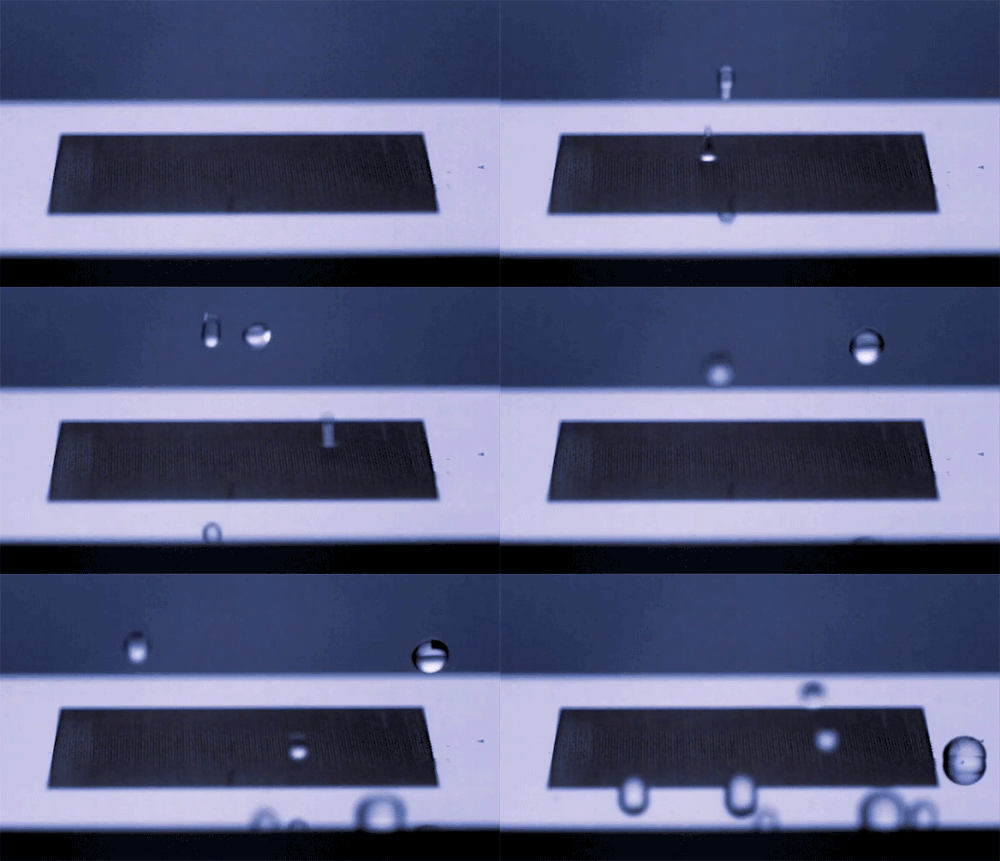
    Over the past few years, researchers have been exploring the dynamics of droplets bouncing on a vibrating fluid. These systems display many behaviors associated with quantum mechanics, including wave-particle duality, single-slit and double-slit diffraction, and tunneling. A new paper examines the system mathematically, showing that the droplets obey many of the same mathematics as quantum systems. In fact, the droplet-wave system behaves as a macroscopic analog of 2D quantum behaviors. The implications are intriguing, especially for teaching. Now students of quantum mechanics can experiment with a simple apparatus to understand some of the non-intuitive aspects of quantum behavior. For more, see the paper on arxiv. (Image credit: D. Harris and J. Bush; research credit: R. Brady and R. Anderson)

  • The Inside of an Evaporating Drop

    [original media no longer available]

    Evaporating droplets may not look like much to the naked eye, but they contain complicated flow patterns. The type of pattern observed depends strongly on the contact line, the place where the liquid, solid, and air meet. When the contact line is pinned–kept unchanged–during evaporation, any particulates in the drop get pulled toward the edges as the drop evaporates. This is what leaves the classic coffee ring stain. It is also what is shown in the first clip in the video above. Contrast this with the second clip, in which the contact line is unpinned and varies irregularly as the drop evaporates. In the unpinned drop, particles are drawn inward during evaporation. The flow patterns are very different as well, complicated by swirling that is the result of force imbalances caused by the irregularly receding contact line. (Video credit: H. Kim)

  • Featured Video Play Icon

    Evaporating Drops

    When still drops evaporate from a surface, they do so in several phases, as illustrated in the video above. Initially, the drop forms a spherical cap. At this point the velocity within the droplet is so small that it is difficult to resolve, but particles within the drop move outward toward the contact line. As the drop evaporates, they form a circle of sediment – the familiar coffee ring. As the drop flattens, radial velocity increases, drawing more and more particles to the coffee ring. Eventually the drop pulls away from the ring, leaving surface tension and evaporation to compete in driving the internal flow. During this phase, some parts of the contact line try to re-establish the flow pattern that made the first ring; this leaves behind circular segments broken up by the increasing instabilities in the contact line. In the final stage, surface tension smooths some of the irregularities and drives an inward velocity that leaves behind radial sediment segments. (Video credit: G. Hernandez-Cruz et al.)

  • Featured Video Play Icon

    Vibrating Droplets

    When still, water drops sitting on a surface are roughly hemispherical, drawn into that shape by surface tension. But on a vibrating surface, the same water drop displays many different shapes, like those in the video above. Researchers have observed more than 30 different mode shapes by varying the driving frequency. The metal mesh placed beneath the glass on which the drops sit helps the researchers determine the drop’s shape. As the drop deforms, the mesh appears to distort due to the refraction of light through the changing shape of the drop’s water-air interface. The distortion allows observers to visualize (and in some experiments even reconstruct) the shape of the drop’s surface. Understanding this kind of droplet behavior is valuable for many applications, including ink-jet printing and microfluidic devices. (Video credit: C. Chang et al.; via Science)

  • Featured Video Play Icon

    Dublin’s Pitch-Drop Experiment

    Readers may recall the University of Queensland’s pitch-drop experiment, recognized as the longest continuously running experiment in the world. Back in 1927, a professor started the experiment with the goal of measuring the extremely high viscosity of pitch. Since then, only eight drops have fallen. Queensland’s is not the only version of this experiment, though; Trinity College Dublin has a similar set-up and have just caught a falling pitch drop on camera for the first time ever. Take a look in the video above. Queensland is expecting a drop to fall sometime this year as well. (Video credit: Trinity College Dublin Physics; via SciAm)

  • Featured Video Play Icon

    Hydrophobia

    Hydrophobic literally means water-fearing, and, once a surface is treated with a hydrophobic coating, the effect on water droplets is stark. The tendency of the non-polar hydrophobic molecules to repel the polar water molecules leads to high contact angles – which make the droplets almost spherical as they glide along the surface. The droplets dance across the surface, colliding and bouncing and coalescing.  (Video and submission credit: M. Bell)

  • Featured Video Play Icon

    Droplets Within Droplets

    This video shows a multi-layered droplet, in which several droplets are formed one inside the other as an initial drop falls through a layer of oil sitting atop another liquid. When the drop falls, its potential energy gets transformed into interface energy, creating a fascinating interplay of surface tension, deformation, and miscibility between the fluids. Such self-contained multi-layered droplets, similar to multiple emulsions, could be helpful in pharmaceutical development. (Video credit: E. Lorenceau and S. Dorbolo 2004)

  • Dye Droplet

    Dye Droplet

    A drop of fluorescent dye falling into quiescent water forms fantastical structures that are a mixture of vorticity, turbulence, and molecular diffusion. The horseshoe-like shape near the front of the drop is a typical shape for two fluids strained by moving past one another. The main section of the drop billows outward like a parachute, but the turbulence of its wake stretches the dye into fine threads that quickly disperse in the water. (Photo credit: D. Quinn et al.)

  • Featured Video Play Icon

    “Levitating Water”

    Al Seckel, a cognitive neuroscientist and expert on illusions, created this “Levitating Water” installation, in which multiple streams of water appear as a series of levitating droplets thanks to a strobing light. The well-timed strobe lighting tricks the brain into seeing many different falling droplets as the same, nearly stationary droplet. The effect is similar to the one created by vibrating a stream of falling water. (Video credit: wunhanglo)

  • Featured Video Play Icon

    Droplet Bounce

    This high-speed video shows the remarkable resilience of a water droplet upon impact against as a solid surface. The droplet deforms into a pancake-shape, with its center depressing almost flat before rebounding upward. The rest of the drop follows, splitting into several droplets as capillary waves dance across its surface. When one satellite drop almost escapes, the main droplet just barely comes in contact with it, the coalescence enough to tip surface tension into pulling them together instead of breaking them apart.  (Video credit: K. Suh/ChemistryWorldUK)