Tag: diffusion

  • Oil in Alcohol

    Oil in Alcohol

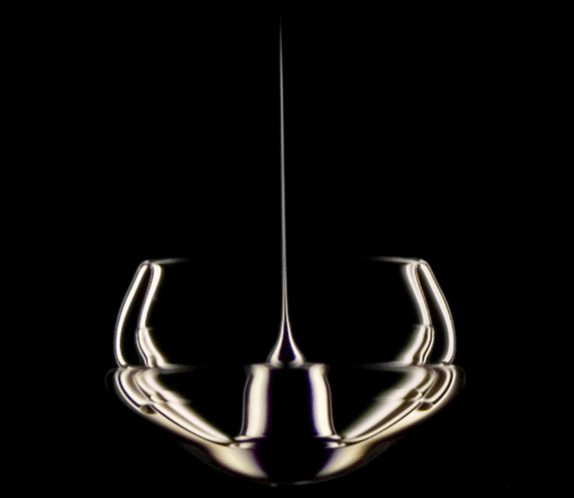
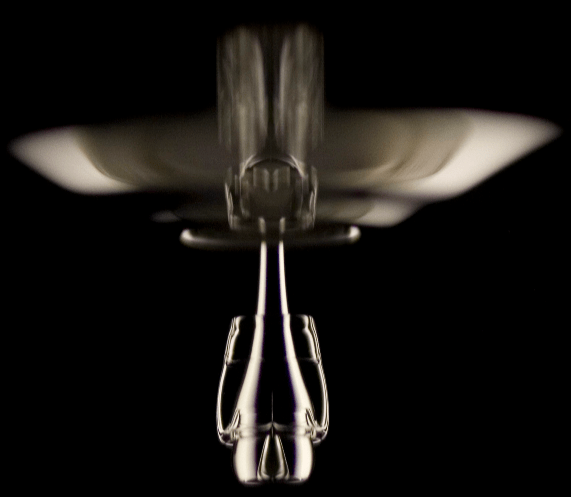
    A drop of oil impacts and falls through a pool of isopropyl alcohol. Momentum, viscosity, and diffusion combine to deform the drop into a shape that is initially like an upside-down wine glass (top image). Because the oil is both denser than the alcohol and soluble in it, the drop sinks and dissolves as it falls. The drop expands rapidly outward, thinning and formed a concave shape around its denser, sinking core (bottom image). Ultimately, the droplet will deform and fragment as it dissolves into the alcohol. (Image credit: R. La Foy et al.)

  • Falling Ink

    Falling Ink

    Photographer Linden Gledhill created these nebula-like composites from photos of ink diffusing in water. The work was inspired by Mark Stock’s “Spherical Rayleigh-Taylor Instabilities” series featured here last week. Like Stock’s computational art, the twisted fingers and vortex rings above form due to the denser ink falling through less dense water. The interface between the two fluids distorts under the effects of gravity and the fluids’ relative motion. Such shapes are ephemeral at best; the falling ink will quickly become turbulent and diffuse throughout the water.  (Photo credit and submission: L. Gledhill)

  • Featured Video Play Icon

    “Jack and the Giant”

    This fantastic music video by Kim Pimmel is a beautiful merger of art and fluid dynamics. Using household goods (and some slightly more exotic ferrofluid), the video shows how mesmerizing diffusion, buoyancy, Marangoni flow, and other fluid effects can be up close. It may also be the first time I’ve ever seen fluid dynamics–specifically bubbles–used as characters! Also be sure to check out some of his previous videos, many of which also feature cool fluid dynamics. (Video credit and submission: K. Pimmel)

  • “Heavy Metals”

    “Heavy Metals”

    Photographer Alberto Seveso’s “Heavy Metals” series builds on his previous works capturing fluid dynamics. By dropping mixtures of ink, liquids, and metallic powder through different fluids, he creates ethereal, billowing forms that turn the processes of diffusion and turbulent mixing into something one could almost touch. Be sure to check out the rest of the series and his online portfolio for more examples. (Photo credits: A. Seveso; via Colossal; submitted by jshoer and @catnogood)

  • Featured Video Play Icon

    “Marco Polo” Theme

    Netflix’s new original series “Marco Polo” has a distinctive and fluidsy title sequence. The artistic team at the Mill created the effect by painting  images in water atop dense paper before introducing Japanese sumi-ink. Using high-speed photography, they filmed the diffusion of the ink into the water as it reveals the larger picture. There’s a great behind-the-scenes break down and video over at their blog. (Video credit: The Mill, submitted by jshoer)

  • “Milky WaY”

    “Milky WaY”

    Photographer Paulo Stagnaro uses milk and food coloring in his series “Milky WaY”. Despite the simple ingredients, the photos illustrate the enormous variety of shape and form in fluid dynamics. Surface tensiondiffusion, and intentional mixing create abstract and ephemeral portraits of fluid motion. For similar work, see Pery Bruge’s art or just try browsing through FYFD’s “fluids as art” tag for more examples of science and art intersecting. (Photo credit: P. Stagnaro; submitted by Stephanie M.)

  • “Smoke”

    “Smoke”

    Ethereal forms shift and swirl in photographer Thomas Herbich’s series “Smoke”. The cigarette smoke in the images is a buoyant plume. As it rises, the smoke is sheared and shaped by its passage through the ambient air. What begins as a laminar plume is quickly disturbed, rolling up into vortices shaped like the scroll on the end of a violin. The vortices are a precursor to the turbulence that follows, mixing the smoke and ambient air so effectively that the smoke diffuses into invisibility. To see the full series, see Herbich’s website.  (Image credits: T. Herbich; via Colossal; submitted by @jchawner@__pj, and Larry B)

    P.S. – FYFD now has a page listing all entries by topic, which should make it easier for everyone to find specific topics of interest. Check it out!

  • Featured Video Play Icon

    Greening the River

    Every year Chicago dyes its river green in honor of St. Patrick’s Day. This timelapse video shows this year’s dyeing, including several passes from a boat distributing the green dye. The color is remarkably slow to diffuse. The boat’s passage does little to affect the motion of the dye already in the river. This is because the boat mainly disturbs the surface and most of the color comes from dye spread throughout the water. It’s like if you tried to stir milk into your coffee just by tapping the surface with your spoon. Instead, the slower, large-scale turbulent motion of the river distributes the dye. For more St. Patrick’s Day physics, be sure to check out Guinness physics and why tapping a beer makes it foam. (Video credit: P. Tsai; submitted by Bobby E.)

  • Reader Question: Oceans Meeting?

    Reader Question: Oceans Meeting?

    Reader favoringfire asks:

    Hi! Maybe you can help me: I’ve seen a pic revolving around Tumblr from the Danish city of Skagen showing the Baltic and North sea meeting. Where they meet the ocean is two very distinct hues of blue–what captions say are “two opposing tides with different densities.” Tides? Currents w/different temps often are often diff color from one another. But can “tides” be of different “densities???”

    After some searching, I think the photo above is probably the one you’ve seen represented as where the Baltic and North Seas meet. It turns out, however, that it’s not. It’s a photo from an Alaskan cruise taken by Kent Smith. Fluid dynamically, though, it’s still very interesting! What we see here is a sharp gradient between regions with very different densities. One side contains lots of freshwater from rivers fed by melting glaciers, which creates a very different density from the general seawater.

    It’s not true, however, that the two won’t mix. This border is not a static phenomenon but one that is ever-changing due to currents and the diffusion of one fluid into another. In a sense, this photo is very much the sea-level version of photos like these which show the massive scale of sediment transport and nutrient mixing that occur in our oceans.

    (Photo credit: K. Smith)
  • Ink Diffusion

    Ink Diffusion

    Alberto Seveso’s gorgeous high-speed photos of ink diffusing in water have a dramatic sense of texture to them. Though still delicate, the whorls of fluid seem almost solid enough to touch. Watch the edges, though, and you can see thin wisps of color and hints of instabilities. Like cream poured into coffee, these ink sculptures are short-lived. Some of his works are available as prints or wallpapers (zip file). (Photo credit: Alberto Seveso)