Backswimmers rule the surface of ponds, streams, and other bodies of water. These insects spend much of their time clinging just beneath the air-water interface, where they hunt larvae and other insects. They use oversized, oar-shaped back legs to row, and they breathe using an air bubble that clings to their abdomen like a personal scuba tank. Oxygen from the water diffuses into the bubble, keeping the insect’s air supply fresh. When the time comes to move to greener pastures, they flip to the other side of the water’s surface, unfurl their wings, and take off. (Image and video credit: Deep Look)
Diffusion is the tendency for differences in a fluid — in density, temperature, or concentration — to even out over time. Think about a drop of food coloring in a glass of water. Even without stirring, that dye will eventually disperse throughout the glass through diffusion. But when there is more than one factor controlling diffusion — like temperature and salinity — things get more complicated. In the ocean, for example, this double-diffusion causes salt fingers like those shown in the first image.
But what happens when the two diffusing fluid layers are flowing? That’s the question at the heart of this video, which explores the intricate mixing that takes place between doubly-diffusing liquids in a channel. (Video and image credit: A. Mizev et al.)
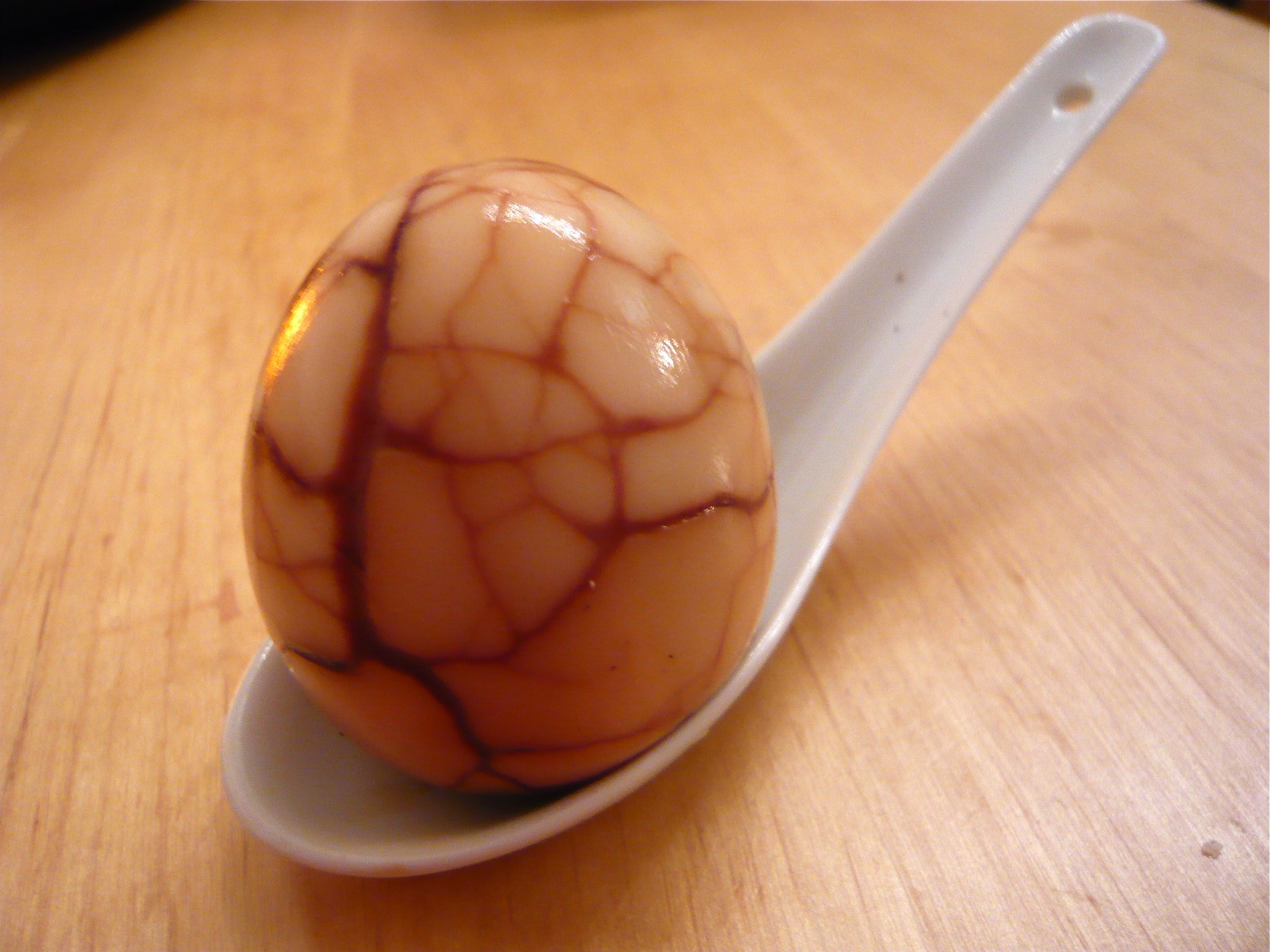
Many cultures around the world marinate hard-boiled eggs — like pickled eggs in Europe or tea- and soy-infused eggs from Asia. These delicacies offer a fun (and tasty) way to demonstrate the concept of diffusion, the tendency of a substance to move from areas of high concentration to low concentration via random molecular motion.
Simply steep peeled, hard-boiled eggs in your sauce (or food dye) of choice. Remove an egg every so often and slice it in half to see how far the sauce traveled. You can also play with the temperature to accelerate the diffusion. The longer an egg steeps and the hotter its surroundings, the further into the egg white the sauce will diffuse! (Image credit: Wordridden; research credit: C. Emeigh et al.)
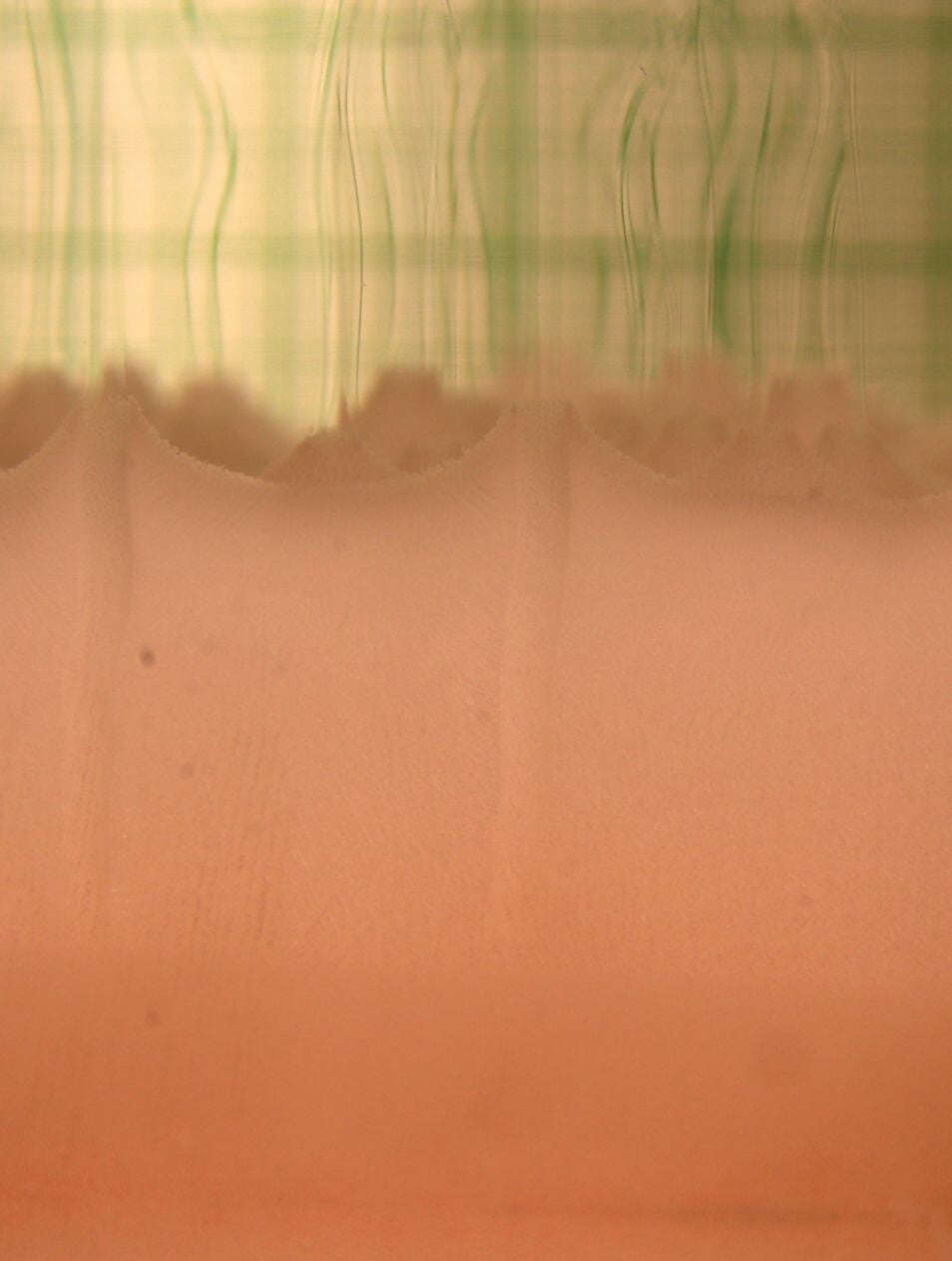
In many geophysical and metallurgical processes, there is a stage with a porous layer of liquid-infused solid known as a mushy layer. Such layers form in sea ice, in cooling metals, and even in the depths of our mantle. Within the mushy layer, temperature, density, and concentration can vary dramatically from one location to another.
The image above shows a mushy layer made from a mixture of water and ammonium chloride. Above the mushy layer, green plumes drift upward, carrying lighter fluid. Look closely within the mushy layer and you’ll see narrow channels feeding up to the surface. These are known as chimneys. In sea ice, chimneys like these carry salty brine out of the ice and into the seawater, increasing its salinity. See this Physics Today article for more details on the dynamics of mushy layers. (Image credit: J. Kyselica; via Physics Today)
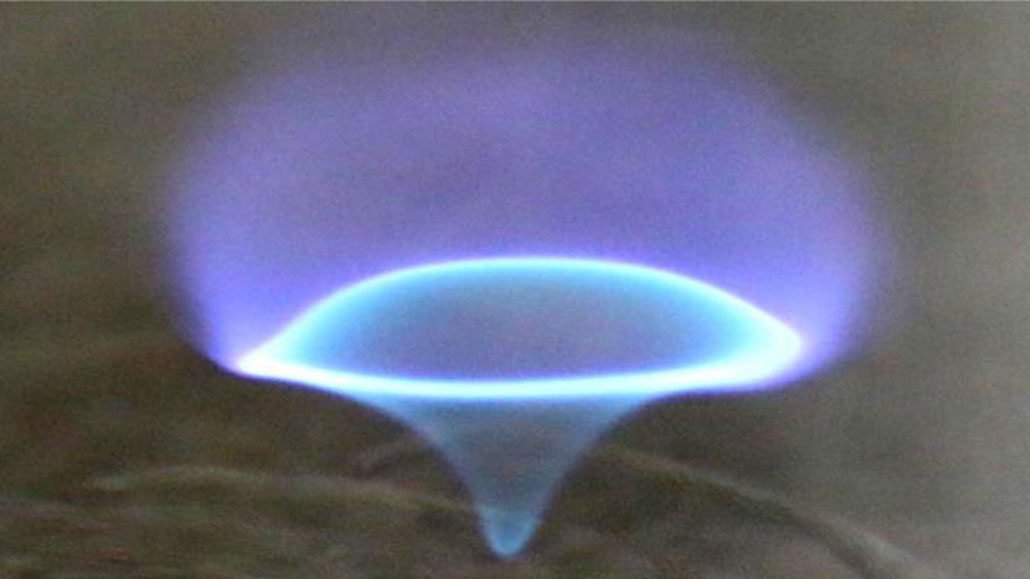
Several years ago, researchers discovered a new type of flame, the blue whirl. Now computational simulations have helped them untangle the complex structure of this clean-burning flame. Their work shows that the blue whirl is made up of three types of flames, which meet to form a fourth.
The conical base of the whirl is a fuel-rich flame in which the fuel and oxygen are initially well-mixed. Above that is a diffusion flame, where the fuel and oxygen are initially separate and the flame’s ability to burn is limited by how readily the two mix. Along the sides of the blue whirl is a third flame type, visible only as a faint wisp. Like the first flame, this one is premixed, but it contains much less fuel than oxygen. Finally, those three flames meet in the bright blue ring of the whirl, where the ratio of fuel and oxygen is just right to burn the fuel completely. (Image and research credit: J. Chung et al.; via Science News; submitted by Kam-Yung Soh)
Despite wide differences in ecology and geology, rivers around the world share certain fundamental features. Physicists study these characteristics by creating small-scale rivers in the laboratory, like the experiment featured in this Lutetium Project video. Within these systems, scientists can carefully control variables and discover useful patterns, like the two parameters needed to describe the shape of a river’s profile! (Image and video credit: The Lutetium Project)
With the right lighting and eye, billowing streaks of dye and paint can become the ethereal wisps of silk. Artist Susi Sie explores this dichotomy in “Silk,” a short, fluidic film made entirely in macro. Sometimes there’s astounding beauty in the complexity of a fluid filmed up close. (Video and image credit: S. Sie)
Meet the water anole, a small lizard native to the tropics of Central America. While studying these anoles, researchers discovered that they could flee underwater and remain submerged for 16 minutes or more at a time. Curious to see how the lizard manages this feat, they filmed them underwater, discovering that the anole seems to exhale a small bubble that sticks on its face and then re-inhale it.
How exactly this built-in “scuba gear” works is still under investigation, but here’s my guess. Fresh oxygen can diffuse from water into a bubble; some insects use this to breathe underwater. The natural, random motion of molecules tends to cause chemicals to move from areas of high concentration to those of low concentration. But this molecular diffusion is extremely slow. That tiny bubble you see isn’t around long enough for any significant molecular diffusion of fresh oxygen. But what if the surface of the bubble is actually much larger?
Notice the silvery shininess we see on the anole. That’s because most of the lizard isn’t actually wet. The anole is superhydrophobic, so its skin has trapped a thin layer of air that appears to extend over a large part of its body. I think perhaps the anole has fresh oxygen diffusing into the air layer across most of its skin, and the large bubble it inhales and exhales serves as a sort of pump to help draw that fresh oxygen through the air layer and into its body. That could help explain how the anole can stay submerged for so long.
As researchers continue to investigate this little aquanaut, it will be interesting to discover just what its secrets are! (Image and video credit: L. Swierk; via Gizmodo)
The new Mumford & Sons single “If I Say” features a fluid-dynamical music video. It’s full of dendritic fingers and flowing colors – likely from combinations of inks, paints, and other fluids. Although the fingers are reminiscent of the viscosity-dependent Saffman-Taylor instability, these appear to be driven by variations in surface tension between the different fluids. That’s a major feature throughout the video; although some of the flow is caused by the syringes depositing fluids, much of it seems to be a Marangoni effect, where flow moves away from areas of low surface tension to ones with higher surface tension. (Video credit: Mumford & Sons; filmed by P. Hofstede; via Katie M.)
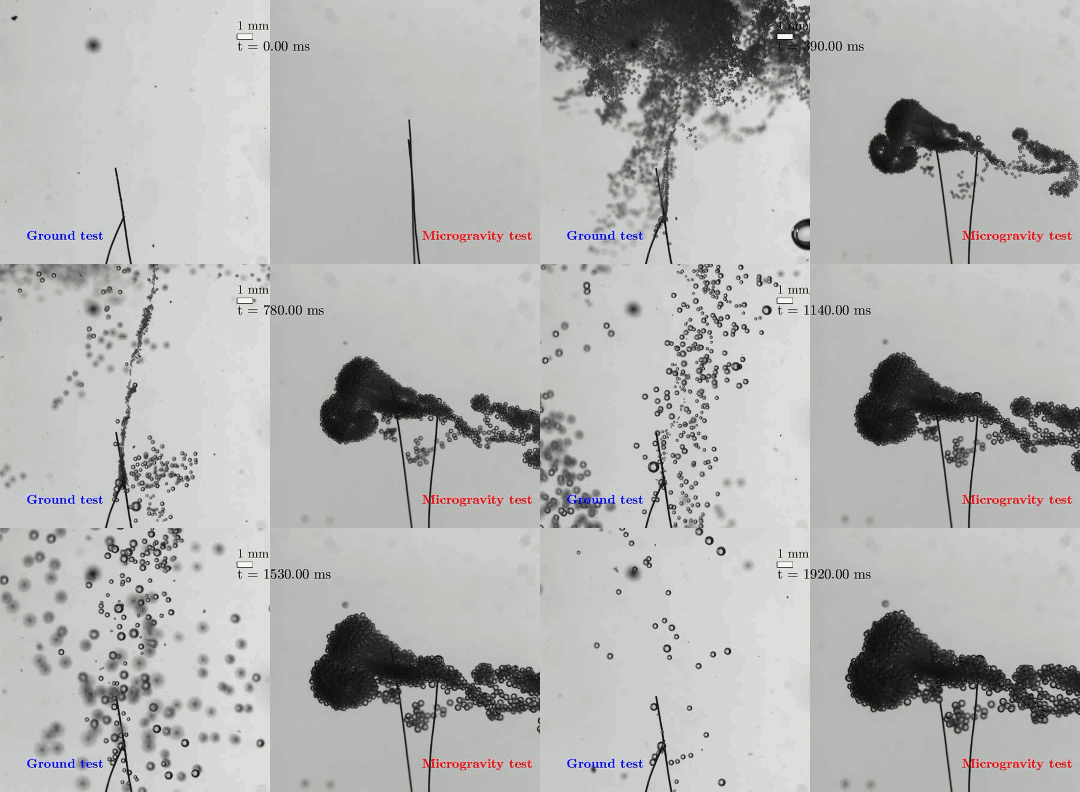
Bubbly beverages are popular among humans, but there’s surprising complexity underlying their seemingly simply carbonation, as explored in a new Physics Today article. Most drinks get their bubbles from carbon dioxide, which at higher than atmospheric pressures, can stay dissolved inside water and other liquids. When that pressure gets released, any carbon-dioxide-filled gas cavity in the liquid adopts the allowable saturation concentration for the ambient pressure, which sets up a concentration gradient of carbon dioxide between the liquid and the bubble. That causes carbon dioxide gas to diffuse into the bubbles, making them grow.
Here on Earth, those growing bubbles are buoyant, and they form rising plumes of bubbles. They continue gathering carbon dioxide as they rise, making them grow ever larger (lower left). In microgravity, on the other hand, the bubbles congregate where they form and continue growing through diffusion (lower right). This is one reason carbonated beverages are unpopular in space – instead of rising to the surface and escaping, all the carbon dioxide in a drink gets consumed, leaving astronauts with no way to expel it aside from burping!