This lovely video from Ruslan Khasanov showcases the beautiful interplay of surface tension, diffusion, and immiscibility in common fluids. With soy sauce, oil, ink, soap, and a little gasoline, he creates a mesmerizing world of color and motion. It’s a great reminder of the wonders that populate our daily lives, if we just look closely enough to see them. (Video credit: R. Khasanov; via Wired; submitted by Trevor)
Tag: diffusion

“Perpetual Puddle Vortex Experiment”
Anthony Hall’s “Perpetual Puddle Vortex Experiment” is an intriguing display of several physical mechanisms. What looks like a puddle is actually a vortex constantly sucking fluid down a hole in the table. The liquid is re-circulated into the puddle so it never disappears. The table itself is treated to be hydrophobic, causing the distinctive curvature and large contact angle of the puddle’s rim. The oils mixed in float on top, creating patterns of foam that visualize the swirling motions of the fluid as the vortex pulls it in. (Video credit and submission by: A. Hall)
Instability: Dense Over Light
Here on Earth, placing a dense layer of fluid atop a less dense layer is unstable. Specifically, the situation causes the interface between the two fluids to break down in what is known as the Rayleigh-Taylor instability.The video above shows a 2D numerical simulation of this breakdown, with the darker, denser fluid on top. The waviness of the initial interface provides a perturbation–a small disturbance–which grows in time. The two fluids spiral into one another in a fractal-like mushroom pattern. The continued motion of the dense fluid downward and the lighter fluid upward mixes the entire volume toward a uniform equilibrium. For those interested in the numerical methods used, check out the original video page. (Video credit: Thunabrain)

“Liquid Jewel”
Just a reminder that today is your last chance to participate in our reader survey. If you haven’t had a chance yet to fill it out, please do. The data are very important to us, not just for this site, but for improving science outreach online in general. Thank to those who have filled out the survey and especially those who left suggestions. You guys have some great ideas!
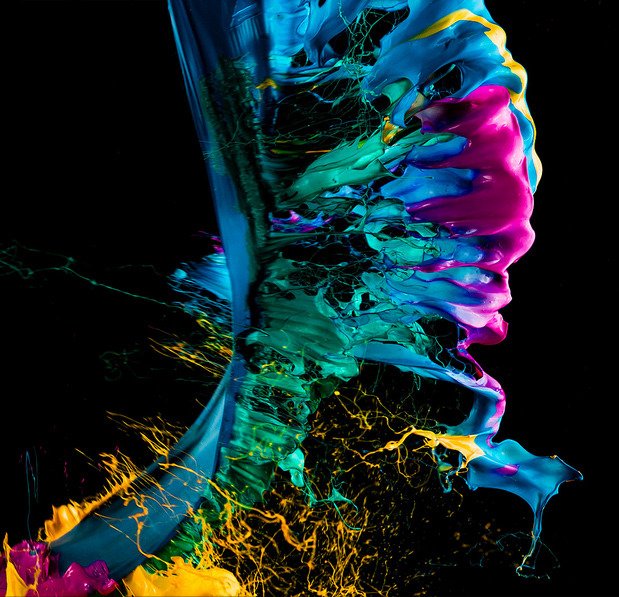
Today’s image is from artist Fabian Oefner’s “Liquid Jewel” series, featuring paint-filled balloons moments after rupture. Oefner has several series displaying physical forces as visual media, including the previously featured “Black Hole” and “Millefiori” photos. (Photo credit: F. Oefner)
Breaking Up a Ferrofluid
Ferrofluids are known for their fascinating behaviors when subjected to magnetic fields, especially for the distinctive peaks they can form. In this video, we see a very thin ferrofluid drop on a pre-wetted surface just as a uniform perpendicular magnetic field is applied. Immediately the droplet breaks up into tiny isolated peaks that migrate out to the circumference. The interface breaks down from center, where the drop height is largest, and moves outward. Simultaneously, the diffusion of ferrofluid from the circumferential droplets into the surrounding fluid lowers the magnetization of those droplets, making it more difficult for them to repel their neighbors. As a result, they drift outward more slowly and get caught by the faster-moving droplets from within. (Video credit: C. Chen)
Ink Drops
This super high resolution video (check the original on YouTube) by filmmaker Jacob Schwarz features slow motion diffusion of ink into water. The subtle differences in density between the ink and the water promote instabilities such as the Rayleigh-Taylor instability and its distinctive cascade of mushroom- or umbrella-like shapes. The mixing of two fluids seems like a simple concept, but the reality is beautiful, complex, and always fascinating. (Video credit: J. Schwarz; submitted by Rebecca S.)
Accidental Painting
Artist D. A. Siqueiros sometimes used a technique he referred to as “accidental painting” in his work, in which he would pour a layer of one color of paint and then pour a second color over it. The two colors would mix in striking patterns. Here researchers recreate the technique and analyze the fluid dynamics of it. Each paint has a slightly different density thanks to the pigments used to color them. When a denser paint is poured over a less dense one (as in the white on black in the video), this activates the Rayleigh-Taylor instability. The white paint will tend to sink down below the black paint due to gravity. At the same time, the spreading of the two paints also affects the shapes and patterns through mixing and diffusion. (Video credit: S. Zetina and R. Zenit)

“Surface Tension”


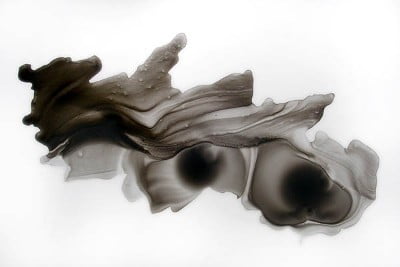

From a series called “Surface Tension,” these ink and water drawings by Marguerite French explore the effects of diffusion, surface tension, and evaporation. The forms left by the thin layer of liquids suggest other natural processes like erosion, weathering, and the rings inside trees. (Photo credits: Marguerite French)
“Ferienne”
In “Ferienne” artist Afiq Omar utilizes ferrofluids, magnetism, and vibration to create analog visual effects. Most of the dot and labyrinthine patterns result from the reaction of a ferrofluid submerged in a nonmagnetic fluid to an external magnetic field. Diffusion effects and surface tension instabilities are also visible in the way the darker ferrofluid breaks down in the carrier fluid. Also be sure to check out Omar’s previously featured fluid film “Ferroux”. (Video credit: Afiq Omar)
The Veil Nebula
There is no grander scale for the observation of fluid dynamics than that of the astronomical. Here Hubble astronomers discuss the formation of the Veil Nebula, a supernova remnant formed some 5,000-10,000 years ago. Wisps of gas and plasma remain, creating stunning astronomical landscapes that are the result of shock waves, turbulence, diffusion, and other processes familiar to us here on Earth. (Video credit: ESA/Hubble)