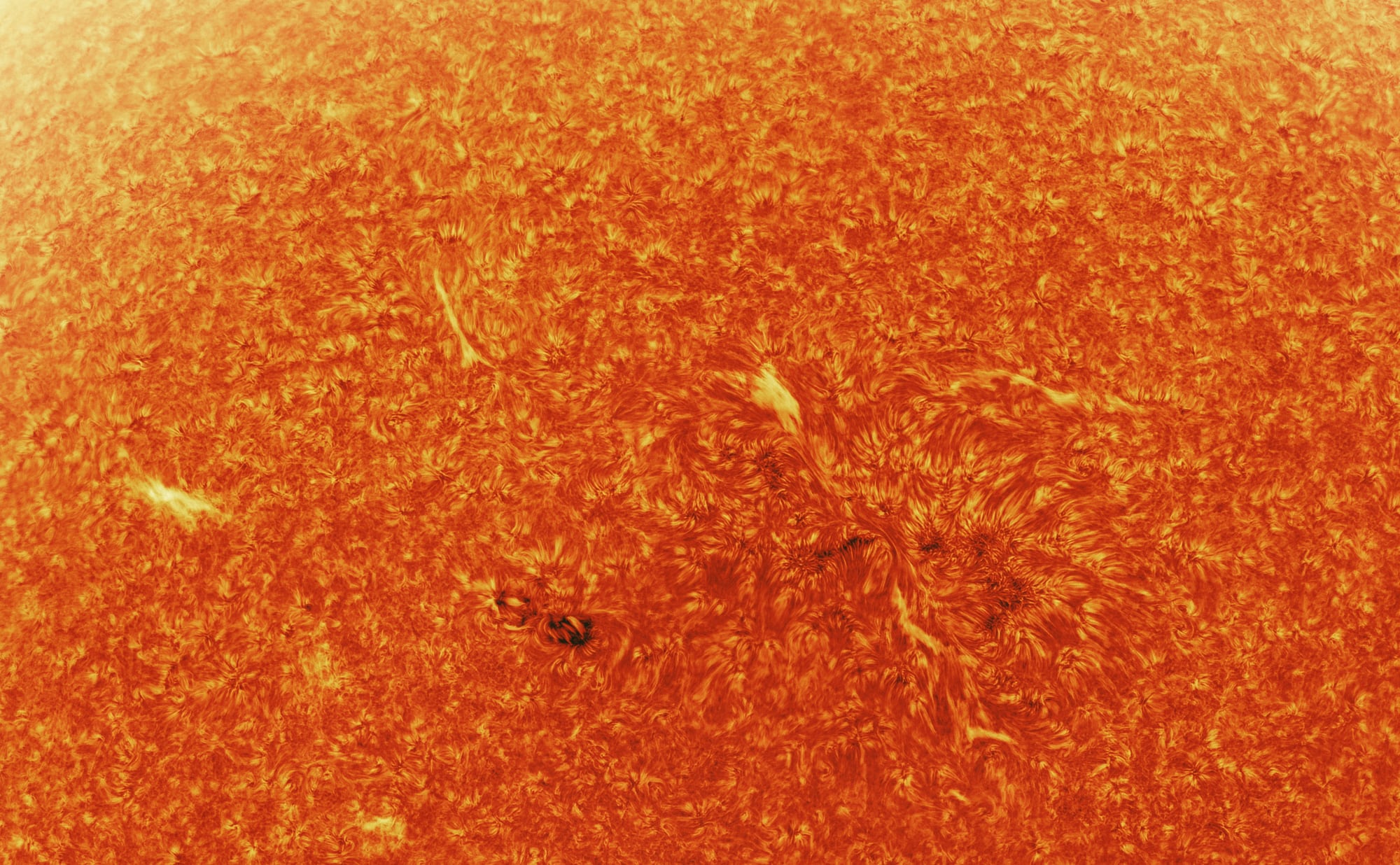
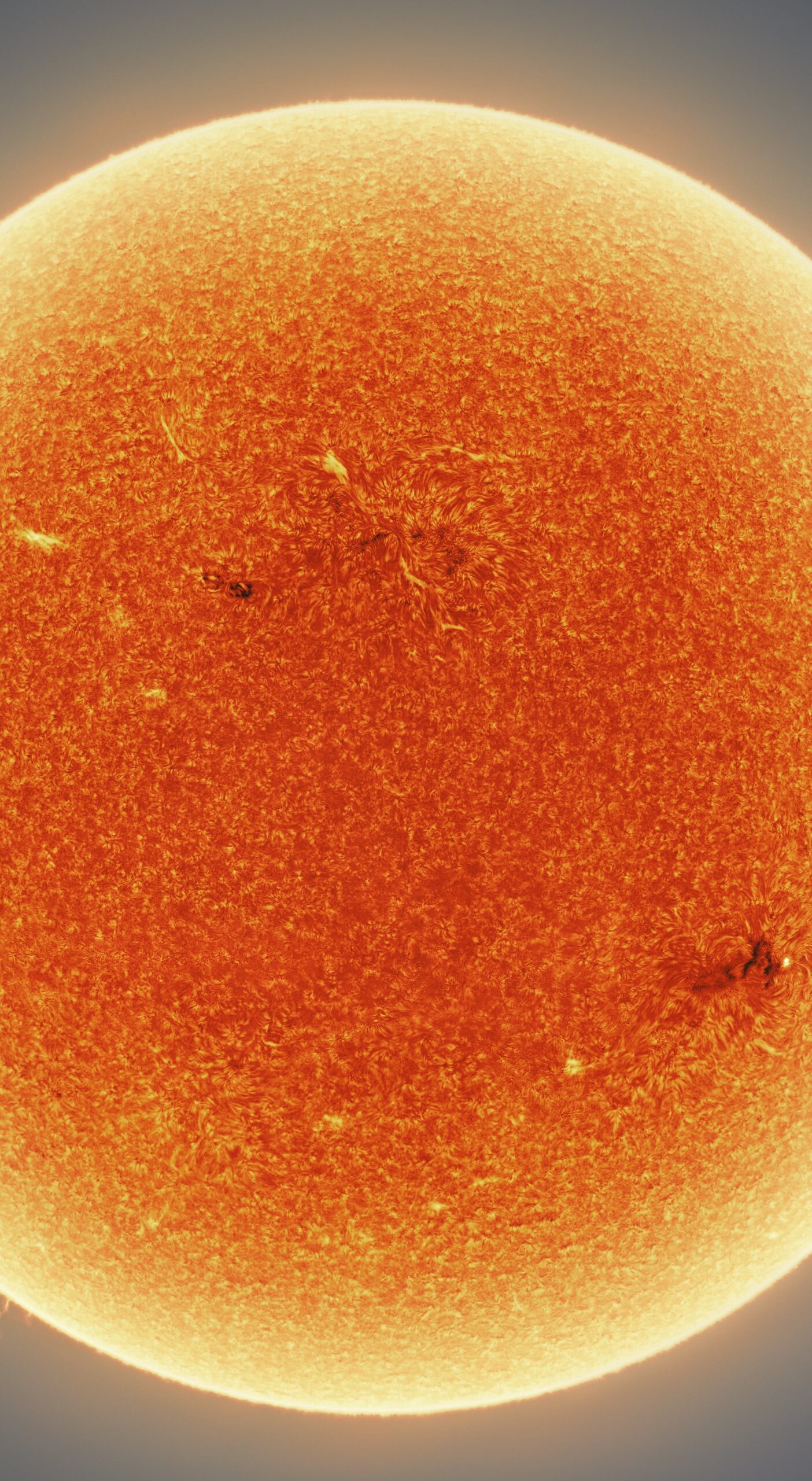
Photographer Andrew McCarthy constructed this spectacular 300-megapixel image of our sun by compositing thousands of individual images. Sunspots, coronal mass ejections, and feathery convective swirls abound. Check out his site for prints of this and other celestial images! (Image credit: A. McCarthy; via Colossal)
Since their invention in the 1960s, lava lamps have been a fascinating example of convection in action. In this video, we see how they’re manufactured, including blowing the glass bottles, shaping the metal holder, and filling the lamps. The key to the lamp’s performance is the delicate thermal balance of its two liquids. As the waxy liquid warms, it floats up the lamp until it reaches the top, cools, and sinks back down to begin again. The exact formulation of the liquids is a closely guarded secret! Want more lava lamps? Check out how a wall of them help secure Internet traffic. (Image and video credit: Business Insider)
Between November 2019 and March 2020 Betelgeuse, the red supergiant star in the constellation Orion’s left shoulder, experienced what’s being called the Great Dimming. Usually, the star is one of the ten brightest stars in the sky, often visible even in the suburban sprawl. But as of February 2020, it had dimmed by a factor of 2.5.
Observers speculated all sorts of causes, including the idea that this was a precursor to a supernova explosion. Instead, it’s a relatively normal occurrence for a star like Betelgeuse. The image above is from a numerical simulation of the star, and it shows approximately what it would look like to the human eye over a 7.5 year time span. As you can see, its brightness varies noticeably, and its surface seems almost to boil. This has to do with convection in the star. Compared to a star like our sun, Betelgeuse has fewer — and much larger — convection cells.
With a little more time and data, astronomers pinned down the exact source of Betelgeuse’s flickering during the Great Dimming. The year before the star belched an enormous bubble of gas into space. Then, when part of the star cooled in the aftermath, that gas condensed and formed a dust cloud which partially obscured the star. You can see an artist’s conception of the situation in the video below. (Image and research credit: B. Freytag; research credit: M. Montargès et al.; video credit: ESO/L. Calçada)
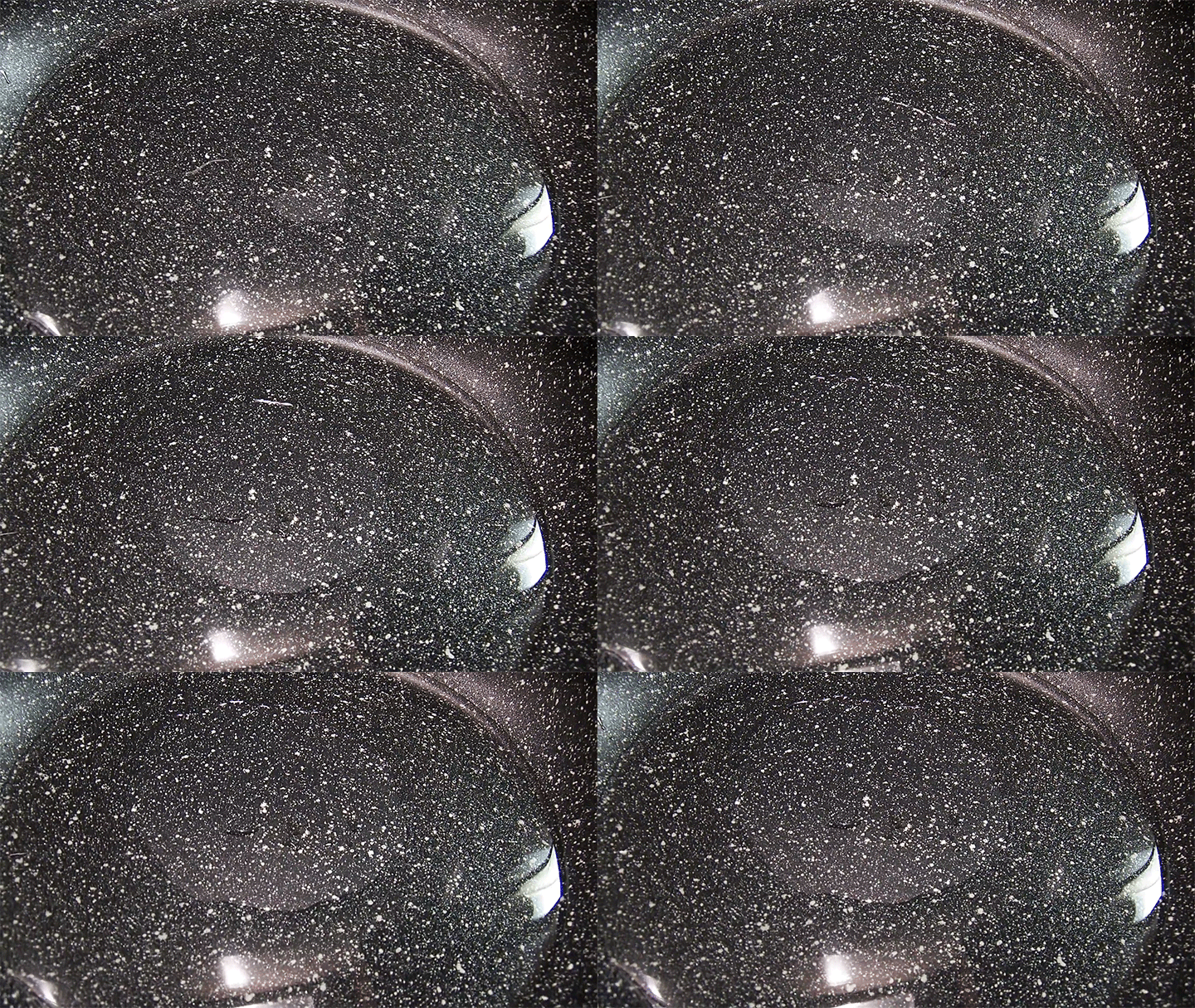
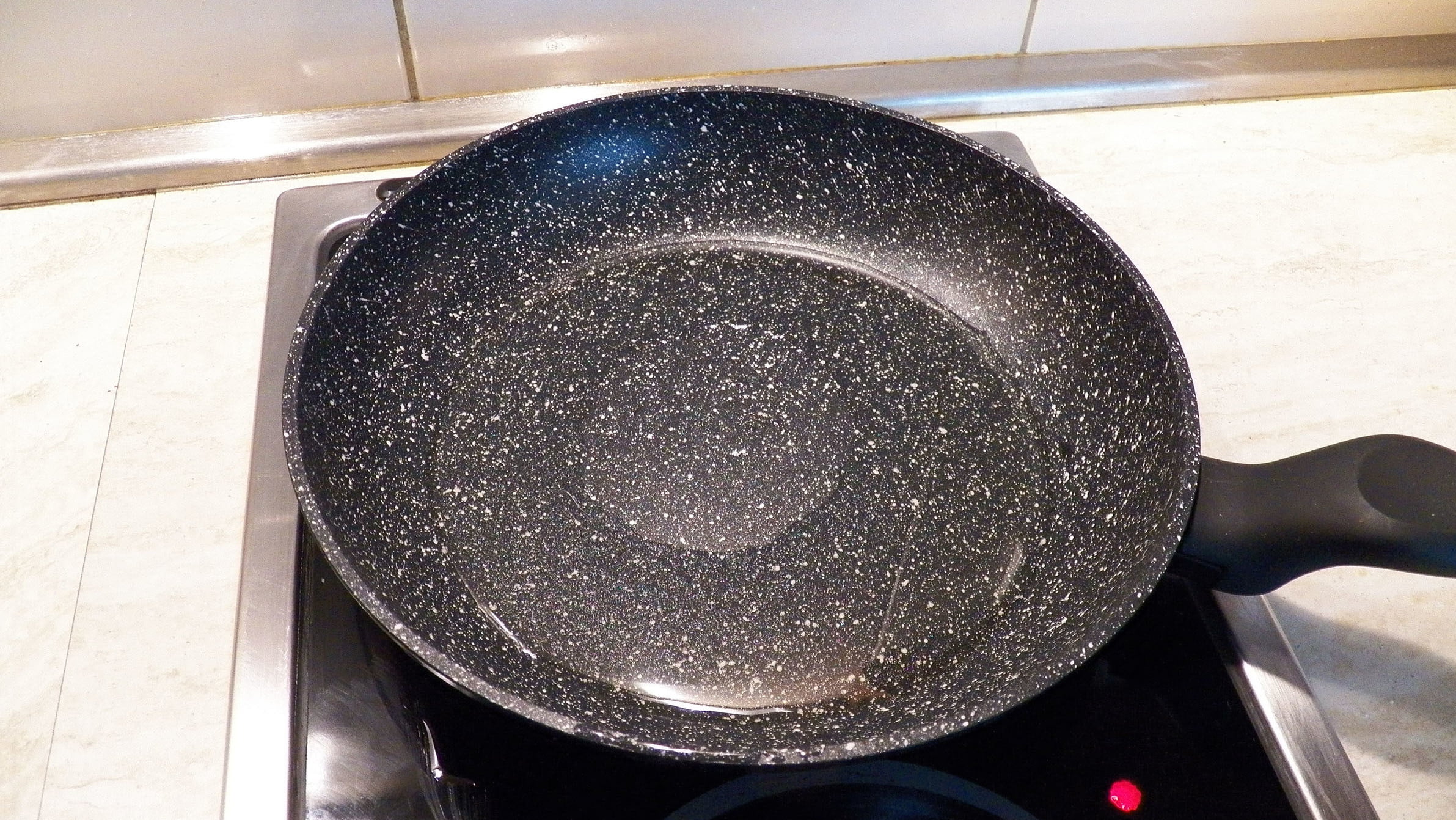
Whether you’re cooking with ceramic, Teflon, or a well-seasoned cast iron pan, it seems like food always wants to stick. It’s not your imagination: it’s fluid dynamics.
As the thin layer of oil in your pan heats up, it doesn’t heat evenly. The oil will be hotter near the center of the burner, which lowers the surface tension of the oil there. The relatively higher surface tension toward the outside of the pan then pulls the oil away from the hotter center, creating a hot dry spot where food can stick.
To avoid this fate, the authors recommend a thicker layer of oil, keeping the burner heat moderate, using a thicker bottomed pan (to better distribute heat), and stirring regularly. (Image and research credit: A. Fedorchenko and J. Hruby)
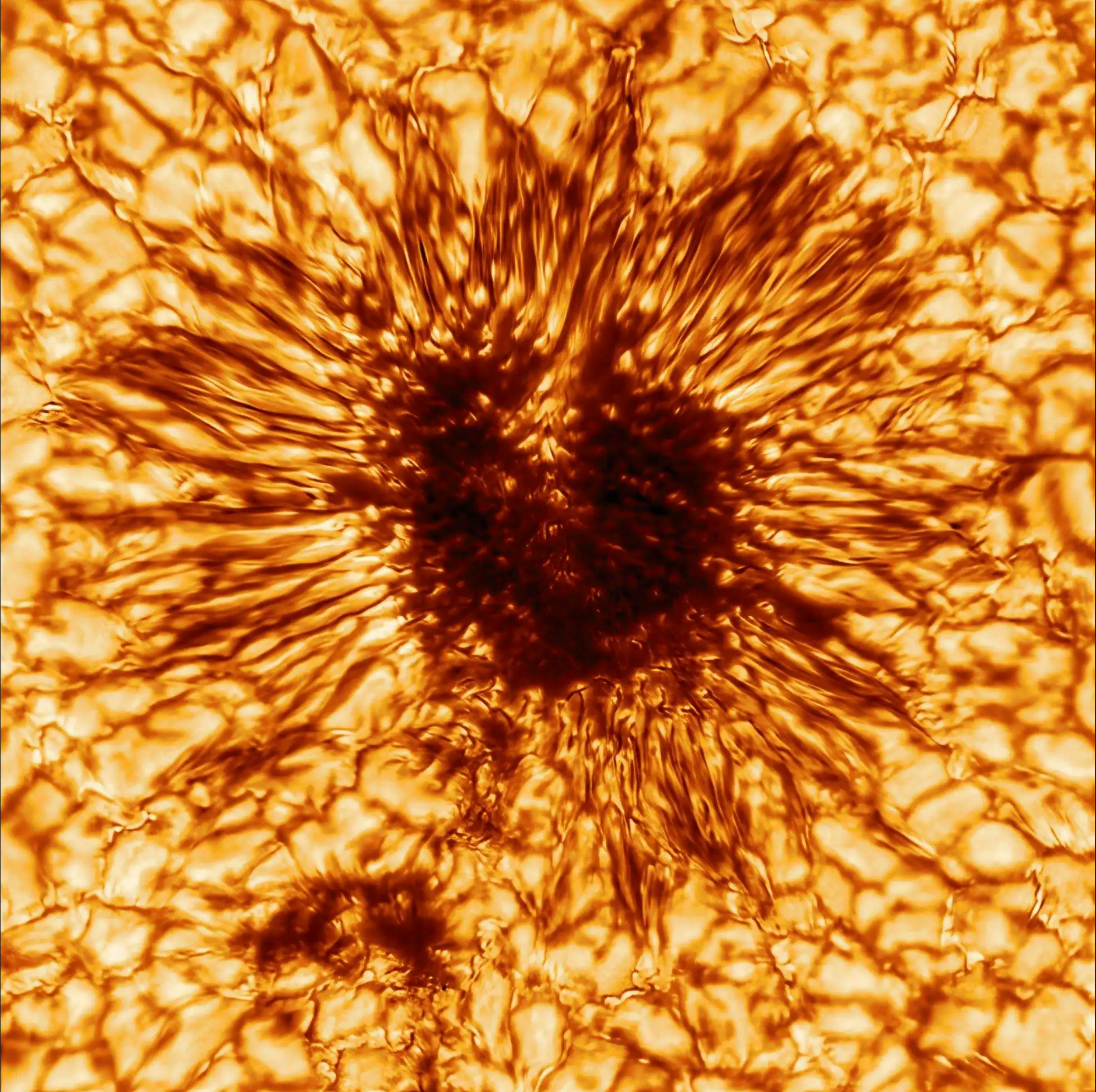
Though it may look like the Eye of Sauron, this image is actually one of our best-ever glimpses of a sunspot. Captured by the Daniel K. Inouye Solar Telescope, this sunspot is larger than our entire planet, yet we can see details as small as 20km across. The dark central region of the image is the sunspot’s umbra, surrounded by the lighter, streakier penumbra. Along the edges of the image, you see a more typical pattern of bright convection cells. Compared to the rest of the sun’s surface, sunspots are cool — about 1,000 K cooler — due to their intense magnetic field flux inhibiting convection. (Image credit: NSO/AURA/NSF; via Bad Astronomer; submitted by Kam-Yung Soh)
Usually, microbial colonies are grown on a solid substrate, but what happens when they grow on a liquid surface? That’s the question explored in this Gallery of Fluid Motion video featuring colonies of brewer’s yeast on various liquid substrates. When the viscosity of the liquid is low enough, the colony actually gets pulled apart (Image 2). This behavior is driven by a convective flow in the liquid caused by the colony’s own growth. As the yeast grow, they deplete nearby sugar, creating a density gradient that triggers convection beneath the colony. (Image, video, and research credit: S. Atis et al.)
Deep in Africa lies one of the world’s strangest lakes. Lake Kivu, over 450 meters in depth, is so stratified that its layers never mix. The upper portion of Lake Kivu consists of less-dense fresh water, which sits upon deeper layers of saltier water full of dissolved carbon dioxide and methane pumped into the lake by volcanic activity.
The lake’s lack of convection means that this deep water simply stays put for thousands of years as it collects gases that remain dissolved only thanks to the immense pressure of the water above. Should that deep water be disturbed — by an earthquake, climate changes, or simply oversaturation — the resulting eruption of carbon dioxide could be deadly for the millions of people living nearby. A similar eruption at smaller Lake Nyos in 1986 asphyxiated about 1,800 people.
Fortunately, Lake Kivu is well-monitored, so such an upwelling should not catch observers off-guard. Learn more about Lake Kivu’s oddities over at Knowable. (Image and research credit: D. Bouffard and A. Wüest, via Knowable Magazine; submitted by Kam-Yung Soh)
The stunning power and beauty of our atmosphere comes to life in Mike Olbinski’s latest short film, “Monsoon 6”. Over the years, I’ve probably watched dozens of Olbinski’s videos, yet he still captures sequences that make me exclaim aloud as I watch. In this one, some of my favorites are the microburst at 2:17 and the development of mammatus clouds at 3:20. How mammatus clouds form is still very much an area of active research; I don’t know if Olbinski’s footage sheds light on their formation, but it is supremely awesome to watch! (Image and video credit: M. Olbinski)
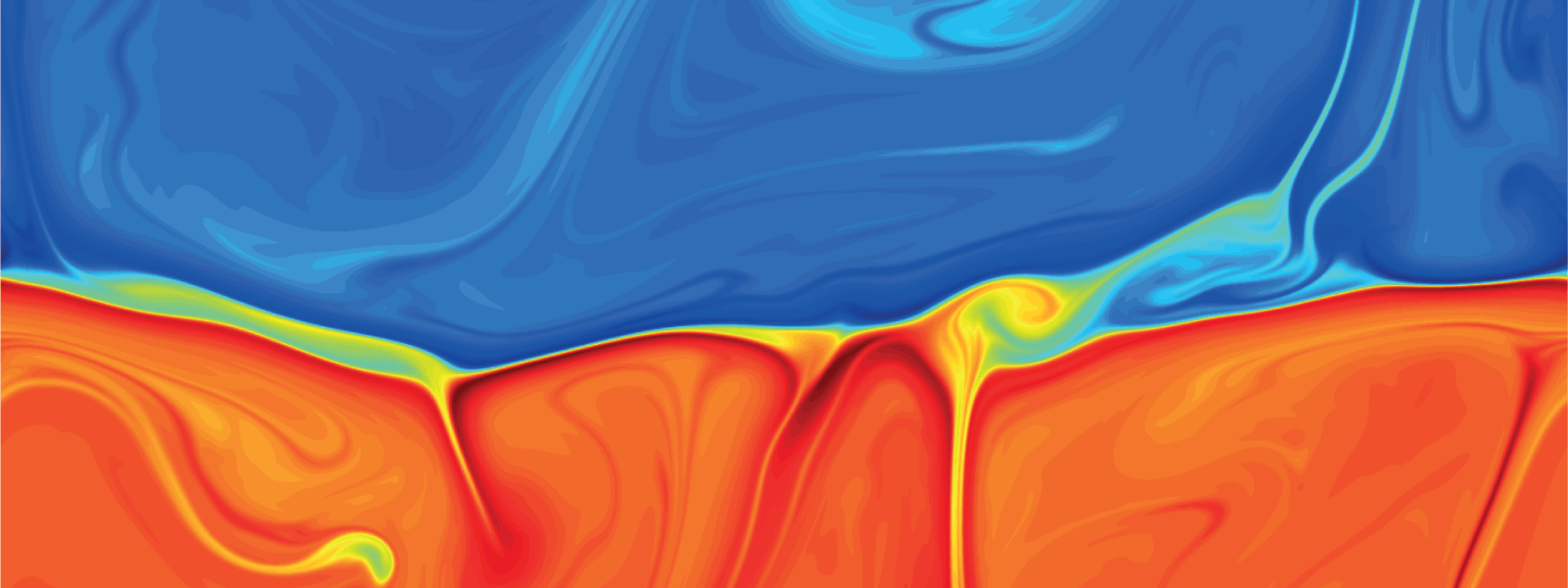
In nature, we often find turbulence mixed with convection, meaning that part of the flow is driven by temperature variation. Think thunderstorms, wildfires, or even the hot, desiccating winds of a desert. To better understand the physics of these phenomena, researchers simulated turbulence between two moving boundaries: one hot and one cold. This provides a combination of shear (from the opposing motion of the two boundaries) and convection (from the temperature-driven density differences).
Please note that, despite the visual similarity, these simulations are not showing fire. There’s no actual combustion or chemistry here. Instead, the meandering orange streaks you see are simply warmer areas of turbulent flow, just as the blue ones are cooler areas. The shape and number of streaks are important, though, because they help researchers understand similar structures that occur in our planet’s atmosphere — and which might, under the wrong circumstances, help drive wildfires and other convective flows. (Image, research, and video credit: A. Blass et al.)
Mike Olbinski’s “Vorticity 3” is a stunning view of storm chasing in the American West. I’ve learned after years in Colorado to always look up because dramatic skies are common here, as is seeing rain falling miles away. Olbinski’s film captures all of that grandeur and more, giving all of us a glimpse inside the incredible storms that mark the summer months in this region. You’ll see spinning supercell thunderstorms, bulbous mammatus clouds, towering cumulus clouds, and more. (Video and image credit: M. Olbinski)