Tag: condensation

  • Featured Video Play Icon

    “Fractal”

    Timelapses are a wonderful way to capture the power and majesty of storms like the supercell thunderstorms featured in Chad Cowan’s “Fractal”. The video contains snapshots from six years’ worth of storms over the US’s Great Plains. The highlights include some spectacular mammatus clouds (0:30) and excellent billowing cloud formation (1:27) with turbulence every bit as towering as that of a volcanic plume. June is one of the best months for amazing storms in the Great Plains, largely thanks to the atmospheric mixing that occurs over the Rocky Mountains. If you have the opportunity to witness these amazing natural displays, enjoy it, but be safe! (Video credit: C. Cowan; image via Colossal)

  • Watching Radiation

    Watching Radiation

    We’re used to radiation being invisible. With a Geiger counter, it gets turned into audible clicks. What you see above, though, is radiation’s effects made visible in a cloud chamber. In the center hangs a chunk of radioactive uranium, spitting out alpha and beta particles. The chamber also has a reservoir of alcohol and a floor cooled to -40 degrees Celsius. This generates a supersaturated cloud of alcohol vapor. When the uranium spits out a particle, it zips through the vapor, colliding with atoms and ionizing them. Those now-charged ions serve as nuclei for the vapor, which condenses into droplets that reveal the path of the particle. The characteristics of the trails are distinct to the type of decay particle that created them. In fact, both the positron and muon were first discovered in cloud chambers! (Image credit: Cloudylabs, source)

  • Tendrils of Fog

    Tendrils of Fog

    Fog snakes its way from the ocean into the Strait of Juan de Fuca in this animation constructed from satellite imagery. The strait lies between Vancouver Island and the Olympic Peninsula in the Pacific Northwest. Fogs like this form when skies are clearer and heat from the surface is able to escape upward. The surface air then cools and condenses into fog. Steady winds pushed fog into the strait over the course of about 9 hours. There’s a remarkable level of detail in the satellite images, taken by the new GOES-16 satellite that launched in late 2016. Notice the ragged wave front as the fog stretches eastward and the shock-wave-like lines behind it in the strait. Both result from interactions between the fog cloud and the shape of the land masses it’s encountered. (Image credit: NASA Earth Observatory)

  • Happy Valentine’s Day

    Happy Valentine’s Day

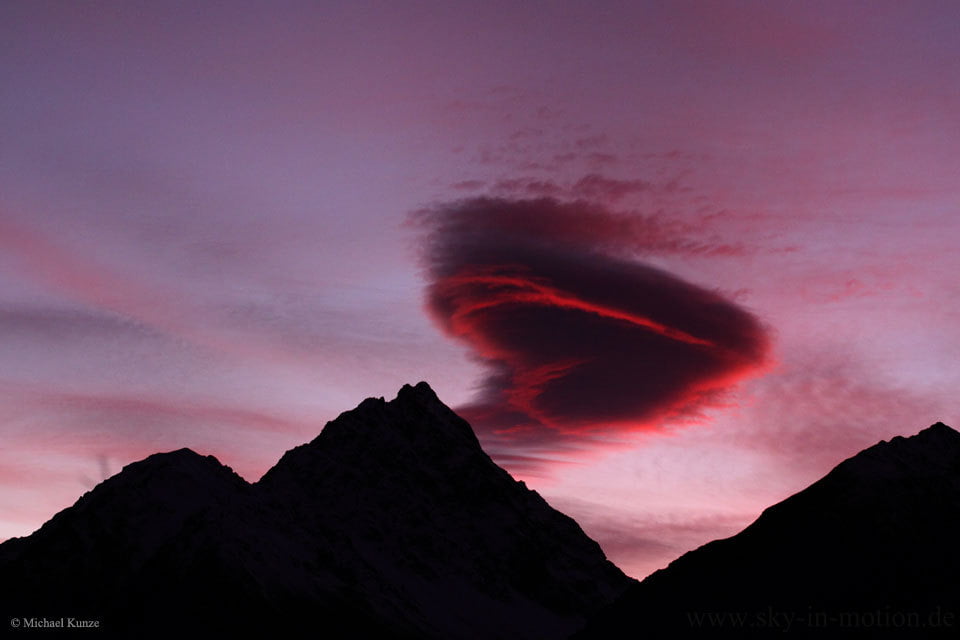
    This heart-shaped atmospheric apparition is a lenticular cloud captured over the mountains of New Zealand. As you can see in the companion video, the cloud itself remains stationary over the mountain. This is a key feature of lenticular clouds, which form when air flowing over/around an obstacle drops below the dew point. This causes moisture in the air to condense for a time before it descends and warms once more. Thus, even though air is continuously flowing past, what we see is a stationary, lens-shaped cloud. Happy Valentine’s Day from FYFD!  (Image credit: M. Kunze, video; via APOD)

  • Featured Video Play Icon

    “Pulse”

    Photographer Mike Olbinski returns with another incredible storm-chasing timelapse video, this time all in black-and-white. To me, that choice helps “Pulse” emphasize the ominous majesty of these supercells and tornadoes by highlighting the textures that make up the clouds. Watching clouds in timelapse, they seem to materialize from nowhere as moisture drawn up from the land cools and condenses. Sped up, suddenly the convective rotation and the roiling turbulence inside clouds is perfectly clear. I especially love the sequence beginning at 2:25, where a distant black line slowly transforms into an incredible landscape marked with successive waves of rolling, turbulent clouds. Watch this one on a large screen at a high resolution, if you can. You won’t regret it! (Video credit: M. Olbinski)

  • Crow Instability

    Crow Instability

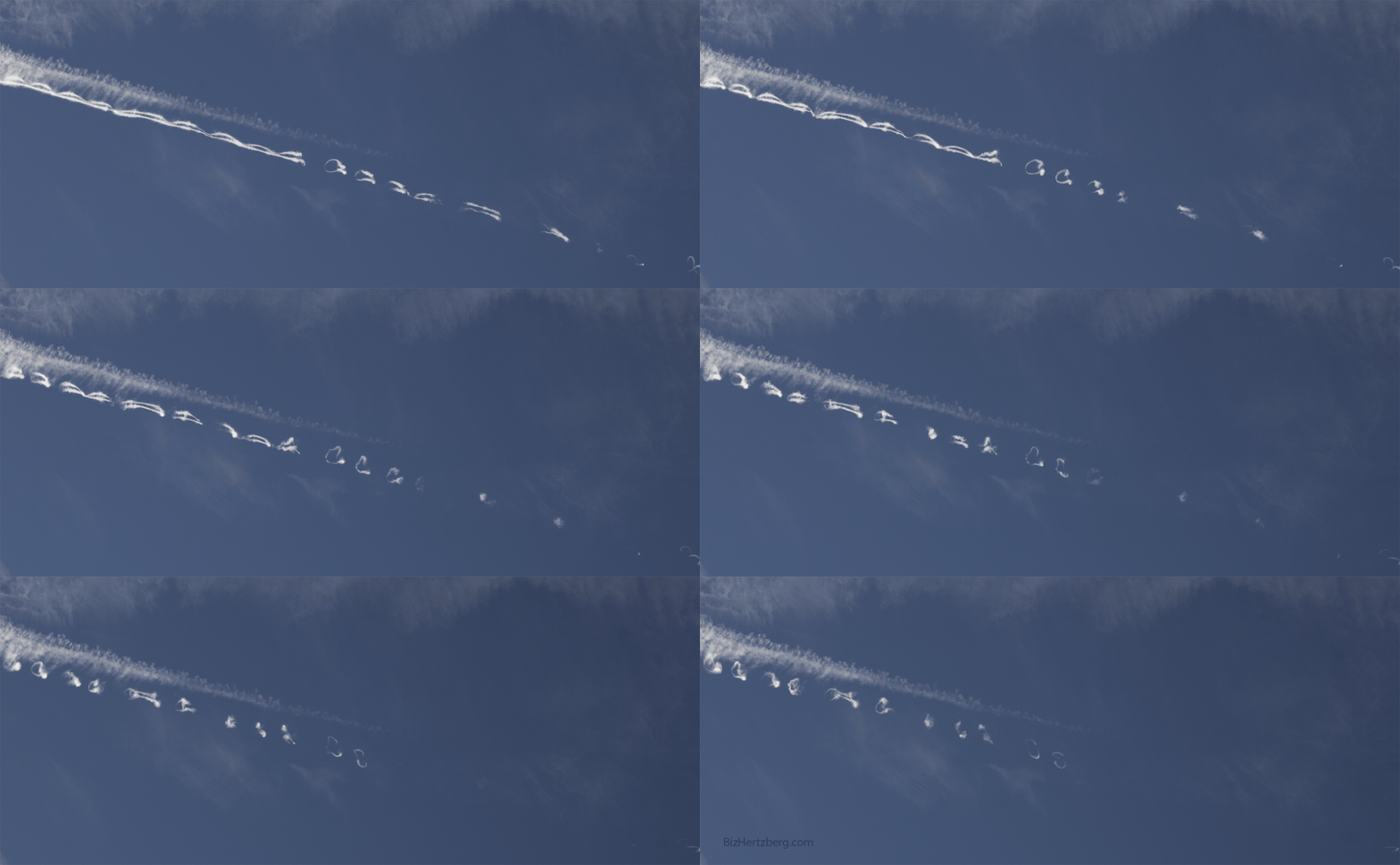
    Watching airplane contrails overhead, you may have noticed them transform into a daisy chain of distorted rings. This is an effect known as the Crow instability. The contrails themselves are the airplane’s wingtip vortices, made visible by water vapor condensed out of the engine exhaust. These two initially parallel vortex lines spin in opposite directions. A slight crosswind can disturb the initially straight lines, causing them to become wavy. This waviness increases over time until the vortex lines almost touch. Then the vortices pinch off and reconnect into a line of vortex rings that slowly dissipate. Be sure to check out the full-resolution version of this animation for maximum effect. (Image credit: J. Hertzberg, source)

  • A Molecular View of Boiling

    A Molecular View of Boiling

    All matter is made up of molecules. But most of the time we treat fluids as materials with given properties – like density, viscosity, and surface tension – without worrying about the individual molecules responsible for those material characteristics. Now that we have much more powerful computers, though, we can begin to simulate fluid behavior in terms of molecules.

    The animations above show some examples of this. In the top animation, we see a gas condensing into a liquid. As the temperature decreases, molecules start clumping together, and eventually settle into a droplet on the solid surface. The lower animation shows the opposite situation – boiling – in which bubbles of vapor nucleate next to the solid surface and grow as more liquid changes phase. To see more examples, including droplets pinching off, check out the full video.   (Image credit: E. Smith et al., source; submitted by O. Matar)

  • Drawing Up Dew

    Drawing Up Dew

    Desert plants have evolved to efficiently collect and capture whatever water they can. Each leaf of the moss Syntrichia caninervis ends in a hairlike fiber called an awn (seen in white in the top image). Tiny as they are, awns are vital to the moss’s water collection, correlating to more than 20% of their dew collection. Extremely tiny grooves on the surface of the awn provide nucleation sites where dew condensed from fog collects. Once a droplet forms on the awn, it grows larger as more fog condenses (middle image). When the droplet grows large enough, the conical shape of the awn will cause surface tension to draw the droplets along the awn and toward the leaf (bottom image).

    (Credits: Syntrichia caninervis moss image – M. Lüth; videos and research – Z. Pan et al., Supplementary Videos 3 and 4; h/t to T. Truscott)

  • Foggy Flows

    Foggy Flows

    The transparency of air makes it easy to overlook its fluid nature. In this National Geographic Travel Photographer of the Year entry, photographer Thierry Bornier captures the early morning view from China’s Yellow Mountain. Foggy clouds flow around and over nearby mountain peaks, like water flowing over rocks in a stream. To see other, similar effects, check out these timelapse videos of fog in the Grand Canyon and clouds around San Francisco. (Image credit: T. Bornier; via Colossal)

  • Roll Clouds

    Roll Clouds

    The roll cloud, or Morning Glory cloud, is a rare phenomenon that looks rather like a horizontal tornado. In reality, it is part of a soliton wave traveling through the atmosphere. At its leading edge, moist air is forced upward, causing water vapor to condense, and, at the trailing edge, air moves downward, dissipating the cloud. These clouds are most frequently observed in Australia near the Gulf of Carpentaria, where local geography and sea breezes promote their growth during springtime. The clouds do appear elsewhere on occasion; the photos above show rolls clouds in Calgary, Alberta and coastal Uruguay, respectively.  (Image credits: G. E. Nyland, D. M. Eberl; see also: Z. Ouazzani)