The scaled wormsnail isn’t much for travel. It lives its whole life cemented to a rock in the tidal lands. And when you can’t go out for food, you have to wait for the food to come to you. During high tides, the snail lets out tendrils of mucus that capture bits of kelp, plankton, and whatever else the water brings. The snails haul their catch directly into their mouths, relying on the mucus’s impressive viscoelasticity to withstand the journey. (Video and image credit: Deep Look)
The Zambezi River winds through eastern Africa, providing much-needed water to plants and animals there. But during the dry season, when rain and river water are scarce, most trees go bare. The apple ring acacia is the exception. These towering trees rely on their taproot, which delves 30 meters or more into the ground, to deliver an ongoing supply of water. Flush with water, the trees remain green, providing vital food and shade to animals during the harshest season of the year. (Image and video credit: BBC Earth)
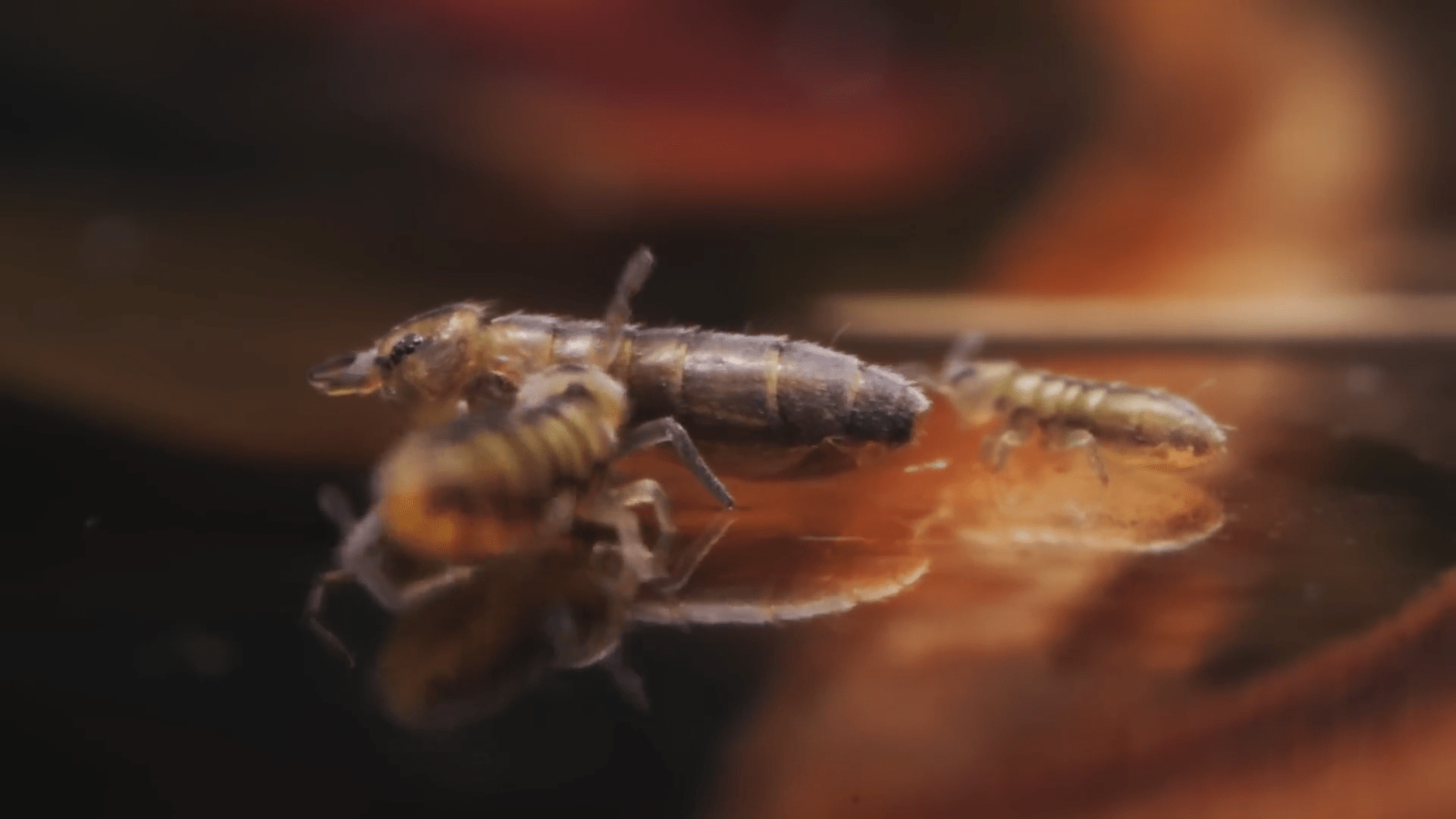
Springtails are tiny hexapods found living on the air-water interface. Like other creatures living at the interface, they sometimes need to make a quick escape. For the springtail, that means a high-flying leap, driven by their fork-shaped furcula. The springtail soars into the air, where it contorts its body and uses aerodynamic forces — along with a droplet it carries on its belly — to orient itself. For landing, it uses that droplet as a sticky anchor that helps it adhere to water (or ground) instead of bouncing. Nailing that landing sets it up to make another daring escape as quickly as needed. (Video and image credit: Deep Look; research credit: V. Ortega-Jimenez et al.)
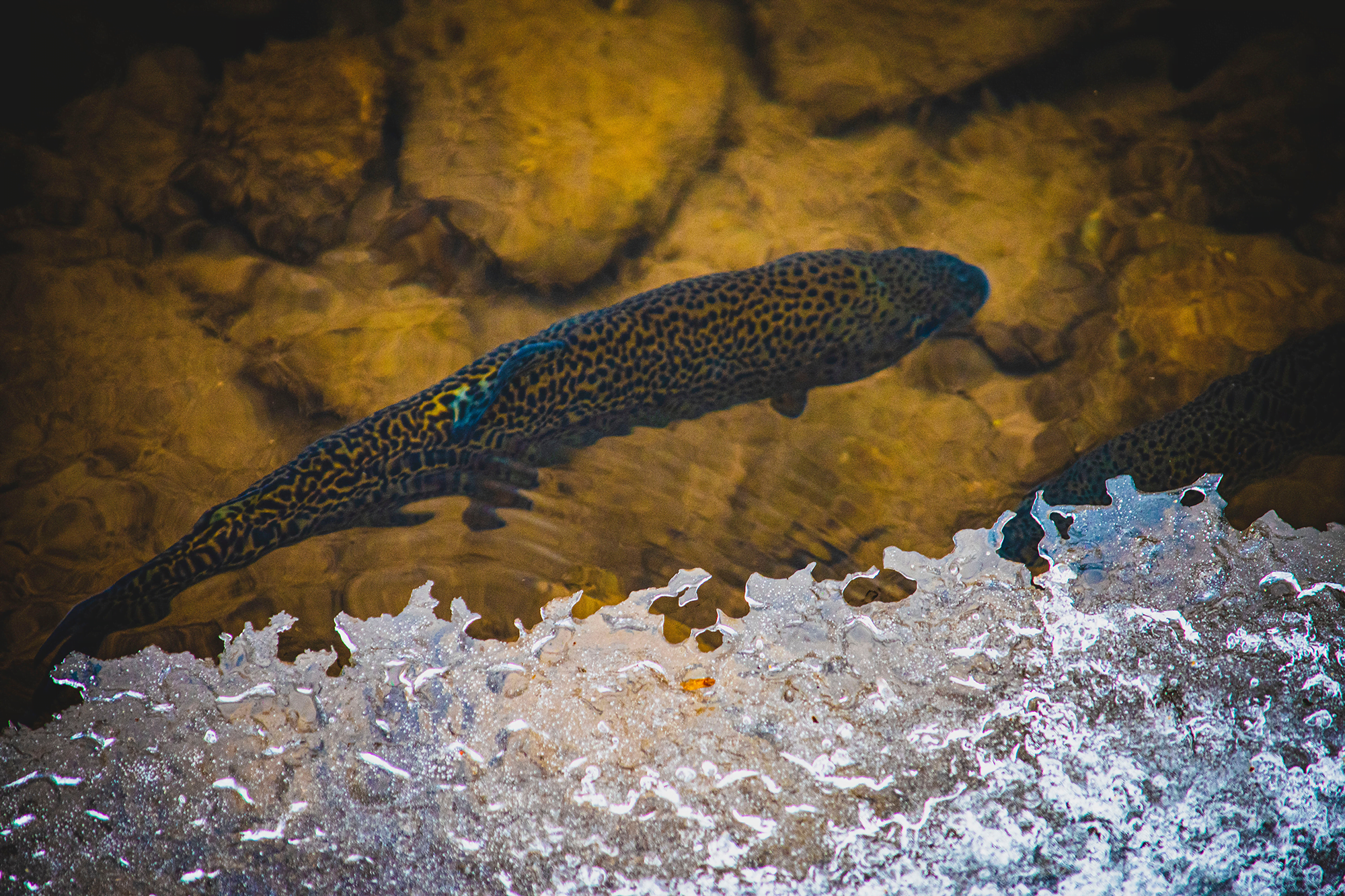
Researchers studying how fishswim have long focused on their tail fins and the flows created there. But a fish’s other fins have important effects, too, as seen in this recent study. Researchers built a CFD simulation based on observations of a swimming rainbow trout, focusing on the flow from its back and tail fins. They found that the vortex created by the back fin stabilizes and strengthens the one generated by the tail. It also played a role in reducing drag on the fish by maintaining the pressure difference across the body. When they tried changing the size and geometry of the fins, the fish’s efficiency suffered, indicating that evolution has already optimized the trout’s fins for swimming efficiency. (Image credits: top – J. Sailer, simulation – J. Guo et al.; research credit: J. Guo et al.; via APS Physics)
Visualization of flow around a digitized rainbow trout.
Quick, agile, and fierce, the hummingbird is an amazing creature. Small for a bird but much larger than an insect, it’s able to hover in place and eat nectar directly from flowers. Many species use a forked tongue with curled edges that help it capture the sweet, viscous fluid. Even their distinctive sounds are fluid-influenced, coming from their wingstrokes and the fluttering of tail and wing feathers. (Image and video credit: BBC Earth)
Blow across the top of a glass bottle, and you’ll get a whistle-like sound. Put some liquid in there and the pitch of the sound changes. Our vocal tracts are basically the same thing: a tube with a hole at the end. But as Joe Hanson shows in this Be Smart video, our ability to change the shape and resonance of our vocal tract by moving our tongues and lips enables us to make a wide range of vowel sounds. Enjoy this dive into the world of linguistic physics! (Video and image credit: Be Smart)
Snakes’ forked tongues have long inspired fear, but, in reality, they are part of a highly-effective sensory system. When snakes flick out their tongues, they waggle them up and down about 15 times a second. That motion draws air inward toward the tongue (Image 2), allowing scent molecules to stick to the saliva on either side of the tongue. Once those molecules are gathered, the snake pulls its tongue back into its mouth, where it settles into two grooves (Image 3). Each one has its own path to the snake’s olfactory organs, giving the snake independent spots to evaluate the left and right forks. That means the snake knows which side has a stronger scent and is better able to track its prey. (Video and image credit: Deep Look)
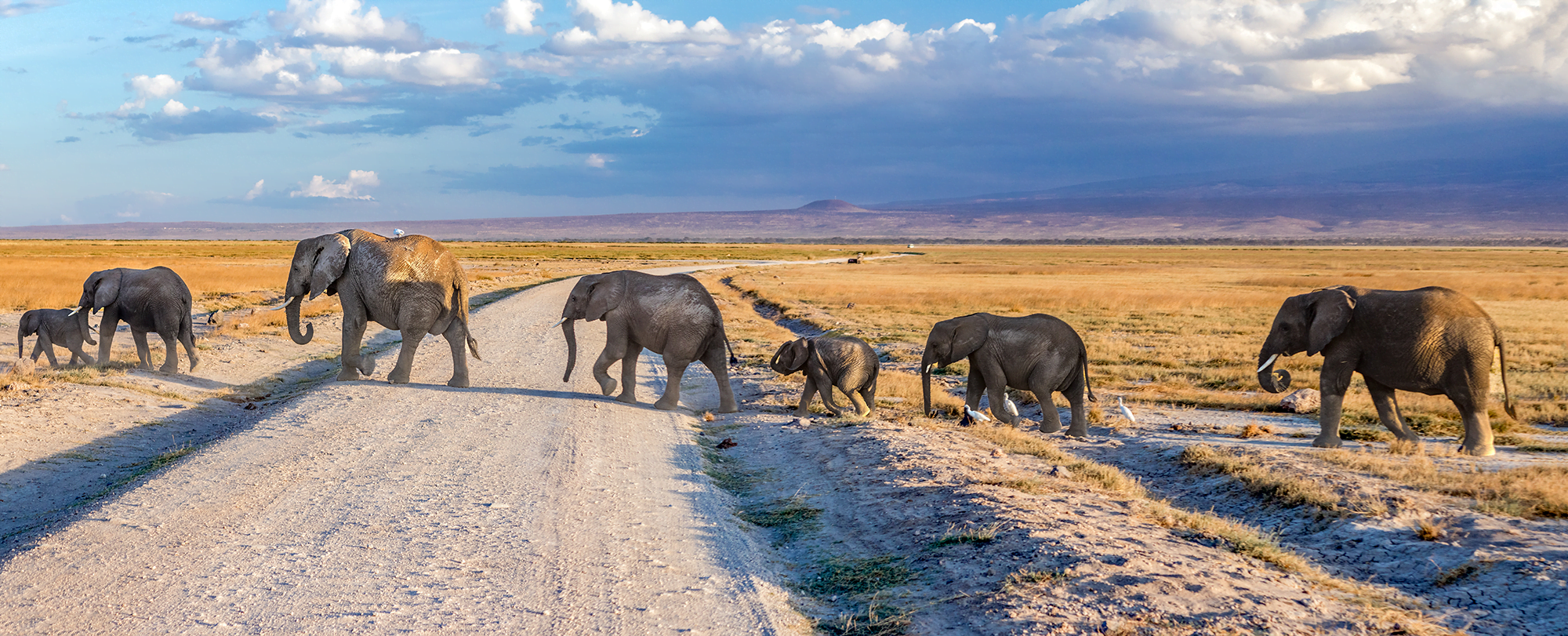
As climate change and human development continue to encroach on animals’ territories, mass migrations will become more and more common. But animals aren’t all equally able to travel long distances at speed. In general, larger animals are faster than smaller ones. But a new study shows that there’s another important factor in an animal’s top speed: heat dissipation.
By studying the characteristics of over 500 animals that walk, fly, and swim, the team found that animals were limited in their speed by how well they could dissipate heat. This makes sense, even from a human perspective; we may be able to run long distances, but once we’re too hot, we have to slow down. The same principle holds for animals, and the bigger the animal, the longer it takes to dissipate heat. As a result, the team found that the fastest animals over long distances all have intermediate body mass. At their size, they can balance the mechanical ability to produce speed with the thermodynamic requirement to dissipate heat. (Image credit: N. and Z. Scott; research credit: A. Dyer et al.; via APS Physics)
Swimming often results in water getting stuck in our ear canals. The narrow space, combined with the waxy surface, is excellent at trapping small amounts of water. If left in place, that excess fluid distorts hearing, can cause pain, and may eventually lead to an ear infection. So most people’s common response is to tilt their head sideways and shake it or jump to knock the water out. This recent study looks at just how much acceleration is needed to dislodge that water.
An acceleration of 7.8g isn’t enough to remove the water from this artificial ear canal.
The team built an artificial ear based on the shape of a human’s ear canal and observed how much acceleration was needed to knock the water out. The answer? Quite a bit. As seen above, nearly 8g of acceleration was enough to distort the interface of the water in the ear canal, but it didn’t move the water out.
At higher accelerations — above 20 times the acceleration due to gravity – the air-water interface distorts enough to get the water to flow. But accelerations that large are enough to potentially damage brain tissues.
At over 24g, the acceleration is enough to dislodge the water from this artificial ear canal. But accelerations this high can cause brain damage.
The problem is worse for children and babies, whose tiny ear canals necessitate even larger accelerations. For them, shaking hard enough to remove water could cause real damage. Instead, a couple drops of vinegar or alcohol in the ear will lower the surface tension and make the fluid easier to remove. (Image credit: top – J. Flavia, others – S. Kim et al.; research credit: S. Kim et al.; submitted by Sunny J.)
Zooplankton are tiny creatures found throughout Earth’s oceans. During the daytime, they linger in the twilight depths, where they are harder for predators to spot. But once the sun sets, zooplankton migrate hundreds of meters upward to reach the abundant food near the surface. When sunrise comes, they migrate back downward. Given their size, this feat is astounding; equivalent to a human running two 10-kilometer races a day at Olympic marathon speeds. And, despite their tiny size, these motions leave a mark; researchers have shown that the collective action of all these tiny swimmers is large-scale turbulence with serious mixing potential. (Video and image credit: Be Smart)