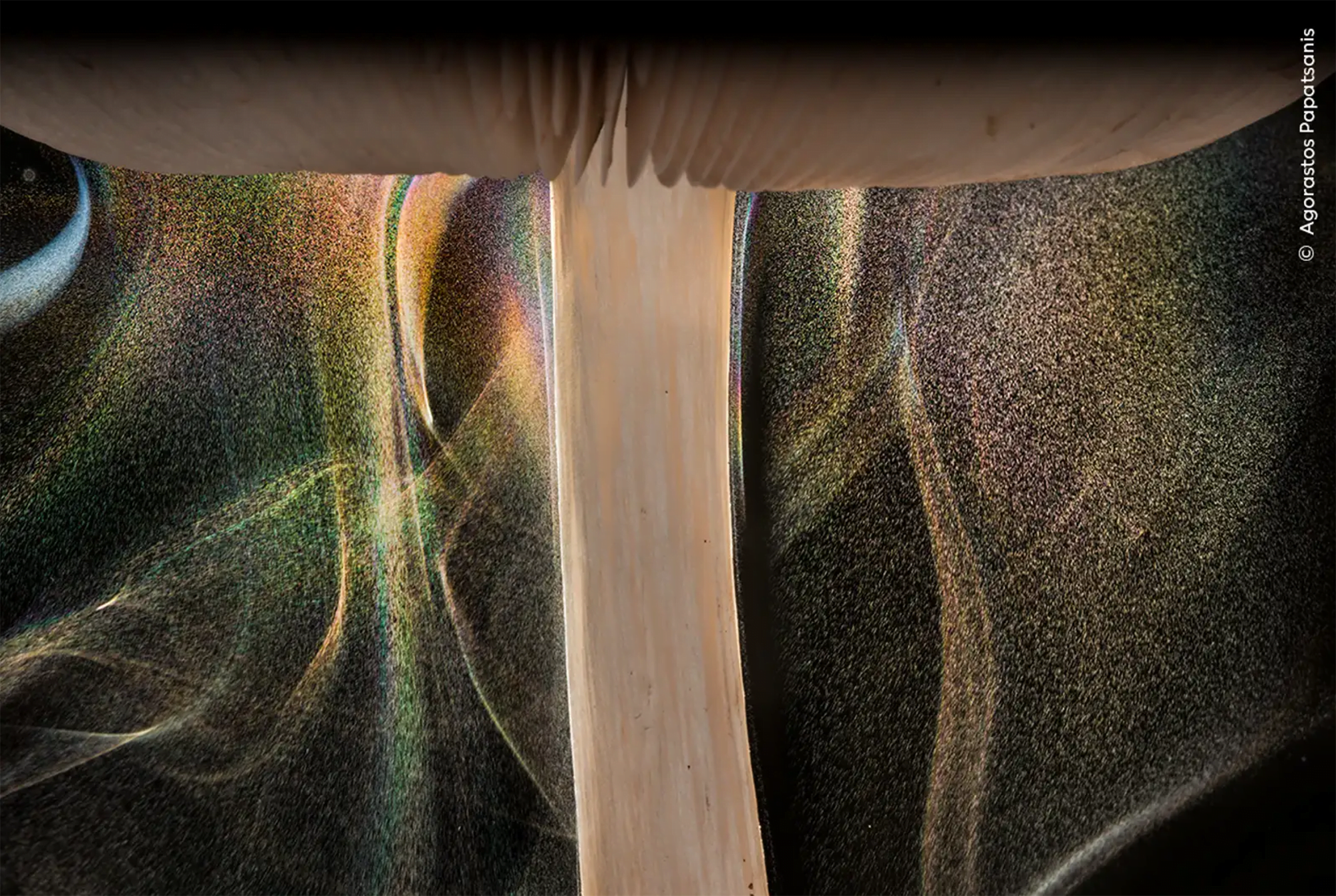
Mushrooms are the fruiting bodies of much bigger, largely underground fungi. Being fruit, mushrooms have the job of spreading spores so that the fungus can reproduce. Some mushrooms rely on the wind; others create their own wind. Still others use vortex rings to carry their spores higher. Who knew such fascinating and beautiful physics lies along the forest floor? (Image credit: top – A. Papatsanis, bottom – I. Potyó; via Wildlife POTY)
Mono Lake, three times saltier than the ocean, is an extreme environment by any measure. But for the alkali fly, it’s home. This extremophile insect dives into the lake, protected by a bubble sheath, to eat and lay eggs. The fly’s wings and body are covered in tiny, waxed hairs that repel water. That traps a bubble of air around the insect, allowing it to breathe. Fresh oxygen can diffuse into the bubble from the water, replenishing the supply. (Image and video credit: Deep Look)
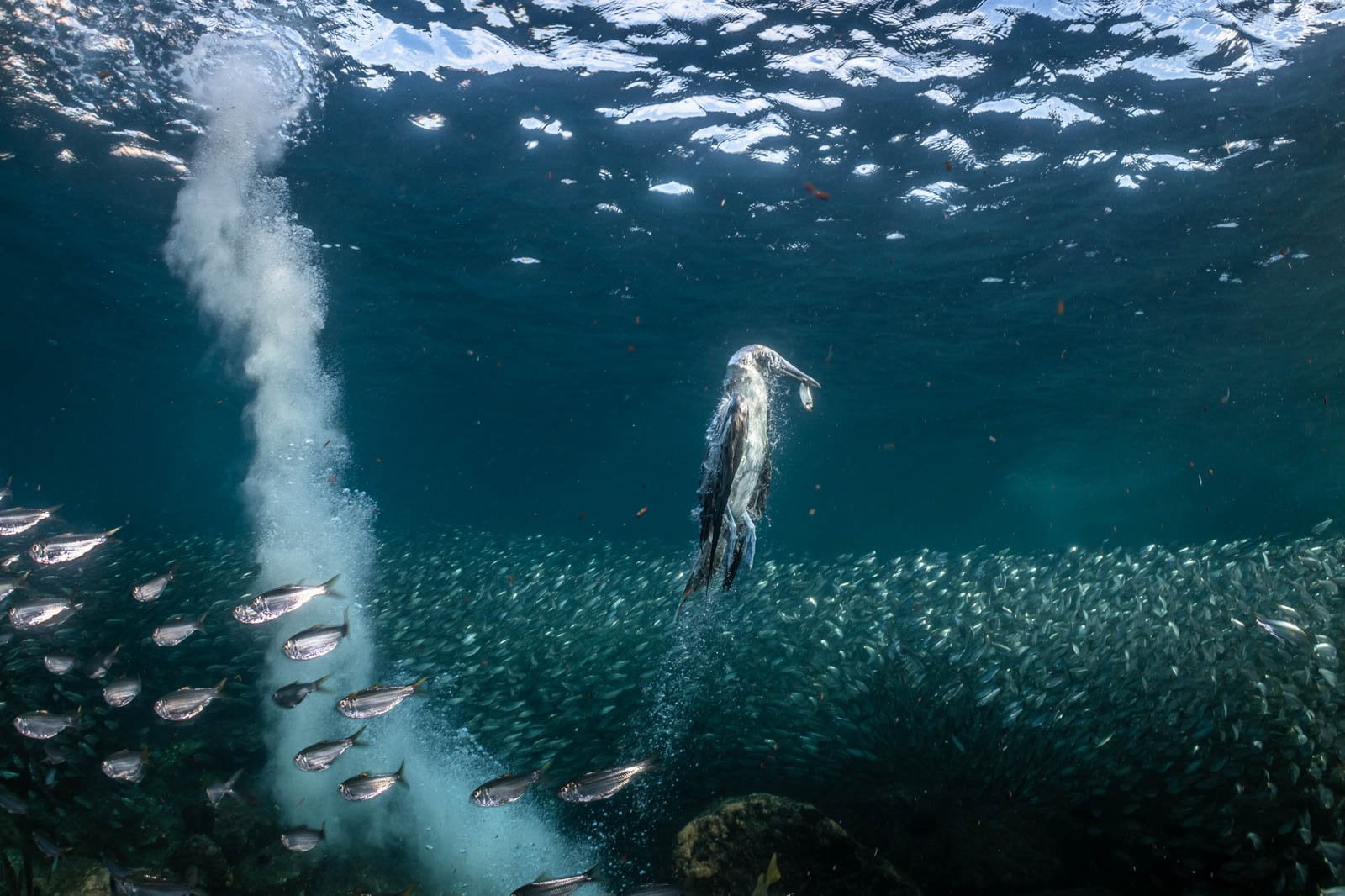
Blue-footed boobies, like many other seabirds, climb to a particular altitude before folding their wings and diving head-first into the water. This acrobatic feat balances the bird’s force of impact and the depth it can reach to ensnare fish swimming there. It’s an incredible process to watch, a fascinating one to study, and, here, a beautiful glimpse of the natural world from a perspective we don’t typically see. (Image credit: H. Spiers, Bird POTY; via Colossal)
Catch a butterfly, and you’ll notice a dust-like residue left behind on your fingers. These are tiny scales from the butterfly’s wing. Under a microscope, those scales overlap like shingles all over the wing. Their downstream edges tilt upward, leaving narrow gaps between one scale and the next. Experiments show that, although butterflies can fly without their scales, these tiny features make a big difference in their efficiency.
At the microscale, a butterfly’s scales overlap like roof shingles but are tilted upward, leaving cavities in the downstream direction.
When air flows over the scales, tiny vortices form in the gaps between. These laminar vortices act like roller bearings, helping the flow overhead move along with less friction and, thus, less drag. Compared to a smooth surface, the scales reduce skin friction on the wing by 26-45%. (Image credit: butterfly – E. Minuskin, scales – N. Slegers et al., experiment – S. Gautam; research credit: N. Slegers et al. and S. Gautam; via Physics Today)
This lab-scale experiment shows how air moves over butterfly scales. As flow moves from left to right, small persistent vortices form in the gaps between scales. These act like roller bearings that reduce the skin friction from air moving past.
The scaled wormsnail isn’t much for travel. It lives its whole life cemented to a rock in the tidal lands. And when you can’t go out for food, you have to wait for the food to come to you. During high tides, the snail lets out tendrils of mucus that capture bits of kelp, plankton, and whatever else the water brings. The snails haul their catch directly into their mouths, relying on the mucus’s impressive viscoelasticity to withstand the journey. (Video and image credit: Deep Look)
The Zambezi River winds through eastern Africa, providing much-needed water to plants and animals there. But during the dry season, when rain and river water are scarce, most trees go bare. The apple ring acacia is the exception. These towering trees rely on their taproot, which delves 30 meters or more into the ground, to deliver an ongoing supply of water. Flush with water, the trees remain green, providing vital food and shade to animals during the harshest season of the year. (Image and video credit: BBC Earth)
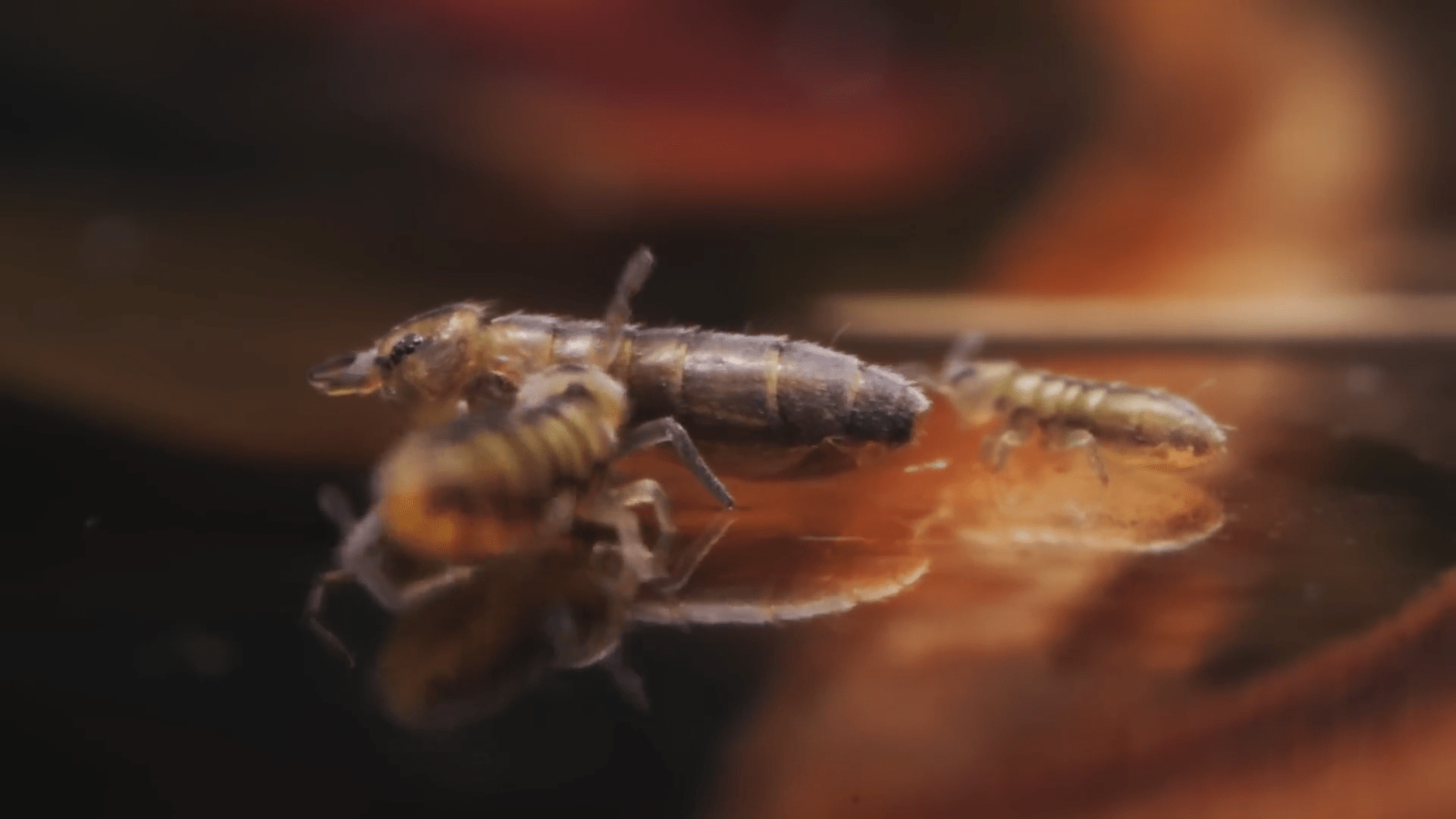
Springtails are tiny hexapods found living on the air-water interface. Like other creatures living at the interface, they sometimes need to make a quick escape. For the springtail, that means a high-flying leap, driven by their fork-shaped furcula. The springtail soars into the air, where it contorts its body and uses aerodynamic forces — along with a droplet it carries on its belly — to orient itself. For landing, it uses that droplet as a sticky anchor that helps it adhere to water (or ground) instead of bouncing. Nailing that landing sets it up to make another daring escape as quickly as needed. (Video and image credit: Deep Look; research credit: V. Ortega-Jimenez et al.)
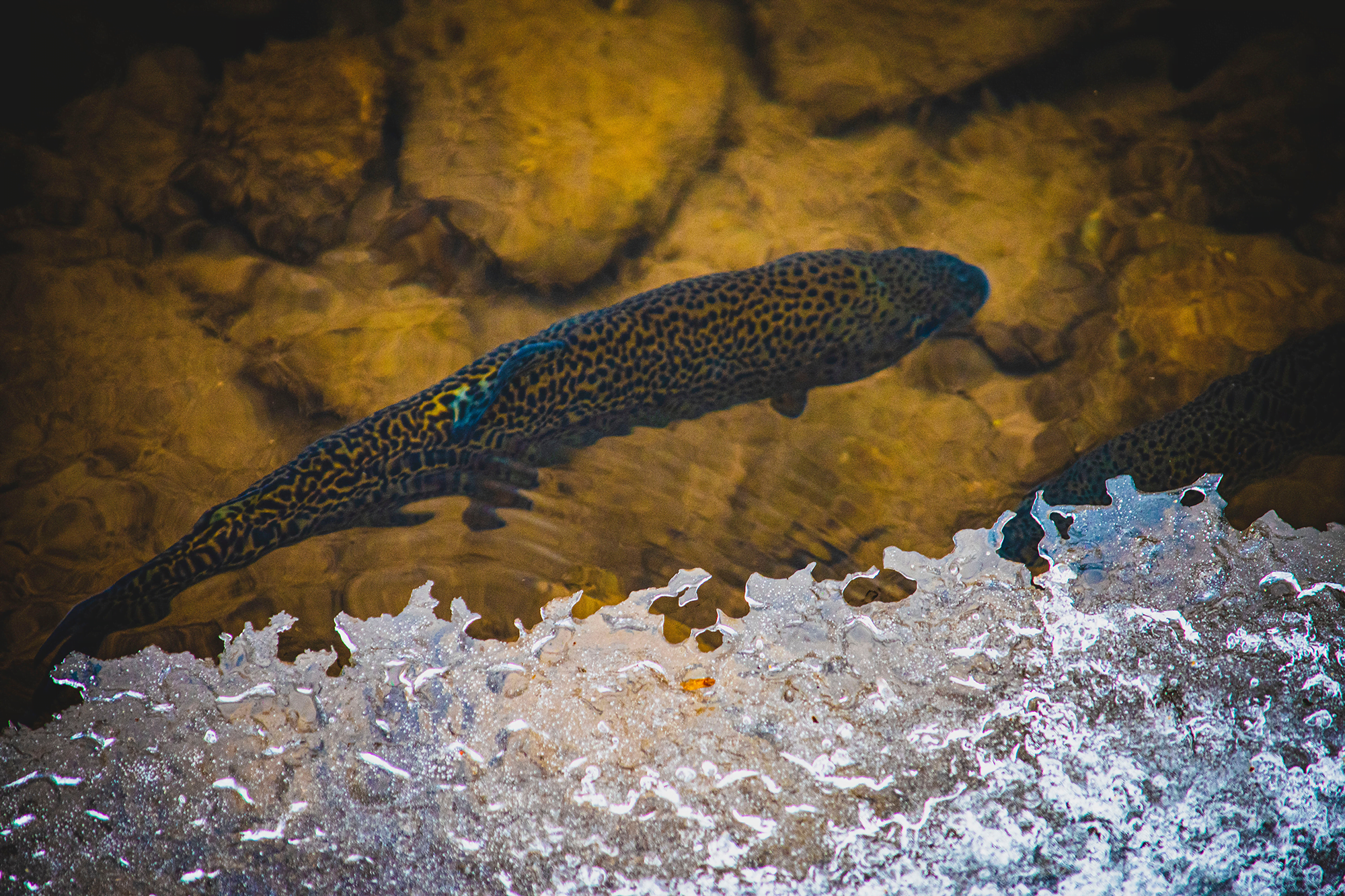
Researchers studying how fishswim have long focused on their tail fins and the flows created there. But a fish’s other fins have important effects, too, as seen in this recent study. Researchers built a CFD simulation based on observations of a swimming rainbow trout, focusing on the flow from its back and tail fins. They found that the vortex created by the back fin stabilizes and strengthens the one generated by the tail. It also played a role in reducing drag on the fish by maintaining the pressure difference across the body. When they tried changing the size and geometry of the fins, the fish’s efficiency suffered, indicating that evolution has already optimized the trout’s fins for swimming efficiency. (Image credits: top – J. Sailer, simulation – J. Guo et al.; research credit: J. Guo et al.; via APS Physics)
Visualization of flow around a digitized rainbow trout.
Quick, agile, and fierce, the hummingbird is an amazing creature. Small for a bird but much larger than an insect, it’s able to hover in place and eat nectar directly from flowers. Many species use a forked tongue with curled edges that help it capture the sweet, viscous fluid. Even their distinctive sounds are fluid-influenced, coming from their wingstrokes and the fluttering of tail and wing feathers. (Image and video credit: BBC Earth)
Blow across the top of a glass bottle, and you’ll get a whistle-like sound. Put some liquid in there and the pitch of the sound changes. Our vocal tracts are basically the same thing: a tube with a hole at the end. But as Joe Hanson shows in this Be Smart video, our ability to change the shape and resonance of our vocal tract by moving our tongues and lips enables us to make a wide range of vowel sounds. Enjoy this dive into the world of linguistic physics! (Video and image credit: Be Smart)