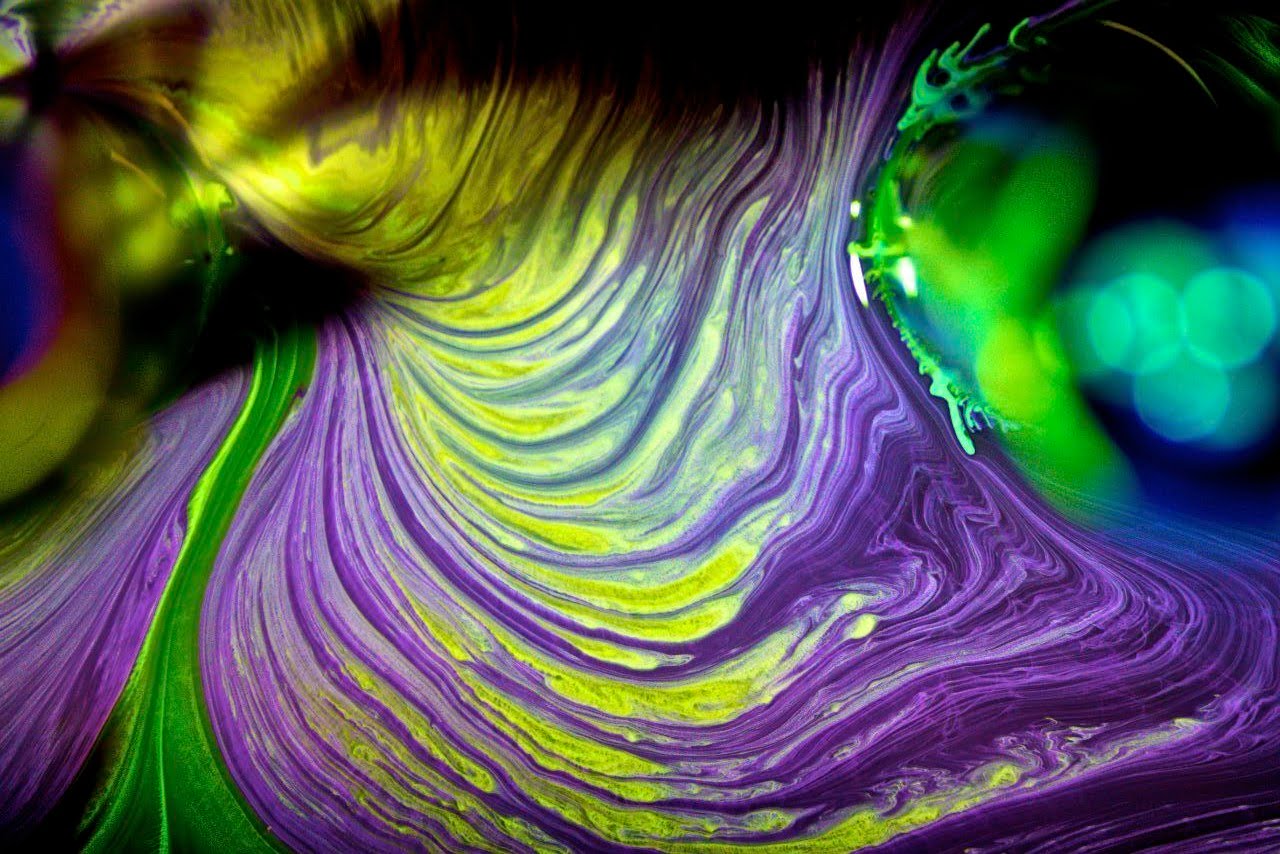
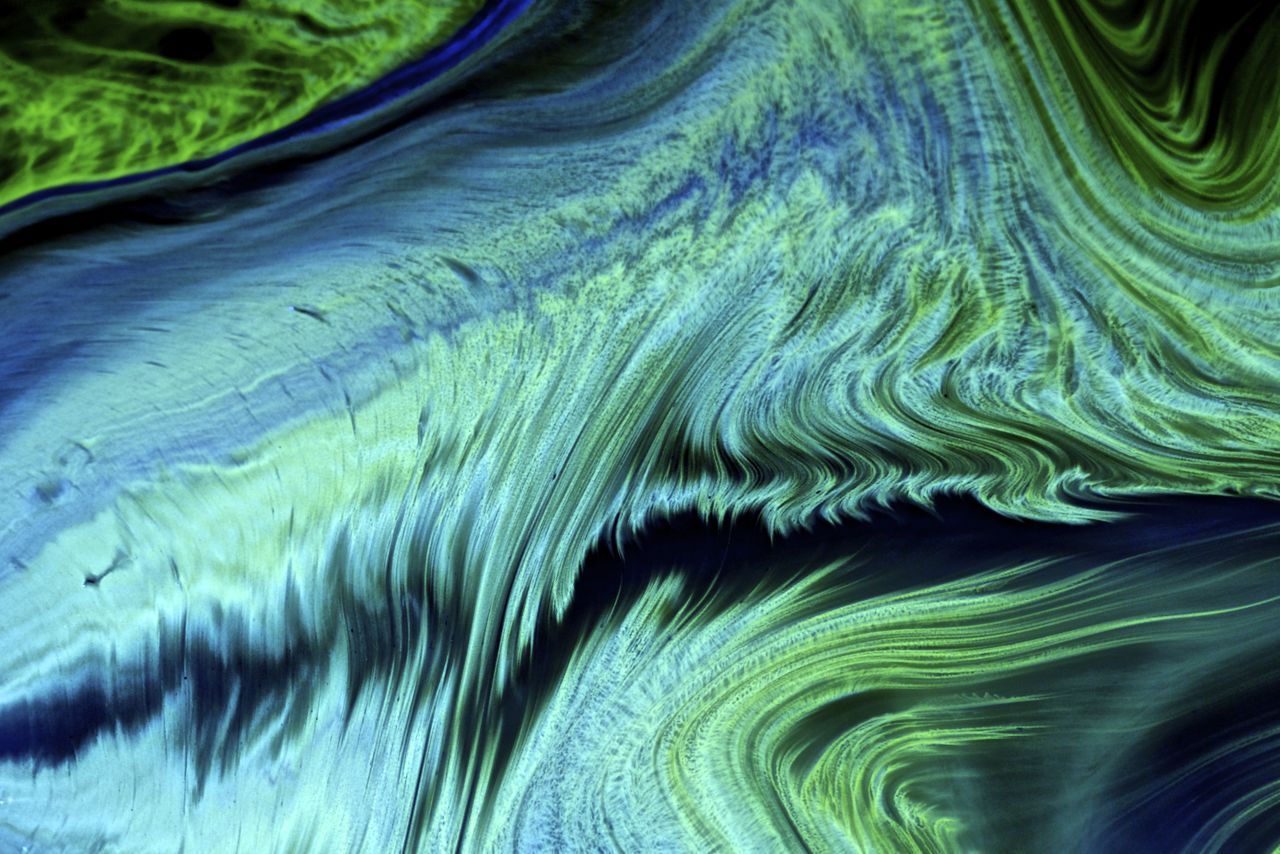
Photographers Cassandra Warner and Jeremy Floto produced the “Clourant” series of high-speed photographs of colorful liquid splashes. The artists took special care to disguise the origin of splashes, making them appear like frozen sculptures. The photos are beautiful examples of making fluid effects and instabilities. Many of them feature thin liquid sheets with thicker rims just developing ligaments. In other spots, surface tension has been wholly overcome by momentum’s effects and what was once ligaments has exploded into a spray of droplets. (Photo credit: C. Warner and J. Floto; submitted by jshoer; via Colossal)
Tag: art

Ink Diffusion
Alberto Seveso’s gorgeous high-speed photos of ink diffusing in water have a dramatic sense of texture to them. Though still delicate, the whorls of fluid seem almost solid enough to touch. Watch the edges, though, and you can see thin wisps of color and hints of instabilities. Like cream poured into coffee, these ink sculptures are short-lived. Some of his works are available as prints or wallpapers (zip file). (Photo credit: Alberto Seveso)

Fluidic Public Art by Charles Sowers
Artist Charles Sowers creates exhibits and public art focused on illuminating natural phenomenon that might otherwise go unnoticed, and much of his work features fluid dynamics directly or indirectly. “Windswept” and “Wave Wall” are both outdoor exhibits that show undulations and vortices corresponding to local wind flow. Other pieces explore ferrofluids through magnetic mazes or feature foggy turbulence. My own favorite, “Drip Chamber”, oozes with viscous fluids whose dripping forms patterns reminiscent of convection cells. Be sure to check out his website for videos of the exhibits in action. (Photo credits: Charles Sowers; submitted by rreis)

Ferrofluid Drop
A drop of ferrofluid is shaped by seven small circular magnets sitting beneath the glass and paper. Ferrofluids are made up of nanoscale ferromagnetic particles suspended in a carrier liquid. Under the influence of magnetic fields, they can take on fantastic shapes, including sharp-tipped droplets and labyrinthine mazes. This image is taken from the National Academy of Science’s book Convergence, focused on the intersection between science and art. (Photo credit: Felice Frankel)

Chronoscapes
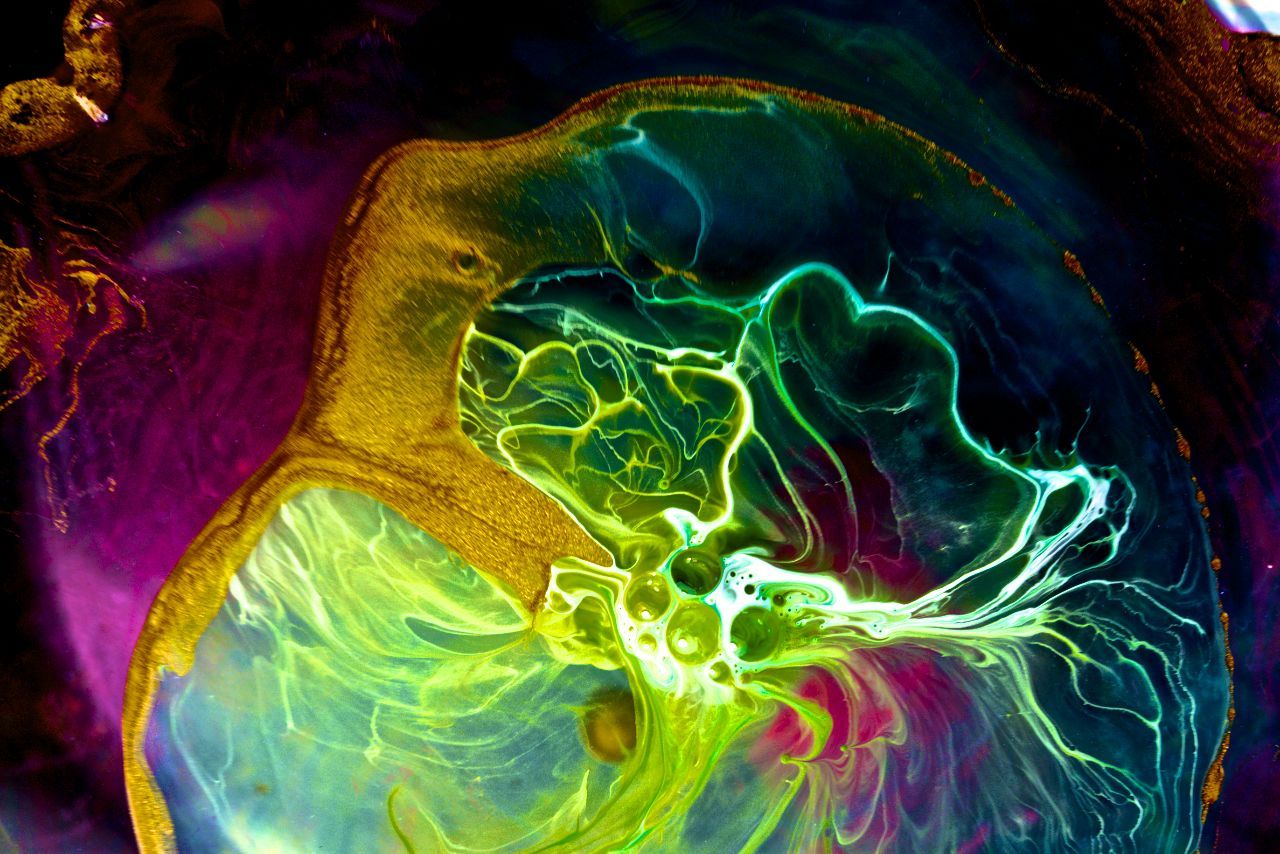
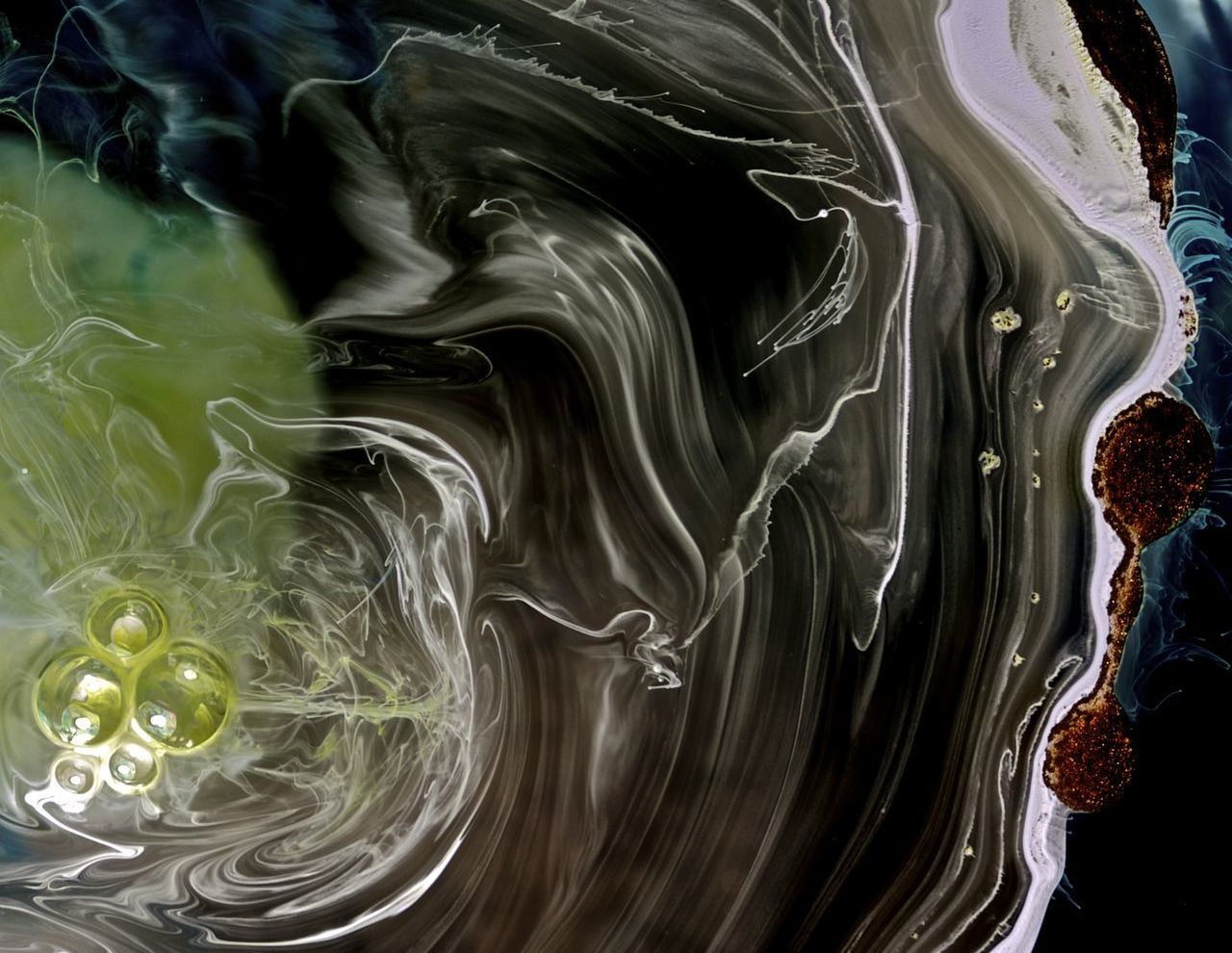
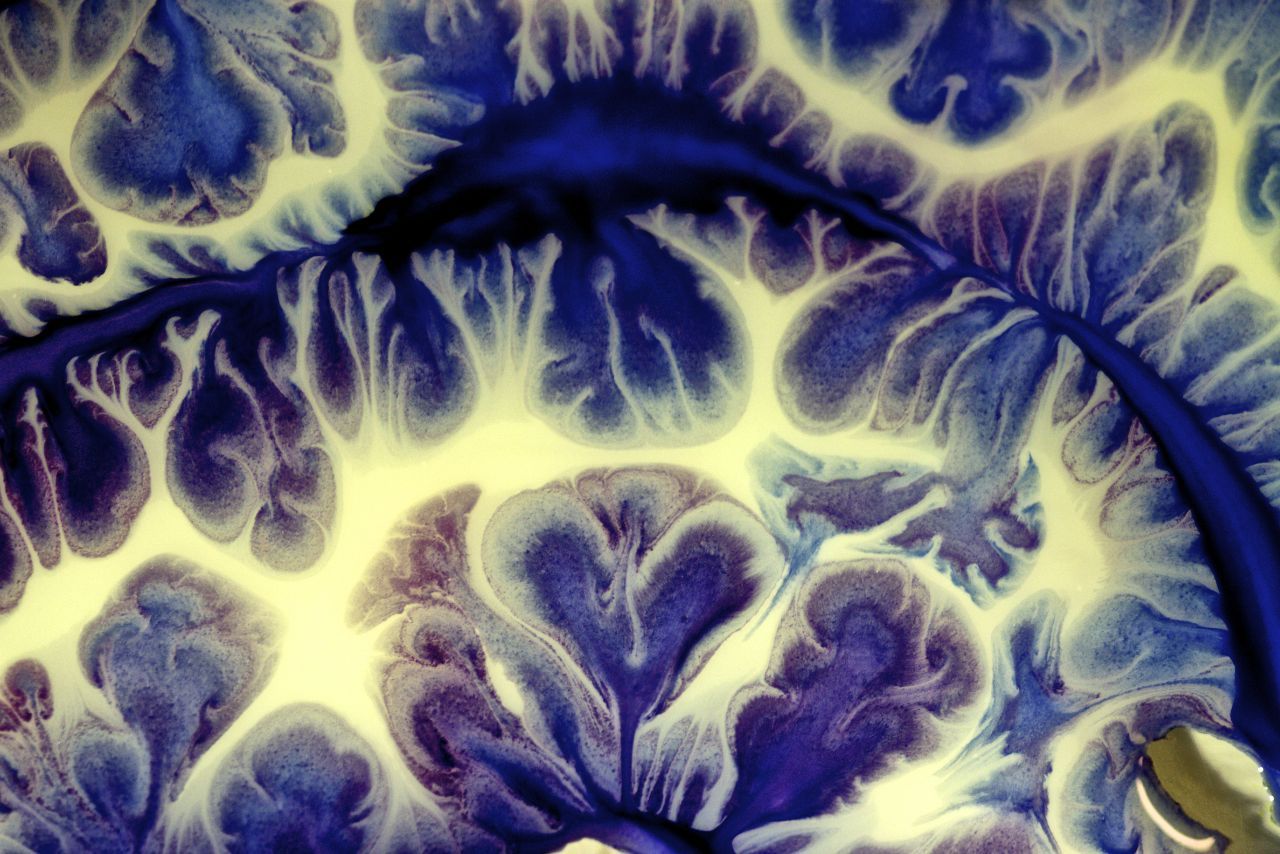
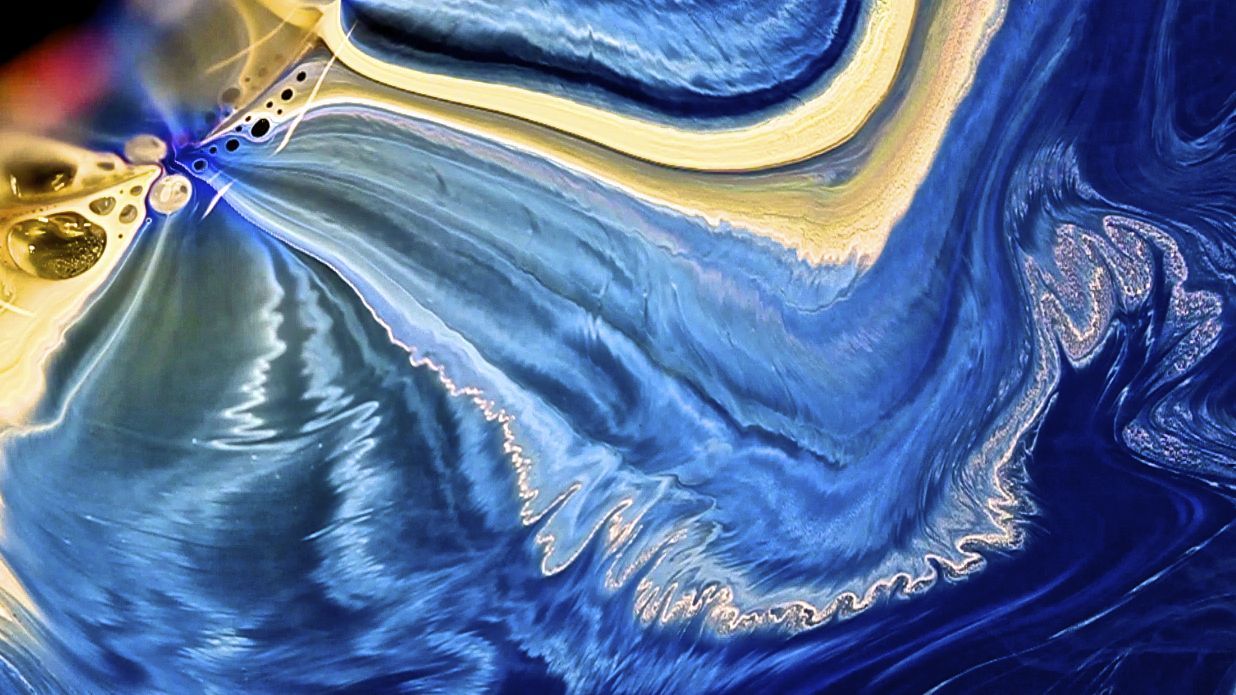
Exeter University artist-in-residence Pery Burge uses ink, water, soap films, and other fluids to create her spectacular “artistic flow visualization”. Looking closely, one sees the influence of bubbles, vortices, diffusion, and many fluid instabilities, all combined to create psychedelic and dream-like landscapes. For more on her work and additional galleries, see her website Chronoscapes. (Photo credit: Pery Burge)

Creating Lava
In Syracuse, NY, artists and scientists work together to study volcanic flows by melting crushed basalt in a special furnace before releasing the lava into the parking lot. This particular flow is very prone to boiling behavior, likely because of the cold air and ground temperatures (less than 0 C). The outer layers of rock cool quickly, leaving bubble-shaped chambers which hotter lava can fill before melting out. (via It’s Okay To Be Smart; submitted by @jpshoer)

Homemade Astronomy
Artist Julia Cuddy uses liquids, soaps, and glitter to create photographs that replicate the look of deep space astronomy. By adding soap to the dyes, she uses Marangoni effects to drive surface tension instabilities that cause swirling colors and motions reminiscent of galaxies and nebulae. Although I’ve seen fluid dynamics used in art before, this may be one of the cleverest usages I’ve seen! (Photo credits: Julia Cuddy)

Fractal Fluids
Part of the beauty of numerical simulation is its ability to explore the physics of a situation that would difficult or impossible to create experimentally. Here the Rayleigh-Taylor instability–which occurs when a heavier fluid sits atop a lighter fluid–is simulated in two-dimensions. Viscosity and diffusion are set extremely low in the simulation; this is why we see intricate fractal-like structures at many scales rather than the simulation quickly fading into gray. (The low diffusion is also what causes the numerical instabilities in the last couple seconds of video.) The final result is both physics and art. (Video credit: Mark Stock)
Paper Marbling
[original media no longer available]
Suminagashi, the Japanese art of “floating ink”, is one of many methods historically used for paper marbling. In it, a shallow layer of water or other viscous fluid serve as a medium for drops of ink that diffuse across the fluid surface and are manipulated with straws, brushes, or other tools. Once a design is complete, an absorbent surface like paper or fabric is carefully placed on top to preserve the art. Among other applications, the technique has historically been used for calligraphy and book bindings.

“Compressed” Outtakes
Bubbles, viscosity, diffusion, capillary action, and ferrofluids all feature in the artistic experiments of Kim Pimmel. Be sure to check out his previous film featured here. (Video credit: Kim Pimmel)